

What if the only thing standing between you and your Mediterranean dream was a simple set of numbers you could easily manage? You've likely spent hours imagining sun-drenched mornings on your terrace in Puerto de Mazarrón or Bolnuevo, only to feel a sudden chill when the topic of Spanish tax arises. It's perfectly natural to feel a bit lost when trying to distinguish between local council rates and national income tax. Many owners worry about the annual cost of non-resident tax in spain, fearing that hidden fees or missed deadlines might cloud their investment.
We understand that you want to focus on the lifestyle, not the paperwork. This guide provides the clarity you need to enjoy your home with total peace of mind. You'll discover the exact taxes you owe as a non-resident property owner, including precise calculation methods and the key dates you need to mark in your calendar. We'll break down the differences between IBI and IRNR across both the Costa Cálida and the Costa Blanca, ensuring your villa in Isla Plana or La Azohia remains a source of joy rather than stress. From understanding imputed income to finding expert support, we've mapped out everything you need to keep your investment secure and legally compliant.
Key Takeaways
- Learn the essential differences between national income tax (IRNR) and local council tax (IBI) to keep your home in the Costa Cálida or Costa Blanca legally secure.
- Calculate the annual cost of non-resident tax in spain using your property’s Catastral value to avoid surprises and ensure accurate budgeting.
- Master the critical tax deadlines, including the 31st December cutoff for national filings and the specific collection windows used by town halls in Puerto de Mazarrón.
- See how effective property management in Isla Plana or Bolnuevo can help you manage local refuse fees and council notices whilst you are abroad.
- Discover expert strategies to minimise your tax liabilities and simplify the paperwork involved in owning a Spanish holiday home.
What is Non-Resident Tax in Spain? An Overview
Owning a holiday home in Puerto de Mazarrón or a sleek apartment on the Costa Blanca brings immense joy, but it also introduces you to the Spanish tax system. The primary obligation for property owners who live abroad is the Impuesto sobre la Renta de no Residentes (IRNR). This is a national tax specifically designed for those who don't reside in Spain full-time. Even if your villa in Bolnuevo remains empty for most of the year, the Spanish authorities consider the mere ownership of a property as a form of "imputed income," which is essentially a benefit they can tax. Understanding the annual cost of non-resident tax in spain is vital for protecting your investment and ensuring your Mediterranean lifestyle remains stress-free.
You'll quickly encounter a "dual-tax" system. This means you are responsible for both national and local payments. Staying compliant isn't just about following the rules; it's about building a solid foundation for your investment. If you decide to sell your property in Isla Plana or La Azohia in the future, having a clean tax record will prevent delays and potential financial penalties during the transaction. Keeping your paperwork in order gives you the freedom to enjoy your time in the sun without worrying about letters from the tax office.
The Difference Between IRNR and IBI
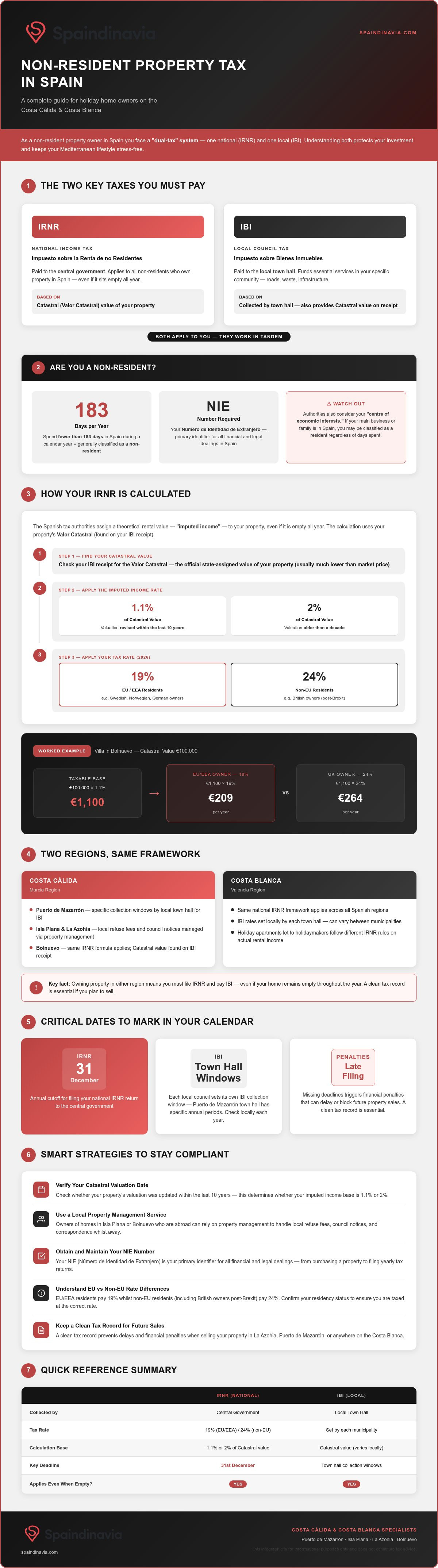
The income tax framework in Spain distinguishes between national and local levies. IRNR is your national income tax, calculated based on the state-assigned value of your property. In contrast, the Impuesto sobre Bienes Inmuebles (IBI) is a local council tax. Whilst IRNR is paid to the central government, IBI is collected by the local town hall to fund essential services in your specific community. Together, these two payments represent the bulk of your annual cost of non-resident tax in spain, and they work in tandem to ensure the infrastructure around your home is well-maintained.
Who is Classified as a Non-Resident?
Determining your status is simpler than it might first appear. Spain uses the 183-day rule; if you spend fewer than 183 days in the country during a calendar year, you're generally considered a non-resident. However, the authorities also look at your "centre of economic interests." If your main business activities are based in Spain, or if your spouse and children live there, you might be viewed as a resident for tax purposes. To manage your obligations correctly, you'll need a valid NIE number (Número de Identidad de Extranjero). This acts as your primary identifier for all financial and legal dealings, from buying a townhouse in the Murcia region to filing your yearly tax returns.
Calculating the Annual Cost of Imputed Income Tax (IRNR)
When you own a holiday home in Puerto de Mazarrón or a bungalow on the Costa Blanca, the Spanish tax authorities assume you're receiving a financial benefit just by having the keys. This is known as "imputed income." It doesn't matter if the property sits empty whilst you're back in the UK or Scandinavia; the state assigns a theoretical rental value to your home and taxes you on it. To find the starting point for your calculation, you'll need to look at your IBI receipt for the "Valor Catastral," which is the official tax value of your property. This figure is usually much lower than the actual market price you paid.
The annual cost of non-resident tax in spain is heavily influenced by when your local town hall last updated these values. If the valuation was revised within the last ten years, the base for your tax is 1.1% of the Catastral value. If the valuation is older than a decade, the base rises to 2%. Once you have this base figure, you apply the relevant tax rate. For 2026, residents of the EU or EEA pay a rate of 19%, whilst non-EU residents, including those from the UK, pay 24%.
A Step-by-Step Calculation Example
The base rate is 1.1% for valuations updated in the last 10 years. Imagine you own a beautiful resale villa in Bolnuevo with a Catastral value of €100,000. First, you calculate the taxable base: €100,000 multiplied by 1.1% equals €1,100. If you're a Swedish resident, your tax would be 19% of that €1,100, resulting in a yearly bill of €209. However, for a British resident, the tax is 24%, meaning the final bill for the same property would be €264. These small differences can add up, so it's wise to consult with local experts who can verify your property's specific valuation date.
Taxes on Actual Rental Income
If you decide to let your apartment in Isla Plana or La Azohia to holidaymakers, the rules change significantly. You're no longer paying a single annual tax on "imputed" income; instead, you must declare the actual profit you earn. EU residents have the advantage of deducting many expenses, such as cleaning, maintenance, and mortgage interest, paying 19% only on the net profit. Non-EU residents, however, must pay 24% on the gross income without any deductions allowed. These rental declarations are handled quarterly, rather than through the annual return used for personal use properties, making organised record-keeping essential for your fiscal health in both the Costa Cálida and the Costa Blanca.
Local Council Tax (IBI) and Other Recurring Costs
Beyond the national income tax, your local town hall plays a significant role in the annual cost of non-resident tax in spain. The most prominent local levy is the Impuesto sobre Bienes Inmuebles, or IBI. This tax is calculated based on the property size, location, and the Catastral value we discussed earlier. Town halls across the Costa Blanca and the Costa Cálida set their own specific rates. This means a villa in Bolnuevo might have a slightly different IBI bill compared to a similar home in the Valencia region. It's a fundamental payment that keeps your local street lights shining and the roads well-maintained.
You'll also need to account for the refuse collection fee, known locally as "Basura." This is a smaller, essential payment for waste management. In areas like Puerto de Mazarrón, this is often a flat annual fee, though some municipalities might bundle it with other services. Missing these small payments can lead to annoying surcharges. Many owners choose to set up a direct debit to keep things simple, ensuring their investment remains in good standing whilst they're away.
Understanding Wealth Tax Thresholds
For those investing in high-end real estate, the Wealth Tax (Patrimonio) is an additional consideration. Generally, non-resident individuals benefit from a €700,000 tax-free threshold. If you own a property jointly with a partner, this threshold effectively doubles to €1.4 million before the tax applies. This makes luxury new build villas in the Murcia region or large estates on the Costa Blanca more accessible than they might first appear. Regional variations do exist; for instance, the Valencia region and the Murcia region have different scales and exemptions, so checking the specific rules for your chosen coast is vital for accurate fiscal planning.
Community Fees for Apartments and Urbanisations
Whilst they aren't technically a tax, community fees are a vital part of your annual carrying costs. If you buy a resale apartment in Isla Plana or a bungalow in a gated urbanisation in La Azohia, you'll likely pay into a community fund. These fees cover the shared pleasures of Mediterranean living, such as pool maintenance, lush garden care, and communal lighting. In popular urbanisations amongst expats in Puerto de Mazarrón, these costs are transparent and well-managed. Including these in your budget ensures a complete picture of the annual cost of non-resident tax in spain and its associated ownership expenses.
Deadlines, Paperwork, and Avoiding Penalties
Managing the annual cost of non-resident tax in spain requires a keen eye on the calendar. Unlike many tax systems, the Spanish non-resident income tax (IRNR) is filed retrospectively. You have until the 31st of December to submit your return for the previous year. For instance, your tax for 2025 must be settled by the end of 2026. Local council tax (IBI) operates on a completely different schedule. Town halls in the Costa Cálida, specifically in areas like Puerto de Mazarrón and Bolnuevo, set their own collection periods. These often fall between August and November, whilst municipalities on the Costa Blanca may choose entirely different windows for their collection.
Don't expect a reminder to arrive at your doorstep abroad. The Spanish tax office, Hacienda, typically expects you to stay informed and proactive. If a deadline passes without payment, you'll face automatic surcharges known as recargos. These penalties can range from 5% to 20% depending on the length of the delay. If left unaddressed, the authorities have the power to freeze your Spanish bank account to recover the debt. This is a stressful situation that is easily avoided with a bit of forward planning and local support in your corner.
Filing Modelo 210
To settle your IRNR, you'll need to submit Modelo 210. This is the official document used to declare both the imputed income for your personal use and any actual rental earnings you've received. Most property owners find the online system a bit daunting, so they favour using a professional gestor to handle the submission. For local taxes like IBI and refuse collection in La Azohia or Isla Plana, setting up a direct debit is the most reliable method. This ensures the town hall takes the payment automatically, saving you from the risk of late fees.
The Role of a Fiscal Representative
A fiscal representative acts as your official point of contact with the Spanish state. They provide an essential service by receiving and acting upon notifications that would otherwise sit in an empty post box whilst you are away. Whether you own a resale apartment or a new build villa, this professional oversight is invaluable. It ensures your investment remains legally sound and your tax records stay pristine. To ensure your home is fully compliant, we can connect you with independent solicitors who specialise in property law across the Murcia and Valencia regions.
Maximising Your Investment with Smart Tax Management
Viewing your property as a long-term asset requires more than just maintaining the garden or the private pool. Effective fiscal management is the silent partner that ensures your investment in the Costa Cálida or the Costa Blanca continues to thrive. By staying organised, you protect the lifestyle you've built and ensure that the annual cost of non-resident tax in spain remains a manageable part of your budget. Clear, consistent tax records are not just a legal requirement; they're an essential tool for a smooth future resale or inheritance process, giving you and your family total security.
Organising your paperwork early in your ownership journey allows you to relax and truly enjoy the Mediterranean atmosphere. Whether you're spending your summers in Puerto de Mazarrón or winters on the Costa Blanca, knowing your affairs are in order provides a level of comfort that's hard to quantify. We always encourage our clients to keep a dedicated file for all property-related expenses, from local council receipts to national tax declarations, ensuring nothing is left to chance.
The Long-Term Value of Compliance
Maintaining a perfect tax record is particularly vital when you decide to move on to your next adventure. As a non-resident seller, the Spanish authorities will automatically retain 3% of the sale price to cover potential tax liabilities. If you've been meticulous with your annual filings, you'll find it much easier to claim this money back. Additionally, keeping every receipt for property improvements is a smart move. Costs for significant renovations in areas like Bolnuevo or Isla Plana can often be used to offset future Capital Gains Tax, potentially saving you thousands of euros. Regular property inspections also play a role here, as they ensure you receive any physical mail from the tax office that might require immediate attention.
How Spaindinavia Supports Your Journey
We pride ourselves on being more than just property finders; we're your local experts and partners throughout your entire journey. Our team provides comprehensive support through a trusted network of independent solicitors and tax specialists who understand the specific requirements of both the Murcia and Valencia regions. We also offer property maintenance services designed for absent owners, ensuring that local tax notices or community fee updates are handled promptly whilst you're away. This proactive approach keeps your fiscal health in top condition, allowing you to focus on the joy of your Spanish home. Contact Spaindinavia today for expert guidance on your Spanish property investment and let us help you secure your Mediterranean dream with confidence.
Secure Your Mediterranean Future with Confidence
Mastering the dual-tax system of IRNR and IBI is the final step in truly owning your dream home. By understanding how to calculate your obligations and marking the key deadlines on your calendar, you transform a complex process into a simple annual routine. Whether you've chosen a resale apartment in Puerto de Mazarrón or a bungalow in Bolnuevo, staying compliant ensures your investment remains a source of happiness rather than an administrative burden. Managing the annual cost of non-resident tax in spain is straightforward when you have the right local knowledge in your corner.
Since 2016, we've acted as a reliable bridge for owners across the Costa Cálida and the Costa Blanca. We provide comprehensive support from your first viewing in Isla Plana or La Azohia to the long-term management of your fiscal health. Our specialists are here to ensure every detail is handled with care and precision. Explore our hand-picked portfolio of New Build Villas in Spain today and take the first step towards a more attractive lifestyle. Your new chapter in the sun is waiting, and we're here to make sure it's as smooth and rewarding as possible.
Frequently Asked Questions
Do I have to pay tax in Spain if I do not rent out my property?
Yes, you're required to pay tax even if your home is strictly for your own holidays. The Spanish state views property ownership as a benefit that generates "imputed income." This applies to all non-resident owners across the Costa Cálida and the Costa Blanca. Whether you own a villa in Bolnuevo or an apartment in the Valencia region, you must file an annual return. This ensures your investment remains compliant whilst you enjoy your time in the sun.
What is the difference between IBI and non-resident income tax?
IBI is a local council tax paid to your specific town hall, whilst non-resident income tax (IRNR) is a national levy paid to the central state. IBI funds local services like street cleaning and lighting in Puerto de Mazarrón or Isla Plana. IRNR is specifically for those who don't live in Spain full-time. Both are essential components of your yearly obligations, and they require separate filings to keep your property records in good standing.
How much is non-resident tax in Spain for UK citizens post-Brexit?
UK citizens are now classified as non-EU residents, which affects the annual cost of non-resident tax in spain. You'll pay a flat rate of 24% on the taxable base of your property. In contrast, residents from EU countries pay a lower rate of 19%. This applies to all property types, from townhouses in Puerto de Mazarrón to luxury new builds on the Costa Blanca. Professional fiscal advice is highly recommended for British owners to ensure accurate calculations.
When is the deadline for filing non-resident tax in Spain for 2026?
The deadline for filing your IRNR for the 2025 tax year is the 31st of December 2026. This retrospective system gives you a full year to organise your paperwork. Local IBI deadlines are different and are set by individual town halls. In the Murcia region, these collection periods often fall in the autumn months. Missing these windows in La Azohia or Bolnuevo can lead to automatic surcharges, so we suggest setting up direct debits early.
Can I deduct expenses from my Spanish non-resident tax bill?
Deductions are only available to residents of the EU or EEA when they rent out their property. If you're an EU resident, you can often deduct costs like maintenance, cleaning, and mortgage interest. However, post-Brexit, UK residents must pay the full 24% tax on their gross rental income without any deductions allowed. This rule applies across both the Costa Cálida and the Costa Blanca, making it a vital consideration for your long-term investment strategy.
What happens if I forget to pay my annual property taxes in Spain?
Forgetting your tax obligations leads to automatic financial penalties and interest charges. These surcharges start at 5% and can climb to 20% if the delay persists. Since the tax office doesn't send reminders to addresses outside of Spain, many owners in Isla Plana or Puerto de Mazarrón are unaware of the issue until they try to sell. In extreme cases, the authorities can freeze your Spanish bank account to recover the outstanding debt and surcharges.
Is wealth tax applicable to all non-resident property owners?
Wealth tax isn't a concern for most owners, as it generally only applies to properties with a net value exceeding €700,000 per person. If you own a home jointly with a partner in Isla Plana or La Azohia, your combined threshold effectively reaches €1.4 million. It's important to remember that the Murcia region and the Valencia region have slightly different rules regarding exemptions. We recommend checking with a local specialist if you're investing in high-value real estate.
Do I need a Spanish bank account to pay my annual taxes?
Whilst it's technically possible to pay from abroad, having a Spanish bank account is much more practical for managing your home. It allows you to set up direct debits for recurring costs like IBI, refuse collection, and community fees in Puerto de Mazarrón. This "set and forget" approach provides peace of mind that your essential bills are paid on time. Most owners find that a local account is the best way to manage the annual cost of non-resident tax in spain.


