

The best Spanish property lawyer isn't just a paper-pusher; they're a forensic investigator of your future home's history. Whether you're dreaming of a new-build villa in Puerto de Mazarrón or a resale apartment on the Costa Blanca, your choice of legal representation is the single most important factor in securing your investment. Knowing the right questions to ask a spanish property lawyer is what separates a stress-free transition to the Mediterranean from a legal nightmare involving hidden debts or 'illegal' builds.
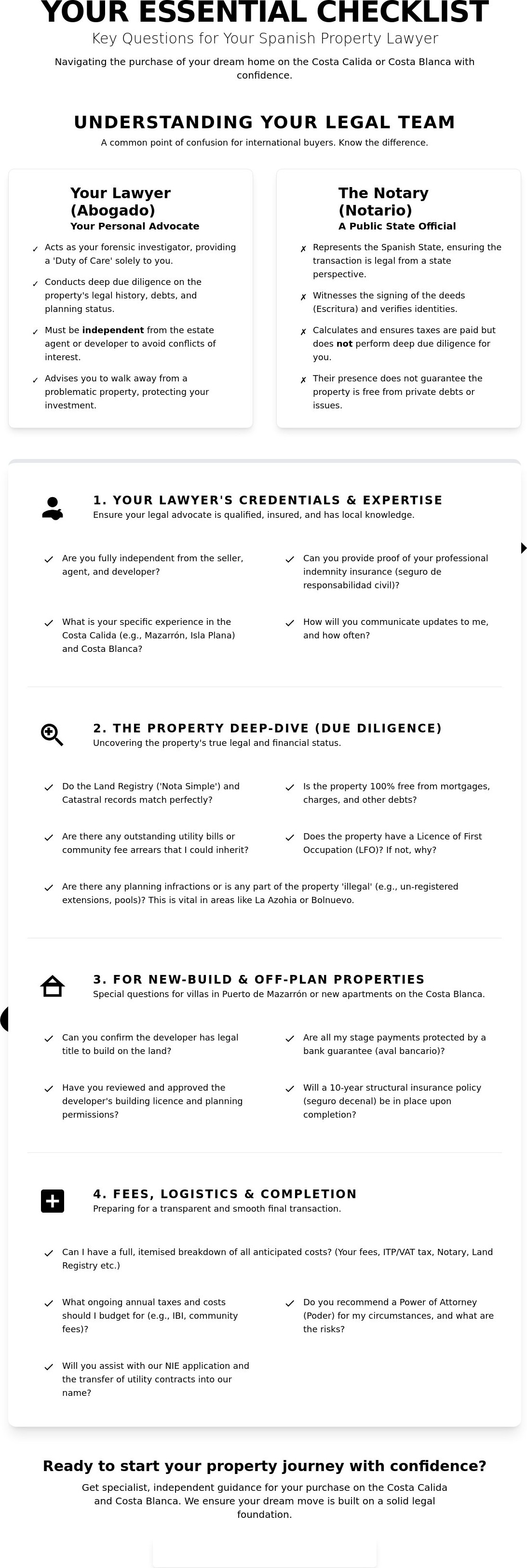
We know that the Spanish legal system can feel like a maze of jargon and unexpected costs, especially when you're trying to realise your dream of a Mediterranean lifestyle whilst distinguishing between a Notary's role and your lawyer's duties. You've worked hard for this life decision, and you deserve to feel completely protected throughout the journey. This guide provides you with a definitive checklist of 21 essential questions to ensure your lawyer is truly in your corner. We'll explore everything from regional tax nuances in the Costa Calida to specific protections for new-builds in Bolnuevo, Isla Plana, and La Azohia, giving you the clarity you need to sign on the dotted line with total confidence.
Key Takeaways
- Learn why hiring an independent solicitor is vital for protecting your interests, whether you are buying a resale apartment on the Costa Blanca or a new-build villa in Puerto de Mazarrón.
- Discover the specific questions to ask a spanish property lawyer regarding their professional indemnity insurance and local expertise to ensure your investment is fully secured.
- Master the due diligence process by understanding how your lawyer verifies 'Nota Simple' and 'Catastro' records for properties in Isla Plana, La Azohia, or Bolnuevo to avoid hidden debts.
- Identify the unique legal safeguards required for new-build purchases, such as verifying developer land ownership and bank guarantees before any funds are transferred.
- Prepare for a transparent completion with an itemised breakdown of all taxes and fees, alongside practical advice on managing Power of Attorney and NIE applications.
Why Independent Legal Advice is Essential for Your Spanish Property Journey
Securing your dream home under the Mediterranean sun is an exciting milestone, yet the legal path in Spain differs significantly from the UK. While British conveyancing is often a standardised administrative process, the Spanish Civil Code places a heavy emphasis on the buyer's responsibility to investigate a property's history. Whether you're falling in love with a resale apartment on the Costa Blanca or a sleek new-build villa in Puerto de Mazarrón, an independent lawyer acts as your forensic advocate. They don't just process paperwork; they verify that the life you're building is on solid legal ground.
Your lawyer's primary role is to provide a 'Duty of Care' that is entirely focused on your interests. This means they must be completely separate from any other party involved in the transaction. In regions like the Costa Calida, where local regulations can vary between municipalities like Mazarrón and Cartagena, having a specialist who knows the local town hall's quirks is invaluable. They're the only ones who will tell you to walk away if a property in La Azohia has unresolved planning issues or hidden debts that could become your responsibility after completion.
Independent vs. Recommended Lawyers: Avoiding Conflicts of Interest
It is common for developers or estate agents to recommend an 'in-house' or 'preferred' lawyer, sometimes even offering their services for free. You should approach these offers with caution. A lawyer suggested by a developer may have a long-standing financial relationship with them, which can cloud their judgment. When interviewing potential firms, one of the first questions to ask a spanish property lawyer is whether they are truly independent of the estate agency or developer involved. You need unbiased advice, especially when reviewing complex purchase contracts for off-plan villas in Bolnuevo or Isla Plana, where your deposit must be protected by bank guarantees.
The Role of the Lawyer vs. the Notary in Spain
A frequent point of confusion for international buyers is the role of the Spanish Notary (Notario). You must understand that the Notary is a public official who represents the Spanish State, not your personal interests. While they witness the signing of the public deeds and ensure regional taxes are correctly calculated, they don't perform deep due diligence on the property's history. Their presence at the signing table doesn't guarantee that a home is free of private debts, utility arrears, or planning infractions. Your lawyer is the one who conducts the investigative legwork in the weeks leading up to the appointment, ensuring the legal groundwork is flawless before the Notary authorises the final transfer.
Verifying Credentials: Questions to Ask About Your Lawyer's Expertise
Finding a lawyer who understands the unique landscape of the Costa Calida and the Costa Blanca is about more than just a friendly face. It's about professional accountability. When narrowing down your shortlist, one of the vital questions to ask a spanish property lawyer is to see proof of their professional indemnity insurance (seguro de responsabilidad civil). This insurance is your safety net; it ensures you're financially protected if a legal error occurs during the purchase of your resale villa in Bolnuevo or a new-build apartment in Torrevieja. Without it, you're essentially carrying all the risk yourself.
Communication is the second pillar of a secure investment. You need 'British-standard' clarity whilst navigating complex Spanish bureaucracy. This doesn't just mean your lawyer speaks English; it means they can explain the nuances of regional law, such as the specific building regulations in the Mazarrón area versus those in the Alicante province. The UK government guidance on buying property in Spain strongly advises using an independent, qualified lawyer to avoid common pitfalls. Finding a partner who provides this level of expert guidance along the coast is the first step towards a secure property purchase.
Checking the 'Colegio de Abogados' Registration
Verify their status. Don't take it on trust. Every legitimate lawyer in Spain must be registered with a local Bar Association (Colegio de Abogados). You can use the national 'Censo de Letrados' online database to check their registration number. Look specifically for the term 'Ejerciente', which means they're currently practising. A 'No ejerciente' member is qualified but not authorised to handle your case. If you're looking at property in Puerto de Mazarrón or Isla Plana, your lawyer will likely be registered in Murcia or a neighbouring province. Never settle for a 'legal consultant' who lacks these formal credentials.
Identifying Red Flags During Your First Consultation
Listen closely during your initial meeting. A significant red flag is any lawyer who guarantees a 'fast-track' process or asks for cash payments to 'speed things up' with local authorities in La Azohia. Legal processes in Spain have set rhythms that cannot be bypassed legally. Another warning sign is a lack of transparency regarding fees. You should receive a clear, written quote that includes VAT (IVA) and outlines potential additional costs for things like NIE applications. If they're vague about the 'Nota Simple' or property legality, it's a sign they may not be prioritising your due diligence. One of the best questions to ask a spanish property lawyer is for a timeline of the due diligence steps they'll take; if they can't provide a structured plan, it's time to look elsewhere.
Due Diligence Deep-Dive: Questions Regarding the Property’s Legal Status
Once you've verified your lawyer's credentials, the focus shifts to the property itself. This stage is where a forensic eye is most needed. One of the most critical questions to ask a spanish property lawyer is how they intend to cross-reference the 'Nota Simple' with the 'Catastro' records. While the Nota Simple confirms ownership and existing mortgages, the Catastro defines the physical boundaries for tax purposes. Discrepancies between these two documents are common in older resale villas in Isla Plana or rural plots near Bolnuevo. If the land size on paper doesn't match the fence line, you could be buying a future legal headache.
You must also ask about the 'Licencia de Primera Ocupación' (Habitation Licence). This document is essential because it confirms the property meets all municipal standards. Without it, you may struggle to secure a mortgage or even connect basic utilities. This is just as relevant for a modern apartment on the Costa Blanca as it is for a traditional townhouse in Puerto de Mazarrón. Additionally, ensure your lawyer verifies that all IBI (Council Tax) payments and community fees are fully settled. In Spain, these debts stay with the property. This means you could inherit the previous owner's unpaid bills if they aren't cleared before the Notary signing.
Uncovering Hidden Debts and Liens
Your lawyer should act as a shield against the previous owner's financial liabilities. Ask them specifically how they will obtain a 'Certificado de estar al corriente' from the community of owners. This certificate proves the seller owes no money for the upkeep of shared areas like pools or gardens. It's also vital to check the status of utility bills. If there are outstanding water or electricity debts in a property in La Azohia, the providers may refuse to transfer the contract into your name until the balance is paid. A thorough lawyer will ensure these are settled or that the costs are deducted from the final purchase price.
Planning Permissions and 'Clandestine' Extensions
Illegal extensions are a frequent pitfall for international buyers. When preparing your questions to ask a spanish property lawyer, focus on the legality of pools, terraces, or converted basements. Many owners in the Murcia region added these features without official planning permission. Your lawyer should request a 'Certificado Urbanístico' to verify the land's current and future use. This is particularly important if you're looking at property on 'suelo rústico' (rural land), where building restrictions are incredibly strict. Knowing exactly what is legally registered now prevents the risk of demolition orders or heavy fines in the future.
Specific Protections for New-Build and Off-Plan Purchases
Stepping into a brand-new home, perhaps a contemporary villa in Bolnuevo or a sleek apartment on the Costa Blanca, is an experience filled with excitement. However, purchasing off-plan or a newly finished property requires a different legal lens than buying a resale. You aren't just buying a building; you're buying a promise. Because of this, the questions to ask a spanish property lawyer must focus heavily on the developer's solvency and the technical certificates that prove the home is fit for purpose. Your lawyer must first verify that the developer actually owns the land and has obtained the necessary building licences from the local town hall in places like Puerto de Mazarrón or Isla Plana before you part with a single Euro.
One of the most vital safeguards in the Spanish market is the Seguro Decenal. This is a mandatory 10-year structural insurance policy that developers must provide. It protects you against major defects in the foundations or load-bearing walls. Without proof of this policy, you should not proceed to completion. Additionally, your purchase contract must include a firm completion date and clear penalty clauses. These clauses ensure that if the developer fails to deliver your home on time, you are financially compensated for the delay. This level of detail is what ensures your investment remains a dream rather than a source of stress.
Bank Guarantees and Stage Payments
The single most important question you can pose is: 'Will my stage payments be protected by an individual bank guarantee?' In Spain, developers are legally required to provide an individual guarantee for every payment you make during the construction phase. This ensures that if the developer goes bust, your money is returned by the bank. You must never pay funds directly into a general business account; always use a designated escrow account. For those looking to secure their future with new build villas in the Murcia region, verifying that these guarantees are 'on-demand' and legally binding is a non-negotiable step in the process.
The Snagging List and Final Completion
As construction nears its end in La Azohia or along the Alicante coast, your lawyer's role shifts to technical verification. They must confirm the architect has issued the Final de Obra (Certificate of End of Works). You should also discuss the possibility of retaining a small percentage of the final payment until a professional snagging list is completed. This gives you leverage to ensure that minor issues, like paint finishes or tile alignment, are corrected before the Escritura (title deed) is signed at the Notary. Your lawyer will guide you on how to structure this retention to protect your interests whilst maintaining a positive relationship with the builder.
Managing the Logistics: Fees, Power of Attorney, and Completion
As you reach the final stages of your purchase, the focus shifts from investigation to execution. This is where administrative precision becomes paramount. One of the most practical questions to ask a spanish property lawyer is for a complete, itemised breakdown of the 'completion funds' required. In 2026, tax rates have shifted; for instance, the Valencian Community on the Costa Blanca recently reduced its Property Transfer Tax (ITP) to 9% for properties up to €1 million. Meanwhile, in the Murcia region, you'll need to budget for similar costs for your home in Bolnuevo or La Azohia. Your lawyer should provide a clear 'pro-forma' invoice that includes notary fees, which are around €1,000 for a €250,000 property, and the 3% retention if you're buying from a non-resident seller.
Beyond the purchase price, your lawyer plays a vital role in setting up your new life. They should assist with your NIE (Foreigner Identification Number) application and help you open a Spanish bank account. These steps are essential for organising utility standing orders for your resale apartment in Puerto de Mazarrón or your new-build villa in Isla Plana. Don't forget to ask about the post-completion phase; your lawyer must confirm when the deeds have been successfully registered at the Land Registry. This process typically takes between two and three months and usually costs between €400 and €650, depending on the property value. Only once this is finished is your ownership fully protected against third-party claims.
Understanding the Breakdown of Legal Fees
Transparency is the foundation of a good working relationship. Ask whether your lawyer's fees are a fixed sum or a percentage of the property price. Most firms charge around 1% of the purchase price, but you must confirm if this includes the mandatory 21% VAT (IVA). You should also clarify if 'extra' services, such as the NIE application or the drafting of a Spanish will, are included in the initial quote or billed separately. Knowing these costs upfront prevents any unpleasant surprises when you're ready to celebrate your new investment on the Costa Blanca or Costa Calida.
Using Power of Attorney (POA) Whilst Abroad
Many buyers choose to grant a Power of Attorney (Poder Notarial) to their lawyer. This allows the lawyer to sign the deeds on your behalf, which is incredibly convenient if you can't travel to Spain for the completion date. You can easily grant this from the UK through a local Notary Public, provided it's legalised with the Hague Apostille. However, a key safety tip is to limit the scope of the POA. Ensure the document specifies that your lawyer can only buy the property and cannot take out a mortgage or sell the asset in your name. This limited scope provides the ultimate balance of convenience and security whilst you wait for the keys to your new home in the Mazarrón area. It's one of the most important questions to ask a spanish property lawyer before the process begins.
Step Into Your New Mediterranean Life with Confidence
Purchasing a property in Spain is about more than just finding the right bricks and mortar; it's about securing a future lifestyle. By mastering the right questions to ask a spanish property lawyer, you ensure that every detail, from the structural warranties of a new-build villa in Bolnuevo to the shifting ITP tax rates on the Costa Blanca, is handled with absolute precision. You now have the tools to verify professional credentials, uncover hidden property debts, and use Power of Attorney to manage your purchase seamlessly from abroad.
We act as your reliable bridge to the local market, offering a harmonised blend of professional expertise and personal warmth. Our independent network of English-speaking solicitors provides expert guidance across both the Costa Blanca and the Costa Calida, specialising in secure transactions for everything from resale apartments to new-build villas. We are here to ensure your journey to Puerto de Mazarrón, Isla Plana, or La Azohia is as smooth and transparent as the Mediterranean itself. Secure your dream home with Spaindinavia’s trusted legal partners and start your next chapter with total peace of mind. Your sunset view is closer than you think.
Commonly Asked Questions about Spanish Property Law
How much does a property lawyer in Spain typically cost?
Legal fees for property transactions in Spain are typically around 1% of the purchase price, plus 21% VAT. Some firms may offer a fixed fee for standard purchases of resale apartments or townhouses. Whether you are buying in Bolnuevo or on the Costa Blanca, this fee should cover comprehensive due diligence, contract negotiations, and assistance at the Notary office.
Do I really need a lawyer if the estate agent says everything is fine?
Yes, you absolutely need independent legal representation to protect your own interests. While estate agents are helpful, their primary goal is to complete the sale, whereas a lawyer's sole duty is to ensure your investment is safe. Having a dedicated professional to verify the legal status of a home in Isla Plana or La Azohia is the only way to avoid hidden liabilities.
Can one lawyer represent both the buyer and the seller in Spain?
While not strictly illegal, it is highly discouraged for a single lawyer to represent both parties because it creates a clear conflict of interest. You deserve an advocate who is 100% committed to your protection. This is especially important when negotiating the terms of a new-build villa on the Costa Blanca or within the Murcia region.
What is a 'Nota Simple' and why is it so important?
A 'Nota Simple' is an official extract from the Land Registry that acts as a property's legal CV. It confirms who the true owner is and reveals any outstanding mortgages, debts, or legal embargoes attached to the land. Your lawyer will always request a fresh copy before any funds are transferred for a property in Puerto de Mazarrón.
How long does the legal process take when buying a Spanish property?
The legal process for a resale property typically takes between six and twelve weeks from the initial deposit to completion. New-build purchases along the Costa Calida or Costa Blanca can take longer, as they are tied to construction milestones and the final habitation licence. Your lawyer will provide a structured timeline based on the specific details of your transaction.
Can a Spanish lawyer help me with my residency or Golden Visa?
Many specialist property lawyers are also experts in immigration law and can assist with residency applications or the Golden Visa. If your investment in the Mazarrón area exceeds €500,000, your lawyer can coordinate the property purchase and the residency paperwork simultaneously. This ensures a smooth transition to your new Mediterranean lifestyle.
What happens if my lawyer discovers the property was built illegally?
If your lawyer finds that a property or an extension lacks the correct licences, they will advise you on whether the situation can be rectified. In many cases, they may recommend withdrawing from the purchase to protect your capital. This highlights why preparing specific questions to ask a spanish property lawyer about planning permissions is such a vital part of the process.
Is it safe to buy a property in Spain whilst I am still in the UK?
It is perfectly safe and very common to purchase property from abroad by using a Power of Attorney (POA). This legal document allows your lawyer to handle the NIE application, open bank accounts, and sign the deeds on your behalf. It is a stress-free way to secure a home on the Costa Blanca or Costa Calida without the need for multiple flights.


