

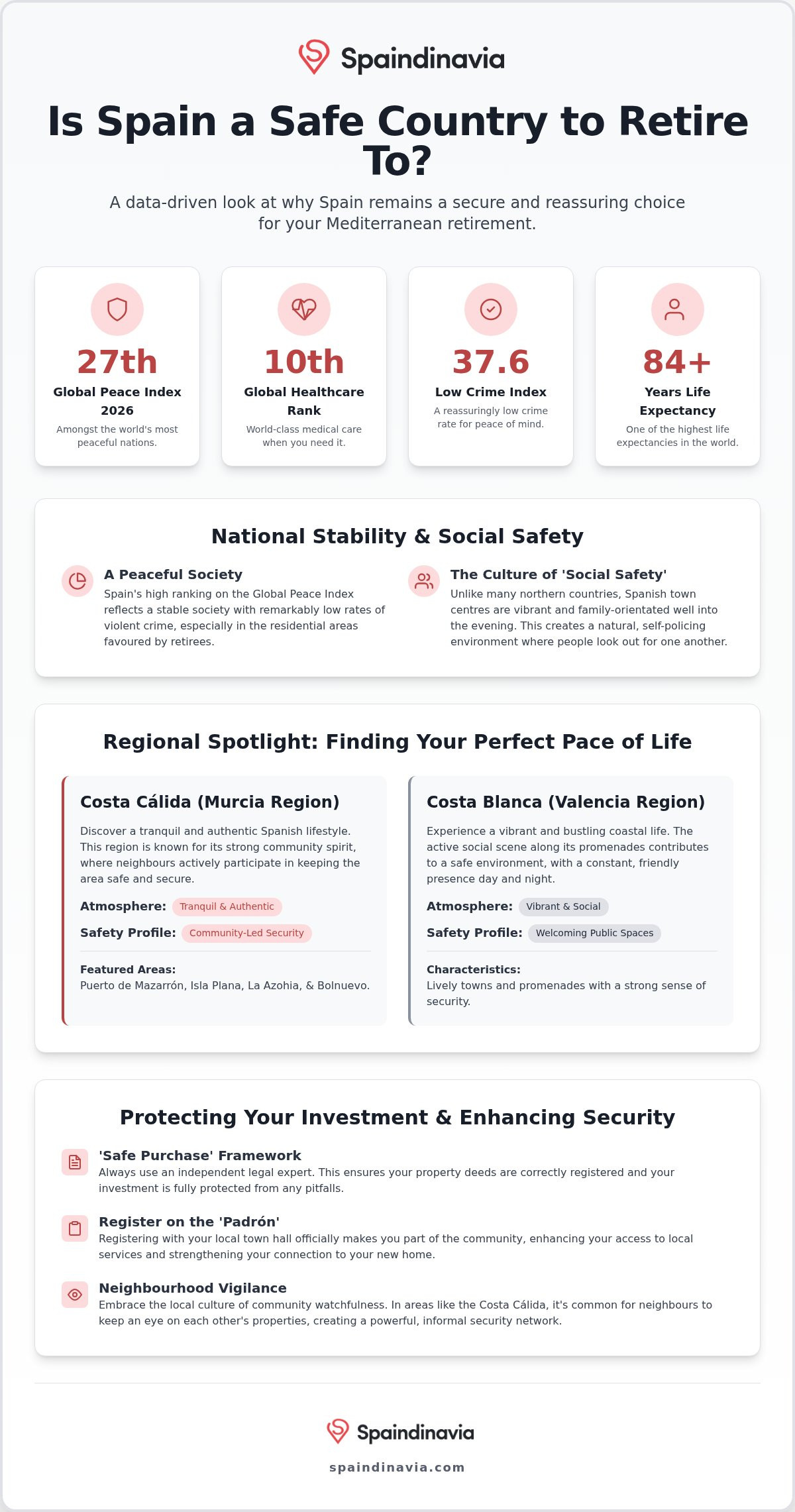
Did you know that Spain is ranked 27th in the 2026 Global Peace Index, making it significantly safer than many of its European neighbours? If you've spent time scrolling through sensationalist headlines about squatters or property scams, it's natural to ask: is spain a safe country to retire to? We understand that moving abroad is a massive life decision, and your peace of mind is the foundation of that dream. Whether you're drawn to the vibrant towns of the Costa Blanca or the tranquil, authentic shores of the Costa Cálida, the reality on the ground is far more reassuring than the news might suggest.
It's completely normal to feel anxious about navigating a foreign healthcare system or protecting your investment from legal pitfalls. This guide provides the clarity you need. We'll explore Spain's low crime index of 37.6 and its world-class healthcare, which is ranked 10th globally in 2026. You'll also find a secure framework for buying property in sought-after spots like Puerto de Mazarrón, Isla Plana, La Azohia, and Bolnuevo. From the social safety of Spanish culture to the specific legal protections in the Murcia and Valencia regions, we'll show you why this Mediterranean haven remains a secure choice for your next chapter.
Key Takeaways
- Discover how Spain ranks 27th in the 2026 Global Peace Index and why its low crime rate makes it one of the most secure destinations for international retirees.
- Understand why the question "is spain a safe country to retire to" is answered by its world-class healthcare system, currently ranked 10th globally for 2026.
- Learn how to protect your investment using the 'Safe Purchase' framework, ensuring your property deeds are correctly registered with the support of independent legal experts.
- Compare the safety profiles of the bustling Costa Blanca and the tranquil Costa Cálida, specifically focusing on the welcoming coastal communities of Puerto de Mazarrón, Isla Plana, and Bolnuevo.
- Identify practical ways to enhance your personal security, from the benefits of registering on the local Padrón to utilising smart home technology and professional key-holding services.
Evaluating National Safety: How Spain Ranks in 2026
There's a unique concept here known as 'social safety'. In many parts of Northern Europe, town centres can feel desolate or even intimidating after dark. In Spain, the culture is the opposite. Streets are filled with families, children, and seniors dining and socialising well into the night. This communal lifestyle creates a self-policing environment where people naturally look out for one another. Whether you are exploring the vibrant promenades of the Costa Blanca or the serene coastal paths of the Costa Cálida, that sense of being part of a watchful, friendly community is always present.
Crime Statistics and Retiree Safety
Spain is officially ranked as the 27th safest country in the world according to the 2026 Global Peace Index. Whilst it's true that petty theft can occur in high-traffic tourist hubs, violent crime is exceptionally rare in the residential areas favoured by retirees. Gaining a realistic perspective on crime levels in Spain helps to dispel the myths often found in sensationalist news. Many of our clients find peace of mind in residential 'urbanisations'. These purpose-built communities often feature shared security measures and a close-knit atmosphere that naturally discourages opportunistic crime, especially in tranquil spots like Puerto de Mazarrón or the surrounding villages.
The Cultural Respect for Seniors
Spanish culture is famously 'family-first', and this extends to a deep, inherent respect for the elderly. Seniors are integrated into the heart of the community rather than sidelined. This cultural backdrop means that social isolation, a common concern for expats, is much lower here than in many other countries. In the Murcia region, particularly in Isla Plana, La Azohia, and Bolnuevo, you'll find active community-led security initiatives. Neighbours often coordinate to keep an eye on properties whilst owners are away, a practice that's just as common across the border in the Valencia region. This collective behaviour ensures that your transition to a Mediterranean lifestyle is supported by a genuine safety net of local care and vigilance.
Healthcare as a Safety Net: Biological Security for Retirees
When you consider the question, is spain a safe country to retire to, you shouldn't just think about low crime rates. For those over 60, true security includes 'biological safety', which is the confidence that world-class medical care is available the moment you need it. In 2026, Spain's healthcare system remains one of the finest in the world, ranking 10th globally in the Numbeo Health Care Index. This robust infrastructure is supported by World Health Organization data on Spain, which highlights a life expectancy of over 84 years, one of the highest on the planet. This longevity is a direct result of a healthcare system designed to be a proactive safety net for all residents.
Many retirees choose to create a redundant safety system by combining public and private care. Whilst the Sistema Nacional de Salud (SNS) provides exceptional emergency and specialist treatment, private insurance offers faster access to non-urgent consultations and a wider choice of specialists. In coastal regions like the Costa Blanca and Costa Cálida, the 112 emergency service is highly efficient. Response times in these areas often outperform those in many Northern European countries. Whether you're in a bustling town in the Valencia region or a quiet seaside village in Murcia, help is never far away.
Accessing the Spanish Healthcare System
Accessing care is straightforward for British pensioners thanks to the S1 form. This document ensures your healthcare costs are covered by the UK, giving you full access to the Spanish public system once you're registered. Local 'Centros de Salud', or health centres, are the heart of every community. In areas like Puerto de Mazarrón and Bolnuevo, these centres are well-equipped and often have staff accustomed to assisting international residents. If you're looking for a home near these essential services, we can help you find resale apartments or villas perfectly positioned for easy access to medical facilities.
Pharmacies and Preventative Care
The Spanish 'Farmacia' system is a vital layer of protection. Recognisable by their glowing green crosses, these pharmacies are staffed by highly trained professionals who can provide expert advice on minor ailments and medication. This culture of preventative care, combined with the Mediterranean diet, plays a huge role in the region's overall health. You'll find that world-class hospitals are within a short drive of popular retirement spots like Isla Plana and La Azohia. This proximity ensures that whilst you enjoy a peaceful coastal lifestyle, you're never isolated from the very best medical technology and expertise available in 2026.
Legal and Financial Security: Protecting Your Investment
When people ask is spain a safe country to retire to, they're often thinking about their life savings just as much as their personal safety. True peace of mind comes from knowing your investment is protected by a robust legal framework. In 2026, Spain's property laws are more transparent than ever, but navigating them requires a steady, expert hand. Whether you're looking at a sleek new build villa on the Costa Blanca or a charming resale apartment in the Costa Cálida, the 'Safe Purchase' framework is your most important tool. This process ensures that every stone is turned over before you commit your hard-earned funds.
You may have seen sensationalist headlines about 'Okupas' (squatters), but it's vital to understand the 2026 reality. For those using a property as their primary residence, the law provides swift and decisive protection. The risk is significantly lower in established residential communities where neighbours look out for one another. To add an extra layer of security, many of our clients in Puerto de Mazarrón and Bolnuevo use professional property management services. These experts provide regular inspections and key-holding services, ensuring your home is monitored and maintained whilst you're away visiting family or exploring other parts of Europe.
Securing Your Property Transaction
The foundation of a secure purchase is the 'Escritura' (Title Deed) and its correct registration in the Land Registry. We consider independent legal advice to be non-negotiable for every client. Whilst the Notary plays a crucial role in witnessing the signing and ensuring the identity of both parties, they don't perform the deep-dive due diligence that an independent solicitor does. Your solicitor will verify that there are no hidden debts or planning infractions attached to the property. For a detailed breakdown of these steps, please see our Buying Property in Spain Guide: The Essential 2026 Checklist for Secure Investment. Remember that regional differences matter; for instance, the Property Transfer Tax (ITP) on resale homes is 10% in the Valencia region, but only 8% in the Murcia region.
Financial Safety and Banking
Financial security in Spain is backed by the Banco de España, which provides a deposit guarantee of up to €100,000 per person, per institution. This offers a level of protection comparable to any major Northern European economy. If you're investing in a new build property, bank guarantees are a legal requirement that protect your stage payments during the construction phase. This ensures your money is safe even if a developer faces delays. In popular spots like Isla Plana and La Azohia, we work exclusively with reputable partners who prioritise these financial safeguards. By choosing the right banking partners and managing your currency transfers wisely, you can insulate your retirement fund from inflation and market fluctuations throughout 2026 and beyond.
Regional Safety Spotlight: Costa Blanca vs Costa Cálida
Whilst national statistics provide a reassuring answer to the question, is spain a safe country to retire to, your daily experience of security often depends on the specific region you choose. The Mediterranean coast isn't a monolith; it offers a diverse range of environments, from bustling international hubs to quiet, traditional villages. In 2026, both the Valencia and Murcia regions continue to be top choices for retirees, yet they offer distinct safety profiles. Infrastructure developments, such as improved smart-city lighting and expanded local police patrols in residential areas, have significantly bolstered the feeling of security across both coastlines.
One factor to consider is the impact of tourism. In some high-density areas, 'over-tourism' can occasionally lead to a rise in opportunistic petty crime, such as pickpocketing, during the peak summer months. Choosing a location that balances popularity with a year-round residential feel is often the key to long-term peace of mind. By focusing on communities with a higher proportion of permanent residents, you benefit from a natural neighbourhood watch effect where people recognise their neighbours and notice unusual activity.
Safety in the Costa Cálida and Mazarrón Area
The Costa Cálida in the Murcia region is frequently praised for its authentic, tranquil atmosphere. In the Mazarrón area, particularly in Puerto de Mazarrón and Bolnuevo, the pace of life is slower and the community is tightly knit. This low-density living acts as a natural deterrent for crime, as these areas don't attract the large, anonymous crowds found in major cities. Isla Plana and La Azohia are often described as secure 'hidden gems'. These villages offer a level of serenity that's hard to find elsewhere, where the primary focus is on well-being and outdoor living. The crime rate in the Murcia region remained low in the first quarter of 2026, at 47.1 offences per thousand inhabitants, which sits comfortably below the national average.
Security Trends in the Costa Blanca South
The Costa Blanca, located in the Valencia region, offers a more cosmopolitan experience. In larger expat hubs like the Orihuela Costa, the presence of well-established international communities provides a different kind of security. Here, you'll find a wealth of English-speaking services and a high degree of communal vigilance. Many retirees in this region choose gated communities or modern urbanisations that offer controlled access and shared security resources. Whilst these areas are more developed than the Costa Cálida, they provide a sense of 'strength in numbers' that many find comforting. Whether you prefer the quiet shores of Murcia or the vibrant life of Valencia, we can help you explore new build villas and apartments in the most secure neighbourhoods along both coasts.
Practical Steps for a Secure Retirement in Spain
Once you've decided that the answer to is spain a safe country to retire to is a resounding 'yes', the next step is to anchor your new life with practical safeguards. Moving to a new country involves a learning curve, but taking a few proactive measures early on will ensure your transition is as smooth as it is secure. Whether you're settling in the sun-drenched Costa Blanca or the tranquil Costa Cálida, your NIE (Número de Identidad de Extranjero) is your legal foundation. This tax identification number is essential for everything from opening a bank account to signing a contract for a bungalow or townhouse. Ensuring your residency and legal paperwork are handled correctly from day one is the first step in building a secure future.
Registering on the 'Padrón' is another vital safety feature. This municipal register tells the local town hall that you live in the area. It isn't just a bureaucratic chore; it ensures your local community receives the correct funding for healthcare, policing, and emergency services. In places like Puerto de Mazarrón and Bolnuevo, being on the Padrón means the local authorities know you're part of the fabric of the town. This visibility is especially helpful for seniors, as it allows local social services to reach out and include you in community initiatives designed to support older residents.
Your First 90 Days Safety Checklist
The first few months are about setting the tone for your new lifestyle. Start with the basics to secure your environment and your well-being. Here are the essential steps:
- Secure your home: Change the locks on your new property immediately. Even in secure areas like Isla Plana or La Azohia, it's good practice to know exactly who has a set of keys.
- Install a smart alarm: Modern security technology is highly affordable in Spain. Many systems connect directly to your smartphone, allowing you to monitor your villa or apartment from anywhere in the world.
- Register at your Centro de Salud: Don't wait until you're unwell. Visit your local health centre in the Murcia or Valencia region to register your S1 form and meet your doctor.
- Find a key-holder: If you plan to travel, employ a professional property management service. Having someone local to check on your home provides immense peace of mind.
- Join a social club: Integration is a safety strategy. Joining an expat or local Spanish social centre helps you build a support network of friends who will look out for you.
Digital and Scams Awareness for Seniors
Whilst physical crime is low, digital safety is increasingly important for expats. Be wary of unsolicited emails or phone calls claiming to be from your bank or the Spanish tax office. Safe banking in the Eurozone is highly regulated, and your bank will never ask for your full PIN or password over the phone. When dealing with any administrative process, always use official government portals for all legal paperwork; if a website doesn't end in '.gob.es', proceed with extreme caution. By combining these digital precautions with the physical security of your home, you'll find that retiring to the Mediterranean is one of the safest and most rewarding decisions you'll ever make.
Embrace Your Secure Mediterranean Future
Starting your new chapter in the sun should be an experience filled with excitement rather than worry. Spain's position as the 27th safest country in the 2026 Global Peace Index, combined with its top-tier healthcare and family-oriented culture, makes it a premier choice for retirees. When you consider the question, is spain a safe country to retire to, it's clear that the combination of low crime rates and high social safety provides a foundation for a truly peaceful life. Whether you're drawn to the vibrant energy of the Costa Blanca or the serene, authentic charm of the Costa Cálida, your peace of mind is well-supported.
Our team at Spaindinavia is dedicated to being your local safety partner throughout this journey. We focus on long-term investment safety by providing expert guidance and a hand-picked portfolio of quality homes in secure locations like Puerto de Mazarrón, Isla Plana, and Bolnuevo. By working with independent solicitors and reputable banks, we ensure that your property purchase is transparent and fully protected. Find your secure dream home with Spaindinavia's hand-picked portfolio and let us help you settle into the lifestyle you've always imagined. We can't wait to help you discover your perfect place in the sun.
Frequently Asked Questions
Is Spain safer than the UK for retirees in 2026?
Spain is statistically safer than the UK, ranking 27th in the 2026 Global Peace Index whilst the UK typically sits lower in the rankings. With a national crime index of 37.6, Spain offers a more stable and secure environment for older residents. Retirees often find the visible presence of the local police and the communal nature of Spanish society provides a much greater sense of personal security than they experienced in Northern Europe.
What should I know about squatters (okupas) before buying a villa?
Squatting is far less common in primary residences than sensationalist headlines suggest, as Spanish law provides swift protection for homeowners in their main dwelling. To ensure total peace of mind for holiday homes, we recommend installing a modern alarm system and using a professional property management service. Choosing a property in an established residential community in the Costa Blanca or Costa Cálida also provides a natural layer of security through vigilant neighbours.
Are the coastal regions of Costa Blanca and Costa Cálida safe for solo retirees?
Yes, both the Costa Blanca and Costa Cálida are exceptionally welcoming and secure for solo retirees. The vibrant social culture means you are never truly alone, with many international clubs and community centres in Puerto de Mazarrón and Isla Plana. When people ask is spain a safe country to retire to as a single person, the answer lies in the high safety ratings for walking alone and the inclusive nature of the local towns.
How do I ensure my property is secure whilst I am back in the UK?
The most effective way to secure your property is to employ a local key-holding or property management service. These professionals perform regular inspections and can respond to any maintenance issues whilst you are away. We also suggest installing smart security cameras and building good relationships with your neighbours in Bolnuevo or La Azohia. A home that is part of a watchful community is always the best deterrent against opportunistic crime.
What is the emergency number in Spain and do they speak English?
The universal emergency number in Spain is 112, and it is free to call from any mobile or landline. Operators are trained to handle calls in multiple languages, including English, especially in popular regions like the Valencia and Murcia provinces. This ensures you can get immediate help from police, fire, or ambulance services without worrying about a language barrier during a critical moment.
Is it safe to walk alone at night in Spanish retirement towns?
Walking alone at night is considered very safe in Spanish retirement towns, with many areas receiving "High" safety ratings in 2026 surveys. This is largely due to the late-night social culture where families and seniors are out in town centres until late. Whether you are in a quiet village in Murcia or a larger hub in the Costa Blanca, the streets remain lively, well-lit, and welcoming after the sun sets.
Are there specific areas in Murcia that retirees should avoid?
There are no specific "no-go" areas in the Murcia region that retirees need to fear, though we suggest focusing on well-established coastal or residential zones. Areas like Puerto de Mazarrón and Bolnuevo are specifically designed for high-quality living with excellent infrastructure. Whilst some industrial parts of larger cities might feel less picturesque, they do not present a significant security threat to residents or visitors.
How does Spain's healthcare system contribute to my overall safety?
Healthcare is a fundamental pillar of safety, and Spain's system is currently ranked 10th globally in 2026. This high level of medical security ensures that you have access to world-class facilities and preventative care throughout your retirement. Knowing that the public health system and modern private hospitals are there to support you provides immense peace of mind. This reliability is a key reason why many conclude that is spain a safe country to retire to for the long term.


