

What if the dream of waking up to the Mediterranean sun turned into a legal nightmare because of one missing certificate? In 2023, foreign buyers accounted for 15% of all property transactions in Spain, according to the Spanish Ministry of Housing, yet many still struggle with the complexity of local regulations. You've likely heard the stories about hidden taxes and notary appointments that seem designed to confuse. It's natural to feel a bit of hesitation when you're dealing with a different legal system and a language barrier that feels like a mountain. We understand that this is one of the biggest life decisions you'll ever make.
This buying property in spain guide provides the clarity you need to move forward with absolute confidence. We've distilled years of local expertise into a secure roadmap for 2026, ensuring you understand every percentage point and legal safeguard required for a successful investment. Discover a step-by-step checklist covering everything from obtaining your NIE to managing your new home long after the keys are in your hand. Let's turn your vision of a sun-drenched life into a secure reality that lasts for generations.
Key Takeaways
- Master the essential administrative foundation to ensure your 2026 property search starts on solid ground and follows a realistic timeline.
- Navigate the legal landscape with confidence using our buying property in spain guide, which helps you transition from emotional searching to secure, rational transactions.
- Learn why budgeting 12-15% above the purchase price is non-negotiable and how to secure the best financial terms for non-residents in the current market.
- Follow a structured "First 30 Days" checklist to move seamlessly from receiving your keys to enjoying stress-free property management and the Mediterranean lifestyle.
Phase 1: The Administrative Foundation Checklist
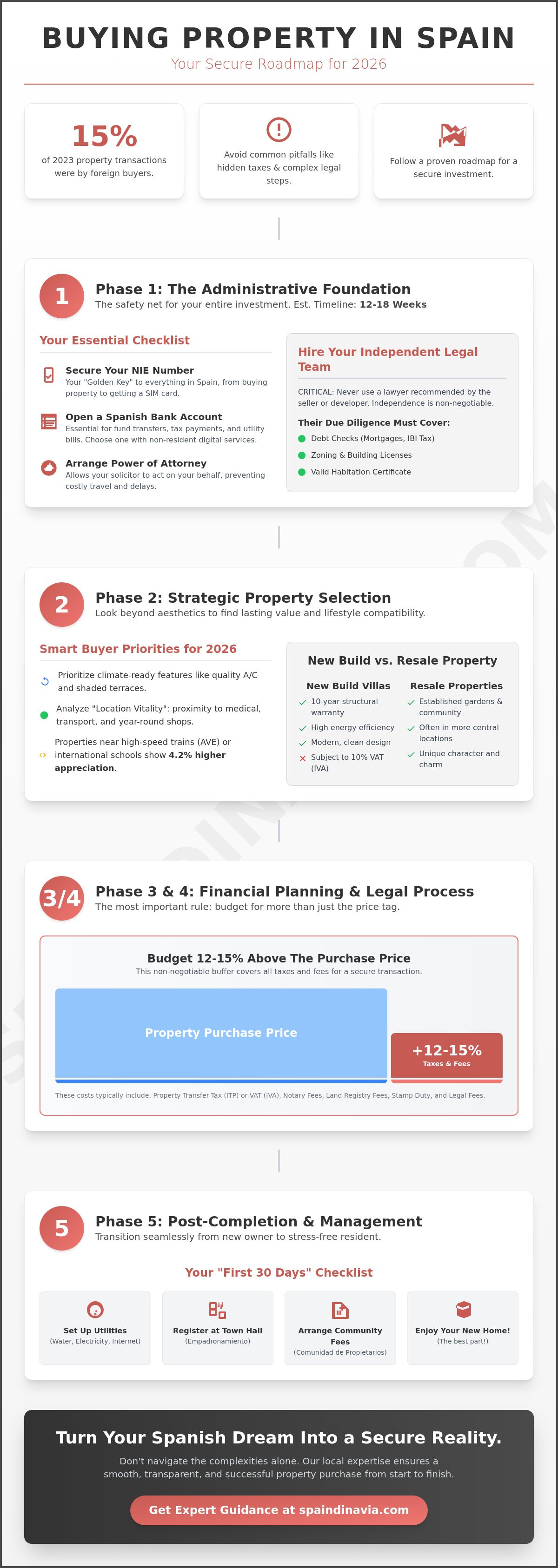
The administrative phase isn't just a hurdle; it's the safety net for your entire investment. Skipping a single step here can lead to delays or financial loss. Understanding the history of the Spanish property market shows us that legal clarity is the only way to ensure a secure purchase. In 2026, the Spanish market moves with a blend of digital efficiency and traditional bureaucracy. You should set a realistic timeline of 12 to 18 weeks from your initial offer to the final signing at the notary.
For international buyers, the Escritura de Poder (Power of Attorney) is a vital tool. It grants your solicitor the legal right to sign documents, open bank accounts, and handle tax filings on your behalf. This is especially helpful if you aren't physically in Spain for every step. It keeps the momentum of the sale moving without requiring you to book last-minute flights. Don't confuse the roles of your team. Your real estate agent is there to find the right home, but your independent solicitor is there to protect your interests. They have different goals, so keeping them separate ensures you get unbiased advice.
Securing Your NIE Number and Bank Account
The NIE (Número de Identidad de Extranjero) is your "Golden Key" to life in Spain. You can't buy a home, pay utilities, or even get a local SIM card without it. Because demand for appointments remains high in 2026, you'll want to follow a clear path on how to get a spanish nie number as soon as you start your search. Alongside this, you'll need a Spanish bank account. Choose a bank that offers robust non-resident digital services. Many modern Spanish banks now provide 24/7 English-language support and specialized apps that make managing international transfers simple and transparent.
Hiring Your Legal Representation
This is the most critical part of any buying property in spain guide. Never use a lawyer recommended solely by the seller or the developer. Independence is non-negotiable. Your lawyer must perform a deep "Due Diligence" check that covers several technical areas:
- Debt Checks: Ensuring there are no outstanding mortgages, local taxes (IBI), or community fees attached to the property.
- Zoning and Licenses: Verifying the property is fully legal and not built on protected land.
- Occupancy Status: Confirming the Cédula de Habitabilidad (Habitation Certificate) is valid and current.
Establish a clear communication protocol with your legal team from day one. Ask for a weekly summary of progress. This keeps the process transparent and ensures you feel confident as you move toward the contract stage. A secure investment is built on this foundation of professional oversight and personal peace of mind.
Phase 2: Property Selection and Strategic Comparison
Start your search by defining your non-negotiables versus your lifestyle wishes. In the 2026 Spanish market, smart buyers prioritize climate-ready features over aesthetic finishes. High-quality air conditioning and shaded outdoor living areas are essential when summer temperatures regularly reach 35 degrees Celsius. This buying property in spain guide helps you look beyond the surface to find lasting value.
Analyze the "Location Vitality" of any area before you visit. Check for proximity to medical centers, year-round supermarkets, and transport links. Data from late 2025 indicates that properties within 15 minutes of a high-speed train link (AVE) or an international school have seen a 4.2% higher appreciation rate than isolated holiday homes. Before you finalize your shortlist, consult a reliable step-by-step guide to buying property in Spain to ensure your financial planning covers all regional variations.
Virtual viewings have become a standard tool, but they require a critical eye. Ask your agent to show you the "hidden" areas, such as the inside of built-in wardrobes or the ceiling corners, where signs of moisture might hide. Request a live street view to gauge the actual traffic noise during peak hours. If you want a partner who knows exactly what to look for, let us help you navigate these details with local expertise.
New Build Villas vs. Resale Properties
New builds are popular for their energy efficiency and sleek, Scandinavian-style design. They come with a ten-year structural warranty (Seguro Decenal), but you must factor in a flat 10% VAT (IVA). Resale properties offer established gardens and community charm. These involve a transfer tax (ITP) ranging from 6% to 10% depending on the autonomous region. While resales allow for immediate move-in, they often require a budget for modernizing insulation or electrical systems.
The Quality Inspection Checklist
Keep a sharp lookout for "Humedad" (damp) in older ground-floor properties, as many built before 2010 lack modern moisture barriers. Property orientation is equally vital. A south-facing terrace provides the winter sun you crave, but it demands high-quality awnings for the July heat. For apartments and townhouses, always review the "Actas" from the last three community meetings. These minutes reveal if the community has debt or if expensive roof repairs are planned for next year. Using this buying property in spain guide ensures you avoid these common financial pitfalls.
Phase 3: The Legal Purchase Process Step-by-Step
Transitioning from the excitement of property viewings to the technicalities of a legal transaction requires a shift in mindset. You are moving from the emotional "dream home" phase into a rational, evidence-based process. In Spain, the legal framework is robust, but it relies on a specific hierarchy of contracts that dictate your rights and obligations. Understanding this sequence is the most effective way to ensure a secure investment as you follow this buying property in spain guide.
The most critical document you will encounter is the Nota Simple. This is an official extract from the Land Registry that provides a snapshot of the property's legal status. It confirms the current owners, the exact boundaries, and, most importantly, any "cargas" or debts attached to the land. According to Spanish law, debts like unpaid property taxes or mortgages stay with the property, not the owner. Verifying this document is the first step in your rational due diligence.
The Reservation and Arras Contracts
The process usually begins with a Reservation Agreement. You pay a small fee, often between 3,000 and 6,000 Euros, to take the property off the market for a set period, typically 14 to 30 days. This gives your lawyer time to conduct initial checks without the risk of another buyer swooping in. Always ensure this deposit is held in a dedicated client account or a secure escrow to prevent it from being released to the seller prematurely.
Once due diligence is complete, you sign the Contrato de Arras. This is a private purchase contract where you typically pay 10% of the purchase price. Under Article 1454 of the Spanish Civil Code, these contracts carry heavy weight. If you back out, you lose your deposit. If the seller withdraws, they must pay you double the deposit amount as a penalty. This provides a high level of security for both parties before the final signing.
Completion and the Public Deed
The "Cita en Notaría" is the final milestone. In Spain, a property sale must be witnessed by a Notary Public to be registered. The Notary's role is to verify the identities of both parties, confirm the payment has been made via bank-guaranteed drafts, and witness the signing of the Escritura de Compraventa (Public Deed). You will need your original passport and your NIE (Tax Identification Number) present for this appointment.
During this meeting, the physical exchange of keys and the final payment occur simultaneously. While the Notary oversees the signing, the process isn't truly finished until the deed is filed at the Registro de la Propiedad (Property Registry). Your representative should provide a "comprobante" or proof of filing immediately after the meeting. This ensures no other claims can be made against the title while the final registration, which usually takes between 60 and 90 days, is being processed.
Phase 4: Financial Planning and Tax Obligations
Securing your dream home requires a clear financial roadmap. As part of your buying property in spain guide, you should always budget between 12% and 15% on top of the agreed purchase price to cover various transaction costs. This buffer ensures you aren't caught off guard by administrative expenses or regional levies. These costs are a standard part of the Spanish system, and having the funds ready prevents delays during the final signing at the Notary.
The 2026 landscape for mortgages in spain for non residents shows a steady market where banks typically offer 60% to 70% Loan-to-Value (LTV) ratios. Lenders now prioritize applicants with stable, documented income from their home countries; a trend that has solidified over the last 24 months. Interest rates have stabilized, making long term financing a viable tool for many international buyers. If you're transferring funds from outside the Eurozone, avoid using traditional retail banks. They often hide high fees in poor exchange rates. Using a specialized currency broker can save you up to 4% on a 300,000 EUR transaction, which is enough to cover your first year of maintenance costs.
A Breakdown of Purchase Taxes and Fees
Understanding property taxes in spain is vital because the amount depends on the property type. New builds attract 10% VAT (IVA), while resale homes are subject to Transfer Tax (ITP), ranging from 6% to 10% based on the autonomous region. You'll also pay Actos Jurídicos Documentados (AJD), or Stamp Duty, which varies between 0.5% and 1.5% depending on the location. Notary and Land Registry fees are fixed by law and usually total around 1,500 EUR for a standard residential purchase. These fees ensure your title is legally protected and correctly recorded in the public registry.
Ongoing Costs of Homeownership
Owning a home involves annual commitments that differ from the initial purchase costs. The IBI (Impuesto sobre Bienes Inmuebles) is your local council tax, billed annually by the town hall to cover local infrastructure and services. You must also account for Non-Resident Income Tax (IRNR). Even if you don't rent out the property, the Spanish tax office assumes a "deemed rental income" and taxes you on it annually. Finally, if your home is part of a complex, you'll pay Community of Owners fees. These cover pool maintenance, gardens, and security; typically ranging from 50 EUR to 250 EUR per month for mid-range apartments. Following this buying property in spain guide helps you account for every Euro, ensuring a stress-free transition to your new life.
Let us help you find a secure investment in the Spanish sun today.
Phase 5: Post-Completion and Property Management
The moment you receive your keys at the notary marks the beginning of an exciting new chapter. While the heavy lifting of the legal process is behind you, the first 30 days of ownership are vital for securing your asset. This final stage of our buying property in spain guide ensures your transition from a buyer to a confident owner is as smooth as the Mediterranean breeze. You've made a significant life decision; now it's time to protect it.
Your immediate priority involves a few administrative essentials. You'll need to ensure the Change of Ownership is registered correctly with the Catastro (Land Registry) and that your first IBI (council tax) payments are scheduled. Most owners find that creating a "First Month Folder" helps keep these documents organized for future tax returns or a potential resale down the line.
Utilities and Home Setup
Don't wait to transfer your utility contracts. In Spain, reconnecting a service that's been cut off is significantly more expensive and time-consuming than a simple name transfer. You should aim to move water, electricity, and internet contracts into your name within the first seven days. Most Spanish utility providers require a Spanish bank account for domiciliación (direct debit). Setting this up is the only way to prevent service interruptions while you're away.
- Electricity and Water: Provide the latest meter readings to ensure you aren't paying for the previous owner's usage.
- Home Insurance: Standard "Building and Contents" insurance is essential from day one. Ensure your policy specifically covers "Civil Liability" to protect you if a leak from your apartment affects a neighbor.
- Community Fees: Introduce yourself to the Administrador de Fincas to ensure your community fees are paid on time, as unpaid debts can lead to legal action against the property.
Rental Management and Maintenance
If you've purchased your home as a spain property investment, your focus now shifts to ROI and preservation. To rent your property to holidaymakers in 2026, you must obtain a Tourist License from the regional government. Requirements have become stricter, often requiring specific energy efficiency ratings or community approval. Professional management is no longer a luxury; it's a necessity for high occupancy.
Key holding services act as your best insurance policy. A local manager performs routine inspections every 15 days to check for humidity, which can build up quickly in coastal climates if a property isn't ventilated. They also provide security by making the home look lived-in. For those seeking reliable support in the Mijas Costa area, keyspropertygroup.com offers the professional management needed to maintain a property remotely. When you choose professional management, you aren't just buying service; you're buying peace of mind. They handle the midnight calls from tenants and ensure your home remains in pristine condition, allowing you to enjoy the rewards of your investment without the stress.
Step Into Your New Spanish Lifestyle
Securing a home in the sun requires more than just a dream; it demands a structured approach. By 2026, the Spanish property market is expected to maintain its position as a primary destination for international buyers, particularly as digital administrative processes become the standard. You've now seen how to navigate the essential phases, from securing your NIE to finalizing the public deeds at the notary. This buying property in spain guide provides the roadmap, but having a partner on the ground makes the journey seamless. We bridge the gap between Scandinavian standards and Spanish charm, ensuring your investment is protected every step of the way.
Our team offers a hand-picked portfolio of the finest new build villas and resale homes, backed by comprehensive support that extends from your first viewing to long-term property management. Don't let the complexity of foreign regulations hold you back. We're here to provide the expert guidance and personal warmth you need for a secure transaction. Your life in the sun is closer than you think, and we're ready to help you make it a reality.
Find your dream home with Spaindinavia today
Frequently Asked Questions
Can I buy property in Spain without a NIE number?
You cannot complete a property purchase in Spain without a NIE number. This unique tax identification number is mandatory for all financial transactions, including signing the deed at the notary and paying taxes. We recommend applying through the Spanish Consulate in your home country or via a power of attorney in Spain to avoid delays in your buying property in spain guide timeline.
What are the total additional costs on top of the property price?
You should budget between 10% and 15% of the purchase price for additional costs. These expenses include the Transfer Tax (ITP) for resale homes, which ranges from 6% to 10% depending on the region, or 10% VAT for new builds. You'll also pay approximately 1% to 2% for notary, land registry, and legal fees to ensure your investment is fully protected.
Do I need to be in Spain physically to complete the purchase?
You don't need to be physically present in Spain to complete your purchase if you grant a Power of Attorney to a legal representative. This document allows your lawyer to sign the public deed and handle tax payments on your behalf. Roughly 45% of our international buyers choose this remote option to manage their acquisition without making multiple trips during the process.
How long does the entire buying process typically take in 2026?
The typical timeline for a property transaction in 2026 spans between 6 and 12 weeks from the initial reservation. Resale properties often move faster, closing within 45 days if the paperwork is ready and there's no mortgage involved. New build projects follow a different schedule based on construction phases, but the legal due diligence remains a constant priority to protect your lifestyle investment.
Is it possible for a non-resident to get a mortgage in Spain?
Non-residents can secure mortgages in Spain, typically covering up to 70% of the property's appraised value or purchase price. Spanish banks require proof of income and tax returns from your home country to assess eligibility for these loans. This financial path is a common part of a buying property in spain guide for those looking to balance their capital while securing a home in the sun.
What is the difference between a reservation contract and an arras contract?
A reservation contract takes the property off the market for a small fee, while an arras contract is a binding agreement involving a 10% deposit. Under Article 1454 of the Spanish Civil Code, if you back out of an arras agreement, you lose your deposit. If the seller withdraws, they must pay you double the amount back as compensation for the broken deal.
Are new build properties in Spain covered by a warranty?
New build properties carry a mandatory structural warranty for 10 years under the Ley de Ordenación de la Edificación (LOE). This law also provides a 3-year warranty for installation defects and a 1-year warranty for minor finishings. These protections offer peace of mind, ensuring your new home meets the strict building standards required for modern Mediterranean living in the 2026 market.
What happens if I sign a contract and then change my mind?
Changing your mind after signing a contract usually results in the loss of your deposit. If you've signed a reservation agreement, the fee is typically non-refundable. In the case of an arras contract, you'll forfeit the full 10% deposit to the seller. We always review these documents carefully with you to ensure you feel confident before committing your funds to a specific dream home.


