

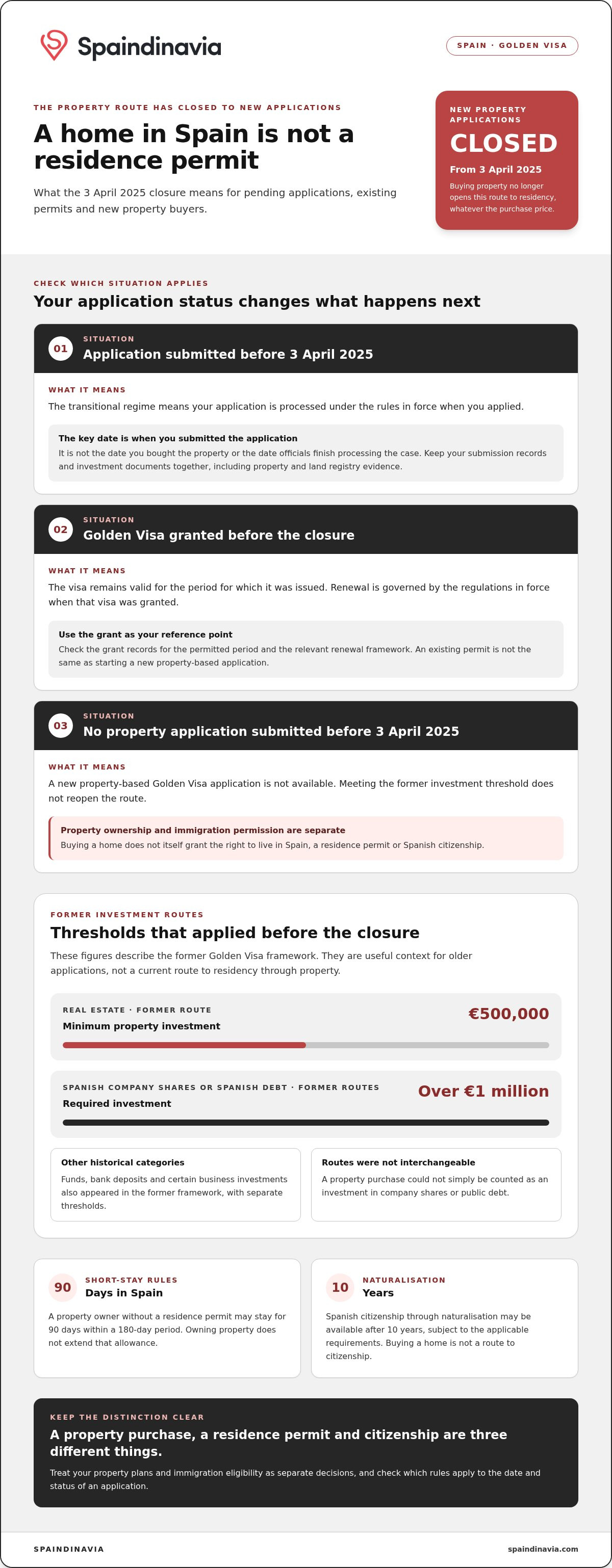
Buying a house in Spain doesn’t give you citizenship or a residence permit: you can’t get Spanish citizenship by buying a house. Spain ended new property-based Golden Visa applications on 3 April 2025, and buying property no longer provides a route to residency, whatever the purchase price. Spanish citizenship through naturalisation may be available after 10 years.
It’s easy to confuse the two: owning a home in Spain can be part of a move towards a new life in the sun, but it does not in itself give you the right to live there. Older information about property investment and the Golden Visa may also describe rules that have since changed.
This article explains how buying a home differs from gaining residency or citizenship, which investment routes existed before the property-based scheme closed, and what the change means for applications already in progress. It also outlines key questions to consider before choosing a Spanish property as a holiday home, investment or future residence.
Key Takeaways
- Buying a home in Spain doesn’t grant citizenship or residency, and the property-based Golden Visa route closed to new applications on 3 April 2025.
- Understand how applications submitted before the closure and visas already granted are treated under the transitional rules.
- Explore the former investment routes and how their different thresholds applied, rather than assuming property purchases could be combined to qualify.
- Learn which financial resources and health insurance requirements applied to the former investor route, and why they matter when reviewing older guidance.
- Separate your property plans from your immigration plans so you can make informed choices about living in Spain.
What if you already had a Golden Visa or an application in process?
Spain’s property-based golden visa is closed to new applications. The change took effect on 3 April 2025, ending a route that had allowed eligible non-EU investors to seek residency through Spanish real estate. Before closure, the minimum property investment was €500,000. Buying property in Spain no longer creates a route to residency, whatever its price, so a purchase made after the closure cannot start a new property-based application.
The legal change followed a longer political process. On 27 November 2024, a proposal to end Spain’s Golden Visa programme was announced, but the Spanish Senate vetoed that proposal. The subsequent closure took effect through Organic Law 1/2025, dated 2 January. It left Articles 63 to 67 of Law 14/2013 without content, removing the legal provisions that had supported investor residence permits, including the real-estate route.
If you submitted a Golden Visa application before 3 April 2025, the transitional regime means it is processed under the rules in force when you applied. The key date is the application submission date, not when you bought the property or when officials finish processing your case. Keep your submission records and investment documents together, including evidence connected with the property and its land registry entry, so you can understand which application they relate to.
An investor whose Golden Visa was granted before the closure keeps it for the period for which it was issued. Renewal is governed by the regulations in force when that visa was granted, rather than by the rules for new applications after 3 April 2025. That distinction matters: an existing permit or a timely pre-closure application is not the same as trying to begin a new real-estate application today.
Historically, the property route required at least €500,000 in real estate investment. Other investment routes had separate thresholds. Before 3 April 2025, Spanish company shares or Spanish debt required an investment of over €1 million. These were distinct qualifying routes, not a way to turn an ordinary property purchase into a current residency application. The route available depended on the investment type and the rules applying at the relevant time.
Older online guidance may still describe property-based Golden Visa applications as open. Read its dates carefully: statements about a tourist entering Spain and later applying, or about a particular permit length, may describe the former system. They do not reopen the route for new applicants. A property owner without a residence permit may stay in Spain for 90 days within a 180-day period under short-stay rules; ownership alone does not extend that allowance.
Residency and citizenship are separate outcomes. A Golden Visa was a residence route, not a passport purchase, and buying a home does not grant Spanish citizenship. Naturalisation may be available after 10 years, subject to the applicable requirements; the former investment route did not remove that distinction. If your goal is a permanent move, treat immigration eligibility and property ownership as two separate decisions, rather than assuming one follows automatically from the other.
For a pending or previously granted application, identify which category fits: submitted before 3 April 2025, already granted, or not yet submitted. The first two are covered by transitional arrangements or the terms of the granted permit. A new property-based application falls outside the closed route, even if the intended investment matches the former €500,000 threshold. That is the practical effect of Spain’s repeal for real-estate investors.
For a visa holder, the grant itself remains the reference point for the permitted period and renewal framework. A granted Spanish Golden Visa remains valid for the period for which it was issued, and its renewal is governed by the regulations in force when it was granted. Closure of the route to new applications should not be confused with a change to the terms attached to an existing permit. Check the grant records to identify the period covered and the regulations relevant to renewal, rather than relying on guidance for new applicants. An existing visa should be assessed according to its own grant and renewal terms, not treated as a new property-based application.
What Investments Qualify for Spain Investment Visa?
The investment thresholds below describe Spain’s former Golden Visa routes, not a current route to residency through property. They are relevant mainly when understanding older applications and the distinction between property and other investment categories.
Minimum property investment thresholds
Under the former property route, the minimum real-estate investment was €500,000. That threshold matters when reviewing a legacy application, because a home’s purchase price alone doesn’t establish what was declared as the qualifying investment. For a legacy application involving multiple properties, the qualifying investment may depend on the details of the application.
If you’re reviewing an old application involving more than one property, compare the declared investment with the purchase documents and ownership records, including the land registry details. Don’t rely on current asking prices or assume several purchases count as one qualifying investment. The relevant context is the application and the rules in force when it was submitted.
Other qualifying investment routes
Property was not the only historical route. The former framework also covered Spanish public debt securities, eligible shares, funds, bank deposits and certain business investments. Each category had its own threshold, so a property purchase could not simply be counted as an investment in company shares or public debt.
For example, the listed threshold for Spanish public debt securities was €2 million. Eligible Spanish stocks, shares, funds or bank deposits had a €1 million threshold. These are historical Golden Visa figures, not current permission to obtain residency by purchasing those assets.
Business investment had its own conditions. An investment of at least €1 million in a Spanish business could qualify when it met specified economic criteria. The amount alone therefore didn’t describe the full route: the investment also needed to fit the relevant business category and criteria.
Older descriptions may group these options under the label “investment visa”. Read the category carefully. A €1 million business investment, for instance, was not the same route as a €1 million investment in eligible Spanish financial assets. Nor did either figure describe the former property threshold.
This distinction is useful when sorting documents for an application made before the route closed. First identify the asset type recorded in the application, then compare its stated value with the threshold for that category. A record showing property ownership in Barcelona, for example, belongs to the property category, not automatically to an enterprise or securities category.
Take care with the word “minimum”. It refers to the stated investment threshold for a particular route; it does not mean every purchase at that level resulted in approval. The former business route included economic criteria, while property and financial assets were separate investment types. Keep these distinctions clear when reviewing old guidance or your own paperwork.
Spain’s closure of new real-estate Golden Visa applications means the €500,000 property threshold is now historical. Buying a home, even one above that amount, no longer provides a property-based way to obtain residency. A high-value home remains property ownership; it does not become a qualifying enterprise investment because it is expensive.
An investment threshold should not be confused with income or private health insurance requirements. Those are separate matters and do not change the investment category used in an older application. Keep investment evidence and personal eligibility documents distinct when reviewing a past case.
For a practical review, make an inventory of the investment type, amount declared, purchase or investment date, and records showing ownership. Then match those details to the historic route named in the application. This helps distinguish a property purchase from other investment categories without treating old Golden Visa figures as current options.
Financial resources and health insurance
Under Spain’s former Golden Visa, investment was not the only application requirement. Applicants also had to show sufficient financial resources and private health insurance. These requirements matter when reviewing a pre-closure application or older guidance, but they do not reopen the route for foreigners buying property today.
A single applicant was required to show monthly income of at least €2,400. The stated amount increased by €600 per month for each dependent. For a household, the figures therefore depended on how many family members were included, not on the value of the real estate investment or the number of properties owned.
A bank letter was used to confirm funds for 24 months of expenses. The calculation multiplied the monthly income requirement by 24, giving the authorities evidence of resources over two years. If you’re reviewing a past application, compare the bank letter with the household size and monthly amount recorded in the application. Keep those financial records separate from property contracts and registry papers.
Private health insurance was a separate requirement under the former investor route. The policy had to provide full coverage in Spain with no co-payments. In practical terms, the applicant needed cover for healthcare in Spain without co-payments for covered treatment. Owning a home or having private cover elsewhere did not, by itself, meet the stated insurance conditions.
Treat that as a past estimate, not a current quote or guaranteed premium. The amount could depend on the policy and applicant, and should not be confused with the financial-resource figure used to support an application.
When checking an old case, sort the documents into three groups: proof of investment, evidence of financial resources, and insurance policy details. A property contract may show a real estate investment, while a bank letter addresses available funds and an insurance certificate describes healthcare cover. These documents support different parts of the application and do not substitute for one another.
Buying property in Spain and having permission to live there are also separate matters. A property deed or land registry record confirms ownership; it is not a residence permit. Without a residence permit, a property owner can stay in Spain for 90 days within a 180-day period under short-stay rules. That limit does not change because the owner has signed contracts or furnished a home.
For a longer stay, the relevant residence route depends on your situation, not simply your home purchase. Spain’s non-lucrative residence option is for people with sufficient means to live in Spain without working there; the stated funds are around €28,800 annually. A digital nomad visa is a separate residence route from the former real-estate investment permit. These are separate routes, not extensions of the former real-estate investment permit.
Neither a temporary permit nor buying property automatically makes someone a permanent resident or citizen. The former Golden Visa’s financial and insurance criteria concerned an investor residence application. They did not turn ownership into permanent status or replace the separate requirements for naturalisation.
If you’re assessing a historic application, note the date, applicant and dependants, declared income, bank evidence, and insurance terms. Match each document to the requirement it was meant to support. This helps distinguish residence paperwork from the contracts and ownership records involved in buying a home.
For an investor residence application, the stated insurance standard is private health insurance with no copayments and full coverage in Spain. Spanish authorities typically calculate adequate living resources at €400 per month for each dependent, so older financial records should be checked against the household details used in the application.
Spaindinavia: New Build Villas
Spaindinavia can help you explore property options while keeping your home search separate from your residency plans. The Costa Blanca offers vibrant areas and a larger property selection, while the Costa Cálida provides a more relaxed lifestyle and better value. For a Costa Cálida search, consider Mazarrón, including Puerto de Mazarrón, Isla Plana, La Azohía and Bolnuevo.
Choose a property type that suits your plans, such as a new-build villa, resale apartment, townhouse or bungalow. Spaindinavia supports buyers throughout the purchase process, working with independent solicitors, banks and local experts. To explore homes in Spain, contact Spaindinavia and discuss your property plans.
Plan your next move with clarity
If you’re wondering whether you can get Spanish citizenship by buying a house, keep your property decision separate from your immigration plans. A home can support the lifestyle you want, but it is not a reason to assume you can live in Spain permanently. Before committing, write down how you expect to use the property, where you want to be based, and which residence route fits your circumstances. This gives you a clearer brief for both your move and your property search.
Spaindinavia can help you explore new-build villas, resale apartments and townhouses, with support throughout the buying process. Consider the setting that suits your everyday life, including local amenities and how often you plan to stay. A clear list of priorities makes it easier to compare homes and focus on properties that fit your plans, not on an immigration promise.
Contact Spaindinavia to discuss your property plans and take a considered next step towards finding a home in Spain.
Frequently Asked Questions
Can I Get Residency in Spain if I Buy a House?
No. Buying a house alone does not give you the right to live in Spain. If you’re asking whether you can get Spanish citizenship by buying a house, ownership alone does not grant citizenship either. You need to qualify through a separate residence route and meet its conditions. For example, Spain’s non-lucrative residence option is for people with sufficient means to live there without working. Treat your property plans and immigration application as separate decisions.
What are the disadvantages of the Golden Visa in Spain?
The main disadvantage for prospective property investors is that Spain no longer accepts new applications through the real-estate route. Historically, it also required a substantial qualifying investment, alongside financial-resource and insurance requirements. The permit provided residence, not citizenship, so it was not a shortcut to a Spanish passport. Relying on older Golden Visa guidance could lead to misunderstanding what a property purchase achieves today. Your residence plan needs to stand independently from the decision to buy.
What were Spain's golden visa rules for property investors, and when did they end?
Spain’s former property-based Golden Visa required a minimum real-estate investment of €500,000. The route for new applications ended on 3 April 2025. Applications submitted before that date are processed under the rules in force when they were made, while permits already granted remain valid for their issued period. The former scheme also had other investment categories, each with its own threshold. Those historical options don’t create a new application route today.
Can owning a home in Spain help with a non-lucrative or other residence visa application?
Owning a home does not, by itself, meet the requirements for a non-lucrative residence application. That route is for people with sufficient financial means to live in Spain without working there. Home ownership may be part of your circumstances, but it does not replace the application’s separate eligibility criteria or prove that you meet them. Before buying, distinguish evidence of owning accommodation from evidence supporting the residence route you intend to pursue.
What are the risks of buying property in Spain to obtain residency or citizenship?
The main risk is buying on the mistaken belief that ownership will secure residency or citizenship. Spain’s property-based Golden Visa route is closed to new applications, so the purchase alone cannot deliver that result. A property transaction also involves its own legal and tax considerations: according to Agencia Tributaria, purchases may be subject to VAT or Property Transfer Tax. Keep the immigration decision separate, and have an independent solicitor review the property documents before committing.


