

Did you know that the 3% tax withheld when you sell your home isn't actually a final bill, but a prepayment that you could potentially reclaim? Mastering the capital gains tax on selling spanish property for foreigners is the most effective way to ensure your investment returns remain exactly where they belong, in your pocket. Whether you are selling a resale villa in the hills of Bolnuevo or a frontline apartment in Puerto de Mazarrón, the prospect of dealing with the Spanish Tax Agency can feel overwhelming. We recognise the frustration of hunting for decades-old receipts or trying to decipher the difference between national tax and local Plusvalía.
This guide provides a clear, expert roadmap designed to help you manage these complexities with ease. We promise to help you calculate an accurate estimate of your liability while identifying every legitimate deductible expense available to you in 2026. We will explore the specific regulations affecting the Costa Cálida and the Costa Blanca, from the coastal retreats of Isla Plana and La Azohia to the vibrant communities of the Valencia region. By the end of this article, you will have the tools to organise your sale with confidence and the certainty that you have met every legal obligation without overpaying a single Euro.
Key Takeaways
- Understand why the flat 19% tax rate applies to your 2026 sale, ensuring you have a clear picture of your obligations for properties across both the Costa Cálida and the Costa Blanca.
- Discover how to use the adjusted purchase price formula to accurately calculate capital gains tax on selling spanish property for foreigners and protect your hard-earned investment returns.
- Learn to distinguish between non-deductible repairs and legitimate capital improvements, such as adding a swimming pool to your villa in La Azohia or Bolnuevo, to lower your taxable gain.
- Navigate the mandatory 3% withholding tax with ease and find out how the correct filing of Modelo 211 by the buyer protects you from future Hacienda enquiries.
- Clarify the difference between national tax and the local Plusvalía land tax to ensure you choose the most favourable calculation method offered by town halls in the Murcia and Valencia regions.
Understanding Capital Gains Tax for Non-Residents in Spain
When you decide to part with your Mediterranean home, understanding the capital gains tax on selling spanish property for foreigners is your first step toward a successful transaction. In Spain, this is formally known as Impuesto sobre la Renta de No Residentes (IRNR). It's a tax levied on the profit you make from the sale, calculated as the difference between your original purchase price and the final sale price. For 2026, the Spanish government maintains a flat tax rate of 19% for all non-resident sellers. This applies whether you're selling a modern apartment in the Costa Blanca or a charming resale villa in the Costa Cálida.
Choosing to sell your property is a significant life decision. Whether your home is located in the bustling Puerto de Mazarrón or the tranquil surroundings of Isla Plana, the financial implications remain the same. The 19% rate is consistent for both EU and non-EU citizens, providing a level of predictability for overseas investors. To get a broader perspective on how these levies fit into the national framework, you can explore the general structure of Taxation in Spain, which outlines the various responsibilities of property owners.
The 183-Day Rule and Tax Residency
Hacienda, the Spanish Tax Agency, uses a specific set of criteria to determine if you're a resident or a non-resident. The most famous of these is the 183-day rule. If you spend more than 183 days in Spain during a calendar year, you're usually classified as a tax resident. These days don't need to be consecutive. It's a common misconception that simply owning a holiday home in Bolnuevo or La Azohia makes you a resident. Unless you've formalised your status, you'll likely be treated as a non-resident. We always recommend obtaining a formal certificate of tax residency from your home country to avoid any confusion during the sale process.
Fixed Rates vs. Sliding Scales
The distinction between resident and non-resident status is vital because it changes how you're taxed. Residents are subject to a sliding scale that can reach up to 28% for high gains. In contrast, non-residents enjoy a fixed 19% rate on property gains. This flat rate is particularly beneficial if you've seen a significant increase in property value, which is common in high-demand areas like the Costa Blanca and the Mazarrón region. Double Taxation Agreements (DTA) also play a protective role. These treaties between Spain and other nations, such as the UK, ensure you don't pay tax on the same profit in two different countries. It's a safety net that allows you to reinvest your returns with peace of mind.
Calculating Your Taxable Gain: The Step-by-Step Formula
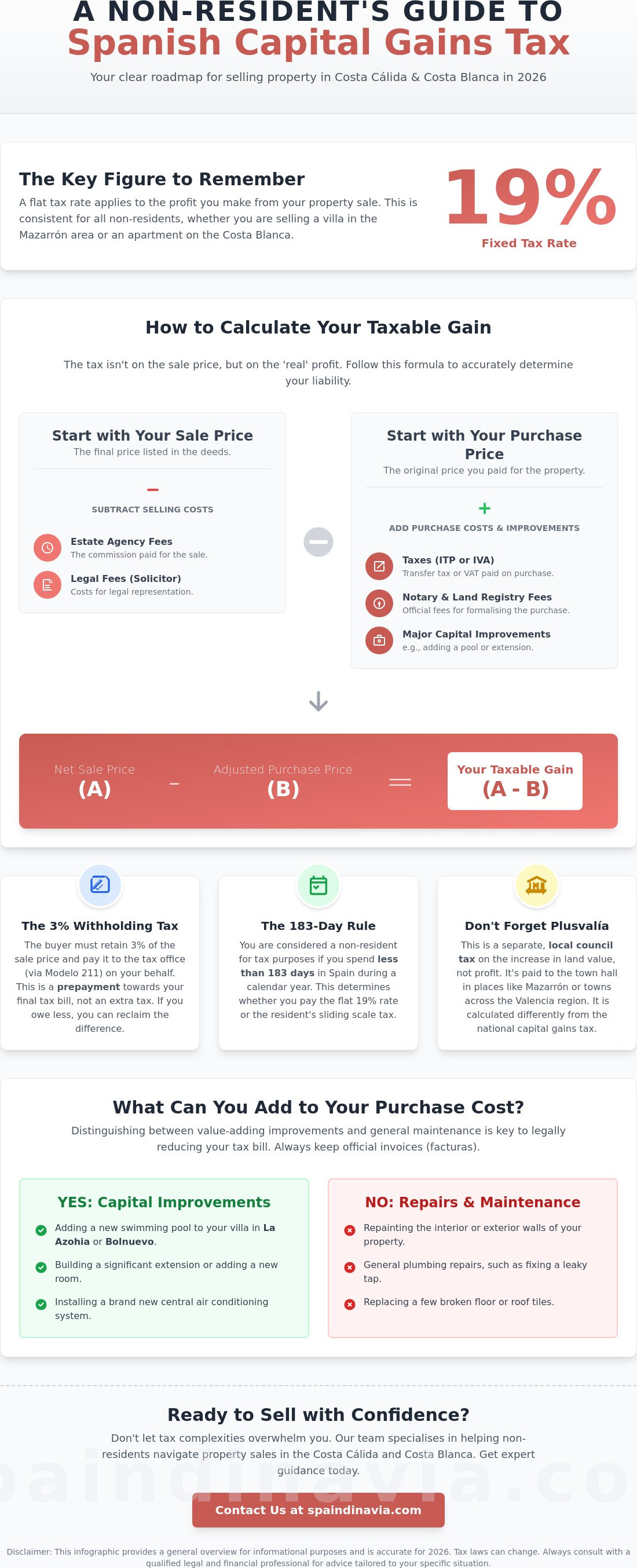
Calculating your potential liability shouldn't feel like a guessing game. The formula for capital gains tax on selling spanish property for foreigners is logical once you break it down into manageable steps. The goal is to determine your "real" profit by adjusting both the original purchase price and the final sale price. Hacienda doesn't expect you to pay tax on the gross difference; they allow you to offset many of the costs associated with owning and selling your home. Whether you are moving on from a sunny townhouse in the Costa Blanca or a coastal retreat in the Costa Cálida, getting these numbers right is essential for protecting your returns.
It's helpful to remember that since 2015, the Spanish government removed the "indexation coefficients" that previously adjusted purchase prices for inflation. This means the calculation is now more direct, but it also makes the deductions you claim even more valuable. Every Euro you can legitimately add to your purchase price or subtract from your sale price reduces the final 19% tax bill.
Step 1: Establishing the Net Purchase Price
When you first collected the keys to your property, you paid significantly more than just the price on the contract. You can add these original acquisition costs to your base price. This includes the Transfer Tax (ITP) for resale homes or IVA for new builds, which often ranges between 8% and 10%. You should also include notary fees, Land Registry charges, and the legal fees you paid to your solicitor at the time. To claim these, you must have the original official invoices, known as facturas. If you bought a resale villa in Bolnuevo or a modern apartment in Isla Plana years ago, finding these receipts is your first priority. Without them, the tax office will only recognise the base price shown on the deeds.
Step 2: Calculating the Net Sale Proceeds
The next step is to determine how much you actually walked away with after the sale. If you're selling a property in the Mazarrón area, such as a bungalow in La Azohia, you can deduct the real estate agency's commission from your final sale figure. You should also subtract the legal fees for the sale and the cost of the mandatory Energy Performance Certificate. Another vital deduction is the municipal Plusvalía tax, which is a local levy paid to the town hall. By subtracting these costs from your sale price, you arrive at your net proceeds. If you're curious about how current market trends might affect your final figure, browsing our latest resale villas can provide a helpful benchmark for prices in the Murcia and Valencia regions.
The 3% Withholding Tax: A Crucial Detail for Overseas Sellers
One of the most surprising aspects of selling your home is the 3% withholding tax, often referred to as the Retención. This isn't an extra fee, but rather a mandatory prepayment of your capital gains tax on selling spanish property for foreigners. When the sale is finalised at the notary, the buyer is legally required to deduct 3% of the total purchase price and pay it directly to the Spanish Tax Agency on your behalf. This ensures that even if a seller leaves the country, the state has already collected a significant portion of the tax due. Whether you're selling a luxury villa in the Costa Blanca or a seaside retreat in Puerto de Mazarrón, this rule remains a constant part of the process.
According to the 2026 guide to Spanish capital gains tax for non-residents, the buyer must submit this payment using Modelo 211 within one month of the sale. It's vital that you or your legal representative obtain a copy of this form. This document acts as your receipt and is the only proof you have that this "down payment" has been made to the Hacienda. Once the sale is complete, you have a four-month window from the date of the sale to file your final tax return, known as Modelo 210, to settle the final balance of your capital gains tax on selling spanish property for foreigners.
How the 3% Retention Protects the Spanish State
Spain implements this rule specifically for non-resident sellers to prevent tax evasion. Since you don't live in Spain permanently, the authorities use this retention as a security deposit. It's important to understand that the legal responsibility for paying this 3% rests entirely with the buyer. If they fail to submit Modelo 211, the Spanish state actually holds the property itself liable for the debt, rather than chasing you personally. However, as a seller in areas like Isla Plana or La Azohia, your main priority is ensuring you get that proof of payment, as you'll need it to claim any potential refunds later.
Reclaiming an Overpayment
Many sellers don't realise that the 3% withheld might actually be more than the tax they actually owe. If your profit was small, or if you sold the property at a loss, you're entitled to apply for a refund of the difference. This is a common scenario for those who have invested heavily in their homes in Bolnuevo or elsewhere in the Murcia and Valencia regions. To successfully claim a refund, your taxes must be entirely up to date. This includes your annual IBI (Council Tax) and the Non-Resident Income Tax (Modelo 210) for all previous years of ownership. Hacienda will meticulously check your records before releasing any funds, so being organised is the key to a smooth reclaim process.
Legitimate Ways to Reduce Your Capital Gains Tax Bill
Whilst the 19% tax rate for non-residents is set in stone, the actual amount you pay is surprisingly flexible if you've been diligent with your paperwork. Navigating the capital gains tax on selling spanish property for foreigners becomes much easier when you understand which receipts to keep and which costs the tax office will accept. Hacienda draws a very sharp line between keeping a property in good condition and actually enhancing its value. By identifying the right expenses, you can significantly lower your taxable gain and protect your hard-earned profit.
It's a common misconception that the "Main Residence Exemption" or the "Over 65 Exemption" applies to everyone. In reality, these benefits are almost exclusively reserved for tax residents who have lived in the property for at least three years. As an overseas seller with a holiday home in the Costa Blanca or the Costa Cálida, you'll likely be subject to the full 19% on your profit. This makes claiming every possible deduction even more vital for your bottom line.
The Golden Rule of Invoices (Facturas)
Hacienda is famously strict about documentation. A simple quote, a handwritten note, or a "cash" receipt will be rejected immediately during a tax audit. To deduct an expense, you must provide a formal Spanish factura. This document must include the company's name and tax ID (CIF/NIF), a clear breakdown of the VAT (IVA), the date, and, crucially, the full address of your property. If you've upgraded your resale villa in Bolnuevo or added a modern kitchen to your apartment in Puerto de Mazarrón, ensure your contractor has provided a compliant invoice. Organising these documents whilst you still own the property is much easier than trying to track down a builder years after the work was finished.
Structural Improvements vs. Maintenance
The tax office distinguishes between "repairs" and "improvements". General maintenance, such as painting the exterior of your townhouse in Isla Plana or fixing a leaky pipe in La Azohia, is considered a repair and cannot be deducted. However, structural work that increases the property's value or changes its footprint is deductible. This includes adding a swimming pool, installing solar panels, glazing a terrace, or building an extension. These are the types of enhancements that make investment properties so attractive in the Murcia and Valencia regions. By categorising these works correctly, you ensure that every Euro spent on improving your home works to reduce your final tax liability. This is a vital strategy for anyone looking to minimise their capital gains tax on selling spanish property for foreigners whilst staying fully compliant with Spanish law.
Navigating the Sale: From Plusvalía to Professional Support
Completing your property sale involves more than just the national capital gains tax on selling spanish property for foreigners. You must also account for a local levy known as Plusvalía Municipal. This tax is often a source of confusion for overseas sellers because it's handled at the local town hall level rather than by the state. Whether you are selling a townhouse in the Costa Blanca or a bungalow in the Costa Cálida, understanding how this local charge interacts with your overall tax liability is essential for a clean exit from the market. Having a professional partner to coordinate these filings ensures you don't leave any loose ends that could lead to future fines.
Plusvalía vs. Capital Gains Tax
Plusvalía is specifically a tax on the increase in the value of the urban land your property sits on. It's entirely separate from the 19% national tax. Since a landmark court ruling in 2021, sellers now have the right to choose between two different calculation methods. You can select the "objective" method based on the cadastral value or the "real gain" method based on your actual profit. Always ask your solicitor to calculate both to see which is cheaper. In a standard sale contract, the seller is responsible for this payment. If you've sold your property at a loss, you're technically exempt from paying Plusvalía, though you must still file a declaration with the town hall in areas like Mazarrón or the wider Valencia region to claim that exemption.
Your Completion Day Checklist
The day you meet at the Notary is the culmination of your journey. It's a structured process where funds are distributed and the keys are handed over. You'll need to bring your original NIE, your title deeds (Escritura), and your most recent utility bills to prove everything is up to date. During the meeting, the buyer will present the cheques. These are usually split to cover any outstanding mortgage, the mandatory 3% retention for the Hacienda, and finally, your net profit. Once the signatures are dry, your legal representative will handle the Modelo 210 filing to settle your final capital gains tax on selling spanish property for foreigners. At Spaindinavia, we act as a reliable bridge between cultures, ensuring every step from Puerto de Mazarrón to the Costa Blanca is handled with personal warmth and expert precision. If you're ready to start your next chapter, book a consultation with our local experts to plan your sale with absolute confidence.
Secure Your Mediterranean Investment Returns
Selling your property should be a moment of celebration, marking the successful end of one chapter and the beginning of another. By understanding the flat 19% rate and the power of legitimate deductions, you've already taken the most important step toward protecting your financial future. Whether your journey has been set against the tranquil hills of Bolnuevo or the vibrant coastlines of the Costa Blanca, being organised with your official invoices and understanding local Plusvalía will ensure a smooth, compliant transition.
Navigating the capital gains tax on selling spanish property for foreigners doesn't have to be a solitary challenge. Our team specialises in everything from new build villas to resale apartments across the Costa Cálida and the Costa Blanca, offering you a partnership built on local knowledge and personal warmth. We coordinate with independent legal and tax experts to provide personalised support from your first listing right through to the final signature at the notary.
We're here to act as your reliable bridge, ensuring your exit from the Spanish market is as rewarding as your time spent here. Start your stress-free selling journey with Spaindinavia today and let us handle the complexities whilst you focus on your next adventure. Your Mediterranean story deserves a perfect finish.
Frequently Asked Questions
Do I have to pay Capital Gains Tax if I sell my Spanish property at a loss?
You don't pay capital gains tax if the sale price is lower than your original purchase price plus associated costs. However, the buyer is still legally required to withhold the 3% retention at the notary. To get this money back, you must file a tax return proving the loss to the Hacienda. This process applies to all sellers, whether your home is a villa in Bolnuevo or an apartment in the Costa Blanca.
How long does it take to get the 3% withholding tax back from the Hacienda?
Refunds typically take between six and twelve months from the date you file your final tax return. The Spanish tax authorities will meticulously check that all your previous obligations, such as annual non-resident income tax and local IBI, are fully paid. Whether your property is located in Puerto de Mazarrón or across the Valencia region, ensuring your tax history is clean is the fastest way to see your funds returned.
Can I deduct the cost of new furniture from my Capital Gains Tax calculation?
No, the cost of furniture and other moveable items cannot be deducted from your gain. Hacienda only allows for structural improvements that are permanently attached to the property and increase its value. If you've added a swimming pool to your home in La Azohia or built an extension on your property in the Costa Blanca, those structural costs are deductible as long as you have the original official invoices.
Is the Capital Gains Tax rate different for British sellers after Brexit?
No, the 19% rate for capital gains tax on selling spanish property for foreigners applies to British sellers exactly as it does to EU citizens. Whilst Brexit changed the tax rates for rental income, property sales remain at the flat 19% rate for all non-residents in 2026. This provides a level of financial certainty for owners across the Murcia and Valencia regions who are looking to capitalise on their investments.
What is the deadline for filing my Capital Gains Tax return (Modelo 210)?
You have a strict four-month window from the date of the sale to file your final tax return. This filing is essential because it's the only way to settle your final liability and either pay any remaining tax due or apply for a refund of the 3% retention. Whether you're selling a holiday home in Isla Plana or an investment property in the Costa Blanca, missing this deadline can result in unnecessary fines.
Can I avoid Spanish CGT if I reinvest the money in a property in my home country?
No, the reinvestment relief is a benefit reserved exclusively for Spanish tax residents who are selling their primary home. As a non-resident selling a secondary residence or investment property, you are liable for the 19% tax on your profit regardless of where you buy your next home. This rule is consistent for all overseas owners, whether their property is in the Mazarrón area or the wider Costa Blanca region.
What happens if I don’t have the original invoices for my property improvements?
Hacienda will reject any claim for deductions that isn't supported by a formal Spanish invoice, or factura. Without these documents, you'll be taxed on the gross profit without the benefit of offsetting your renovation costs. If you've modernised a resale villa in Bolnuevo or upgraded an apartment in the Costa Blanca, finding those original receipts is vital for reducing your capital gains tax on selling spanish property for foreigners.
Is Plusvalía tax the same as Capital Gains Tax?
No, Plusvalía is a local municipal tax paid to the town hall based on the increase in the value of the land. Capital Gains Tax is a national tax paid to the state on the actual profit you make from the transaction. You'll likely encounter both when selling in areas like Puerto de Mazarrón or the Costa Blanca, so it's important to budget for both liabilities to ensure a stress-free completion.


