
Could a single missing document stand between you and your Mediterranean dream? Whether you are looking at a resale villa in Bolnuevo or a modern apartment in the Costa Blanca, getting a certificate of habitation (cédula de habitabilidad) is the vital step that transforms a building into a legal home. We understand that the prospect of tackling Spanish paperwork often brings a sense of dread, especially when you are worried about the legality of your investment or the simple ability to connect your water and electricity. It is natural to feel a bit overwhelmed by these requirements whilst you are trying to plan your move.
You aren't alone in feeling this way, as many homeowners find the regional variations between the Costa Calida and the Valencian Community quite confusing. This 2026 guide is designed to provide you with total peace of mind by breaking down exactly what you need for properties in Puerto de Mazarrón, Isla Plana, and La Azohia. You will learn the difference between the various licence types, how to renew an expired certificate, and the quickest ways to ensure your utilities are running smoothly. Let's simplify the process so you can focus on the excitement of your new lifestyle.
Key Takeaways
- Understand how this essential document verifies your home meets safety and hygiene standards, ensuring your resale apartment or villa is fully compliant.
- Discover the step-by-step process of getting a certificate of habitation (cédula de habitabilidad) by coordinating with a qualified technical engineer.
- Learn why this certificate is the key to connecting water and electricity without delays, whether you are in Puerto de Mazarrón or along the Costa Blanca.
- Navigate the specific differences in requirements between the Murcia region and the Valencian Community to avoid common legal pitfalls during your purchase.
- Secure your investment and streamline future mortgage or valuation requests by keeping your habitation licences up to date.
What is a Cédula de Habitabilidad and Why is it Essential?
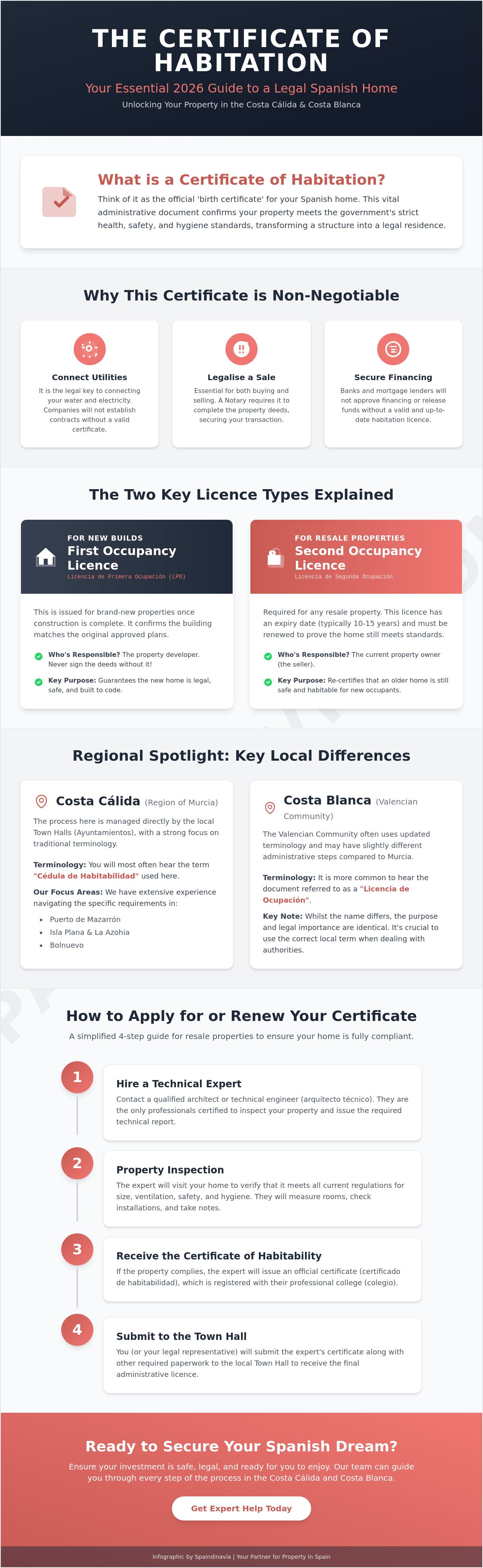
Think of the Cédula de Habitabilidad as the "birth certificate" for your Spanish home. It is a mandatory administrative document that confirms your property meets the strict health, hygiene, and safety requirements set by the regional government. Without this certificate, a building is technically just a structure; it only becomes a legal residence once the authorities have verified that it's safe for you to live there. This applies whether you are looking at sleek new build villas in the Costa Blanca or charming resale apartments in the Costa Cálida.
Whilst the requirement to have this document is a national one, the actual management and issuance are handled by local town halls. This means the specific steps can vary slightly between the Murcia region and the Valencian Community. For instance, the paperwork you'll need for a bungalow in Puerto de Mazarrón might differ from what's required for a townhouse in Alicante. Regardless of the location, the certificate ensures that your living space adheres to modern building codes and is fit for your new Mediterranean lifestyle.
The Purpose of the Habitation Certificate
The primary reason for getting a certificate of habitation (cédula de habitabilidad) is to guarantee that a property is legally fit for human habitation. It acts as a vital safeguard, preventing the illegal use of industrial units or commercial premises as homes. By verifying factors like ventilation, minimum room sizes, and safe electrical installations, the certificate protects your well-being. This verification is so fundamental that we've highlighted it as a non-negotiable step in our Buying Property in Spain Guide. It's the document that unlocks your ability to live in the home legally and apply for holiday rental licences if you plan to generate income from your investment.
A Vital Document for 2026 Property Owners
In 2026, the administrative landscape in Spain is more transparent than ever. Digital records now make this document easily traceable for authorities and utility companies alike. You cannot ignore an expired or missing certificate in the current market, especially in high-demand areas amongst the Mazarrón coastline like Isla Plana, La Azohia, and Bolnuevo. Getting a certificate of habitation (cédula de habitabilidad) ensures that your property remains liquid and attractive to future buyers. It provides the peace of mind that your investment is fully compliant with the latest regulations, allowing you to settle into your new life with total confidence. Whether you're in the Costa Cálida or the Costa Blanca, this document is your anchor for a secure and legal home ownership experience.
First vs Second Occupancy: Navigating the Different Licences
One of the most common points of confusion when getting a certificate of habitation (cédula de habitabilidad) is understanding which version you actually need. Depending on whether you're falling in love with a brand-new villa or a charming resale apartment, the document's name and requirements shift. In the Valencian Community (Costa Blanca), you'll often hear it referred to as a licencia de ocupación, whilst in the Murcia region (Costa Cálida), the terminology might lean back toward the traditional cédula. Both serve the same goal: proving your home is ready for you to enjoy safely.
Licencia de Primera Ocupación for New Builds
If you're eyeing a sleek new build villa in Puerto de Mazarrón or Isla Plana, you'll be dealing with the Licencia de Primera Ocupación (LPO). This is the developer's responsibility. They must obtain this from the local town hall once construction is finished to prove the building matches the original permits. Never sign the deeds at the Notary without seeing this document first. It's your guarantee that the home is legal and fully compliant with local urban planning. Many buyers overlook this, but it's central to banking requirements for habitation certificates, as lenders won't release funds for your mortgage without it.
Licencia de Segunda Ocupación for Resale Properties
For those choosing a resale villa in Bolnuevo or a townhouse in La Azohia, you'll need the Licencia de Segunda Ocupación. Think of this as a regular health check for your property. In the Valencian Community, this licence typically has a validity of 10 years, after which it must be renewed. The process has become much faster recently; in many areas of the Costa Blanca, it can be obtained in as little as 24 to 48 hours through a process called declaración responsable (responsible declaration). If you're currently browsing resale apartments in the Costa Cálida, always ask your agent if the habitation licence is current before proceeding with your offer.
Whilst the Costa Blanca and Costa Cálida share many similarities, the administrative "flavour" can vary. By knowing whether you need a first or second occupancy licence, you avoid the frustration of delayed utility connections or unexpected legal hurdles later on. To help you keep track, here is a quick summary of responsibilities:
- New Builds: The developer must provide the LPO before the sale is finalised.
- Resale Properties: The seller is usually responsible for providing a valid LSO.
- Utility Connections: Both documents are essential for setting up water and electricity contracts in your name.
Understanding these differences helps you navigate the market with confidence and ensures your transition to the Mediterranean sun is as smooth as possible.
The Critical Role of Habitation Certificates in Buying and Selling
Imagine picking up the keys to your new resale villa in Bolnuevo, only to find you cannot turn on the lights or run a bath. This is the frustrating reality for many who overlook the importance of getting a certificate of habitation (cédula de habitabilidad) before completing their purchase. This document is far more than just a legal formality; it is the master key that unlocks the essential services you need to enjoy your home. Whether you are moving into a townhouse in the Costa Blanca or a bungalow in the Costa Cálida, your property's legal status directly dictates your quality of life.
The impact of a missing or expired certificate extends to your finances as well. Spanish banks almost always require a valid certificate to proceed with a property valuation. If you are applying for a mortgage to secure a property in Isla Plana or La Azohia, a missing certificate can cause your application to stall or be rejected entirely. Being organised and ensuring this document is in place before you reach the Notary is the best way to protect your investment and avoid unnecessary stress.
Connecting Utilities and Services
To establish a "Contract of Supply" in your name, utility companies require proof that the property is fit for habitation. Without a valid certificate, providers for water and electricity will refuse to change the name on the contract. This often leaves new owners stuck on a builder’s supply, known as obra. Whilst this might seem like a minor detail, staying on a builder’s supply is a costly mistake. These tariffs are intended for construction sites and are significantly higher than standard residential rates, often doubling your monthly outgoings. Getting a certificate of habitation (cédula de habitabilidad) ensures you can transition to a residential contract immediately, saving you money and ensuring a reliable service.
Selling Your Property in the Costa Blanca or Costa Cálida
If you are planning to list your resale apartment or villa for sale, your first step should be to check the expiry date on your current certificate. We recommend doing this at least six months before you intend to go to market. Whilst some competitors might suggest that a buyer can pay for the renewal, it is standard practice amongst reputable agencies in both the Murcia and Valencia regions for the seller to provide a valid document. Having this paperwork ready makes your property much more attractive to serious buyers and prevents the sale from derailing at the final hurdle.
At Spaindinavia, we ensure these legal essentials are checked early in the process for every property we handle in Puerto de Mazarrón and the surrounding areas. This proactive approach provides peace of mind for both the seller and the buyer, ensuring that the dream of a Mediterranean lifestyle doesn't get caught up in avoidable paperwork delays. Being prepared is the most effective way to ensure a smooth, secure, and successful property transaction.
How to Apply for or Renew Your Certificate: A Step-by-Step Guide
Applying for your certificate doesn't have to be a daunting task. In 2026, the process has become more streamlined thanks to digital submissions, yet it still requires a clear, methodical approach. Whether you are renewing a licence for a townhouse in the Costa Blanca or getting a certificate of habitation (cédula de habitabilidad) for a resale villa in the Costa Cálida, following these steps ensures you remain on the right side of the law. The process generally follows a standard path: hire a professional, conduct an inspection, submit your paperwork, and pay the municipal fees. Once approved, you must keep the original document safe, as you'll need it for any future utility changes or if you decide to list your property for sale.
The Role of the Architect
The first step is to hire a qualified technical engineer, often known as an aparejador. Their job is to visit your property and certify that it matches the official plans held at the Town Hall. They will check essential elements like ventilation, minimum room sizes, and the safety of your electrical and water installations. In the Mazarrón area, particularly for properties in Puerto de Mazarrón, Isla Plana, and La Azohia, we always recommend using local architects. They have an intimate understanding of specific town hall quirks and regional building standards, which can save you significant time. Once the inspection is complete, the engineer issues a certificate of compatibility, which serves as the foundation of your application.
Administrative Fees and Timelines
The cost and time involved in getting a certificate of habitation (cédula de habitabilidad) vary depending on your location. In the Valencian Community, many municipalities now use the Declaración Responsable process. This is a game-changer for 2026 property owners, as it allows you to submit your documents and receive a stamped copy that is valid for utility companies in as little as 24 to 48 hours. Fees in the Costa Blanca are often calculated by usable square metre; for example, in Valencia city, the municipal tax is approximately €0.16 to €0.17 per square metre. In the Costa Cálida, fees are set by each individual Ayuntamiento, so a bungalow in Bolnuevo may have different costs compared to an apartment in Murcia city. Generally, you can expect the total cost, including the engineer's fee and taxes, to range between €80 and €150 for a standard-sized home.
If you are currently looking to secure your next investment, we can help you navigate these requirements with ease. Explore our current range of resale villas and apartments to find a home that is fully compliant and ready for your move.
Ensuring Your Spanish Dream is Legal and Secure
Securing your place in the sun is a journey filled with excitement, yet it requires a steady hand to navigate the administrative details. By understanding the importance of getting a certificate of habitation (cédula de habitabilidad), you've already taken a significant step toward protecting your investment. Full legal compliance isn't just about satisfying a town hall requirement; it's about the peace of mind that comes from knowing your home is safe, your utilities are secure, and your future resale will be effortless. Whether you're settling into a new build villa in the Costa Blanca or a charming townhouse in the Costa Cálida, having your paperwork in order is the ultimate foundation for a relaxed Mediterranean lifestyle.
The administrative maze can feel complex, especially with the subtle differences between the Murcia and Valencia regions. Acting now to verify your documents, rather than waiting for a crisis during a sale or a utility failure, ensures you stay in control of your property's status. Working with local experts who breathe the local market and understand every technical nuance is the best way to turn a potentially stressful process into a simple, manageable task.
Our Commitment to Your Security
At Spaindinavia, we take our role as bridgebuilders seriously. We don't just list properties; we vet every home in our portfolio to ensure the correct habitation licences are in place before they even reach our website. Our team maintains close collaborations with independent solicitors and experienced local engineers who specialise in the Mazarrón area. This deep-rooted presence in Puerto de Mazarrón, Isla Plana, La Azohia, and Bolnuevo allows us to provide a level of security that is second to none. We prioritise quality and long-term investment value, ensuring that every resale apartment or bungalow we represent meets the high standards you deserve. Our focus is always on your safety and the long-term success of your move to Spain.
Take the Next Step with Confidence
Life by the Mediterranean is meant to be enjoyed without the weight of administrative worry. With the right support, getting a certificate of habitation (cédula de habitabilidad) becomes a routine part of a successful property journey. We invite you to explore our hand-picked portfolio of legal and fully vetted properties along the coast, where the beauty of the landscape is matched by the security of the deal. From the golden sands of the Costa Cálida to the vibrant towns of the Costa Blanca, your perfect home is waiting. Contact Spaindinavia to find your secure Spanish home and let us help you turn your dream of a new lifestyle into a beautiful, legal reality.
Secure Your Mediterranean Future Today
Your journey to a new life in Spain should be defined by the sound of the waves and the warmth of the sun, not the stress of administrative hurdles. We've explored how getting a certificate of habitation (cédula de habitabilidad) acts as the essential safeguard for your investment, ensuring your property is legally fit for habitation and ready for utility connections. Whether you're settling into a resale apartment in Puerto de Mazarrón or a modern villa in the Costa Blanca, having this document in order is the key to a smooth transition.
At Spaindinavia, we pride ourselves on being more than just agents. We are local experts with deep roots in Isla Plana, La Azohia, and Bolnuevo, specialising in new build villas and resale properties that are fully vetted for legal compliance. Our team provides comprehensive support throughout the entire buying process, giving you the confidence to move forward with your dream. Find your perfect, fully legal home in Spain with Spaindinavia and let us handle the complexities whilst you focus on the lifestyle. Your secure, sunny future is just a conversation away.
Frequently Asked Questions
Is the Cédula de Habitabilidad mandatory in all of Spain?
No, the requirement for this document is not nationally unified and varies significantly between autonomous communities. Whilst Catalonia maintains very strict regulations, regions like Andalusia have replaced the document with the Licence of First Occupation (LPO). However, in both the Costa Blanca and Costa Cálida, it remains a fundamental administrative requirement. Local town halls in these regions use the certificate to ensure every home meets specific safety, hygiene, and health standards before anyone moves in.
What happens if I buy a property without a habitation certificate?
Buying a property without a valid certificate can lead to significant practical and legal complications. You will likely find it impossible to change the name on water or electricity contracts, leaving you stuck with expensive builder's rates or no service at all. Additionally, it may be difficult to register the home as a holiday rental or secure a mortgage. Ensuring you are getting a certificate of habitation (cédula de habitabilidad) before completion protects you from these avoidable headaches.
How long is a habitation certificate valid for in the Costa Blanca?
In the Valencian Community, which includes the Costa Blanca, the second occupancy licence typically has a validity of 10 years. Once this period expires, you must renew it to ensure the property remains compliant for future sales or utility updates. This differs from other regions like Catalonia, where the validity can extend to 15 years. Always check the specific expiry date on your document if you are planning to list your villa or apartment for sale.
Can I get a mortgage in Spain if the certificate has expired?
Most Spanish lenders will refuse to approve a mortgage if the habitation certificate has expired or is missing. Banks require this document to conduct a formal valuation, as it proves the building is a legal residence rather than a commercial space. If you are eyeing a resale villa in Bolnuevo or Isla Plana, ensure the seller provides an up to date certificate early in the application process. This prevents your mortgage approval from stalling at the final hurdle.
How much does it cost to renew a Cédula de Habitabilidad in 2026?
The total cost to renew the certificate generally ranges between €80 and €185, depending on your region and property size. This figure typically includes the professional fee for the architect's inspection and the municipal taxes paid to the town hall. In the Costa Blanca, the "declaración responsable" process has helped keep administrative costs lower for many homeowners. For a standard apartment in the Murcia region, you should budget for these combined professional and administrative fees to modernise your paperwork.
Do I need a new certificate if I renovate my home in Puerto de Mazarrón?
Yes, major renovations that alter the layout, size, or usage of your property usually require a new certificate. If you have extended your villa in Puerto de Mazarrón or converted a large space into extra bedrooms, the original document no longer accurately reflects the home's state. Obtaining a fresh certificate after works are finished ensures your property remains legal. It also ensures your insurance coverage stays valid, as insurers often require the property details to match official records.
Is a first occupancy licence the same as a habitation certificate?
They are related but serve different stages of a property's life. The Licence of First Occupation (LPO) is issued by the developer for a brand new building to confirm it matches the original building permits. The habitation certificate, or second occupancy licence, is the renewal used for resale properties. Both documents confirm the home is fit to live in, but you will specifically deal with the LPO when buying new build apartments in La Azohia or across the Costa Blanca.
What documents do I need to provide to the architect for the inspection?
To assist the architect with getting a certificate of habitation (cédula de habitabilidad), you should have your property deeds and a recent council tax receipt ready. They will also need a copy of your NIE or passport and, if available, the previous expired certificate. Providing these documents allows the engineer to verify the property's history and ensures the new certificate is issued without any discrepancies. It is a straightforward process when you have your paperwork organised amongst your other essential records.


