

Did you know that the Spanish Supreme Court recently scrapped the mandatory national rental registry, yet securing a tourist licence in the Murcia region has actually become more nuanced? You've likely felt the weight of confusion as rules shift between national and regional authorities, especially when trying to navigate the laws and regulations for renting out properties short term in Costa Calida. It's perfectly natural to feel a sense of unease about potential fines or the strict 60% approval rule now required from your Homeowners' Association whilst you're looking to protect your investment in Puerto de Mazarrón, Isla Plana, or Bolnuevo.
We believe that your journey towards owning a holiday home should be defined by excitement, not legal anxiety. This guide will help you master the requirements for both the Murcia region and neighbouring Costa Blanca, providing a clear path to compliance. We'll walk you through the step-by-step licensing process, clarify the tax implications for non-residents, and show you exactly how to keep your investment legally sound in La Azohia and beyond. You'll gain the peace of mind that comes from knowing your property is fully secure and ready to welcome guests to this beautiful coastline.
Key Takeaways
- Navigate the latest laws and regulations for renting out properties short term in Costa Calida by understanding how to secure the necessary 60% majority vote from your homeowners' association.
- Learn the specific licensing steps for the Murcia region compared to the Valencian Community, including the essential five-year renewal rule currently required in Costa Blanca.
- Follow our practical checklist to organise your NIE number and Urban Compatibility Certificate, ensuring your property in Puerto de Mazarrón or Isla Plana meets all local standards.
- Master your tax obligations as a British owner by understanding the 2026 IRNR rates and which expenses you can deduct to maximise your rental return.
- Identify the critical legal distinctions between a "Vivienda de Uso Turístico" and a seasonal rental to ensure your investment in Bolnuevo or La Azohia remains fully compliant.
Defining Short-Term vs Seasonal Rentals in 2026
Understanding the legal landscape starts with the "Vivienda de Uso Turístico" (VUT). In simple terms, this refers to a property that you rent out for tourism purposes. Following a significant ruling by the Spanish Supreme Court on 21 May 2026, the mandatory national registry was annulled. This means you no longer need a national registration number. However, regional requirements remain strictly in place. You must still obtain a regional tourist licence to stay compliant with the laws and regulations for renting out properties short term in Costa Calida, a requirement that is equally strictly enforced across the Costa Blanca.
The distinction between a holiday let and a seasonal rental is vital for your peace of mind. Holiday lets are governed by regional Tourism Laws, whilst seasonal rentals fall under the Urban Leases Act (LAU). This choice dictates your legal obligations and tax structure. Given the massive impact of Tourism in Spain on the local economy, authorities are keen to ensure every rental in areas like Bolnuevo is properly categorised, just as they are in popular Costa Blanca hubs like Torrevieja. If you provide services like regular cleaning or linen changes, you're firmly in the tourist rental category.
The 10-Day vs 30-Day Threshold
Regional differences are particularly striking when you compare the Costa Blanca with the Murcia region. In the Valencian Community, which covers the Costa Blanca, authorities often use a 10-day threshold to identify tourist use. Stays shorter than this are almost always viewed as holiday lets. Conversely, the Murcia region takes a broader view. Here, if your property in Puerto de Mazarrón or Isla Plana is furnished and marketed to tourists, it's considered a tourist rental regardless of how many days the guest stays. If you prefer to avoid the VUT licence in either region, you might consider seasonal rentals. These typically last longer than 31 days and serve a specific purpose, such as a work placement or a winter retreat for guests seeking the mild climates of both the Costa Cálida and the Costa Blanca.
Marketing Your Property: The Role of Digital Platforms
Digital platforms like Airbnb, Booking.com, and VRBO have become much stricter in 2026. They're now legally required to verify your regional registration number before your listing goes live. If you try to market a "ghost listing" without a verified licence in La Azohia or anywhere along the Costa Blanca, you face immediate delisting and substantial fines. It's essential to display your licence number clearly in all promotional materials. This transparency doesn't just satisfy the laws and regulations for renting out properties short term in Costa Calida; it also builds trust with your potential guests. They want to know they're booking a secure, legal home for their Mediterranean getaway, whether they're choosing the rugged beauty of Mazarrón or the vibrant shores of the Costa Blanca.
The 60% Rule: Navigating Homeowners’ Association Approval
Securing your neighbours' blessing is often the most daunting part of becoming a host. Under a reform of Spain’s Horizontal Property Act, your "Comunidad de Propietarios" holds significant power over your investment. To begin renting to tourists, you now need explicit approval from a 3/5ths majority of owners. This 60% rule applies to both the number of owners and the total ownership shares they represent. Whether you're eyeing a modern apartment in Puerto de Mazarrón or a townhouse in the Costa Blanca, this vote is a mandatory hurdle for any new venture.
Understanding the laws and regulations for renting out properties short term in Costa Calida means being proactive before you even sign a purchase contract. Always request a copy of the community statutes. If the building's deeds already prohibit holiday lets, reversing that decision requires a unanimous vote, which is nearly impossible to achieve. If you're still searching for a property with high rental potential and a welcoming community in either the Murcia or Valencia regions, exploring our latest resale apartments is a fantastic place to start.
Grandfather Clauses and Existing Licences
If you already hold a valid tourist licence for your property in Isla Plana or Bolnuevo, you can breathe a sigh of relief. This regulation isn't retroactive. If your home was legally operating before the law changed, your "acquired rights" are generally protected across both the Costa Cálida and the Costa Blanca. The Region of Murcia Tourism Law (Ley 12/2013) provides the foundational legal framework for these operations, but the national reform specifically targets new applications to give residents more control. Even if the association later votes to ban new rentals, your existing licence should remain valid.
Increasing Fees for Holiday Rentals
Be prepared for the possibility of higher running costs. Homeowners' associations have the legal right to increase community fees for properties used for tourism by up to 20%. This isn't an automatic charge; it must be formally proposed, voted on, and recorded in the official meeting minutes. Whilst an extra 20% might feel like a burden, it's often used as a compromise to gain the 60% approval you need. It covers the perceived extra wear and tear on communal areas like lifts and pools in busy areas like La Azohia or popular coastal complexes in the Costa Blanca. To win over your neighbours, present a clear plan showing how you'll manage noise and guest behaviour to keep the peace amongst long-term residents in both regions.
Costa Cálida vs Costa Blanca: Regional Licensing Variations
Deciding where to invest involves looking closely at the regional fine print. Whilst both regions are stunning, the laws and regulations for renting out properties short term in Costa Calida currently offer a more straightforward path than those found in the Valencian Community of the Costa Blanca. In 2026, the Murcia region is widely regarded as a more landlord-friendly zone. This is largely because it avoids the mandatory five-year licence expiration that now applies to properties in the Costa Blanca. Understanding these laws and regulations for renting out properties short term in Costa Calida allows you to plan your ROI with greater confidence, knowing your licence isn't on a ticking clock, unlike the renewable permits required in the Valencia region.
This stability provides a sense of security that is becoming harder to find in other popular tourist hubs along the Mediterranean. By choosing the right location, you aren't just buying a home; you're securing a future income stream without the constant worry of shifting regional goalposts. It's about finding that perfect balance between a beautiful lifestyle and a sound business decision, whether you are drawn to the rugged charm of the Murcia coast or the established resorts of the Costa Blanca.
Licensing in the Mazarrón Area
If you're looking at property in Puerto de Mazarrón, Isla Plana, or Bolnuevo, your first port of call is the local town hall to secure a "Certificado de Compatibilidad Urbanística" (Urban Compatibility Certificate). This document confirms your property aligns with local planning. Whilst this step is also mandatory across the Costa Blanca, the wait times in the Murcia region for 2026 are generally shorter. In La Azohía and the wider Mazarrón municipality, approval timelines are typically quite efficient, often taking between two to four months. Conversely, investors in the Valencia region may face more stringent municipal zoning restrictions and longer administrative queues.
Costa Blanca South: Orihuela Costa and Torrevieja
Contrast the relatively open market of the Murcia coastline with the Costa Blanca South, particularly in bustling hubs like Torrevieja or Orihuela Costa. Here, the Valencian Community has introduced stricter "tourist zone" regulations to manage high demand. The most significant hurdle is the five-year renewal rule; landlords in the Costa Blanca must proactively renew their licences every five years or risk losing their right to rent. This stands in stark contrast to the current legal framework in the Murcia region, where licences do not impose such expiration dates. This makes the market in areas like Puerto de Mazarrón and Isla Plana feel much more accessible and welcoming for new buyers compared to the saturated zones often found in the Alicante province.
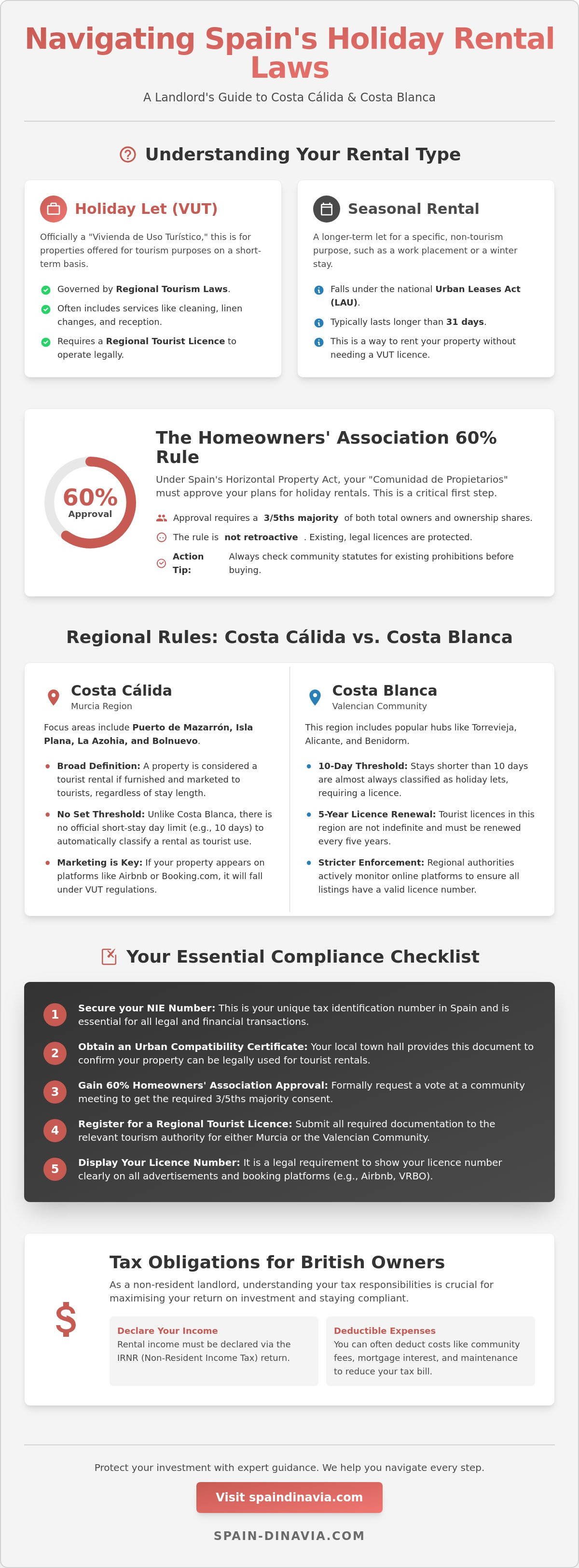
Essential Compliance Checklist for Spanish Landlords
Staying on the right side of the laws and regulations for renting out properties short term in Costa Calida requires a methodical approach. It's not just about finding the perfect villa in Bolnuevo or a flat in Puerto de Mazarrón; it's about ensuring every legal box is ticked to protect your investment. Following the correct sequence saves you from the stress of rejected applications or, worse, heavy fines. We've simplified the journey into five essential steps to help you move forward with confidence.
- Step 1: Identity and Habitation. You must have a valid NIE (Foreigner Identification Number) and ensure your property holds a current "Licencia de Ocupación" (Occupancy Licence) to prove it's fit for residents.
- Step 2: Urban Approval. Secure your Urban Compatibility Certificate from the local town hall in Mazarrón or your specific municipality in Costa Blanca to confirm tourist rentals are permitted in your exact location.
- Step 3: Tourism Registration. Register with the provincial "Registro de Turismo" to receive your unique VUT (Vivienda de Uso Turístico) number.
- Step 4: Police Connectivity. Set up your account with the Guardia Civil or National Police to report guest data. This is a non-negotiable national requirement.
- Step 5: Protection. Arrange specific public liability insurance that explicitly covers holiday guests, as standard home insurance usually won't suffice.
If you're looking to acquire a home that already meets these high standards, explore our curated selection of holiday rental properties today.
Guest Identification and Data Protection
Every guest over the age of 14 must be registered via a "Parte de Entrada" (Entry Form). According to Royal Decree 933/2021, you're legally bound to transmit this identification data to the Spanish authorities within 24 hours of their arrival. To make this manageable, many landlords in Isla Plana and La Azohia now use digital check-in tools that automate this reporting. Remember, you're also a data controller under GDPR rules. You must store guest details securely and only for the legally required period, ensuring your visitors' privacy is as protected as your property.
Health, Safety, and Equipment Standards
Your property must meet specific "tourist quality" standards to pass potential inspections. This includes having a visible first aid kit and a fire extinguisher that is serviced annually. You're also required to provide "Hojas de Reclamaciones" (official complaint forms) and a sign informing guests of their availability. Finally, don't forget your plaque. You must display the official regional symbol (such as the "VFT" or "VUT" sign) near the main entrance. This small detail is a major signal to authorities that you're a professional, compliant landlord who respects the local community.
Tax Obligations and Maximising Your Rental ROI
Mastering the financial side of your investment is the final step in achieving true peace of mind. Whilst the laws and regulations for renting out properties short term in Costa Calida focus heavily on licences and safety, your tax obligations are equally critical for a successful venture. In 2026, non-resident owners must navigate the Non-Resident Income Tax (IRNR), typically filed using Modelo 210. Whether your property is a sun-drenched apartment in Bolnuevo or a villa in Costa Blanca, understanding your specific tax bracket is essential for calculating your true return on investment. Accurate record-keeping is your best friend here.
Currently, most short-term rentals remain exempt from VAT provided you don't offer hotel-like services such as daily cleaning or breakfast. However, stay alert to a government proposal from May 2025 that suggests applying a 21% VAT to all tourist rentals. Keeping a close eye on these shifting laws and regulations for renting out properties short term in Costa Calida ensures you're never caught off guard by new fiscal requirements. For the 2025 tax year, remember that the deadline for filing your annual return is 20 January 2026.
Post-Brexit Tax Realities for UK Owners
For our British clients, the landscape changed significantly after Brexit. UK residents are now classed as non-EU/EEA residents. This means you're subject to a flat tax rate of 24% on your gross rental income. Unlike your neighbours from EU countries who pay a 19% rate on their net income, UK owners generally cannot deduct property-related expenses like mortgage interest, maintenance, or utility bills from their tax bill. This makes it even more important to have a robust occupancy strategy for your property in La Azohia or Isla Plana. Professional fiscal representation is highly recommended to ensure your quarterly filings are accurate and submitted on time.
Maximising Occupancy in Costa Cálida and Costa Blanca
Success in the 2026 market isn't just about the busy summer months. With over 320 days of sunshine each year, the Mazarrón area is a magnet for "winter sun" seekers looking for longer stays between October and March. This year-round appeal is where Spaindinavia’s rental management provides immense value, helping you balance short-term holiday peaks with steady seasonal occupancy. When choosing between a new build or a resale property, consider that new builds often command higher nightly rates due to modern energy efficiency and contemporary aesthetics. You can ensure your investment is secure with our expert buying guide to help you weigh up these options and navigate the market with total confidence.
Secure Your Future in the Spanish Sun
Navigating the laws and regulations for renting out properties short term in Costa Calida might feel like a complex puzzle, but with the right knowledge, it becomes a clear path to a rewarding lifestyle. You've seen how regional differences, such as the five-year renewal rule in Costa Blanca versus the stability in the Murcia region, can shape your long-term strategy. From securing that vital 60% community vote to managing your quarterly tax filings, every step you take brings you closer to a secure and profitable Mediterranean investment.
Since 2016, we've specialised in Puerto de Mazarrón and the surrounding gems of Isla Plana, Bolnuevo, and La Azohia. We provide the comprehensive management and legal support you need to handle the heavy lifting, ensuring you're always compliant with both Murcia and Valencia regional laws. Your dream of a stress-free rental property is within reach. Explore our hand-picked portfolio of rental-ready properties in Costa Cálida and take the first step toward your new chapter today. We're here to guide you every step of the way.
Frequently Asked Questions
Do I need a tourist licence to rent my property to friends and family?
No, you don't need a licence for purely private, non-commercial stays where no money changes hands. However, if you charge a fee or advertise the stay in any way, you must comply with the laws and regulations for renting out properties short term in Costa Calida. This applies regardless of whether the guests are relatives or close friends, as authorities view any paid stay as a commercial activity.
Can my Homeowners’ Association (HOA) ban short-term rentals if I already have a licence?
Generally, a homeowners' association cannot stop you from renting if you already held a valid licence before they voted to implement a ban. These new regulations are not retroactive, meaning your "acquired rights" are protected. Whilst the association in your Isla Plana or Bolnuevo community can vote to increase your fees by up to 20%, they cannot typically cancel an existing, legally obtained licence.
What are the fines for renting out a property without a licence in Murcia?
Fines for operating an unlicensed holiday rental in the Murcia region can be substantial, often starting at several thousand Euros for minor infractions. For serious or repeat offences, penalties can reach as high as €600,000. Given that platforms like Airbnb now verify registration numbers, it's essential to ensure your property in La Azohia or Puerto de Mazarrón is fully registered to avoid these heavy financial penalties.
How much does it cost to obtain a tourist rental licence in Costa Cálida?
The regional registration itself is currently free in the Murcia region, but you'll need to budget for the Urban Compatibility Certificate from your local town hall. These municipal fees vary depending on whether you're in the Mazarrón area or the Costa Blanca. You might also choose to hire a professional to handle the paperwork, which provides peace of mind that your application is correct from day one.
Do I have to pay tax in Spain on my rental income if I am a UK resident?
Yes, all UK residents must pay Non-Resident Income Tax (IRNR) on income earned from Spanish property. Following Brexit, British owners are taxed at a flat rate of 24% on their gross rental income. Unlike EU residents who might pay 19% on net income in the Costa Blanca, UK residents currently cannot deduct expenses like maintenance or utilities from their Spanish tax returns.
Is it mandatory to have a complaint book (Hojas de Reclamaciones) in my rental property?
Yes, it is a legal requirement to have official "Hojas de Reclamaciones" available for guests in every tourist rental. You must also display a clearly visible sign informing guests that these complaint forms are available on the premises. This rule is strictly enforced across both the Murcia and Valencia regions to ensure high standards of consumer protection for all visitors.
How long does the licensing process take in the Puerto de Mazarrón area?
You should typically allow between two to four months for the full licensing process in the Puerto de Mazarrón area. This includes the time needed to secure the Urban Compatibility Certificate from the town hall and the final regional registration. Whilst some areas in the Costa Blanca can experience longer delays due to high demand, the process in the Murcia region remains relatively efficient for new investors.
Can I rent out individual rooms in my villa or must it be the whole property?
In the Murcia region, a "Vivienda de Uso Turístico" licence is generally intended for the rental of the entire property as a single unit. If you're looking to rent out individual rooms whilst you live in the property, you may fall under different regulations for guest houses or bed and breakfasts. For most owners in Bolnuevo or Isla Plana, renting the whole property is the most straightforward path to compliance.


