

Could your neighbours actually vote to end your holiday rental income overnight? As we approach 2026, many owners in Puerto de Mazarrón and across the Mediterranean coast are asking this very question. Understanding the latest laws and regulations for renting out short term properties in Costa Blanca is no longer just a recommendation; it's essential for protecting your lifestyle investment. It's completely natural to feel a sense of unease when the rules change, especially when you've put so much love into your home in Isla Plana or La Azohia.
We know that tracking the regional differences between the Valencia region and the Costa Calida in the Murcia region can be confusing. This guide is designed to give you total peace of mind. You'll master the 2026 Spanish rental reforms to ensure your property in Bolnuevo remains legal, profitable, and protected from community disputes. We'll provide a clear roadmap to compliance and explain how a dedicated management partner can help you navigate the bureaucracy so you can simply enjoy the rewards of your investment.
Key Takeaways
- Identify whether your property falls under short-term or seasonal rules in both the Costa Blanca and the Costa Cálida to ensure correct registration.
- Navigate the updated laws and regulations for renting out short term properties in Costa Blanca, specifically the new mandatory five-year licence renewal cycle.
- Understand how the 3/5 majority rule allows your community of owners in Puerto de Mazarrón or Isla Plana to vote on your rental activity.
- Ensure you meet all habitability standards and guest registration deadlines to protect your rental business in Bolnuevo or La Azohia.
- Learn why professional local support is the most effective way to handle the increasing bureaucratic demands of the 2026 Spanish rental reforms.
Short-Term vs. Seasonal: Which Rental Category Do You Fall Under?
Deciding how to market your property starts with a simple question: how long do you want your guests to stay? The answer determines which legal framework you'll need to follow. Given the massive impact of Tourism in Spain on the local economy, regional governments have created specific categories to manage the flow of visitors. For property owners, this means choosing between a high-turnover tourist rental and a more stable seasonal let. It's the foundation of your business model and dictates your daily responsibilities.
The 11-Day Rule in Costa Blanca
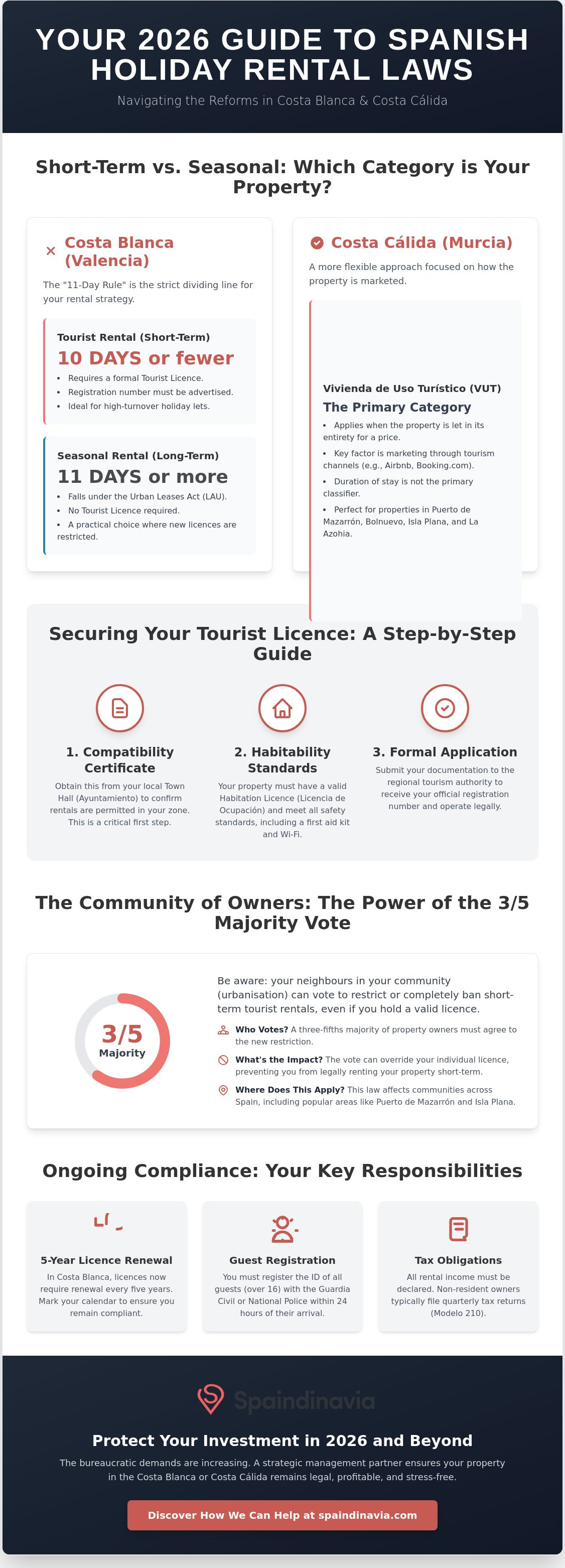
In the Valencian Community, the distinction is remarkably precise. If you rent out your apartment or villa for periods of 10 days or fewer, you are officially operating a tourist rental. The laws and regulations for renting out short term properties in Costa Blanca are strict about this threshold. Stays under 11 days require a formal tourist licence from the Generalitat Valenciana, and you'll need to display your registration number on platforms like Airbnb or Booking.com to avoid hefty fines. It's a system designed to ensure quality and safety for every visitor.
However, you might prefer a different approach. Stays exceeding 11 days fall under the Urban Leases Act (LAU) as "seasonal rentals". This is often a strategic choice for owners in areas where new licences are restricted. Whilst you lose the high nightly rates of short stays, you gain simplicity. Seasonal rentals don't require the same tourist licence, though you must still have a written contract that clearly states the stay is for leisure and not a permanent residence. It's a clever way to keep your home in the Costa Blanca productive whilst staying safely within the law.
The Costa Cálida Alternative
Just a short drive south, the Murcia region offers a slightly different landscape for property owners. If your heart is set on a resale villa in Bolnuevo or a townhouse in Isla Plana, you'll find the regional decree is often described as more flexible. Murcia doesn't use the same 11-day "Golden Line" as Valencia. Instead, it classifies properties as "Vivienda de Uso Turístico" (VUT) when they are let out in their entirety for a price, regardless of the duration, provided they are marketed through tourism channels.
Owners in Puerto de Mazarrón and La Azohia should be aware that "Viviendas Vacacionales" have their own distinct registration paths. This category is typically reserved for properties that don't quite fit the VUT criteria but still offer holiday accommodation. Whether you're looking at investments properties in the Costa Blanca or a quiet retreat in the Costa Cálida, identifying your category early is the best way to ensure your journey into the rental market is both legal and profitable.
Securing Your Tourist Licence: Requirements in Valencia and Murcia
Obtaining a tourist licence is the most significant step toward turning your property into a legal holiday home. While the process involves several layers of bureaucracy, it's designed to protect both you and your guests. Whether you've chosen a resale apartment in the Costa Blanca or a charming townhouse in Puerto de Mazarrón, the requirements are specific but manageable with the right guidance. It's a journey that ensures your investment is built on a solid legal foundation.
The Compatibility Certificate: The Ultimate Hurdle
Before you can even apply for a licence, you must obtain a Certificate of Urban Compatibility from your local Ayuntamiento (Town Hall). This document confirms that the land-use laws in your specific area allow for holiday rentals. It's a critical first step because some "saturated zones" in the Costa Blanca have implemented moratoriums, leading to immediate rejections for new applications. In the Mazarrón area, including Bolnuevo and Isla Plana, we still see a welcoming environment for new build villa licences, but checking the local urban plan remains essential. It's the Town Hall that holds the final say on the laws and regulations for renting out short term properties in Costa Blanca and the neighbouring Murcia region.
Property Standards and Inspections
Once compatibility is confirmed, your property must meet strict habitability standards. You'll need a valid Licencia de Ocupación (Habitation Licence) to prove the building is fit for use. Regional authorities also require a specific inventory of equipment. This includes modern essentials like Wi-Fi and air conditioning, alongside safety items like first aid kits and fire extinguishers. These standards contribute to your property's "Star Rating", which determines how you can market your home to potential guests. You should always be prepared for a potential inspection from regional tourism authorities, as they verify that every detail matches your application.
The regulatory environment is shifting with the introduction of the 2026 Digital Registry. This central Spanish database will track every booking in real-time, ensuring total transparency across the country. These updates are part of the broader Spanish Tourist Rental Regulations designed to maintain high standards across the industry. Finally, remember that compliance isn't just about paperwork. You must display an official plaque with your registration number outside the property and keep "Hojas de Reclamaciones" (official complaint forms) available for guests at all times. If you're feeling overwhelmed by the paperwork, looking at investment properties with a partner who understands the local nuances can make the entire journey much smoother.
The Community of Owners: Navigating the Three-Fifths Majority Rule
Organic Law 1/2025 has introduced a significant shift in how holiday homes are managed within residential complexes. It’s no longer enough to simply comply with the regional laws and regulations for renting out short term properties in Costa Blanca or the Murcia region. Now, your neighbours have a direct say in your business model. This change was designed to balance the needs of permanent residents with the vibrant tourism sector that defines life in places like Puerto de Mazarrón and Isla Plana. Trust is everything here.
The core of this new power is the "Three-Fifths Rule". In simple terms, a community of owners can now vote to prohibit or limit short-term rentals if three-fifths of the owners agree. These owners must also represent three-fifths of the community ownership quotas. It’s a double requirement that ensures a broad consensus. Additionally, communities are now legally permitted to increase maintenance fees by up to 20% for properties used as holiday lets. This surcharge helps cover the extra wear on communal pools and gardens. One vital detail is that these rules are generally non-retroactive. If you already have a licence, you’re usually protected. However, this protection often ends when the property is sold. The new owner might find themselves unable to rent if a ban was voted in previously.
Due Diligence for Buyers
If you're currently browsing resale apartments in Bolnuevo or La Azohia, checking the 'Estatutos de la Comunidad' is the most critical step you can take. Check the statutes. Your solicitor must verify if any active ban or restrictive vote is already in place. Buying into a "rental-friendly" urbanisation is the best way to protect your future income. In many cases, new build villas offer more security. Their initial statutes are often drafted with holiday letting in mind. Verifying this during the purchase process is non-negotiable.
Managing Neighbour Relations
The best way to prevent a restrictive vote is to be a model member of the community. Most disputes arise from noise, poor rubbish disposal, or unauthorised use of facilities. Implementing strict guest screening can prevent these issues before they start. It's also a legal requirement in many areas to display an emergency contact number for neighbours. By showing people in the Costa Blanca or Costa Cálida that you take their peace seriously, you build a foundation of security. Staying informed about the laws and regulations for renting out short term properties in Costa Blanca ensures your investment remains both legal and welcomed by those living alongside you.
Ongoing Compliance: Renewals, Digital Registries, and Tax Obligations
Maintaining your holiday home is about more than just fresh towels and a clean pool. Once you've secured your licence, the focus shifts to long-term compliance. The legal landscape in Spain is becoming increasingly integrated, with tourism data now frequently cross-referenced against tax records. Whether you own a bungalow in Puerto de Mazarrón or a resale apartment in the Costa Blanca, staying organised is the only way to protect your rental income. It's a continuous process that requires attention to detail and a proactive mindset.
One of the most significant changes involves the lifespan of your permit. The latest laws and regulations for renting out short term properties in Costa Blanca now mandate that licences expire every five years. This isn't an automatic renewal. You must actively prove that your property still meets the current 2026 standards. In the Murcia region, while the five-year expiry isn't currently applied in the same way, the introduction of the "Central Registry of Short-Term Rentals" in 2026 will bring both regions under a unified digital eye. This system is designed to ensure every booking is transparent and every owner is registered.
Daily operations also carry legal weight. You must report guest ID data to the Guardia Civil or National Police within 24 hours of their arrival. This applies to every guest over the age of 14, regardless of whether they are staying in a villa in Isla Plana or a townhouse in La Azohia. Failing to meet this window can result in significant fines. It's a task that demands a reliable system, especially if you aren't local to the property yourself.
The Renewal Process in 2026
Proactive filing is vital. You must submit your renewal application at least one month before your current licence expires. You'll need to provide updated documentation, including proof of insurance and a valid habitation certificate. Be aware that if a property hasn't been rented out for a significant period, authorities may choose not to renew the licence. They want to ensure that active tourist accommodation is available in popular areas like Bolnuevo. Check your dates. Missing the filing window by even a few days can lead to the automatic cancellation of your registration.
Tax Deductions for EU Residents
Tax for Non-Residents (IRNR) is a quarterly obligation that differs based on your residency status. EU residents currently pay a 19% tax on net rental income and can deduct various expenses. This includes mortgage interest, management fees, and general maintenance. However, following Brexit, UK residents are classified as Non-EU and face a higher 24% tax rate on gross income without the ability to claim these deductions. Regardless of where you live, you must keep formal "Facturas" (invoices) for every euro spent. This meticulous record-keeping is the only way to satisfy the tax office during an audit. If you're looking to expand your portfolio, browsing our latest holiday rental properties can help you find investments that balance these tax obligations with high yield potential.
Strategic Property Management: Protecting Your Investment in 2026
Managing a holiday home used to be a straightforward task of handing over keys and ensuring the pool was clean. Under the 2026 regulatory framework, the "Do It Yourself" approach is becoming nearly impossible for most owners. Between the 24-hour guest reporting window and the meticulous record-keeping required for the new digital registry, the administrative burden has grown significantly. Whether you own a resale apartment in the Costa Blanca or a bungalow in Puerto de Mazarrón, having a local partner is no longer a luxury; it's a necessity for survival.
A dedicated management partner provides more than just convenience. They act as your boots on the ground, handling immediate guest issues in La Azohia or Bolnuevo and ensuring that every booking complies with the laws and regulations for renting out short term properties in Costa Blanca and the Murcia region. This local presence is vital for maintaining good relations with your community of owners. When a professional team manages guest behaviour and handles police reporting, it reduces the risk of the community votes we discussed earlier. It's about protecting your investment through professional excellence.
Choosing the Right Property for Rentals
Success starts before you even sign the deeds. In the current climate, new build villas often represent a safer path than older resale apartments. This is because their community statutes are frequently designed with modern rental needs in mind, offering fewer restrictions. When we look at the data for 2026, rental yields in Isla Plana and La Azohia remain strong due to high demand for quality, legal accommodation. Whilst Torrevieja in the Costa Blanca offers high volume, the Murcia region often provides a more relaxed regulatory environment for new entries.
We often recommend an "Investment Shield" strategy. This involves prioritising properties that come with pre-verified licence compatibility or are located in areas with clear, stable urban plans. By selecting a property with a guaranteed path to a tourist licence, you remove the biggest variable in your business plan. It's the most effective way to ensure your capital is working for you from day one.
The Spaindinavia Advantage
We pride ourselves on being more than just property finders. We are bridge builders who organise the entire end-to-end process for our clients. Our hand-picked portfolio focuses on quality and long-term potential, ensuring that every home we represent is a place where we would be happy to stay ourselves. We work closely with independent solicitors to secure your transaction and verify that your property meets every requirement for its tourist licence. This holistic approach ensures that you can enjoy the Mediterranean lifestyle whilst we handle the complex bureaucracy. If you're ready to take the next step, speak to our team today about our Rental Management Services and discover how we can help you thrive in the 2026 rental market.
Secure Your Future Under the Sun
Success in the Mediterranean property market is about balancing your dream lifestyle with the practicalities of legal compliance. You now understand how the 11-day threshold in the Valencia region and the unique community voting rules in the Murcia region can shape your investment journey. Staying ahead of the laws and regulations for renting out short term properties in Costa Blanca is the most effective way to ensure your home in Puerto de Mazarrón or Isla Plana remains a source of joy rather than stress.
Thriving in 2026 depends on choosing the right property and a partner who truly knows the coast. Since 2016, we've served as local experts in the Mazarrón area, specialising in Bolnuevo and La Azohia whilst collaborating with trusted solicitors and banks to protect our clients. We take the weight of bureaucracy off your shoulders so you can focus on the rewards of ownership and the beauty of the Spanish coast.
Browse our rental-ready New Build Villas in Costa Cálida and Costa Blanca and let's start your journey today. Your Mediterranean dream is entirely within reach, and we're here to ensure it stays protected for years to come.
Frequently Asked Questions
Do I need a tourist licence if I only rent to friends and family?
You don't need a licence if you are hosting guests entirely for free. However, as soon as any payment is exchanged for the stay, the property is legally classified as a rental. This rule applies whether your home is in Isla Plana or the Costa Blanca. If you are charging "mates' rates" to cover costs, you still need to follow the laws and regulations for renting out short term properties in Costa Blanca or the Murcia region to remain legal.
Can the Community of Owners take away my existing tourist licence in 2026?
Existing licences are generally protected by non-retroactivity rules, meaning a community of owners cannot usually strip you of a licence you already hold. However, they can vote to prohibit future rentals or the transfer of licences to new owners. If you are buying a resale apartment in Bolnuevo, it's vital to check the community statutes first, as the rules for new owners can differ significantly from those for existing ones.
How much does it cost to apply for a tourist licence in the Murcia region?
The administrative fee for a tourist licence in the Murcia region is relatively low, typically under €100 for the government filing. However, you should also factor in the cost of obtaining a mandatory habitability certificate and potential architect fees. Whether you're registering a villa in La Azohia or a flat in the Costa Blanca, the total investment in compliance is small compared to the potential fines for operating without the correct registration.
What is the "11-day rule" for holiday rentals in Costa Blanca?
The 11-day rule is the threshold that defines a tourist rental in the Valencia region. Any stay shorter than 11 days requires a formal tourist licence and registration with the authorities. If your guests stay for 11 days or more, the stay is classified as a seasonal rental under the Urban Leases Act (LAU). This distinction is vital for owners in the Costa Blanca, whereas the Murcia region uses different criteria based on marketing channels and services provided.
Are there specific areas in Puerto de Mazarrón where licences are restricted?
There are currently no blanket bans on licences in Puerto de Mazarrón, but individual applications are subject to Town Hall approval. Every application requires a Certificate of Urban Compatibility to ensure the specific area or building isn't considered saturated. This local control is similar to the saturated zones seen in parts of the Costa Blanca. We always recommend checking with the local Ayuntamiento before committing to a purchase in Isla Plana or Bolnuevo.
What happens if I rent out my property without a licence in 2026?
Operating without a licence in 2026 carries severe financial risks, with fines often starting at €10,000 and reaching much higher for serious infractions. With the new central digital registry, authorities can easily cross-reference booking platforms with tax and tourism records. This increased surveillance makes it nearly impossible to hide unlicenced activity in the Costa Blanca or the Murcia region. Following the laws and regulations for renting out short term properties in Costa Blanca is the only way to protect your investment.
Do I have to pay tax in Spain if I already pay tax on rental income in the UK?
You must pay tax in Spain on any income generated from a Spanish property. Thanks to the Double Taxation Treaty between the UK and Spain, you won't pay tax on the same income twice. You'll typically pay your Spanish tax first and then claim this as a credit on your UK self-assessment. This process ensures you stay compliant in both jurisdictions, whether your property is in La Azohia or the Costa Blanca, protecting your long-term financial security.
How often do I need to renew my tourist licence in the Valencia region?
In the Valencia region, you must now renew your tourist licence every five years. This proactive renewal ensures that your property still meets the latest safety and quality standards set by the regional government. Failure to file your renewal at least one month before the expiry date could lead to the automatic loss of your licence. Owners in the Murcia region should also stay alert, as digital registry requirements are becoming more aligned across both Mediterranean coasts.


