

Did you know that in 2026, there are approximately seven potential buyers for every home currently on the Spanish market? Whilst this high demand is fantastic news for your sale price, the actual legal process for selling a house in spain can still feel like a daunting bureaucratic marathon. You’ve worked hard for your investment, so it’s only natural to feel a little anxious about hidden Plusvalía taxes or the complexities of the 3% non-resident retention.
We understand that you want a transition that's as smooth and sunny as a morning in Puerto de Mazarrón. Whether you're selling a resale villa in Bolnuevo, a townhouse in Isla Plana, or a property in La Azohia, our guide provides the clarity you need to move forward with confidence. From the Costa Calida to the Costa Blanca, we'll help you calculate your net proceeds and organise the exact documents required to ensure your Notary appointment is a moment of celebration rather than stress.
This comprehensive 2026 guide breaks down the latest Capital Gains tax rates and regional requirements in both Murcia and Valencia. We've simplified the essential steps to give you a secure, stress-free path to completion, allowing you to focus on your next big life decision with total peace of mind.
Key Takeaways
- Organise your mandatory documents early, including a fresh 'Nota Simple' from the Land Registry, to ensure your sale in the Costa Calida or Costa Blanca proceeds without delays.
- Navigate the legal process for selling a house in spain with confidence by understanding the transition from the initial reservation agreement to the binding 'Contrato de Arras'.
- Learn how to accurately calculate your net proceeds after the 2026 Capital Gains and Municipal Plusvalía taxes are applied to your property sale in the Murcia or Valencia regions.
- Discover exactly what happens during the Notary appointment to ensure a calm and secure completion for your villa in Bolnuevo or your apartment in Puerto de Mazarrón.
- Identify how professional support helps you bridge the gap between different legal cultures whilst managing the specific requirements of coastal areas like Isla Plana and La Azohia.
Preparing the Legal Paperwork and Mandatory Documents
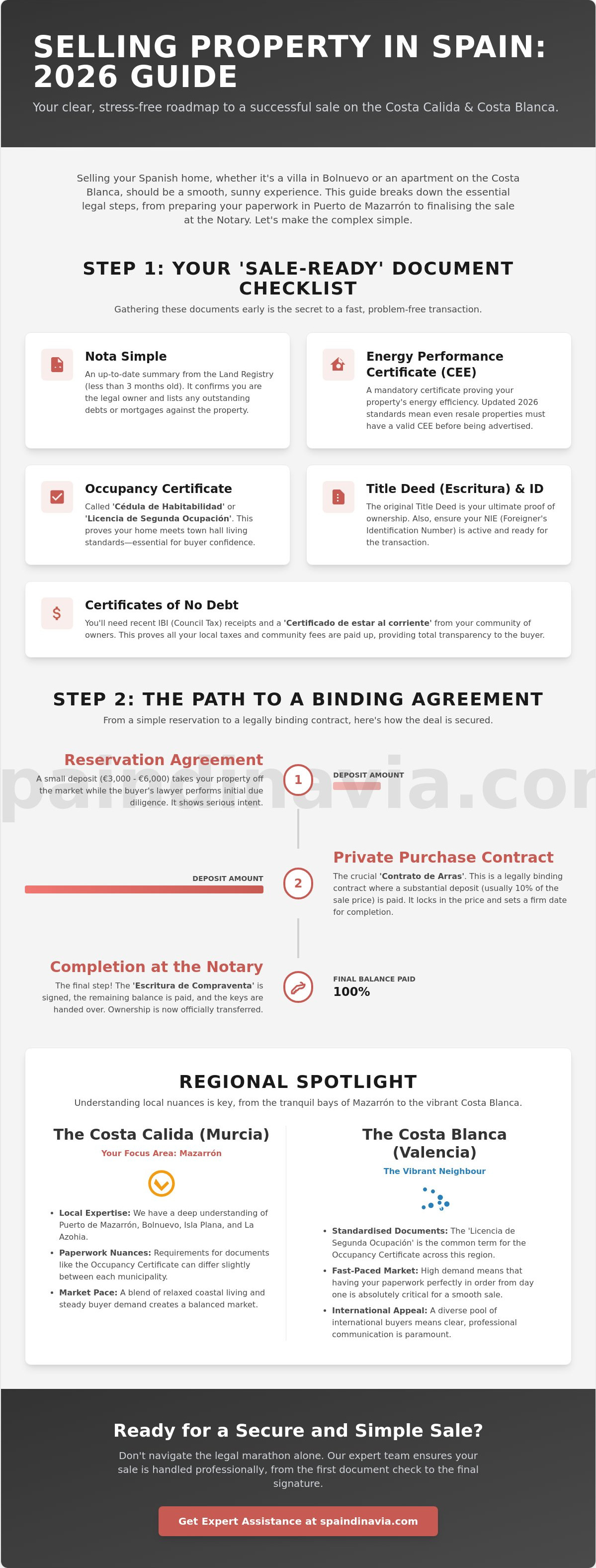
Gathering your paperwork early is the secret to a fast, stress-free sale. The legal process for selling a house in spain begins long before you welcome your first viewer. Having a "sale-ready" folder prevents the eleventh-hour panic that often derails transactions. Because the Spanish legal system relies heavily on administrative precision, any missing certificate can pause your progress for weeks. It's about creating a transparent environment where a buyer feels safe to commit.
Your most vital document is a fresh Nota Simple from the Land Registry. This summary confirms you're the rightful owner and highlights any outstanding mortgages or charges. In 2026, buyers and their solicitors expect this to be less than three months old. You'll also need a valid Energy Performance Certificate (CEE). New 2026 standards require even residential resale properties to meet updated efficiency ratings before they're advertised. Whether you're selling a resale villa in Bolnuevo or a townhouse in Isla Plana, these documents are non-negotiable for a legal listing.
The Cédula de Habitabilidad (Occupancy Certificate) is another essential piece of the puzzle. This document proves the property meets the town hall's living standards. In the Valencia region (Costa Blanca), this is frequently referred to as the 'Licencia de Segunda Ocupación', whilst in the Murcia region (Costa Calida), the requirements can vary slightly between municipalities. Proving your home is "legal" for habitation is a major hurdle cleared, especially for those looking to purchase investment properties for holiday rentals.
Ownership and Identity Verification
Your Escritura (Title Deed) serves as the ultimate proof of ownership. Whilst the modern digital registry has made verification faster, the physical deed remains a cornerstone of the legal process for selling a house in spain. Ensure your NIE (Foreigner Identification Number) is active; if it hasn't been used in years, it's wise to check its status with your legal representative. If you're selling a property in La Azohia that was inherited or is held in a company name, you'll need additional documentation to prove your legal right to sign the sale. These extra layers of verification protect both you and the buyer from future claims.
Certificates of Compliance and Debt
Transparency builds trust and speeds up the path to the Notary. You must provide IBI (Council Tax) receipts for the last four years to show your taxes are up to date. Additionally, you'll need a Certificado de estar al corriente from your community administrator. This confirms you've paid all community fees and that no major works are planned. If you've added a private pool to your bungalow in Puerto de Mazarrón or extended a terrace, ensure these structural alterations are declared and registered at the town hall before listing. Unregistered builds are a common deal-breaker during legal negotiations, so addressing them now ensures a smoother journey to completion.
The Contractual Stages: From Reservation to Arras
Once your documents are in order, the next phase of the legal process for selling a house in spain begins with the formal agreements. This transition from a verbal offer to a binding contract is designed to protect both parties, but it requires a clear head and a firm grasp of your obligations. In the bustling markets of Puerto de Mazarrón and across the Costa Blanca, things can move quickly. Understanding these steps ensures you don't feel rushed into a commitment you aren't ready for.
A reservation agreement is usually the first formal step. It involves a small deposit, typically between €3,000 and €6,000, to take your home off the market whilst the buyer's solicitor conducts initial checks. This is common practice across both the Costa Calida and the Costa Blanca. It signals intent without the heavy legal weight of the next stage. Following this, you'll move to the Contrato de Arras. This is the pivotal moment of the sale where a substantial deposit, usually 10% of the purchase price, is paid. This contract defines the final price, the deadline for completion, and the specific type of Arras you are using.
There are three main types of Arras contracts in Spain:
- Penitential Arras: The most common choice, allowing either party to withdraw at a cost.
- Confirmatory Arras: A binding commitment where neither party can easily withdraw; the deposit is simply the first payment of the price.
- Penalty Arras: Similar to penitential, but it allows the non-defaulting party to still demand completion of the sale through the courts.
The Power of the Penitential Arras
The Penitential Arras is a favourite amongst British sellers because it offers a clear, albeit costly, exit strategy. Under the "double deposit" rule, if the buyer pulls out, you keep their 10% deposit. However, if you decide not to sell, you must pay the buyer back double that amount. It's a significant risk that demands certainty before signing. When we help clients manage their exclusive portfolio of properties, we always emphasise the importance of setting a realistic completion timeline within this contract to avoid accidental defaults.
Navigating Due Diligence as a Seller
During the period between the Arras and the Notary appointment, the buyer's solicitor will perform due diligence. If you're selling a resale villa in Bolnuevo or a townhouse in Isla Plana, expect queries regarding utility debts or structural changes. Managing "snagging" requests or minor repairs now prevents friction on completion day. Always ensure a detailed inventory list is attached to the contract. Listing every appliance and piece of furniture included in the sale avoids disputes and ensures a harmonious handover in La Azohia or any of our beautiful coastal locations.
Calculating Taxes and Transaction Costs for Sellers in 2026
Understanding your net proceeds is often the most stressful part of the legal process for selling a house in spain. You've seen the headline sale price, but it's the figures that remain after taxes and costs that truly matter for your next chapter. In 2026, the Spanish tax system remains a two-tier structure consisting of Capital Gains Tax and the Municipal Plusvalía. Whether you're selling a penthouse in Puerto de Mazarrón or a bungalow on the Costa Blanca, getting these calculations right from the start prevents unwelcome surprises at the Notary's office.
The Municipal Plusvalía (IIVTNU) is a local tax based on the increase in the value of the land your property sits on. Following the 2021 regulations, you can still choose between two calculation methods to ensure you pay the lower amount. The "Objective Method" uses the cadastral value and a coefficient set by the town hall, whilst the "Real Gain Method" looks at your actual profit. If you're selling your home in Bolnuevo at a loss, you're exempt from paying this tax, though you must still file the declaration to prove the loss to the local authorities in the Murcia or Valencia regions.
You can legally reduce your tax liability by keeping a meticulous record of allowable deductions. These include:
- Estate agency fees (typically 3% to 6% of the sale price) plus the 21% VAT (IVA).
- Legal fees paid to your solicitor for managing the sale.
- Notary and Land Registry fees from when you originally purchased the property.
- Costs of structural renovations, provided you have official "facturas" (invoices) and the necessary building licences.
Capital Gains Tax (CGT) Explained
For 2026, Capital Gains Tax rates for residents are progressive, starting at 19% for the first €6,000 of profit and reaching 28% for gains over €300,000. If you're a non-resident from the EU, Iceland, or Norway, you'll pay a flat rate of 19%, whilst those from other countries are taxed at 24%. It's a significant cost, but there are vital lifelines. Residents over the age of 65 who sell their primary residence are generally exempt from CGT. Similarly, if you're under 65 and reinvest the proceeds into a new permanent home within two years, you may qualify for relief. This applies whether you're moving within the Costa Calida or relocating to the Costa Blanca.
The 3% Non-Resident Retention Mechanism
If you don't reside in Spain for tax purposes, the buyer is legally required to withhold 3% of the purchase price and pay it directly to the Spanish Tax Agency (Agencia Tributaria). This acts as a security deposit against your potential Capital Gains Tax. Once the legal process for selling a house in spain is complete, your representative will submit Form 211. If your actual tax bill is lower than the 3% retained, or if you've sold at a loss, you can claim a refund. Be aware that the tax office can take several months to process these refunds, especially for properties in popular areas like Isla Plana or La Azohia, so patience is essential.
Completion at the Notary and Finalising the Sale
The Notary appointment is the definitive climax of the legal process for selling a house in spain. It is here, in a quiet office in Puerto de Mazarrón or perhaps a bustling centre on the Costa Blanca, where the ownership of your property officially transfers. Unlike in the UK, the Spanish Notary is a public official who represents the law rather than either party. Their primary duty is to verify that the transaction complies with all regulations, ensuring that the identity of the signatories is correct and that the property is sold free of unexpected encumbrances.
Preparation for this day is vital. You'll need to bring all original documents, including your passport, NIE, and the latest utility bills. If you cannot be physically present for the signing, you can grant a Power of Attorney (POA) to your solicitor. This is a common and secure way for international sellers to finalise a deal without the need for travel. Once the Notary is satisfied, the Escritura de Compraventa (Public Deed of Sale) is signed by both parties, banker's drafts are exchanged, and the keys are handed over. It is a moment of significant relief and celebration.
Our expertise ensures your home is positioned perfectly amongst our portfolio of resale apartments and villas, helping you reach this final stage with total confidence.
The Notary Appointment Walkthrough
The atmosphere at the Notary is formal but generally relaxed. The official will read the deed aloud, often in Spanish, which is why having a professional translator or a bilingual solicitor is essential. They will confirm the final payment amounts and verify that any outstanding debts, such as a mortgage, are being settled from the proceeds. Notary fees are regulated by a sliding scale, typically ranging between €600 and €875 for a standard sale. Once the signatures are dry, you'll receive a Copia Simple, which is an unofficial copy of the new deed for your records.
Post-Completion Responsibilities
Your work isn't quite finished when you leave the Notary's office. You must ensure your mortgage is formally cancelled at the Land Registry, a process that can cost around €400 if managed independently or more if handled by your bank. You also have exactly 30 days to pay the Municipal Plusvalía tax at the local town hall. Whether your property is a townhouse in Isla Plana or a bungalow in La Azohia, notifying the community of owners about the change in ownership is a crucial final step. We also recommend taking final meter readings for water and electricity on the day of completion to ensure a clean break from all utility contracts.
How Professional Support Simplifies the Selling Process
The legal process for selling a house in spain involves many moving parts, and trying to manage them alone can be overwhelming. Whilst the steps we've covered are logical, the administrative reality often requires a local touch. An independent solicitor acts as your shield against bureaucracy, ensuring that every document is filed correctly and every deadline is met. They provide the business-like seriousness needed for a secure transaction, whilst a dedicated property partner offers the personal warmth that makes the journey enjoyable.
Choosing a partner with a hand-picked portfolio and a proactive marketing strategy is vital. It isn't just about listing a property; it's about finding the right buyer who appreciates the lifestyle of the Costa Cálida or the Costa Blanca. By bridging the gap between international sellers and local authorities, professional support ensures you don't get lost in translation. Whether you're selling a resale apartment in Puerto de Mazarrón or a luxury villa in Bolnuevo, having experts who care about your whole journey creates a sense of safety that is truly priceless.
The Spaindinavia Approach to Secure Transactions
We believe in a collaborative approach, working closely with local legal experts and banks to create a seamless experience for our clients. Our commitment to transparency means you'll always have a clear understanding of your net proceeds and the status of your sale. We treat every transaction with the highest level of security, ensuring your Spain property investment concludes with the positive outcome you deserve. This focus on detail allows you to relax, knowing that the technicalities are being handled by passionate professionals.
Expert Guidance Across Coastal Regions
Our 'bridge-building' philosophy is designed to create trust for international clients who may not be familiar with the regional nuances of the legal process for selling a house in spain. We provide specialised support across both the Costa Cálida and the Costa Blanca, acknowledging the distinct differences in local regulations between the Murcia and Valencia regions. From the tranquil shores of Isla Plana and La Azohia to the vibrant communities of the Valencian coast, we're here to guide you. If you're ready to move forward, we invite you to request a consultation to organise your sale with confidence and clarity.
Step Into Your Next Chapter with Confidence
Selling your home is more than a transaction; it's the start of a new adventure. By preparing your documentation early and understanding your 2026 tax obligations, you've already cleared the biggest hurdles. Whether you're parting with a villa in Bolnuevo or an apartment in Puerto de Mazarrón, mastering the legal process for selling a house in spain ensures you remain in control from the first viewing to the final signature at the Notary.
We believe that your journey should be defined by excitement rather than administrative stress. Our team acts as a bridge between the Costa Cálida and the Costa Blanca, offering expert support that combines local knowledge with a personal touch. Through our close collaborations with independent solicitors and banks, we provide a hand-holding service that secures your interests at every turn.
Let Spaindinavia guide you through a secure and stress-free sale. We're here to ensure your transition is smooth, transparent, and perfectly aligned with your future goals. Reach out today and let's begin this journey together.
Frequently Asked Questions
Do I need to be in Spain to sell my house?
No, you don't need to be physically present in Spain to complete your sale. You can grant Power of Attorney (POA) to a trusted legal representative who can sign the public deed on your behalf at the Notary. This is a very common choice for our international clients selling resale villas in Bolnuevo or townhouses in Isla Plana, as it allows the sale to proceed whilst you remain comfortably in your home country.
How much are the total legal fees when selling a property in Spain?
Total costs depend on your specific situation, but they always include regulated Notary fees, Land Registry fees, and your solicitor's charges. Notary fees for the public deed of sale generally fall between €600 and €875. You should also account for real estate agent commissions, which typically range from 3% to 6% of the sale price plus 21% VAT, alongside any costs for mandatory certificates like the CEE.
What is the 3% retention for non-residents and can I get it back?
The 3% retention is a mandatory withholding from the purchase price that the buyer pays directly to the Spanish Tax Agency on your behalf. It acts as a security deposit against your Capital Gains Tax liability. If your actual tax bill is lower than the amount retained, or if you've sold your property in La Azohia at a loss, your solicitor can apply for a refund once the transaction is finalised.
How long does the legal process for selling a house in Spain typically take?
The legal process for selling a house in spain typically takes between four and eight weeks from the moment you sign the Arras contract to the final completion. This timeline depends heavily on how quickly your paperwork is organised. Having your certificates ready in advance ensures that your sale in the Murcia or Valencia regions proceeds without unnecessary administrative delays or missed deadlines.
What is Plusvalía and who is responsible for paying it?
Plusvalía is a local municipal tax based on the increase in the value of the land during your period of ownership, and the seller is legally responsible for paying it. You must settle this tax at the local town hall within 30 days of the Notary appointment. Whether you are in the Costa Calida or the Costa Blanca, you can choose between two different calculation methods to ensure you pay the lower amount.
Is it mandatory to hire a solicitor when selling my Spanish home?
Whilst hiring a solicitor isn't a legal requirement in Spain, it is highly recommended to ensure a secure transaction. A solicitor acts as your expert guide, navigating the regional differences between the Murcia and Valencia regions and protecting you from hidden tax traps. They manage the complex legal process for selling a house in spain, providing peace of mind that every detail is handled with professional precision.
What happens if the buyer finds a legal issue during due diligence?
If the buyer's solicitor identifies a legal issue, such as an unregistered terrace or an outstanding debt, it must usually be resolved before completion. Depending on your Arras agreement, you may need to carry out repairs or offer a price reduction to keep the sale on track. Proactively organising your paperwork for your home in Puerto de Mazarrón helps you identify and fix these issues before they become deal-breakers.
Can I sell my property if I still have an outstanding Spanish mortgage?
Yes, you can sell your property even if you have an outstanding mortgage. Your bank will provide a certificate of the remaining debt, and the mortgage is officially cancelled at the Notary's office on the day of completion. The buyer will typically issue two separate banker's drafts: one to your bank to clear the loan and another to you for the remaining balance of the sale proceeds.


