

What if the difference between a flourishing 5.4% rental yield and an unexpected financial burden was simply knowing which side of a regional border your new villa sits on? You've likely spent hours admiring sun-drenched terraces in Puerto de Mazarrón or Isla Plana, only to feel a pang of anxiety when the conversation turns to Spanish fiscal obligations. It's completely natural to feel confused by regional differences or worried about non-resident obligations whilst planning your move. Understanding property taxes for spanish real estate investors doesn't have to be a source of stress; instead, it's the key to securing your future under the sun.
We're here to help you master these complexities so you can invest with absolute confidence and maximise your returns across both the Costa Cálida and the Costa Blanca. You'll gain a crystal-clear budget for purchase costs and a practical understanding of annual running expenses for properties in La Azohia and Bolnuevo. This 2026 guide breaks down everything from regional ITP rates in Murcia to the specific rules in the Valencian Community, providing the roadmap you need for a tax-efficient investment that protects your lifestyle and your capital.
Key Takeaways
- Learn how to budget accurately for your purchase by distinguishing between VAT on new build villas and ITP on resale apartments across the Costa Blanca and Costa Cálida.
- Discover why the "Cadastral Value" is the foundation of your annual tax planning and how it impacts your yearly municipal fees in areas like Puerto de Mazarrón and Bolnuevo.
- Gain a competitive edge by understanding property taxes for spanish real estate investors to identify legal deductions that can significantly boost your net rental yields.
- Compare regional tax variations to see how choosing a home in Isla Plana or La Azohia instead of the Valencian Community could save you thousands in initial costs.
- Identify the three essential professionals you need on your team to ensure your investment remains secure, compliant, and fully optimised for the long term.
Initial Purchase Taxes: Budgeting for Your Spanish Investment
Budgeting for your dream home in Puerto de Mazarrón or Isla Plana starts with a clear view of the initial tax landscape. Whilst the process might seem complex at first, understanding property taxes for spanish real estate investors is actually quite logical once you separate new builds from resale properties. For a broader context, you might find this overview of taxation in Spain helpful as a starting point for your research. Your choice between a brand-new villa and a charming resale apartment will determine which tax you pay, and your choice of region will decide the final percentage.
VAT and Stamp Duty on New Build Villas
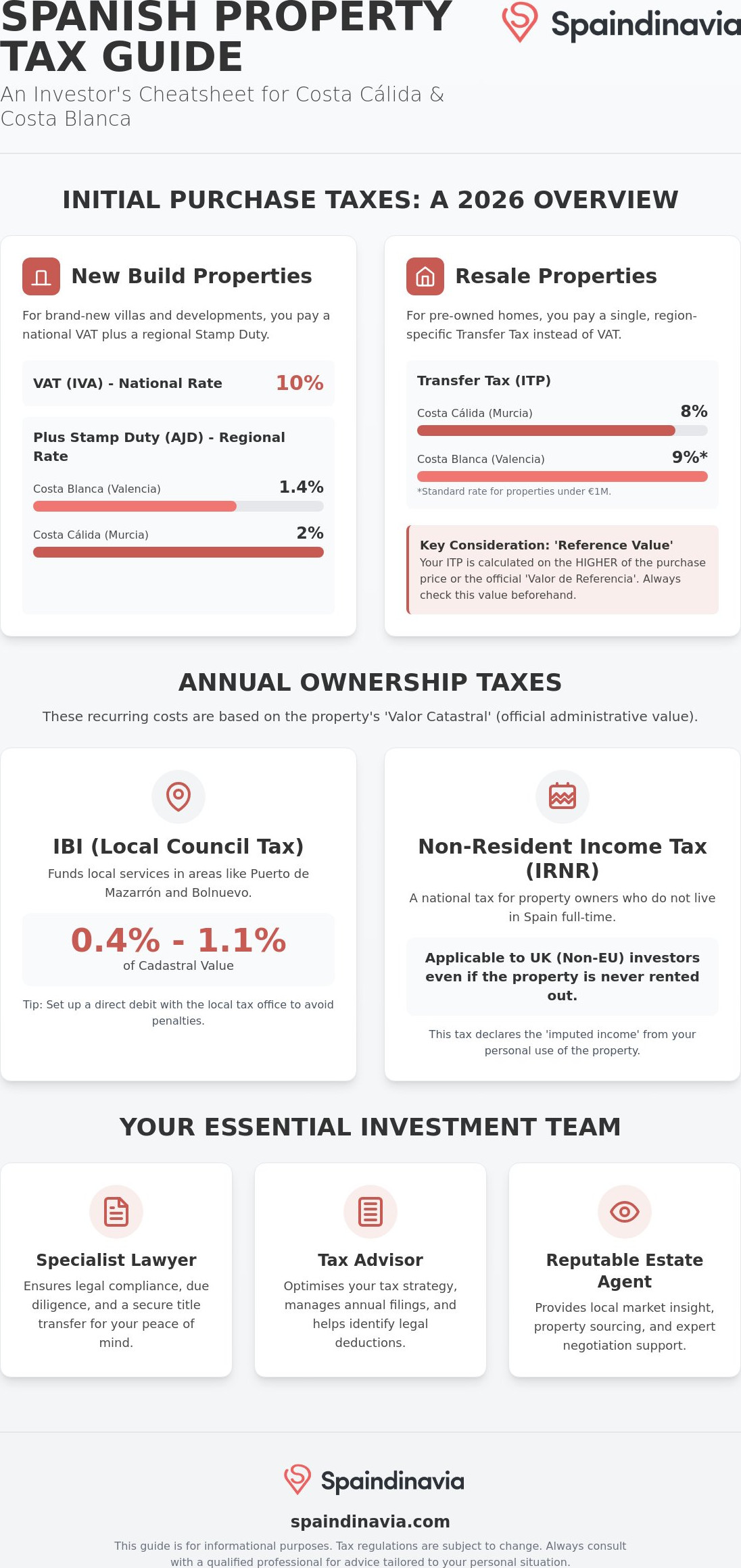
If you're eyeing a sleek, modern villa in Bolnuevo or a frontline development in La Azohia, you'll be dealing with VAT (IVA). This is a national tax, so it doesn't matter if you buy in the Murcia region or the Valencian Community; the rate remains a consistent 10%. This fixed rate provides a level of predictability for your initial calculations. However, the regional difference appears in the Stamp Duty, known locally as AJD (Actos Jurídicos Documentados). This tax is paid in addition to VAT and covers the legal recording of the property's title deeds.
In the Costa Cálida, AJD is currently set at 2%. In contrast, the Costa Blanca (Valencian Community) offers a slightly lower rate of 1.4% as of June 2026. These amounts are calculated based on the price stated in the escritura (title deed). You'll typically need to settle these obligations within 30 days of signing at the notary. It's a quick turnaround, so having your funds organised in advance is essential for a smooth transaction.
Transfer Tax (ITP) for Resale Properties
Choosing a resale apartment or a traditional townhouse changes the tax calculation entirely. Instead of VAT, you'll pay Transfer Tax (Impuesto sobre Transmisiones Patrimoniales, or ITP). This is where your choice of location significantly impacts your budget. The Murcia region currently offers a flat ITP rate of 8%, making it an attractive option for those looking at investment properties in the Mazarrón area. Meanwhile, the Costa Blanca applies a standard rate of 9%, which rises to 11% for properties valued over €1 million.
One critical detail for 2026 is the "Reference Value" (Valor de Referencia). The tax office now calculates your ITP based on whichever is higher: your actual purchase price or the official value assigned by the Cadastre. Don't be tempted to under-declare your purchase price to save on taxes. This is a common pitfall that almost certainly triggers an audit and heavy fines. We always recommend checking the Reference Value before you sign any contracts to ensure your budget is realistic and your investment remains secure.
Annual Ownership Taxes: What to Expect Every Year
Once you've collected the keys to your new home in Bolnuevo or Isla Plana, your focus shifts from one-off purchase costs to the annual rhythm of Spanish taxation. Understanding property taxes for spanish real estate investors means recognising that you'll deal with two distinct authorities: your local Town Hall (Ayuntamiento) and the national tax agency (Agencia Tributaria). The foundation of these payments is the Valor Catastral, or cadastral value. This is the official administrative value of your property, which is usually significantly lower than the market price. It's the most important figure for your tax advisor, as almost every annual fee is calculated as a percentage of this number.
IBI: The Local Council Tax Explained
IBI (Impuesto sobre Bienes Inmuebles) is the Spanish equivalent of council tax. It funds everything from the well-maintained promenades in Puerto de Mazarrón to the street lighting in La Azohia. In both the Costa Cálida and the Costa Blanca, rates typically range from 0.4% to 1.1% of the cadastral value. Missing the payment deadline, which usually falls between September and November, results in immediate surcharges. We always recommend setting up a direct debit through the local tax office, such as Suma in the Valencian Community or the regional tax agency in Murcia, to ensure you never miss a date whilst you're back in the UK.
Non-Resident Income Tax (IRNR) for UK Investors
For British investors, post-Brexit rules mean you're now classified as non-EU residents. This affects your IRNR (Impuesto sobre la Renta de no Residentes). Even if you don't rent out your property, the Spanish government assumes you derive a benefit from owning it. This is known as "imputed income tax." You're taxed at 24% on a small percentage, usually 1.1% or 2%, of the cadastral value. Whilst headlines regarding a proposed 100% tax for non-EU buyers have caused some anxiety, it remains a proposal that has not been enacted as of July 2026. Current laws provide a stable, predictable framework for your financial planning.
If you choose to operate your property as a rental investment, the tax structure changes. You'll move from imputed tax to taxing the actual rental income received. As a non-EU resident, you're currently taxed at 24% on the gross income without the ability to deduct expenses like community fees or repairs. This makes choosing a high-yield location even more critical. If you're still searching for the right opportunity, exploring our latest investment properties in the Mazarrón area can help you find a home that balances these costs with strong potential returns.
Regional Variations: Costa Cálida vs. Costa Blanca
Choosing between the Costa Cálida and the Costa Blanca is often a matter of personal preference, but for the savvy buyer, it's also a calculation of regional incentives. Whilst Spain's national laws provide a general framework, each autonomous community has the power to set its own rates for Transfer Tax (ITP) and wealth tax. This means that two identical properties separated by just a short drive across the regional border can carry vastly different price tags once taxes are settled. Understanding property taxes for spanish real estate investors requires looking at the total cost of ownership over ten years, not just the first day.
Investing in the Costa Cálida and Murcia Region
In the Murcia region, which encompasses our favourite coastal spots like Bolnuevo and Puerto de Mazarrón, the tax landscape is particularly welcoming. The standard ITP rate for resale properties is a flat 8%. This is one of the most competitive rates in Spain, especially when compared to the tiered systems found in other coastal areas. For instance, a €300,000 resale apartment in Puerto de Mazarrón would typically incur an ITP bill of €24,000.
For those looking at long-term capital growth in tranquil areas like Isla Plana or La Azohia, this lower entry cost allows you to keep more of your capital for property improvements. There are also specific reductions available; for example, large families or buyers under 35 may qualify for even lower rates if the property becomes their permanent home. This makes the Mazarrón area not just a lifestyle choice, but a strategically sound financial move for those looking to keep initial costs manageable.
The Costa Blanca Perspective: Valencia Region Taxes
Crossing into the Valencian Community and the Costa Blanca, the standard ITP rate increases to 9% for most purchases as of June 2026. If you're investing in a luxury villa valued over €1 million, this rate climbs further to 11%. Using that same €300,000 example, your tax bill would rise to €27,000. Whilst €3,000 might not seem like a deal-breaker, it's a significant sum that could otherwise cover your first few years of local council taxes and community fees.
However, the Costa Blanca offers its own set of advantages regarding annual ownership. The wealth tax (Patrimonio) exemption in the Valencian Community is currently set at a generous €1 million per person as of 2026. This high threshold protects the majority of investors from additional annual levies on their global assets. Whether you prefer the rugged beauty of the Mazarrón coastline or the bustling energy of the Costa Blanca South, knowing these regional nuances ensures your investment strategy is built on solid ground from the very beginning.
Maximising ROI: Tax Deductions and Rental Income
Transforming your sun-drenched villa in Bolnuevo or Puerto de Mazarrón into a thriving business requires a shift in perspective. You're no longer just a homeowner; you're a manager of a Mediterranean asset. Understanding property taxes for spanish real estate investors is just as much about what you can eventually claim back as what you pay out each quarter. Whilst the rules changed significantly following the UK's departure from the EU, a structured approach to your finances ensures your rental yields remain healthy and your investment stays protected.
The most critical distinction to grasp is how your residency status affects your tax base. EU and EEA residents are currently taxed at 19% on their net rental income, meaning they can deduct most property-related expenses. However, as a British investor, you're currently taxed at 24% on the gross rental income. This means you cannot deduct day-to-day running costs from your quarterly tax returns. Whilst this sounds daunting, it makes selecting high-demand locations like Isla Plana or La Azohia even more vital, as the strong rental demand in these areas helps absorb the higher tax obligation.
Allowable Expenses for Property Investors
Even if you cannot deduct expenses from your quarterly rental income tax as a non-EU resident, you must keep every single receipt. These costs are essential for understanding property taxes for spanish real estate investors because they can be used to offset your Capital Gains Tax when you eventually decide to sell. Keep a meticulous log of the following:
- Notary and Land Registry fees paid during the initial purchase.
- Legal fees and professional expenses related to the acquisition.
- Significant home improvements, such as adding a private pool or modernising a kitchen in a resale apartment.
- Property management fees and marketing costs used to secure tenants.
- Local taxes like IBI and community fees paid throughout your ownership.
If you're looking to start your journey with a property primed for the market, browsing our selection of holiday rental properties is the first step toward building a profitable and tax-efficient portfolio.
Capital Gains and Wealth Tax Considerations
Planning your exit strategy is just as important as the purchase itself. When you sell your property in the Costa Blanca or Costa Cálida, you'll be subject to Capital Gains Tax (CGT). For non-EU residents, this is a flat rate of 24% on the profit. By adding your initial purchase taxes and subsequent property improvements to your original purchase price, you can significantly reduce the "profit" on paper, thereby lowering your final tax bill.
Wealth tax is another factor to keep on your radar. In 2026, the Valencian Community maintains a generous €1 million exemption, whilst the Murcia region also offers high thresholds that protect the majority of individual investors. If your total Spanish assets exceed €3 million, you may also need to consider the national Solidarity Tax. Staying informed about these figures ensures your global assets remain secure whilst you enjoy the lifestyle benefits of the Mazarrón coast.
Navigating the Process: Professional Support for Secure Investment
Taking the leap into the Spanish property market is an exhilarating journey, but it's one you shouldn't walk alone. Whilst we've covered the rates and regulations, understanding property taxes for spanish real estate investors is ultimately about implementation. Navigating the administrative path between the Costa Cálida and the Costa Blanca requires a dedicated team that understands both the national framework and the local nuances of town halls in places like Puerto de Mazarrón or Bolnuevo. By surrounding yourself with experts, you transform a complex legal process into a secure, well-managed transition to your new lifestyle.
The foundation of a safe purchase rests on an essential trio: your real estate agent, an independent solicitor, and a fiscal representative. For British investors, independent legal advice is non-negotiable. Your solicitor's role is to ensure the property is free of debts and that the "Reference Value" we discussed earlier aligns with your expectations. Meanwhile, a fiscal representative acts as your ongoing bridge to the Spanish tax authorities, ensuring your non-resident filings are accurate and timely. For those managing a broader international portfolio, resources such as cidatax.it can provide guidance on cross-border regulatory compliance. One actionable tip we always give our clients: request a full tax simulation before you sign a reservation contract. This document provides a line-by-line breakdown of every cost, from notary fees to regional ITP, so there are never any surprises at the finish line.
Securing Your Transaction with Local Experts
Local knowledge is your best defence against administrative errors. In the Mazarrón area, specifically within the charming pockets of Isla Plana and La Azohia, local experts understand the specific municipal requirements that might differ from the Costa Blanca North. We help you organise the essential building blocks of your investment, such as obtaining your NIE number (tax identification) and opening the correct type of Spanish bank account. To better manage these international finances, many modern fintech solutions leverage Wealthreader to provide secure banking aggregation. Having these correctly linked for your IBI and utility direct debits is the simplest way to maintain a stress-free investment whilst you are back in the UK.
Your Next Steps with Spaindinavia
At Spaindinavia, we pride ourselves on being more than just a bridge between cultures; we're your partners throughout the entire journey. Whether you're interested in our sleek new build villas or our hand-picked resale apartments, we ensure every step is handled with professional integrity and personal warmth. Our commitment doesn't end at the notary's office. Many of our clients utilise our rental management services to help finance their investment, turning their holiday home into a self-sustaining asset.
Ready to secure your future under the Mediterranean sun? Browse our latest portfolio of investment properties across the Murcia and Valencia regions today. We invite you to book a personal consultation to discuss your 2026 investment goals, where we can provide the clarity and confidence you need to make your Spanish dream a reality.
Secure Your Mediterranean Future with Confidence
Mastering the fiscal landscape is the final piece of the puzzle in your journey toward owning a piece of paradise. Whether you've set your sights on a coastal retreat in Bolnuevo or a high-yield investment in the Costa Blanca, the clarity you've gained today ensures your capital is protected. By distinguishing between regional ITP rates and planning for annual non-resident obligations, you're no longer just dreaming; you're strategising for success. Understanding property taxes for spanish real estate investors is the foundation upon which a secure and profitable portfolio is built.
Since 2016, we've acted as specialists across the Costa Cálida and Costa Blanca, providing comprehensive support that spans from your initial NIE application to professional property management. We collaborate strictly with independent solicitors to guarantee that every transaction in Puerto de Mazarrón, Isla Plana, or La Azohia is 100% secure and transparent. Your transition to a warmer climate should be filled with excitement rather than administrative worry. Explore our exclusive New Build Villas and start your Spanish investment journey today. We're ready to guide you home.
Frequently Asked Questions
Do I have to pay taxes in both the UK and Spain on my rental income?
You are required to declare your rental income in both countries, but you won't be taxed twice on the same profit. Spain and the UK maintain a long-standing double taxation treaty. This means you pay your Spanish tax first and then claim that amount as a credit against your UK tax bill. Whether your property is in Bolnuevo or the Costa Blanca, keeping accurate records of your Spanish tax payments is essential for your HMRC filings.
What is the difference between IBI and IRNR in Spain?
IBI is a local municipal tax equivalent to council tax, whilst IRNR is a national income tax for non-resident owners. IBI funds local services in Puerto de Mazarrón or Isla Plana and is paid to the Town Hall annually. IRNR is paid to the central government and applies even if you don't rent out the property. Understanding property taxes for spanish real estate investors involves managing these two distinct obligations to ensure your investment remains fully compliant.
How much should I allow for total closing costs when buying in Murcia?
You should allow between 10% and 12% of the purchase price for total closing costs in the Murcia region. This budget covers the 8% Transfer Tax (ITP) for resale homes, along with notary fees, land registry charges, and legal expenses. In the Costa Blanca, these costs are slightly higher because the standard ITP rate is 9%. Having these funds ready ensures a smooth completion for your new home in La Azohia or Puerto de Mazarrón.
Can I deduct my travel expenses to Spain from my rental income tax?
No, as a British resident, you cannot currently deduct travel expenses or any other running costs from your Spanish rental income tax. Post-Brexit rules classify UK investors as non-EU residents, who are taxed at 24% on the gross rental income. This differs from EU residents who pay 19% on the net income. This makes choosing high-demand areas like Isla Plana or Bolnuevo vital, as strong rental yields help to balance these higher tax obligations.
What happens if I forget to pay my non-resident property tax?
Forgetting to pay your non-resident tax results in automatic surcharges and interest being added to the original amount. The Spanish tax system is highly digitalised in 2026, and consistent non-payment can eventually lead to an embargo on your Spanish bank account. We always recommend that investors in the Costa Cálida or Costa Blanca use a fiscal representative to manage these filings. This simple step prevents administrative errors and protects your long-term investment.
Is the Spanish Wealth Tax applicable to all foreign investors?
Wealth Tax is only applicable if your net Spanish assets exceed the generous regional thresholds. In the Valencian Community (Costa Blanca), the individual exemption is currently €1 million as of 2026. The Murcia region also offers high thresholds that protect the majority of individual buyers in Puerto de Mazarrón and Isla Plana. Because it's a personal tax, couples who buy a property in joint names effectively double their available tax-free allowance.
Does the 2026 tax law offer any incentives for new build properties?
The 2026 framework offers specific incentives for new build properties, particularly those with high energy efficiency ratings. Whilst VAT remains at a fixed 10% across both the Costa Blanca and Costa Cálida, many modern villas in La Azohia qualify for local tax reductions. These incentives are a key part of understanding property taxes for spanish real estate investors, as they can significantly lower your annual running costs over the first few years of ownership.
How do I calculate the Plusvalía tax when I eventually sell my property?
Plusvalía is calculated based on the increase in the value of the land from the day you bought it to the day you sell. You can choose between two calculation methods: the objective system based on cadastral values or the real profit system. Your solicitor will help you determine which method results in a lower bill for your property in Bolnuevo or the Costa Blanca. It's a local tax paid to the Town Hall within 30 days of the sale.


