
Did you know that in 2024 alone, there were over 16,400 reported incidents of illegal occupation in Spain? It's a sobering thought for anyone who has invested in a holiday home, especially as the national crime index has climbed to 37.6 in 2026. We understand that your property in the sun is more than just bricks and mortar; it's a hard-earned lifestyle choice that deserves complete protection. Whether you own a modern apartment in the Costa Blanca or a coastal villa in the Costa Calida, specifically around the sun-drenched areas of Bolnuevo or Isla Plana, the distance shouldn't dampen your peace of mind. Keeping your spanish property safe while away is about more than just a sturdy lock; it's about staying informed and being proactive.
We agree that the fear of 'okupas' or undetected maintenance issues can cast a shadow over your time back home. That's why we've created this guide to ensure your investment remains a source of joy rather than stress. You'll discover the most effective strategies to shield your home from intruders and learn how the latest legal changes, like the 2025 "express eviction" process, work in your favour. We'll walk you through the essential 'Triple Lock' approach, combining physical barriers with smart AI monitoring and a trusted local presence. From the vibrant Puerto de Mazarrón to the tranquil shores of La Azohia, we'll help you create a secure, lock-up-and-leave environment for the year ahead.
Key Takeaways
- Master the distinction between opportunistic burglary and squatting to better protect your investment in the Costa Blanca or the Mazarrón area of the Costa Calida.
- Learn how to organise your digital deeds and utility bills to take full advantage of the latest 2025 "express eviction" legal reforms.
- Discover the most effective strategies for keeping your spanish property safe while away by creating a convincing and modern 'lived-in' illusion.
- Understand why professional property management in Bolnuevo or across the Costa Blanca is the gold standard for providing the 48-hour evidence police require.
- Evaluate the balance between DIY smart technology and professional monitoring to find a bespoke security plan for your Spanish villa or apartment.
The Reality of Property Security in Spain: Burglary vs Squatting
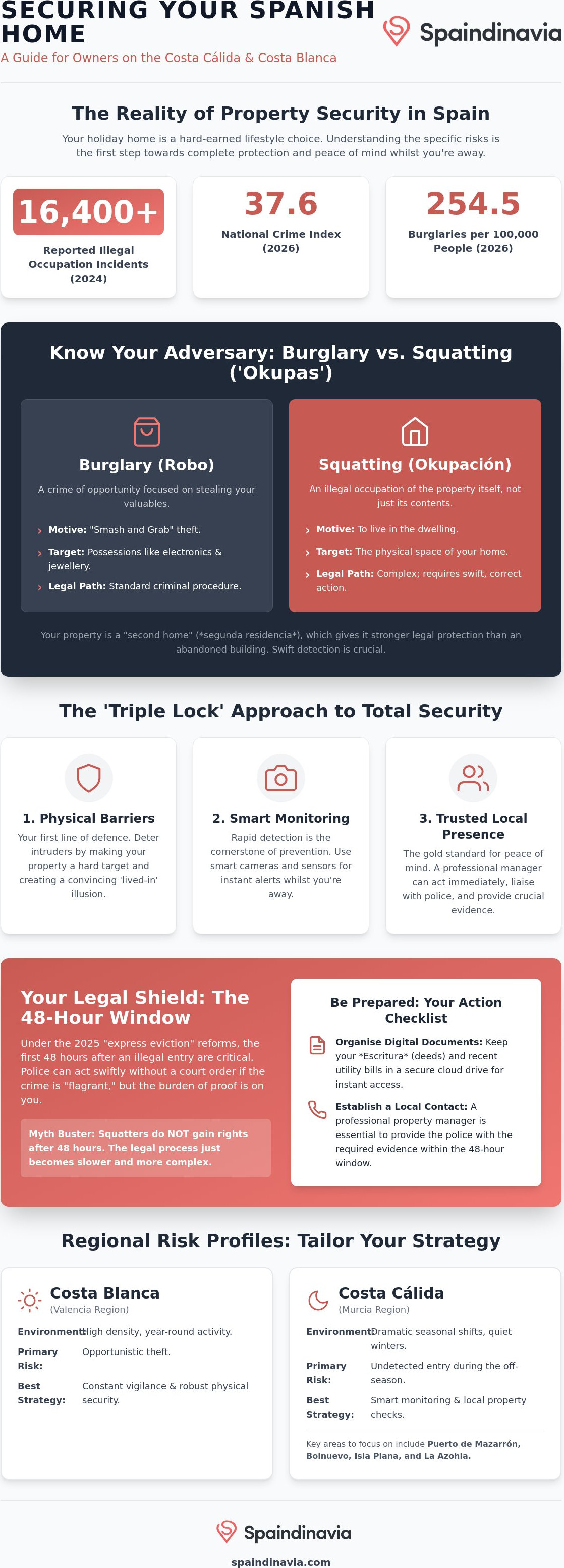
Owning a villa in Bolnuevo or a sun-drenched apartment in the Costa Blanca is a dream come true for many. However, the practical side of keeping your spanish property safe while away involves understanding threats that differ significantly from those in the UK. In Britain, we mostly worry about a "smash and grab" burglary. In Spain, while burglary rates sit at approximately 254.50 per 100,000 population in 2026, a more complex concern is the "okupa," or squatter. Burglary is opportunistic; a thief wants your television or jewellery. Squatting, however, is an occupation of the space itself. This distinction is vital because the legal pathways to resolution are entirely different.
Leaving a Mediterranean home unattended for months creates a psychological weight that many owners aren't prepared for. It isn't just about protecting your belongings; it's about protecting your right to access your own home. A standard UK security mindset, which often relies on a simple alarm and a good relationship with the neighbours, doesn't always translate to the Spanish market. With the national crime index rising to 37.6 in 2026, a more robust, local approach is necessary to ensure your investment remains secure whilst you are abroad.
Understanding the 'Okupa' Phenomenon in 2026
The Spanish legal system distinguishes between allanamiento de morada (breaking into a lived-in dwelling) and usurpación (occupying an empty property). For most holiday home owners, your property is considered a "second home," which fortunately carries more protection than a completely abandoned building. A major shift occurred with Organic Law 1/2025, which aimed to streamline evictions. Police intervention is most effective within the first 48 hours of an illegal entry. During this window, they can often act without a lengthy court order if the crime is considered "flagrant." This is why rapid detection is the cornerstone of Squatting in Spain prevention. Don't believe the myth that once someone is inside for 48 hours, they "own" the place; the legal process simply becomes slower and more complex.
Regional Risk Profiles: Costa Cálida and Costa Blanca
Security needs vary between the Murcia region and the Valencia region. The Costa Blanca, with its high density of international residents and year-round activity, requires constant vigilance against opportunistic theft. In contrast, parts of the Costa Cálida, particularly coastal gems like Isla Plana and La Azohia, experience more dramatic seasonal shifts. In Puerto de Mazarrón and Bolnuevo, many properties remain empty during the winter months. This quiet period is when the risk of undetected entry increases. Effective strategies for keeping your spanish property safe while away in these areas must account for the lack of "eyes on the street" during the off-season. Whether you're in a bustling Valencia plaza or a quiet Murcia cove, your security plan needs to be as dynamic as the local lifestyle.
The 2026 Legal Framework: Protecting Your Rights as an Owner
Understanding the legal landscape is the first step in keeping your spanish property safe while away. In 2026, Spanish law continues to offer strong protection for "second homes" (segunda residencia), which includes your holiday villa in Bolnuevo or your apartment on the Costa Blanca. Unlike abandoned buildings, these properties are legally considered dwellings. This means an intrusion is often treated as allanamiento de morada (breaking and entering), allowing for swifter police action. However, the burden of proof lies with you. You must be able to demonstrate that the property is actively used and maintained.
We recommend keeping digital copies of your Escritura (title deeds) and recent utility bills on a secure cloud drive. If an incident occurs whilst you're in the UK, having these documents instantly accessible is vital for the local authorities. For those still in the planning stages of their purchase, the official UK government guidance provides an excellent foundation for understanding your rights as a foreign owner. You should also ensure your alarm system is connected to a Central Receptora de Alarmas (CRA). In Spain, police prioritisation often depends on whether a certified security company has verified the alert through a central station.
One critical warning: never attempt a "self-help" eviction. It's tempting to fly to Alicante or Murcia and change the locks yourself, but this can lead to criminal charges for coercion. The 2025 "express eviction" process under Organic Law 1/2025 now targets a 15-day resolution period, which is a significant improvement over previous years. To ensure you're following the correct legal path from the start, it's often wise to consult with experienced local experts who understand the regional nuances of the Valencia and Murcia markets.
The Role of the Guardia Civil and Policia Nacional
Registering your property's contact details with the local Guardia Civil in areas like Puerto de Mazarrón can lead to faster response times. If you suspect an intrusion, the Denuncia (official report) must be filed immediately. This document is the trigger for all legal proceedings. In smaller communities like Isla Plana or La Azohia, having a professional real estate agent who can act as your local liaison is invaluable. They often provide the "eyes on the ground" needed to verify an issue before it escalates into a legal headache.
Insurance Requirements for Unoccupied Homes
Check your insurance policy for "unoccupied" clauses. Most standard policies for homes in the Costa Blanca or Costa Calida have limits, typically 30, 60, or 90 days. If your property is empty for longer, you'll likely need a specific "holiday home" policy. It's also important to distinguish between theft of contents and damage caused by squatters; many basic policies won't cover the latter unless specifically stated. In the Murcia region, installing a certified alarm system doesn't just provide peace of mind; it can also lead to a noticeable reduction in your annual premiums.
Practical Comparison: DIY Security vs Professional Monitoring
Choosing between a self-installed system and a monitored service is a pivotal decision for keeping your spanish property safe while away. Many owners in the Costa Blanca and the Costa Calida initially lean towards DIY solutions like Ring or Nest doorbells. Whilst these are excellent for checking if a delivery has arrived at your Bolnuevo villa, they often fall short during a genuine security breach. Relying solely on a "Neighbourhood Watch" approach with local friends in La Azohia or Isla Plana can also be risky. Your friends have their own lives; a missed WhatsApp message could be the difference between a quick police response and a long legal battle.
In 2026, AI-integrated cameras have become remarkably sophisticated. These systems now distinguish between the movement of a stray cat and a human intruder, significantly reducing those middle-of-the-night false alarms. Even the smartest camera is only as good as the response it triggers. This is where Spanish property law updates regarding security evidence become vital. Without a certified connection to a central hub, your video footage might not carry the same weight when you're trying to prove a crime to the authorities in Puerto de Mazarrón or across the Valencia region.
The Limitations of DIY Smart Home Tech
While basic DIY alarm kits can be purchased for under €200 in 2026, they have significant vulnerabilities. Professional burglars are increasingly using Wi-Fi jammers to silence wireless consumer cameras. Additionally, the Spanish summer heat in the Murcia region can wreak havoc on battery-powered devices, leading to unexpected shutdowns. The biggest hurdle remains the police response. If your DIY app pings your phone in London, the Policia Nacional are unlikely to dispatch a patrol car based on a homeowner's unverified report. You lack the professional verification required for high-priority intervention.
Benefits of Certified Alarm Systems
Professionally installed wireless alarm systems, which currently start from approximately €290 to €529, offer a higher tier of protection. Companies like Securitas or Prosegur provide the "Alarm Badge" deterrent, which squatters in the Costa Blanca actively avoid. These systems are linked to a Central Receptora de Alarmas (CRA). When an alarm triggers, the CRA verifies the threat and contacts the police directly, fulfilling the legal requirements for "flagrant" crime evidence. With monitored services available from €19.90 per month as of June 2026, the cost-benefit analysis strongly favours professional monitoring for keeping your spanish property safe while away. Modern 2026 models also feature anti-jamming technology and independent power backups, ensuring your home in Mazarrón remains guarded even during power cuts or network interference.
A Comprehensive Checklist for Securing Your Spanish Home
Securing your Mediterranean retreat involves more than just setting a digital alarm. It requires a holistic approach that blends physical barriers with clever psychological deterrents. Whether you've invested in a modern apartment in the Costa Blanca or a traditional villa in the Costa Calida, the goal remains the same: keeping your spanish property safe while away. By following a structured checklist, you can eliminate the common vulnerabilities that opportunistic burglars or squatters look for when scouting quiet coastal neighbourhoods.
Physical fortification is your first line of defence. In Spain, this often involves 'persianas' (heavy exterior shutters) and 'rejas' (decorative security grilles). Ensure your 'rejas' are professionally bolted and your 'persianas' are fitted with anti-lift locks. These traditional methods remain popular for a reason; they're incredibly difficult to bypass without making significant noise. When combined with modern technology, these physical barriers create a formidable obstacle for anyone attempting unauthorised entry.
Exterior and Perimeter Security
Start with the outside. In the Mazarrón area, particularly around Bolnuevo and Puerto de Mazarrón, garden maintenance is a major tell. Overgrown palms and dry weeds signal that nobody has been home for weeks. Ensure your garden is tidied and hedges are trimmed before you leave. Similarly, an overflowing letterbox is a beacon for intruders. Arrange for a local service to clear your post regularly. For those owning bungalows or townhouses, don't forget the solariums and upper terraces. These are often overlooked entry points that require reinforced locks or motion-sensor lighting to remain secure.
Internal Preparation and Maintenance
Practical maintenance is a form of security in itself. Turning off the main water supply is just as important as locking the front door. A leak in an empty property can cause catastrophic damage before it's discovered. Consider installing smart water shut-off valves that you can control from your smartphone. Humidity is another concern in coastal areas like Isla Plana and La Azohia. Whilst you want the property sealed, some ventilation is necessary to protect its value. Use high-quality humidity absorbers or smart climate control systems to keep the air fresh without compromising your home's integrity.
The 'Habitation Evidence' Strategy
Creating a 'lived-in' illusion is your best defence. Modern smart home technology allows you to set your 'persianas' and interior lights to move at irregular intervals. This mimics natural human behaviour much better than a simple timer. We also recommend preparing a 'Security Folder' for your legal representative or property manager. This should contain copies of your deeds, insurance policies, and contact details. If you're still in the process of choosing a home, it's vital to consult a buying property in spain guide that highlights the benefits of secure, gated urbanisations. For tailored advice on protecting your specific property type, you can always speak with our local experts who live and work in these communities every day.
Leveraging Professional Property Management for Total Security
While high-tech alarms and physical barriers are vital, a professional human presence is often the deciding factor in keeping your spanish property safe while away. In the bustling developments of the Costa Blanca or the more tranquil coves of the Costa Calida, having a local expert who can physically visit the site changes everything. It's the difference between watching an intruder on a camera from your living room in the UK and having a trusted partner on the ground who can act immediately. A professional team doesn't just watch; they manage the environment to ensure your home never looks like an easy target.
Property managers play a critical role in providing the '48-hour evidence' police require to treat an occupation as a flagrant crime. As we discussed in the legal section, speed is the most important factor in the 2025 "express eviction" process. Having someone who can legally enter the property, verify an intrusion, and file a Denuncia within hours is the ultimate security layer. This proactive approach is what distinguishes a truly secure investment from a vulnerable one.
Key Holding: More Than Just a Spare Set
Professional key holding is the gold standard for absent owners. Unlike a well-meaning neighbour in Bolnuevo who might be away for the weekend, a professional manager provides guaranteed availability. They offer emergency access for the authorities or utility companies if a maintenance crisis occurs. In Puerto de Mazarrón, this service ensures that essential repairs are carried out without you needing to book an expensive last-minute flight. Most importantly, professional key holders are trained to spot the subtle signs of a potential "okupa" scouting mission, such as small plastic markers on doorframes or junk mail left to pile up in the gate.
Maximising Occupancy as a Security Strategy
A managed holiday rental property is statistically less likely to be targeted by squatters. Frequent movement and vetted guests create a constant cycle of activity that makes a building an unattractive target for long-term occupation. If you're considering this route, see our spain property investment guide for tips on managing rental yields alongside security. A professional team ensures that every guest is registered with the police, fulfilling your legal obligations whilst keeping the home occupied and secure throughout the year.
Peace of Mind with Spaindinavia
At Spaindinavia, we pride ourselves on being more than just property finders. We're your local eyes and ears in Isla Plana, La Azohia, and the wider Mazarrón region. Our hand-picked portfolio of villas and apartments is backed by our commitment to your long-term security and happiness. We understand the local rhythm of life in both the Murcia and Valencia regions, allowing us to provide a bespoke level of care that a generic security firm simply cannot match. Contact Spaindinavia today to discuss our property management and key holding services.
Protecting Your Mediterranean Investment for the Future
Your journey towards a stress-free Mediterranean lifestyle shouldn't be interrupted by worries about what's happening while you're back in the UK. We've explored how a robust security strategy combines the latest 2026 AI technology with the essential legal protections offered by the 2025 express eviction reforms. By reinforcing physical barriers like 'persianas' and ensuring your property has a 'lived-in' feel through smart automation, you're already ahead of the curve. These practical steps ensure that your home in the sun remains a place of relaxation rather than a source of concern.
Ultimately, keeping your spanish property safe while away is most effective when you have a trusted local partner on the ground. Whether you own a new build villa in Bolnuevo or a resale apartment in the Costa Blanca, a professional presence ensures that your investment remains a sanctuary. Since 2016, our team has been based in Puerto de Mazarrón, providing comprehensive support alongside independent solicitors and local experts to safeguard homes in Isla Plana, La Azohia, and beyond. We are here to bridge the gap between your two worlds with expertise and care.
Secure your Spanish dream home with Spaindinavia's professional management services. Let your time away be filled with anticipation for your next visit, knowing your piece of paradise is in safe hands.
Frequently Asked Questions
Is it legal for squatters to stay in my Spanish home if I'm away?
No, squatting is illegal in Spain, but the speed of eviction depends on how the property is classified. If you use the property as a holiday home, it's legally regarded as a "second residence," which provides stronger protection against allanamiento de morada (breaking and entering). This classification allows the police to act much faster than they would for a completely abandoned or empty building that has no evidence of habitation.
What is the '48-hour rule' for squatters in Spain in 2026?
The 48-hour window is the critical period during which the police can often evict intruders without a prior court order if the crime is considered "flagrant." Under the Organic Law 1/2025, rapid reporting is essential for keeping your spanish property safe while away. If you miss this initial window, you'll need to use the "express eviction" legal process, which currently targets a resolution within 15 days for owners in the Murcia and Valencia regions.
Can my insurance company refuse a claim if my Spanish property was empty?
Yes, insurers can deny claims if the property has been unoccupied for longer than the period specified in your policy. Most standard contracts for homes in the Costa Blanca or Costa Calida have limits of 30, 60, or 90 days. You must inform your provider if the villa will be empty for extended periods or switch to a specialist holiday home policy that specifically covers "unoccupied" risks and potential squatter damage.
Should I leave my 'persianas' (shutters) up or down when I'm away?
Leaving shutters permanently closed for months is a clear signal to burglars in Bolnuevo or Isla Plana that the house is empty. The most effective strategy is to use smart automation to move them at irregular intervals. If you don't have automated shutters, leaving them partially open is often better than a total blackout. This allows for ventilation whilst maintaining a lived-in appearance that deters opportunistic scouts.
Are smart doorbells legal to use on Spanish streets?
Smart doorbells are legal, but they must comply with strict Spanish data protection (AEPD) regulations. You are permitted to monitor your own entrance for security, but the camera shouldn't constantly record public pavements or your neighbours' private spaces. In many urbanisations across the Costa Blanca, it's also wise to check your specific community rules before installation to ensure you're fully compliant with local privacy expectations.
How much does professional key holding cost in the Costa Cálida?
Industry data from March 2026 suggests that fixed maintenance and key holding fees for unoccupied properties typically range between €300 and €2,000 per year. This cost varies based on the size of your property and the frequency of inspections. For owners in Puerto de Mazarrón or La Azohia, this investment covers essential security checks, post collection, and providing emergency access to the authorities or utility companies if an issue arises.
What should I do if I find someone has entered my property in Spain?
Contact the Guardia Civil or Policia Nacional immediately to file an official Denuncia. Do not attempt to enter the property or confront the individuals yourself, as this can lead to criminal charges against you for coercion. Provide the police with your digital deeds and recent utility bills to prove your ownership. This documentation is vital for keeping your spanish property safe while away and triggering the fast-track eviction process.
Do security grilles (rejas) actually deter burglars or just signal an empty home?
Security grilles are a highly effective physical deterrent and are a standard feature on most homes in Spain, whether they are occupied or not. They don't signal an empty home; instead, they signal a property that is difficult and noisy to break into. In coastal areas like Mazarrón, rejas are particularly useful because they allow you to leave windows open for cooling ventilation whilst maintaining a secure perimeter against intruders.


