

Would you knowingly buy someone else's debt along with your new Mediterranean home? In the Spanish property market, financial burdens like mortgages and unpaid taxes are tied directly to the bricks and mortar, meaning they don't simply vanish when the keys change hands. Understanding the nota simple document in spain is the single most important step you can take to protect your investment. Whether you're falling in love with a villa in Bolnuevo or a modern apartment on the Costa Blanca, this document acts as the property's "medical record," revealing the true owner and any hidden legal issues.
It's completely natural to feel a bit overwhelmed by legal jargon or worried about boundary discrepancies whilst searching for your dream life abroad. We're here to help you navigate these complexities with confidence and ease. This comprehensive 2026 guide promises to give you total peace of mind before you sign any contract. You'll learn exactly how to read a registry extract like a local expert, how to spot critical red flags, and how to secure your piece of paradise in Puerto de Mazarrón, La Azohia, or Isla Plana without any nasty surprises. Let's ensure your journey to the Costa Cálida or Costa Blanca is as smooth and secure as possible.
Key Takeaways
- Learn why this Land Registry extract is the ultimate "medical record" for your property and why its validity is only a temporary snapshot of the home's legal status.
- Master the process of understanding the nota simple document in spain to verify legal owners and identify any hidden debts before you commit to a purchase.
- Discover how to cross-reference property boundaries and square metres to ensure the villa you see in Puerto de Mazarrón or Isla Plana matches the official records.
- Understand how specific regional laws, such as the "Ley de Costas," impact homes across the Costa Cálida and Costa Blanca to avoid future legal complications.
- Follow our simple 2026 step-by-step guide to requesting an updated document directly from the official registry website for total peace of mind.
What is a Nota Simple and Why is it Indispensable for Your Spanish Property Purchase?
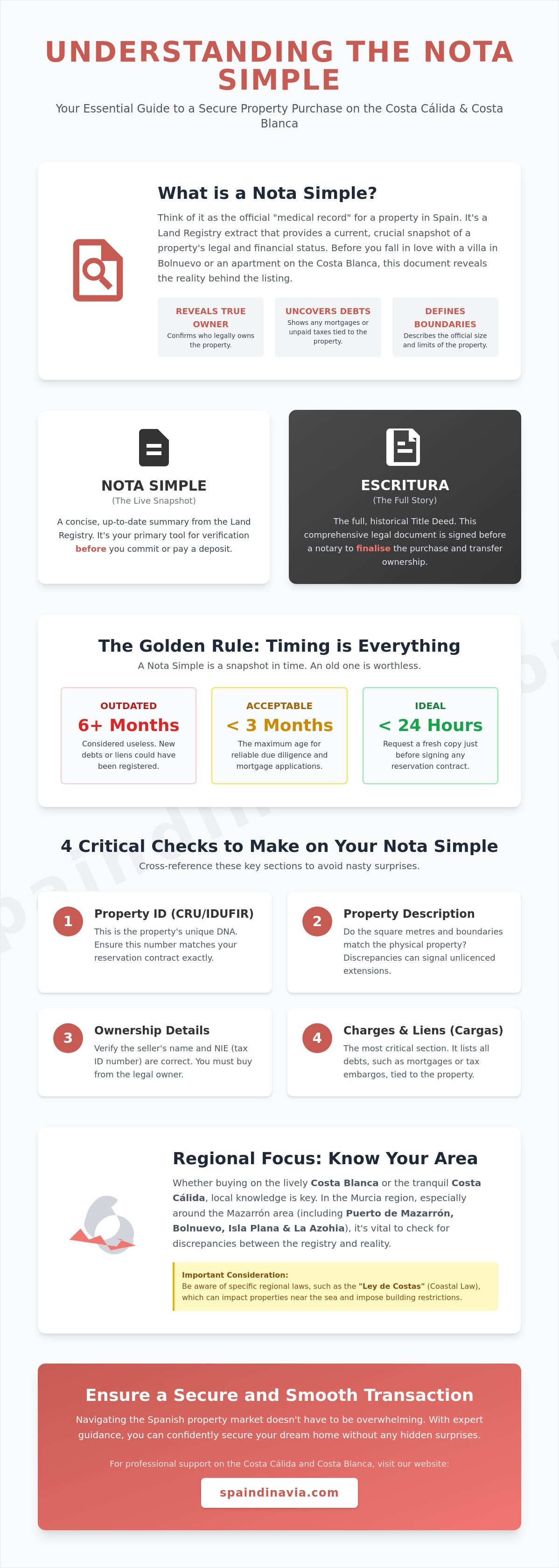
Understanding the nota simple document in spain is your first line of defence when buying a home. Think of it as an official, non-certified extract from the Land Registry, known locally as the Registro de la Propiedad. It provides a real-time summary of who truly owns the property and what financial burdens it carries. Whilst it isn't a replacement for the full title deed, it's the most powerful tool in your due diligence toolkit. In 2026, lenders for Spanish mortgages won't even begin a valuation without seeing a fresh copy issued within the last few weeks. It ensures that the bank's investment, and yours, is protected from the very start.
Whether you're eyeing a charming townhouse in Bolnuevo or a frontline bungalow in Isla Plana, the registry doesn't care about the aesthetic appeal; it cares about the legal reality. In the Murcia region, specifically around the Mazarrón area, we see buyers often confused by how quickly property status can shift. The Costa Blanca offers a similar landscape where transparency is key to a happy purchase. Because debts in Spain are often tied to the property rather than the individual, this document is the only way to prove you aren't accidentally inheriting someone else's unpaid taxes or private loans.
The Difference Between a Nota Simple and the Escritura
Many buyers confuse the Nota Simple with the Escritura, but they serve very different purposes. The Escritura is the full title deed; it's a lengthy, historical document signed before a notary that tracks the property's entire life story. In contrast, the Nota Simple is a concise summary of that story as it stands right now. Whilst you need the Escritura to finalise the sale, the Nota Simple is what you use to verify the true state of a property in Costa Cálida before you hand over a deposit. The Nota Simple is the "live status" of the property. It bridges the gap between what a seller tells you and what the official records actually show.
Why Timing is Everything When Requesting Your Copy
A Nota Simple is essentially a snapshot in time. A version that is six months old is practically useless because a new lien or mortgage could have been registered against the property yesterday. We always recommend having a copy that is no older than three months, though ideally, you should see one requested within 24 hours of signing a reservation contract. Currently, 2026 digital updates have made real-time registry checks faster than ever, often delivering results in less than a day. At Spaindinavia, we understand this urgency. We ensure an updated copy is always available for our new build villas and resale apartments, providing a clear path for buyers in La Azohia and Puerto de Mazarrón.
Decoding the Sections: What Your Nota Simple Reveals About a Property
Opening your first registry extract feels like cracking a code. Whilst the language is formal, the structure is thankfully consistent across both the Costa Cálida and the Costa Blanca. Mastering the art of understanding the nota simple document in spain starts with the Property ID. Every property has a unique identity known as the CRU (Código Registral Único) or the older IDUFIR number. Think of this as the property's DNA. If this number doesn't match the one on your reservation contract, stop immediately. It's the only way to ensure the villa you're viewing in Bolnuevo is the exact legal entity you're actually buying.
The description section follows, detailing the boundaries and square metres. It's quite common in the Murcia region for physical boundaries to differ slightly from the registry. However, if the document describes a 100-square-metre bungalow in La Azohia but you're standing in a 150-square-metre villa with a second floor, you've spotted a major red flag. This often means extensions were built without the correct licences. When you request a Nota Simple online, always cross-reference these measurements with the physical reality to avoid future legal headaches or issues with your mortgage lender.
Identifying Ownership and Legal Rights
Verification is the core of a safe transaction. You must ensure the names on the document match the sellers' NIE (tax ID) numbers exactly. Be particularly wary of "Usufructo," which is the legal right of someone to live in or use the property even if they don't own it. This is common in inheritance cases across Puerto de Mazarrón and Isla Plana. You don't want to buy a beautiful seaside apartment only to find a distant relative has a legal right to occupy it for life. If you're browsing our resale apartments in the Murcia region, we've already helped clarify these details for you.
The "Charges" Section: Spotting Debts and Encumbrances
The "Cargas" section is where the real detective work happens. This part of the document lists everything that might cost you money or limit your rights.
- Hipotecas (Mortgages): Most properties have these. They aren't a deal-breaker, but they must be cancelled at the notary upon completion.
- Embargos: These are serious. They indicate the property has been seized or flagged due to unpaid debts, such as court-ordered settlements or massive tax arrears.
- Servidumbres (Easements): These are rights of way. For example, a utility company might have the right to access a cable running through your garden in the Costa Blanca.
Red Flags: When to Walk Away or Seek Legal Counsel
Small discrepancies are normal, but some issues require immediate professional help. If the document shows unpaid IBI (Council Tax) or community fee alerts, these debts will become yours once you sign. An "Afección Fiscal" is usually a standard note about tax payment and isn't typically a reason to panic, but anything labelled as a "Cierre Registral" (Registry Closure) is a total stop sign. This means the registry has blocked any changes to the property status, often due to serious legal disputes. Always ensure your solicitor scrutinises every line before you commit any funds.
The Step-by-Step Guide to Requesting an Updated Nota Simple in 2026
Requesting a registry extract has never been more straightforward thanks to the full digitalisation of the Land Registry (Registro de la Propiedad) in 2026. Whether you're falling in love with a resale villa in Bolnuevo or a modern apartment on the Costa Blanca, you can now access official data from your laptop in a matter of minutes. However, understanding the nota simple document in spain requires a methodical approach to ensure you're looking at the right property and the most current data. Following these steps will help you secure the information you need without unnecessary stress.
- Step 1: Gather the property details. You'll need the owner's full name, the property's location, or ideally, the CRU (unique registry code). If you're looking at a home in La Azohia, having the specific plot number or previous registry volume data is incredibly helpful.
- Step 2: Access the official portal. Visit the "Registradores" website. This is the primary authority for all property records in Spain.
- Step 3: Justify your "Legitimate Interest". You must state why you're requesting the data. As a prospective buyer, this is a valid reason (Interés Legítimo) that the registry will accept.
- Step 4: Pay the registry fee. The official rate in 2026 is €9.02 plus VAT (IVA), totalling approximately €10.91. If you need a comprehensive guide to the Nota Simple to help explain these costs to your family or partners, it's a great resource for international buyers.
- Step 5: Receive and translate. The document usually arrives as a PDF via email within 24 to 48 hours. Since it's written in formal Spanish, you may want to pay a small extra fee for an official translation.
Online vs. In-Person Requests
The efficiency of the 2026 digital Land Registry portal has made physical visits almost obsolete for properties across the Costa Blanca and Costa Cálida. Digital requests are faster and provide a clear electronic trail. Whilst a physical visit to a registry centre in a town like Mazarrón is still possible, it's rarely necessary for standard searches. Most British buyers prefer to let their solicitor or agent handle this step to ensure no details are lost in translation. We always encourage this approach to maintain the highest level of security in your transaction.
Using an Independent Solicitor for Interpretation
Simply holding the document in your hand isn't enough; you need expert eyes to interpret what those "charges" actually mean for your future. A solicitor will cross-reference the Nota Simple with the Catastro (the regional tax office) to check for discrepancies. This is vital in areas like Puerto de Mazarrón or Isla Plana, where older properties might have extensions that appear in the tax office but not the Land Registry. For more advice on this, refer to our guide on finding a property lawyer in Murcia. They'll ensure that the dream home you see is exactly what you're legally buying.
Beyond the Basics: Regional Considerations in Costa Cálida and Costa Blanca
Spain's real estate market isn't a single monolith; laws and registry habits can shift as you cross regional borders. When you're understanding the nota simple document in spain, you must look for nuances that are specific to the Murcia and Valencia regions. One of the most critical elements is the "Ley de Costas" (Coastal Law). In Puerto de Mazarrón, for instance, a frontline property might have a registry note indicating it falls within a protected coastal zone. This could severely restrict your ability to renovate compared to a similar home in Orihuela Costa on the Costa Blanca. The document acts as an early warning system for these regional planning restrictions.
The distinction between "Urbano" and "Rústico" land is another area where the registry proves its worth. In the rural outskirts of Isla Plana or La Azohia, a property might look like a standard residential villa but be registered on "rústico" land. This status often limits mortgage options and building permissions. The registry extract will clearly state the land's classification, helping you verify the "urbanisable" status before you commit. For those interested in our new build villas, we ensure the "Declaración de Obra Nueva" (Declaration of New Work) is already processed, which confirms the building is legally registered as a completed dwelling.
The Costa Cálida Perspective: Mazarrón, Bolnuevo, and La Azohia
In the Mazarrón area, specifically around Bolnuevo and La Azohia, coastal boundary checks are a top priority. The Murcia Land Registry often includes regional tax notes that are unique to this part of the coast. It's vital to verify that your home is registered as a residential dwelling. We occasionally see older resale properties registered as "agricultural warehouses," which can lead to complications with utility contracts. Always ensure the registry description matches the physical reality of your Mediterranean escape.
The Costa Blanca Perspective: Comparing Valencia Region Records
The Land Registry offices in the Alicante province handle things slightly differently, particularly regarding "Tourist Licences." In many parts of the Costa Blanca, the registry now includes annotations if a community of owners has voted to ban short-term holiday rentals. This is a massive factor if you're buying a resale apartment as an investment. Furthermore, older records in the Costa Blanca South sometimes use archaic boundary descriptions. Modernising these entries during the purchase process protects you from historical planning disputes that might not exist in the newer developments of the Costa Cálida.
Ensuring a Secure Transaction: How Spaindinavia Supports Your Journey
Buying a home should be an inspiring chapter, not a source of legal anxiety. At Spaindinavia, we believe that understanding the nota simple document in spain is the foundation of a secure transaction. Our commitment to transparency starts before you even step foot in a property. We provide an updated registry extract for every listing in our portfolio, ensuring you have the facts from day one. By collaborating closely with independent solicitors, we verify every line of your document, from boundary markers in Bolnuevo to ownership shares on the Costa Blanca. Whilst the registry extract provides the data, our team provides the context you need to move forward.
This rigorous approach is especially vital when considering our new build villas. We ensure that all "Declaración de Obra Nueva" paperwork is perfectly in order, protecting you from the planning disputes that can sometimes plague less diligent transactions. A "clean" Nota Simple isn't just about your current peace of mind; it's a strategic move to maximise your future ROI. When the time comes to sell your Mediterranean retreat, having a flawless registry history ensures a swift and profitable resale. We treat your investment with the same care and seriousness as if it were our own.
Hand-Picked Portfolio and Legal Peace of Mind
We take great pride in our hand-picked selection of properties. Our team pre-screens every home in Puerto de Mazarrón, Isla Plana, and La Azohia to ensure they meet our strict legal and aesthetic standards. For British buyers, our "no surprises" policy means we've already asked the tough questions about debts and boundaries before you arrive for a viewing. We bridge the gap between two different legal cultures, making the complex feel simple and the uncertain feel secure.
Whether you're looking for a modern townhouse or a sprawling coastal estate, we've done the groundwork to ensure the property is debt-free and legally sound. View our latest New Build Villas in Costa Cálida to start your search with absolute confidence. We're not just finding you a house; we're securing your future lifestyle under the Spanish sun.
A Partner Through Every Step of the Buying Process
Our role extends far beyond simply showing you a property. We're your partner from the very first enquiry to the final signature at the Notary. We'll help you navigate the complex Spanish property investment landscape, ensuring your capital is safe and your lifestyle dreams are realised. We understand that moving to the Costa Cálida or Costa Blanca is a big life decision, and we're here to provide the guiding, calm hand you need.
A secure purchase starts with understanding the nota simple document in spain today. By choosing a partner who prioritises legal clarity and personal warmth, you can focus on the excitement of your new life rather than the stress of the paperwork. We're here to ensure every line of that registry document tells a story of security and joy for years to come.
Your Secure Path to a Mediterranean Dream
Securing your future home in the sun should be a joyful experience, and the right knowledge makes all the difference. Mastering the art of understanding the nota simple document in spain is the most effective way to ensure your investment in Puerto de Mazarrón, Bolnuevo, or across the Costa Blanca is protected. By identifying hidden charges and verifying legal boundaries early, you transform a complex legal process into a clear path forward. This document is the key to ensuring your new life starts on a foundation of total security.
Since 2016, our team has been based in Puerto de Mazarrón, acting as local experts for those seeking New Build Villas and high-quality resale properties. We pride ourselves on our independent legal and banking partnerships, ensuring every transaction is as secure as it is inspiring. Whether you're drawn to the quiet beauty of Isla Plana or the vibrant stretches of the Costa Blanca, you don't have to navigate these steps alone. Contact Spaindinavia today for expert guidance on your Spanish property search. Your dream of a debt-free life by the Mediterranean is well within reach, and we look forward to welcoming you home.
Frequently Asked Questions
Is the Nota Simple legally binding in a Spanish court?
No, the Nota Simple is an informative document rather than a legally binding certificate. Whilst it provides the essential data required for due diligence, a "Certificación Registral" is the document you'd need if you require something with full legal weight in a court of law. For the vast majority of property purchases in Puerto de Mazarrón or across the Costa Blanca, however, the Nota Simple is the standard tool used by banks and solicitors to verify a property's status.
How long does it take to get a Nota Simple in 2026?
You can typically expect to receive your document within 24 to 48 hours when requested online. Digitalisation in 2026 has significantly improved the response times of Land Registry offices across both the Murcia and Valencia regions. In many cases, if the request is submitted early in the business day, the PDF can arrive in your inbox by the afternoon, making it easier than ever to move quickly on a villa in Bolnuevo.
Can I request a Nota Simple in English from the registry?
No, the official registry extract is always issued in Spanish as it is a formal legal record. However, the official portal does allow you to request a translated version for an additional fee of approximately €30 plus VAT. Understanding the nota simple document in spain is much simpler with this professional translation, especially if you aren't yet comfortable with the technical legal terms used in the Mazarrón area or the Costa Blanca.
Does the Nota Simple show the actual purchase price of the property?
No, the Nota Simple doesn't disclose the specific price paid by the current or previous owners. It focuses on the legal description, ownership details, and any active charges or mortgages tied to the property. If you're looking to verify the historical sale price for a bungalow in Isla Plana or an apartment in Alicante, your solicitor would usually need to consult the "Escritura" or specific tax records instead.
What is the difference between a "Nota Simple" and a "Nota Localizadora"?
A Nota Simple provides the specific legal details for one individual property that you have already identified. In contrast, a "Nota Localizadora" is a broader search tool used to find out if a specific person or company owns any property across the entire Spanish registry system. If you've already found a home you love in La Azohia, the Nota Simple is the only document you need to verify its legal standing.
What happens if the square metres on the Nota Simple don’t match the Catastro?
Discrepancies between the Land Registry and the Catastro (the tax office) are quite common, particularly with older homes in the Murcia region and the Costa Blanca. Generally, the Land Registry is the authority on legal ownership, whilst the Catastro handles physical characteristics for tax purposes. If the registry shows significantly fewer square metres than the physical villa, it often means an extension was built without the correct licences, which requires professional legal analysis.
Can a Nota Simple be used to prove ownership for a Golden Visa application?
Whilst a Nota Simple is an excellent tool for initial checks, the Spanish authorities usually require a "Certificación Registral" for the actual Golden Visa application. This is a more formal, signed document that provides the necessary proof of investment. Understanding the nota simple document in spain is still a vital first step, as it ensures the property you are buying in the Mazarrón area or the Costa Blanca is legally sound before you begin the residency process.
Who pays for the Nota Simple, the buyer or the seller?
The buyer typically pays the cost of the Nota Simple as it's a standard part of their own due diligence. Since the official registry fee is only €9.02 plus VAT (IVA), it's a very affordable way to gain peace of mind. To make your journey smoother, we often provide updated copies for our listings in Puerto de Mazarrón and the Costa Blanca, ensuring you have all the facts before you even book a viewing.


