
What if the construction site of your dream villa in Puerto de Mazarrón falls silent and the developer's office doors remain locked? It's a scenario that keeps many investors awake at night, leading them to ask exactly what happens if a spanish developer goes bankrupt in the current climate. Whether you're planning a move to a modern apartment in the Costa Blanca or a serene bungalow in Isla Plana, the fear of losing your life savings to a complex insolvency process is entirely understandable.
We believe that your journey to the Mediterranean should be defined by peace of mind, not by confusion over foreign legal terms. Whilst the thought of a builder facing financial trouble is stressful, the Spanish legal system in 2026 offers significant safeguards to ensure you aren't left behind. This guide promises to show you how to navigate these protections, including the vital role of bank guarantees and the latest 2026 Supreme Court rulings on deposit recovery. We'll provide a clear roadmap for buyers across both the Costa Calida and the Costa Blanca, proving that with the right knowledge, your investment in places like Bolnuevo, La Azohia, or the wider Valencia region remains secure.
Key Takeaways
- Understand the 'Concurso de Acreedores' process and how a formal administrator manages assets to protect your interests during a developer's insolvency.
- Discover how modern laws like Ley 20/2015 mandate bank guarantees, providing a definitive answer to what happens if a spanish developer goes bankrupt and how your funds are ring-fenced.
- Learn why you must continue stage payments to maintain your legal standing and the specific conditions required to formally cancel a contract and claim a full refund.
- Identify the vital evidence you need to gather to protect your investment, whether you are buying a new build villa in Bolnuevo or a modern apartment across the Costa Blanca.
- See how partnering with experts who vet developers in the Puerto de Mazarrón area and the wider Valencia region ensures you only work with builders who provide individual bank guarantees as standard.
Understanding Spanish Developer Insolvency: The 'Concurso de Acreedores'
Hearing the term 'Concurso de Acreedores' can feel like a cold shadow falling over your sunny plans in Bolnuevo or Isla Plana. In the simplest terms, this is the formal legal framework for Understanding Spanish Developer Insolvency. It is a court-supervised process where a judge and a court-appointed administrator step in to manage a company’s finances when they can no longer meet their obligations. If you are worried about what happens if a spanish developer goes bankrupt, the first thing to realise is that this process is designed to bring order to a difficult situation. It doesn't always mean the cranes will stop turning forever.
The bankruptcy administrator takes over the decision-making from the developer's directors. Their primary goal is to assess whether the company can be saved or if it must be liquidated. There is a vital distinction here between temporary liquidity issues, where a builder just needs more time to pay debts, and total liquidation. In the Costa Blanca or the Murcia region, many projects have actually reached completion under administration because it was the most logical way to repay creditors. It's a structured journey, not an immediate dead end.
The Legal Phases of Insolvency in Spain
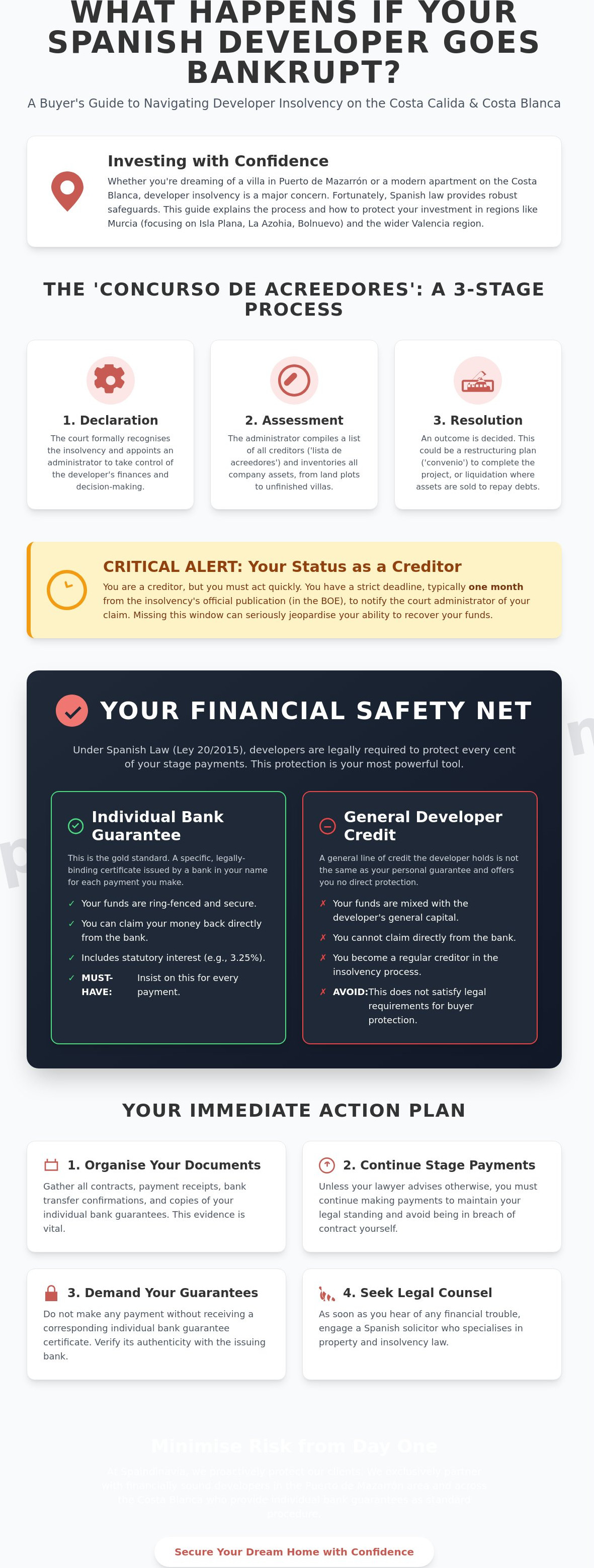
The process moves through three distinct stages. First is the declaration, where the court officially recognises the insolvency and appoints the administrator. Next comes the assessment phase. This is where the administrator creates the 'lista de acreedores', or the list of creditors. They tally up every euro owed and every asset owned, from unsold plots in Puerto de Mazarrón to half-finished villas in the Valencia region. Finally, the resolution phase determines the outcome. This might involve a 'convenio', which is a formal agreement to restructure debt and finish the builds, or the final step of liquidation where assets are sold off.
Your Status as a Creditor
As a property buyer, you are considered a creditor. However, you aren't automatically at the front of the queue. In the hierarchy of debt, the Spanish state and employees often come first. This is why being formally recognised by the administrator is so critical. You must notify the court of your claim within a strict legal deadline, usually one month from the date the bankruptcy is officially published in the State Gazette (BOE). If you miss this window, your claim could be downgraded, making it much harder to recover your funds if you don't have other safeguards in place. Whether you've invested in a townhouse in La Azohia or a bungalow near the Mediterranean coast, your legal standing depends on your proactivity during these early weeks.
The Safety Net: Bank Guarantees and Insurance Policies
Whilst the legal phases of administration might sound intimidating, you aren't walking this path alone. The most robust defence against the uncertainty of what happens if a spanish developer goes bankrupt is the mandatory bank guarantee, known locally as an aval bancario. Under the stringent requirements of Ley 20/2015, every developer in the Costa Calida and Costa Blanca is legally obligated to secure your stage payments through either a bank guarantee or a specialised insurance policy. This law significantly strengthened buyer protections compared to older regulations, ensuring that your funds are ring-fenced from the developer's general operating capital. If the project stalls or the builder enters insolvency as defined by the Spanish Insolvency Act, these instruments allow you to claim your money back directly from the financial institution, often with the statutory interest of 3.25% included.
Individual vs. General Bank Guarantees
It's vital to understand that a general line of credit held by the developer isn't the same as your personal safety net. You should always insist on an individual certificate for every single stage payment you make, whether you are buying a villa in Bolnuevo or an apartment in the Costa Blanca. This document must name you as the beneficiary and specify the exact amount protected. Without this individual certificate, claiming your funds becomes significantly more difficult. We always recommend that you verify the validity of these documents directly with the issuing bank's branch in the Murcia region or Valencia region to ensure they are active and correct. For those seeking secure property investments, this verification is a non-negotiable step in our vetting process.
Insurance Policies as an Alternative
Sometimes, developers use a 'Seguro de Caución', or surety insurance, instead of a bank guarantee. These policies offer the same legal protection and are equally valid under Spanish law. If a builder in Puerto de Mazarrón or Isla Plana defaults, you file your claim with the insurance company rather than a bank. Many investors find that insurance claims can sometimes be processed slightly faster than bank guarantees, though both are reliable. If your developer failed to provide a guarantee at the start, don't panic. Spanish courts have a strong history of holding the banks themselves liable if they accepted your deposits without ensuring a guarantee was in place, provided you have clear proof of payment to the developer's designated account.
Recovery Scenarios: What You Can Claim and When
If you find yourself asking what happens if a spanish developer goes bankrupt, the most important rule is to keep your own side of the bargain. Legal experts often refer to this as the 'Two Wrongs' principle. If you stop making your agreed stage payments because you suspect the builder is in trouble, you might inadvertently breach your contract yourself. This mistake can give the developer’s administrator a legal reason to cancel your purchase without returning your deposit. You must continue payments to keep your legal rights intact, unless a solicitor formally advises you that the contract is already rescinded. By staying compliant, you remain a protected creditor rather than a defaulting buyer.
When a developer fails to deliver, you are generally entitled to recover the principal amount of your deposits plus legal interest. For 2026, the statutory legal interest rate in Spain is 3.25%. A significant Supreme Court ruling in January 2026 further clarified that this interest continues to accrue until the date you actually receive your money, rather than stopping when the developer first declared insolvency. This is a vital protection for those waiting for refunds on properties in Puerto de Mazarrón or across the Costa Blanca. Even if a building is structurally complete, you still have the right to claim if the developer cannot provide the License of First Occupation (LFO), as the property isn't legally habitable without it.
The Importance of Contractual Deadlines
Your purchase contract will specify a completion date. Once this date passes, including any grace periods, the developer is in 'Late Delivery'. This is the trigger you need to execute your bank guarantee. Be extremely cautious if a developer asks you to sign an addendum extending the deadline. Whilst they might claim 'Force Majeure' due to weather or supply chain issues, Spanish courts are increasingly strict about what qualifies as an unavoidable delay. Never sign an extension without legal advice, as it could void your current guarantee. A Notary can document the failure to deliver, providing the essential proof required to start your recovery process in the Murcia region or Valencia region.
When the Property is Nearly Finished
Deciding whether to pull out or wait is a personal choice that depends on how close the project is to completion. In some cases, especially in popular areas like Isla Plana, La Azohia, or Bolnuevo, a new developer may step in to buy the assets and finish the works. Alternatively, the bank holding the guarantees might agree to release funds specifically to complete the build rather than issuing refunds. This can often be a faster route to your new lifestyle than starting a fresh search. We suggest evaluating the remaining works with a professional surveyor before making a final decision on whether to execute your guarantee or push for completion.
Immediate Steps to Protect Your Investment
If the silence from your building site becomes deafening, you must act with precision. Discovering what happens if a spanish developer goes bankrupt is the first step, but your physical recovery plan begins with documentation. You should immediately gather every scrap of evidence related to your purchase. This includes bank transfer receipts, stamped invoices, and all signed contracts. Whether you are invested in a new build villa in Bolnuevo or a modern apartment in the Costa Blanca, having a complete file ready for review is your greatest asset. Do not wait for the developer to contact you; their priority will be managing their own survival, whilst yours must be protecting your capital.
Instruct an independent solicitor who specialises in Spanish property law the moment you suspect insolvency. It is vital to avoid direct negotiations with the developer’s staff or their in-house legal team without your own representative present. They may attempt to offer you alternative plots or verbal promises of future completion to keep you from executing your guarantee. These informal arrangements often lack legal weight and can complicate your standing in the Commercial Court. Your solicitor will instead formalise your status as a creditor with the bankruptcy administrator, ensuring you are included in the official 'lista de acreedores' within the strict one-month deadline.
Documenting Your Claim
Creating a comprehensive paper trail is about more than just keeping receipts. You must ensure all your stage payments were made to the developer’s designated 'Special Account' (Cuenta Especial). Under Spanish law, these accounts are legally separated from the builder’s daily expenses to protect buyer deposits. We have seen cases in Isla Plana and La Azohia where developers requested payments to general accounts; if this happened to you, your solicitor needs to know immediately. Remember that WhatsApp messages or verbal assurances from a site manager hold no legal standing in court. Only written, signed, and officially received correspondence will support your case.
Working with an Independent Solicitor
The difference between a developer’s lawyer and your own independent counsel is the difference between conflict of interest and total loyalty. Your solicitor will liaise directly with the Juzgado de lo Mercantil (Commercial Court) to track the progress of the 'concurso'. They will also handle the process of claiming against the bank guarantee or insurance policy. Typically, the time limit to claim against a bank guarantee is two years from the date the developer breached the delivery deadline. For those looking to secure their future in the sun, choosing a partner who prioritises safety is the best way to ensure these legal hurdles are handled before they ever become a problem. Recovery through a valid bank guarantee is often much faster than waiting for a full liquidation process, usually taking months rather than years.
How Spaindinavia Minimises Risk for New Build Buyers
Whilst the legal frameworks we've discussed provide a safety net, the most effective strategy is to avoid the need for recovery altogether. We believe that your journey to a new life in the sun should be filled with excitement, not anxiety. This is why our role goes far beyond simply showing you properties. We act as a professional filter, using a rigorous vetting process to evaluate every builder we represent across the Costa Cálida and the Costa Blanca. By the time you see a floor plan for a new build villa or apartment, we've already looked into the developer's track record and financial stability. Our goal is to ensure you never have to experience the stress of what happens if a spanish developer goes bankrupt.
We maintain a strict policy of only partnering with builders who provide individual bank guarantees as a standard part of their contract. This isn't a "nice-to-have" feature in our eyes; it's a fundamental requirement for a secure transaction. We organise independent legal support for you from day one, ensuring that a qualified solicitor reviews every document before you part with a single euro. This proactive approach creates a 'calming centre' for our clients, providing the transparent communication and local expertise you need to make a confident decision.
Expertise in the Costa Cálida and Costa Blanca
Our deep roots in the Mazarrón area give us a unique advantage. We live and work in the communities of Puerto de Mazarrón, Isla Plana, La Azohia, and Bolnuevo. This local presence allows us to spot "red flags" that an overseas agent might miss, such as a sudden halt in activity on a site or changes in a developer’s local reputation. We also understand the distinct market differences between the regions. The Murcia region often features more boutique, family-run developments with a personal touch, whilst the Costa Blanca in the Valencia region is home to some of Spain's largest construction firms. Each requires a different level of scrutiny, and we tailor our advice accordingly; to discover how these large-scale enterprises use sophisticated systems to boost procurement efficiency and ensure project stability, you can visit NaviWorld (Thailand) Co., Ltd..
Your Partner for Secure Investment
We're committed to guiding you through the entire buying journey, acting as a bridge between your dreams and the local reality. We provide professional, jargon-free advice that empowers you to understand every step of the process. For a detailed look at how to protect yourself, we recommend reading our Buying Property in Spain Guide: The Essential 2026 Checklist for Secure Investment. If you're ready to start your journey with a team that puts your security first, contact Spaindinavia for a secure property search in the Mazarrón area today. We're here to ensure your investment in the Mediterranean lifestyle is as solid as the foundations of your new home.
Secure Your Future Under the Mediterranean Sun
Understanding the legal landscape and the robust protections of 2026 allows you to move forward with clarity. You now know that mandatory bank guarantees and the strict oversight of the Spanish Insolvency Act are designed to keep your savings safe. Whether you're dreaming of a new build villa in Puerto de Mazarrón or a modern apartment in the Costa Blanca, your investment is protected by more than just a contract; it's backed by a structured legal system. Knowing exactly what happens if a spanish developer goes bankrupt gives you the power to act quickly, whilst proper vetting ensures you likely won't ever have to.
We invite you to secure your Spanish property investment with Spaindinavia’s expert guidance. As specialists in high-quality new build villas across both the Costa Cálida and Costa Blanca, we hand-pick our portfolio for quality and long-term potential. By collaborating with independent solicitors and banks, we ensure 100% transaction security from Bolnuevo to the wider Valencia region. Your dream of a new lifestyle in La Azohia or Isla Plana is within reach, and we're here to ensure every step you take is on solid ground. Let's make your Mediterranean vision a secure reality together.
Frequently Asked Questions
Can I get my deposit back if the builder goes bankrupt in Spain?
Yes, you can recover your deposit if the developer has provided a valid bank guarantee or insurance policy. Under Ley 20/2015, all off-plan payments must be protected by these financial instruments. This safeguard ensures that if a builder in Bolnuevo or the Costa Blanca fails to deliver your home, the bank or insurer is legally responsible for returning your funds plus 3.25% interest.
Should I stop making stage payments if I hear the developer is in trouble?
No, you should never stop making payments without formal legal advice from your solicitor. Halting payments unilaterally can put you in breach of contract, which might give the developer’s administrator a reason to cancel your purchase without a refund. Whether you are buying in Puerto de Mazarrón or the Valencia region, staying compliant with your payment schedule is vital to maintaining your status as a protected buyer.
What is a bank guarantee (Aval Bancario) and why is it essential?
An aval bancario is a legal promise from a bank to return your deposits if the builder defaults on the project. It is essential because it allows you to bypass the developer’s insolvency proceedings and claim your money directly from the financial institution. Without this individual certificate, understanding what happens if a spanish developer goes bankrupt becomes much more stressful, as you would have to wait for the court to liquidate the developer's assets.
How long does it take to recover money from a bankrupt Spanish developer?
Recovering funds through a bank guarantee typically takes between six and eighteen months once the breach of contract is formalised. If you have to go through the court-led insolvency process instead, the timeline can extend to several years. Proactive legal action in the Murcia region or Costa Blanca is necessary to ensure your claim is processed within the two-year limitation period for guarantee claims.
What happens if the developer did not provide a bank guarantee?
If no guarantee was provided, your solicitor must list you as a creditor in the formal 'concurso de acreedores' process. Whilst this is more complex, Spanish courts have a strong history of holding banks liable for accepting deposits without ensuring a guarantee was in place. Your legal representative will need to prove the funds were paid into the developer's account to seek recovery through these alternative court routes.
Can a new developer take over a bankrupt project and finish my house?
Yes, a new developer can acquire the assets of an insolvent company and finish the project. This often occurs in high-demand areas like Isla Plana or La Azohia where the land and build value remain attractive to investors. In these cases, you might be given the choice to continue with the new builder or proceed with a refund claim through your existing bank guarantee or insurance policy.
What is the role of a bankruptcy administrator in Spain?
The bankruptcy administrator is a court-appointed professional who takes control of the developer’s assets and finances to manage their debt. Their job is to evaluate the company's situation and determine if it can be restructured or must be liquidated. They manage the official list of creditors and decide whether a project in the Costa Blanca or Murcia region can be finished to repay the buyers.
Is it safe to buy off-plan property in Spain in 2026?
Buying off-plan is safe in 2026 as long as you work with reputable agents who rigorously vet every developer. The current Spanish legal system provides robust insurance and banking safeguards that protect your capital from the first payment. When you ensure your solicitor confirms each bank guarantee for your villa in Bolnuevo or apartment in the Valencia region, you have a clear answer to what happens if a spanish developer goes bankrupt; you simply execute your guarantee and recover your funds.


