

What if owning your dream home by the sea didn't mean paying tax twice on every single pound of rental profit or capital gain? If you feel bewildered by declaring cross-border assets across two different legal jurisdictions, you are certainly not alone. The fear of dual liabilities can quickly overshadow the excitement of coastal living, but avoiding double taxation on property ownership in Spain is entirely straightforward when you know how the rules operate. Bilateral treaties ensure you aren't penalised twice, eliminating duplicate taxes through foreign tax credits rather than blanket exemptions.
Whether you are letting a holiday apartment in sunny Puerto de Mazarrón, Bolnuevo, Isla Plana, or La Azohía in the Costa Cálida, or settling into a villa in the Costa Blanca, clear tax planning brings peace of mind. Discover how double tax treaties safeguard your overseas property income and gains from punitive duplicate taxation. In this comprehensive 2026 guide, we unpack the filing mechanics of Modelo 210 alongside your domestic tax return, explore regional distinctions between Murcia and the Valencian Community, and show you how to protect your returns safely.
Key Takeaways
- Understand how international tax treaties apply foreign tax credits, giving you a clear roadmap for avoiding double taxation on property ownership in spain.
- Discover the specific filing process for Spanish Modelo 210 forms to ensure your rental yields and capital gains are credited accurately against domestic liabilities.
- Uncover how imputed income tax on unrented holiday homes is treated by overseas tax authorities, helping you prevent unexpected cross-border filing errors.
- Compare regional tax obligations between the vibrant Costa Blanca and the tranquil Costa Cálida, exploring how local variations affect property holdings in Puerto de Mazarrón, Bolnuevo, Isla Plana, and La Azohía.
- Learn how combining property market expertise with independent legal representation ensures your Mediterranean home remains a secure, tax-efficient investment.
Understanding Double Taxation on Spanish Property: How Double Tax Treaties Work
Double taxation arises when two separate countries assert the legal right to tax the same income or capital asset. For overseas buyers investing along the Mediterranean coastline, gaining a firm grasp of this concept is vital. Gaining a clear baseline through Understanding Double Taxation reveals why bilateral conventions exist: they remove economic friction so cross-border investors aren't charged duplicate fees on identical earnings.
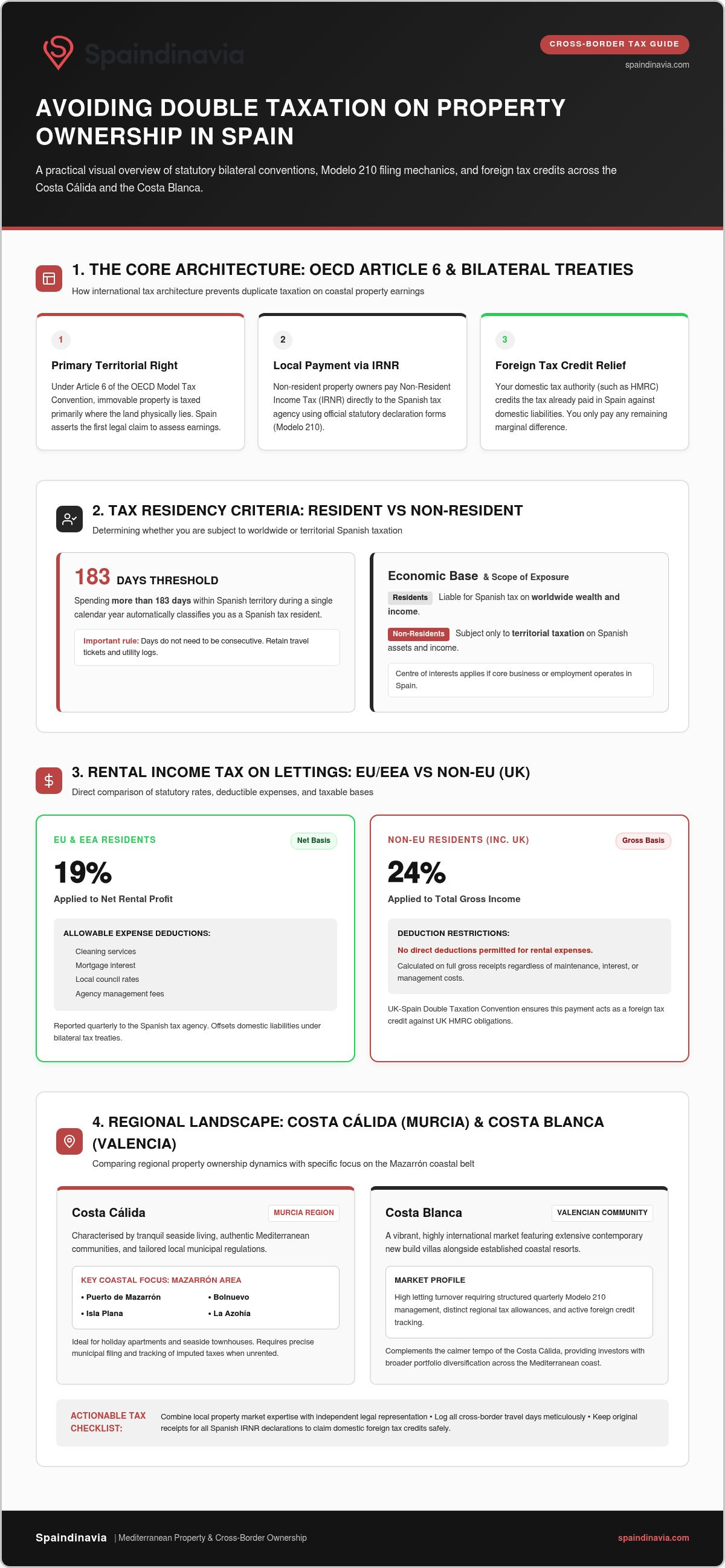
The cornerstone of international tax architecture rests upon Double Taxation Agreements (DTAs). Under Article 6 of the OECD Model Tax Convention, immovable property is taxed primarily where the land physically lies. If your property stands on Spanish soil, Spain holds the primary right of taxation. This rule applies whether you purchase a contemporary new build villa in the vibrant Costa Blanca or a tranquil seaside townhouse in the Costa Cálida. Fortunately, successfully avoiding double taxation on property ownership in spain does not rely on local tax exemptions. Instead, it functions through a statutory foreign tax credit mechanism, where your home country credits the tax paid locally in Spain against your domestic bill.
The Core Mechanics of Double Tax Treaties (DTAs)
Bilateral treaties between Spain and non-resident partner nations, including the United Kingdom, establish clear territorial boundaries. Because real estate is rooted in Spanish soil, Spanish tax authorities collect their share first. When you declare those same earnings to domestic tax authorities, such as HMRC, they calculate a foreign tax credit offset. This credit offsets what you have already paid in Spain, ensuring you only pay any marginal difference rather than being charged twice.
Tax Residency Rules: Resident Versus Non-Resident Status
Your ongoing tax exposure depends on residency status. To plan your finances effectively, keep these statutory boundaries in mind:
- The 183-day rule: Spending more than 183 days within Spanish territory during a single calendar year automatically classifies you as a Spanish tax resident. These days do not need to be consecutive.
- Economic centre of interests: If your core business, main employment, or primary economic base operates from Spain, authorities can deem you a tax resident regardless of total days.
- Worldwide versus territorial liability: Residents pay Spanish tax on their global wealth and income. Non-residents face territorial taxation, meaning Spain only taxes income and assets physically situated within the country.
Keeping thorough records of travel dates, flight itineraries, and utility bills protects your non-resident standing. Whether you are letting a holiday apartment in Bolnuevo, enjoying a townhouse in Puerto de Mazarrón, or dividing your season between Isla Plana, La Azohía, and the Costa Blanca, meticulous logs make avoiding double taxation on property ownership in spain predictable and stress-free.
Spanish Property Taxes Liable to Double Taxation: Rental Income, Imputed Tax, and Capital Gains
Holding coastal property exposes non-resident owners to three distinct tax charges under Spanish Non-Resident Income Tax (IRNR). Successfully avoiding double taxation on property ownership in spain requires knowing precisely which of these charges generate usable foreign tax credits abroad, and which do not.
Rental Income Tax (IRNR) on Lettings
Letting out your property triggers quarterly reporting under Spanish tax law. EU and EEA residents enjoy a 19% rate on net rental profit, allowing direct deductions for cleaning, mortgage interest, local council rates, and agency management fees. Non-EU residents, including UK owners following Brexit, face a 24% tax rate applied to total gross income without expense deductions.
Under statutory provisions like the UK-Spain Double Taxation Convention, the Spanish IRNR you pay on letting returns offsets your domestic liability. If your home tax bill exceeds the Spanish assessment, you settle only the difference locally; if the Spanish liability is higher, your home liability drops to zero.
Spanish Imputed Property Tax on Personal Use
Leaving your home vacant for exclusive personal use does not exempt you from annual Spanish taxation. The Agencia Tributaria assesses deemed income on non-let urban dwellings, taxing the owner on theoretical personal benefit:
- Tax base calculation: 1.1% of the cadastral value (valor catastral) if the local council updated rateable valuations within the previous 10 years, or 2% if not revised.
- Applicable tax rates: 19% on that deemed sum for EU/EEA residents, and 24% for non-EU/EEA residents.
- Filing deadline: Due by 31 December of the calendar year following the tax year.
Foreign revenue bodies, such as HMRC in the UK, generally classify this charge as an administrative property levy rather than an actual income tax. Consequently, domestic authorities rarely permit foreign tax credits for imputed payments, meaning this Spanish levy cannot offset domestic income taxes.
Capital Gains Tax and the 3% Non-Resident Withholding
Disposing of Spanish real estate incurs capital gains tax on realised profit at 19% for EU/EEA citizens and 24% for non-EU sellers. To safeguard tax revenues, Spanish law mandates that the buyer withholds 3% of the total purchase price directly at the notary completion, paying it immediately to the tax office on your behalf.
When you file your final disposal return, this retained 3% is deducted from your overall capital gains liability. You can claim the final Spanish capital gains charge as a dollar-for-pound foreign credit on your home tax return, eliminating duplicate exposure.
If you are exploring holiday rental properties across the Costa Blanca or considering resale apartments in the Costa Cálida hubs of Puerto de Mazarrón, Bolnuevo, Isla Plana, or La Azohía, clear tax planning keeps your net yields completely protected.
How to Claim Relief Under Double Taxation Agreements: Step-by-Step Mechanism
Claiming cross-border tax relief demands a methodical, two-step approach across both revenue services. Securing genuine protection and avoiding double taxation on property ownership in spain means accurately submitting Spanish declarations first, collecting statutory proof of payment, and entering those figures onto your domestic tax return.
Submitting Spanish Modelo 210 Correctly
Every non-resident property declaration starts with Modelo 210. Before filing, gather your property's 20-digit cadastral reference, notarised title deeds, and detailed rental account ledgers. Timing depends on the property's use:
- Rental income filings: Submit quarterly returns between the 1st and 20th of April, July, October, and January for income collected in the prior quarter.
- Personal use filings: For unrented periods, submit an annual return for deemed imputed tax by 31 December following the reporting year.
- Proof of settlement: Always archive your official submission acknowledgement and the bank debit reference (NRC code). Foreign tax inspectors require both before granting cross-border credits.
Claiming Foreign Tax Credit Relief in Your Home Country
Once you've settled your Spanish liability, declare your Spanish earnings on your domestic return, such as the UK self-assessment Foreign Pages (SA106). Report gross revenue converted to your home currency alongside the exact tax paid to the Agencia Tributaria.
Domestic revenue bodies apply a statutory ceiling: your Foreign Tax Credit Relief cannot exceed the domestic tax payable on that same foreign income stream. Unused Spanish tax credits generally cannot offset taxes due on domestic earnings. Setting up your finances correctly right from acquisition is essential; buyers should review the buying property in Spain guide for complete acquisition checklists.
Preventing Mismatches and Dual Exposure
Timing differences between legal jurisdictions often cause administrative headaches. The Spanish fiscal year runs strictly on a calendar basis from 1 January to 31 December, whereas the UK tax year runs from 6 April to 5 April. You must apportion Spanish quarters cleanly across British tax periods.
Convert your financial receipts using the official annual average exchange rates published by your national central bank rather than daily tourist rates. Discrepancies here can trigger administrative audits. Navigating these rules successfully ensures that avoiding double taxation on property ownership in spain remains an orderly process, leaving you free to enjoy your home on the sun-drenched Costa Blanca or along the idyllic bays of Puerto de Mazarrón, Bolnuevo, Isla Plana, and La Azohía in the Costa Cálida.
Regional Property Ownership Nuances: Comparing Costa Blanca, Costa Cálida, and Mazarrón
Your choice of Mediterranean coastline influences your day-to-day lifestyle and shapes your ongoing running costs. Understanding regional distinctions is just as vital as avoiding double taxation on property ownership in spain when calculating your true net yield. While bilateral tax treaties apply uniformly nationwide, local market structures and municipal fees differ noticeably between autonomous regions.
Costa Blanca vs Costa Cálida: Lifestyle and Investment Dynamics
The Costa Blanca in the Alicante province delivers exceptional international connectivity, lively resort towns, and a high-density holiday letting market. Here, sleek new build villas and coastal bungalows attract substantial short-term summer bookings, requiring frequent quarterly tax administration.
In contrast, the Costa Cálida in the Murcia region offers a calmer, traditionally Spanish way of life characterised by lower building density, unspoilt coastlines, and steady mid-to-long-term tenancies. This leads to distinct operational patterns: higher turnover on the Costa Blanca versus consistent, predictable tenancies along the Costa Cálida, directly influencing your annual accounting rhythm.
The Mazarrón Coastal Enclaves: Puerto de Mazarrón, Isla Plana, and Bolnuevo
Within the Costa Cálida, the Mazarrón coastline holds remarkable appeal for cross-border purchasers seeking character and value:
- Puerto de Mazarrón: A bustling marina town operating year-round with promenade dining, medical centres, and excellent letting potential for modern apartments.
- Isla Plana and La Azohía: Intimate coastal villages renowned for tranquil crystal-clear coves, fresh seafood restaurants, and panoramic mountain backdrops.
- Bolnuevo: Celebrated for its unique wind-carved sandstone formations and private resale villas tucked along a wide, natural beach.
Local Municipal Levies Affecting Owners
Alongside non-resident income declarations, Spanish property owners pay local municipal taxes directly to their town hall. The primary charge is the Impuesto sobre Bienes Inmuebles (IBI), Spain's council tax, calculated against the official rateable cadastral value. Municipalities also issue a separate annual refuse collection charge (basura).
Local rates vary between town halls across Valencia and Murcia. Because overseas tax authorities regard IBI and refuse fees as municipal service levies rather than income taxes, they cannot be offset against domestic income taxes via foreign tax credits. Factor them into your operational budget early. Ready to find your ideal coastal property? Explore new build villas and resale apartments with Spaindinavia to secure a compliant purchase backed by experienced local professionals.
Securing Your Spanish Property Investment: Expert Support with Spaindinavia
Turning the dream of Mediterranean homeownership into reality should feel exhilarating, not overwhelming. A successful, secure acquisition brings together genuine property market insight and strict independent legal scrutiny. Handled collaboratively from the very start, avoiding double taxation on property ownership in spain becomes a natural, routine element of your ownership journey rather than an administrative hurdle.
Collaborative Legal and Fiscal Due Diligence
Every reliable purchase begins with thorough legal verification. Spaindinavia works hand in hand with vetted, independent English-speaking solicitors and tax advisors across south-eastern Spain. Your legal counsel confirms title deeds at the Land Registry, verifies cadastral boundaries, and checks that no historic municipal debts linger on the dwelling. Clear conveyancing documentation safeguards your investment from initial reservation through to signing the public deed at the notary.
End-to-End Property and Rental Management
For international buyers who do not reside in Spain year-round, ongoing asset care is paramount. Spaindinavia supports owners well beyond the completion day with professional rental management and attentive key holding services. Regular inspection visits preserve your property's condition, whilst managed lettings optimise booking occupancy. Crucially, detailed revenue statements and clear expense ledgers simplify the preparation of quarterly Modelo 210 filings with your fiscal representative, providing neat paper trails for claiming domestic tax credits.
Starting Your Property Journey Confidently
Whether you picture yourself waking up in a contemporary new build villa in the Costa Blanca or relaxing in a beachfront resale apartment within the Costa Cálida, finding the right property requires attentive guidance. Our tailored portfolio features hand-picked holiday rental properties, scenic townhouses, and peaceful coastal bungalows across Puerto de Mazarrón, Bolnuevo, Isla Plana, and La Azohía.
Pairing your lifestyle vision with independent legal professionals guarantees that your purchase remains safe, enjoyable, and completely tax compliant across borders. Explore properties with Spaindinavia to begin your Mediterranean search with experienced, local specialists by your side.
Step Forward into Confident Mediterranean Property Ownership
Navigating cross-border obligations doesn't have to complicate your coastal lifestyle. By understanding how bilateral tax treaties grant direct offsets through foreign tax credits, and by maintaining timely Modelo 210 submissions, avoiding double taxation on property ownership in spain becomes entirely manageable. You can confidently protect your rental yields and personal capital whilst enjoying the very best of Mediterranean living.
Whether you are drawn to sleek new build villas in the Costa Blanca or sea-view resale apartments across the Costa Cálida in Puerto de Mazarrón, Bolnuevo, Isla Plana, and La Azohía, expert guidance ensures complete peace of mind. We pair your lifestyle aspirations with a trusted network of independent solicitors and fiscal advisors, backed by dedicated rental management and key holding services. Begin your Spanish property journey with Spaindinavia today and look forward to sunshine, security, and a seamless cross-border move.
Frequently Asked Questions
Can I be taxed twice on rental income earned in Spain?
No, you won't be taxed twice on rental income because bilateral tax conventions prevent dual taxation. Spain taxes the income first as the host country. When declaring foreign rental profits domestically, such as to HMRC in the UK, you claim a foreign tax credit for the levy paid in Spain. This mechanism ensures your total liability matches the higher rate between the two countries, making avoiding double taxation on property ownership in spain straightforward for owners.
Does the UK-Spain Double Taxation Agreement exempt me from Spanish tax?
No, the bilateral treaty doesn't exempt you from Spanish property tax. Under Article 6 of the OECD Model Convention, the country where the property physically stands holds primary taxing rights. Non-resident owners must pay Spanish non-resident income tax on rental yields or imputed personal use. The treaty provides relief by allowing you to credit those Spanish payments against your home tax bill rather than giving you an exemption in Spain.
Can I offset Spanish imputed property tax against my home country taxes?
In most cases, no, you cannot offset Spanish imputed tax against your domestic taxes. Imputed income tax is levied on unrented holiday homes for deemed personal enjoyment. Domestic bodies, including HMRC in the UK, classify this as an administrative property charge rather than a direct tax on realised income. Because no actual income is generated, foreign tax credit relief isn't granted, meaning this cost won't reduce your domestic tax liability.
How do I claim Foreign Tax Credit Relief on Spanish property earnings?
You claim Foreign Tax Credit Relief by reporting your Spanish earnings and the tax already paid on your domestic self-assessment tax return. After submitting your quarterly Modelo 210 in Spain, keep the official filing receipt and bank NRC payment confirmation code. In the UK, enter these converted figures on the Foreign Pages (SA106). This offsets your Spanish tax directly against your UK liability, ensuring avoiding double taxation on property ownership in spain works effectively.
What is the difference between tax rules in Costa Cálida and Costa Blanca?
National income and non-resident tax rates remain identical across both regions, but regional purchase taxes and municipal levies differ. Costa Blanca belongs to the Valencian Community, whereas Costa Cálida sits within the Region of Murcia, each setting distinct property transfer tax rates. Furthermore, local town halls, such as Mazarrón encompassing Puerto de Mazarrón, Bolnuevo, Isla Plana, and La Azohía, set individual municipal council rates (IBI) and local rubbish collection fees.
What happens if I forget to submit my non-resident Modelo 210 return?
Missing your Modelo 210 filing deadline can lead to financial surcharges, late-payment interest, and potential penalties from the Agencia Tributaria. Spanish tax authorities cross-reference land registry and utility consumption data digitally. If you voluntarily file late before receiving a formal notification, you face percentage surcharges without immediate punitive fines. Ignoring filing obligations risks formal enforcement, blocked Spanish bank accounts, and costly delays when eventually selling your coastal home.
Do I pay capital gains tax in both Spain and my home country when selling?
You report the sale in both jurisdictions, but you don't pay double tax on your realised profits. Spain assesses capital gains tax on the net gain, retaining a mandatory 3% withholding at the notary completion. You then declare the sale on your domestic tax return. Any capital gains tax paid in Spain directly offsets your domestic liability via foreign tax credits, meaning you only pay the difference if your domestic rate is higher.


