

Why would you owe income tax on a sunny retreat that sits quietly locked up for most of the year? It feels entirely counterintuitive, yet for non-resident owners, understanding imputed income tax on Spanish property is the difference between effortless ownership and unexpected tax penalties. Under Spanish law, keeping a holiday home reserved for private use is treated as a deemed taxable benefit, meaning the tax authority expects an annual declaration even if you never rent out the keys.
You don't have to let administrative forms like Modelo 210 cloud your Mediterranean lifestyle. In this 2026 guide, you will learn how Spanish imputed property tax works, how it is calculated, and how to stay compliant effortlessly. We preview the precise cadastral rules, compare administrative details between the Costa Blanca and the Costa Cálida, and examine local realities across the Mazarrón area, including Puerto de Mazarrón, Bolnuevo, and neighbouring Isla Plana and La Azohía.
Key Takeaways
- Master the fundamentals of non-resident taxation, gaining absolute clarity on why vacant holiday homes generate an annual taxable benefit under Spanish law.
- Discover the exact method for calculating liability using rateable values, making understanding imputed income tax on Spanish property straightforward and manageable.
- Compare local cadastral realities across the Costa Cálida and the Costa Blanca, contrasting valuation impacts from Puerto de Mazarrón, Bolnuevo, Isla Plana, and La Azohía up to southern Alicante.
- Navigate official Modelo 210 filing procedures and statutory calendar deadlines with complete confidence to protect against avoidable fines or embargoes.
- Learn how to pro-rata your tax declarations correctly when balancing personal holiday stays with rental revenue periods.
What Is Imputed Income Tax on Spanish Property?
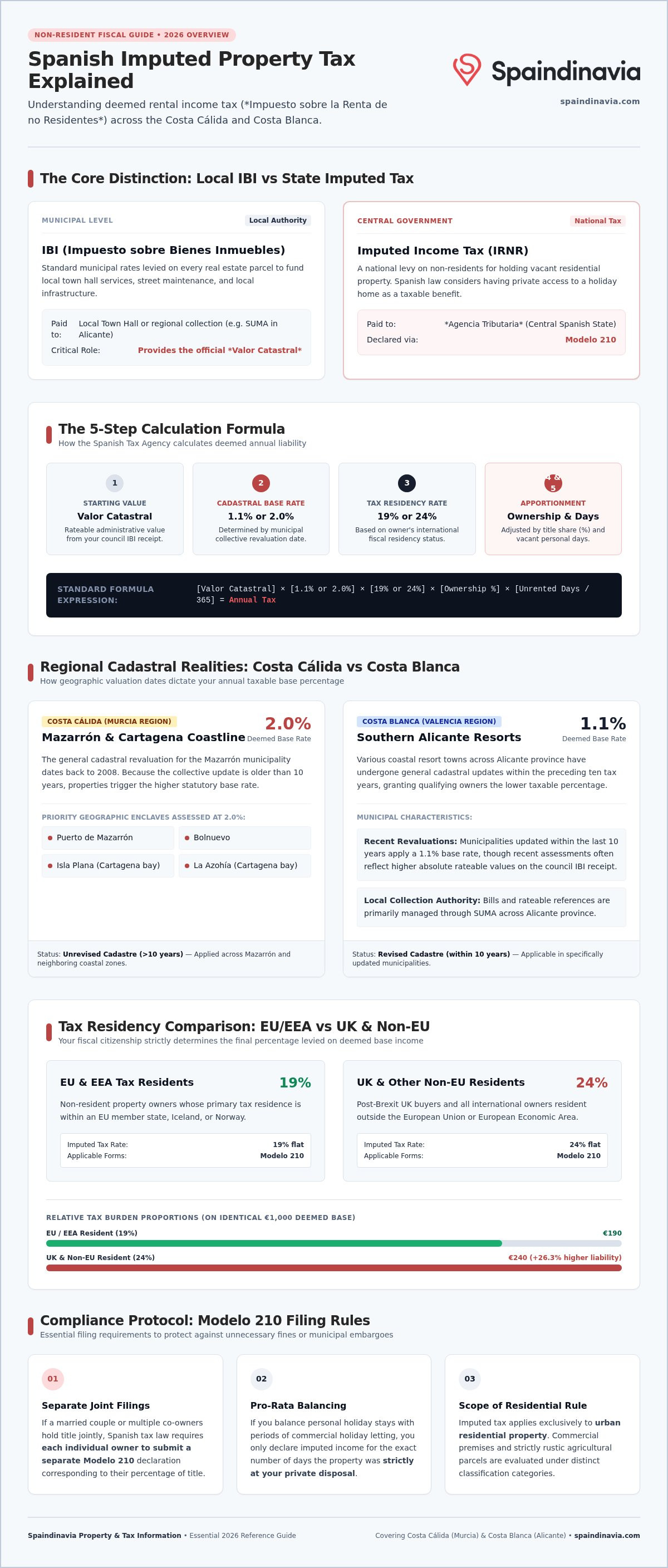
Imputed income tax, formally known as renta imputada de bienes inmuebles, is a state-level levy assessed on non-resident property owners. Governed under the Non-Resident Income Tax rules (Impuesto sobre la Renta de no Residentes, or IRNR), it treats the private availability of residential real estate as a quantifiable economic perk. Gaining a firm grasp of this concept is vital for anyone owning a Mediterranean bolthole, as understanding imputed income tax on Spanish property ensures you protect your investment against unnecessary fiscal friction.
The Logic Behind Spanish Deemed Rental Income
Spanish tax legislation assumes that any urban residential home at the owner's personal disposal produces a financial advantage. Even if your coastal apartment sits shuttered from November to April, the Spanish Tax Agency (Agencia Tributaria) views your right to use the property as deemed income. The tax applies purely based on your ownership and the absence of a paying tenant. Commercial premises and strictly rustic parcels follow distinct valuation categories and do not fall under this domestic residential rule.
Imputed Tax vs Council Tax (IBI): Avoiding Confusion
Many overseas owners mistakenly assume that settling their annual council bill clears their total fiscal duties. That confusion causes significant headaches. Within the wider Spanish property tax framework, there are two distinct payments you must manage independently:
- Municipal Rates (IBI): Impuesto sobre Bienes Inmuebles is a local council charge paid directly to your municipal town hall (or regional collection agencies like SUMA in Alicante) to fund local services and infrastructure.
- Imputed Income Tax (IRNR): A national tax declared to the central Spanish state via Modelo 210 for holding vacant residential property.
Crucially, you cannot calculate your national imputed liability without your local IBI receipt, because that council document establishes the property's official rateable base.
Who Is Liable to Pay in 2026?
Any non-resident individual holding legal title to urban residential property in Spain must file. If a married couple or business partners buy a property jointly, each named owner must submit a separate Modelo 210 reflecting their specific ownership percentage. Your citizenship and tax residence dictate the applied percentage: EU and EEA residents enjoy a 19% rate on their deemed base, while UK and other non-EU buyers pay a 24% rate. For detailed purchase prerequisites before taking title, consult our buying property in Spain guide to safeguard your acquisition from day one.
How Spanish Imputed Property Tax Is Calculated
Working out your annual liability is straightforward once you know where to look. When mastering the nuances of understanding imputed income tax on Spanish property, you follow a predictable five-step calculation that removes all guesswork from your annual budgeting.
Understanding the Rateable Cadastral Value (Valor Catastral)
Step one requires locating your property's valor catastral. This is the official administrative value assessed by the government, and you can find it directly on your annual council tax receipt (the local IBI bill from your town hall or SUMA in Alicante). Crucially, this administrative figure is almost always substantially lower than your actual open-market purchase price.
Revised vs Unrevised Municipal Cadastral Rates
Step two and three involve determining your taxable base by checking the date of your town's last general revaluation:
- Revised Municipalities (1.1%): Applied if your local council updated its cadastral values within the current tax year or the preceding ten tax years.
- Unrevised Municipalities (2.0%): Applied if the collective valuation is older than ten years.
This geographic distinction matters. Across the municipality of Mazarrón, covering Puerto de Mazarrón and Bolnuevo, the general valuation dates back to 2008, triggering the 2% base rate. The same applies across the bay in Cartagena's picturesque enclaves of Isla Plana and La Azohía. By comparison, various resort towns across the Costa Blanca have undertaken collective updates within the past decade, placing their taxable base at 1.1%.
EU/EEA Citizens vs UK and Non-EU Property Owners
Step four applies your personal tax rate to that base, determined strictly by where you hold fiscal residency:
- EU and EEA Residents: Assessed at a flat rate of 19%.
- UK and Non-EU Residents: Assessed at a flat rate of 24% (with post-Brexit rules disallowing general maintenance expense deductions against imputed values).
Consider a practical comparison: on an apartment with a revised €100,000 cadastral value (a taxable base of €1,100), an EU resident pays €209, whilst a UK resident pays €264. Finally, step five apportions this figure if you only owned the home for part of the calendar year. You simply divide the annual total by 365 and multiply by the exact days the title was registered in your name.
Once calculated, declarations are submitted through the official Agencia Tributaria Modelo 210 filing portal. If you are currently evaluating new build villas or resale apartments, accounting for these predictable holding costs gives you total financial peace of mind right from the start.
Cadastral Realities Across Costa Cálida and Costa Blanca
Municipal cadastral values do not follow a uniform national standard. Instead, local councils set valuations based on when their collective surveys took place. A critical part of understanding imputed income tax on Spanish property involves recognising how these administrative valuations vary between the relaxed coastal shores of the Region of Murcia and the high-density developments of Alicante province.
Property Valuation Dynamics in Costa Cálida and Mazarrón
The Costa Cálida stands out for its accessible property values and modest baseline valuations. In the municipality of Mazarrón, covering the vibrant seaside promenade of Puerto de Mazarrón and the tranquil coves of Bolnuevo, the municipal urban IBI rate is 0.54%, with historical general cadastral valuations dating back to 2008. Tucked along the same 35-kilometre bay, the idyllic coastal hamlets of Isla Plana and La Azohía belong to the municipality of Cartagena, which last undertook general revisions in 2007. Because both municipal valuations are older than ten years, properties generally use the 2% base rate. However, lower baseline rateable values in these traditional fishing enclaves often yield total tax bills that remain comfortably affordable.
Valuation Trends Across the Southern Costa Blanca
Cross the regional border into the southern Costa Blanca, and you enter the Valencian Community. Here, municipal collections are administered by SUMA Gestión Tributaria rather than local town halls. Many Costa Blanca municipalities, having witnessed extensive residential expansion, have undergone more frequent collective revisions over the past decade, placing their base rate at 1.1%. Even with that lower multiplier, the substantially higher cadastral values across bustling Alicante developments can produce a comparable or higher final liability than older valuations in Murcia.
New Builds vs Resale Homes: Fiscal Base Comparisons
Property typology also shapes your initial tax obligations:
- Resale Apartments and Villas: Established properties come with an existing cadastral reference clearly recorded on historical IBI bills, providing complete certainty from day one.
- New Build Villas: Brand-new homes may undergo an administrative delay of several months before the local cadastre issues an individual valor catastral.
Under statutory AEAT rules, if an individual cadastral valuation has not been formally issued by the time your return is due, you must apply the 1.1% rate to 50% of the property's acquisition price. Independent solicitors always verify these municipal records before completion, ensuring you submit precise provisional figures via the Agencia Tributaria Modelo 210 filing portal and avoid unexpected retroactive adjustments.
Filing Modelo 210: Deadlines, Procedures, and Pitfalls
Submitting your annual return represents the practical culmination of understanding imputed income tax on Spanish property. Rather than letting paperwork become a source of stress, following an established filing routine keeps your Mediterranean ownership entirely hassle-free.
The Annual Calendar and Submission Methods
Imputed income returns are filed in arrears for the preceding calendar year under Income Code 02. For the 2025 tax year (declared in 2026), non-residents can submit their return between 1 January and 31 December, with direct debit payments cutting off on 23 December. Under Order HAC/623/2026, returns for the 2026 tax year onwards move to a streamlined filing window running from 1 April through 31 December of the following year.
You can lodge declarations digitally using a Spanish digital certificate or Cl@ve PIN via the tax agency website. Alternatively, non-residents who spend most of the year abroad frequently rely on an independent fiscal representative to calculate liabilities, draft returns, and arrange bank debits on their behalf.
Common Non-Resident Filing Mistakes to Avoid
Several recurring errors create unnecessary complications for overseas homeowners:
- Assuming Direct Debit Covers Everything: Paying your annual IBI council rate does not settle your state-level imputed tax.
- Submitting a Single Form for Multiple Owners: If a couple buys a townhouse in Puerto de Mazarrón or a bungalow in the Costa Blanca, each spouse must file an individual Modelo 210 for their specific ownership share.
- Overlooking Address Updates: The tax office sends notifications to your official fiscal address in Spain unless you formally register your primary overseas postal residence.
Consequences of Neglecting Spanish Tax Returns
Ignoring annual tax obligations triggers automated administrative responses. Under Article 27 of the General Tax Law, voluntary late submissions incur a 1% surcharge plus an extra 1% for each complete month of delay. Unresolved notices eventually attract formal penalties, compounding interest, and local bank account embargoes.
Outstanding liabilities also surface during future conveyancing. When selling resale villas or holiday apartments in Bolnuevo, Isla Plana, or La Azohía, the Spanish Tax Agency withholds certification until all historic non-resident taxes are cleared. If you are preparing to purchase resale apartments or holiday rental properties in Murcia or Alicante, browse coastal properties with Spaindinavia to ensure your purchase is supported by independent legal and fiscal experts right from the start.
Balancing Personal Use and Holiday Letting with Spaindinavia
Many international buyers choose to enjoy their Mediterranean retreat for several months each year whilst letting it to holidaymakers during peak periods. A central aspect of understanding imputed income tax on Spanish property is recognising how this hybrid lifestyle directly shapes your annual tax obligations.
Hybrid Use: Transitioning from Personal Holiday Home to Rental
Spanish tax legislation ensures you never pay double taxation on the same calendar dates. When you rent out your home, you pay imputed tax only for the exact number of days the property remained unoccupied or reserved for personal leisure. Days with paying guests are declared quarterly as rental revenue under separate non-resident income rules. Maintaining an accurate booking register is essential, particularly because tax authorities cross-reference data submitted by digital booking platforms directly against your annual Modelo 210 filing.
The Advantage of Expert Property Management
Transitioning a private residence into a compliant holiday let involves distinct regional obligations. While holiday rental properties across the Costa Blanca must navigate municipal urban compatibility certificates and €1,000,000 public liability insurance policies, the Region of Murcia operates a regional registration system with €300,000 coverage. Professional management bridges this gap entirely. Spaindinavia oversees key holding, guest registrations, and home care across the bay, supplying transparent, date-stamped records so your fiscal representative can calculate your pro-rata days without friction.
Securing Your Sun-Drenched Coastal Property Peacefully
Whether you are searching for new build villas in Puerto de Mazarrón and Bolnuevo, characterful resale apartments in Isla Plana and La Azohía, or modern townhouses and bungalows along the southern Costa Blanca, sound fiscal planning protects your long-term capital appreciation. Pairing local real estate insight with an established network of independent legal and tax advisers ensures your investment remains secure from the outset. Connect with the team at Spaindinavia to explore exceptional coastal homes and begin your Mediterranean chapter with total confidence.
Enjoy Seamless Property Ownership Under the Spanish Sun
Navigating non-resident taxes doesn't need to complicate your Mediterranean dream. By separating municipal IBI council rates from state Modelo 210 declarations, checking your local rateable base, and recording rental days accurately, understanding imputed income tax on Spanish property becomes a simple annual task rather than a burden.
Whether you're drawn to new build villas in Puerto de Mazarrón, coastal resale homes in Bolnuevo, Isla Plana, and La Azohía, or modern apartments along the Costa Blanca, protecting your investment starts with sound planning. Spaindinavia supports you at every stage with a hand-picked portfolio of premium coastal properties, comprehensive key holding and holiday rental management, and a trusted regional network of independent bilingual solicitors and fiscal consultants. When you have the right local team by your side, managing your Spanish home is effortless. Find your dream home in Costa Cálida and Costa Blanca with Spaindinavia and begin your new chapter with complete confidence.
Frequently Asked Questions
What happens if I never rent out my Spanish holiday home?
You are still required to declare and pay imputed income tax every year. The Spanish Tax Agency treats the property's availability for personal use as a deemed economic benefit, regardless of how many weeks you actually spend inside. Leaving the home locked up without generating rental income simply means declaring 365 days of personal use on Modelo 210. This fundamental rule is central to understanding imputed income tax on Spanish property.
Do British citizens pay higher imputed tax than EU citizens?
Yes, British homeowners pay a higher rate than EU and EEA residents. Following the UK's departure from the European Union, British non-residents are subject to a flat 24% rate on their calculated taxable base. In contrast, EU and EEA citizens pay a lower rate of 19%. This distinction applies whether you own a coastal apartment in Puerto de Mazarrón in Costa Cálida or a villa in Costa Blanca.
Is Spanish imputed income tax included in my annual council tax (IBI) bill?
No, imputed income tax is completely separate from your annual municipal council tax. Your IBI bill is a local levy paid directly to your municipal town hall or collection agency, such as SUMA across the Costa Blanca. Imputed tax is a national Non-Resident Income Tax declared directly to the Spanish Tax Agency via Modelo 210. Settling your council tax does not fulfil your state-level income tax obligations.
How do I find my property's valor catastral to calculate the tax?
You can find your property's valor catastral printed directly on your local IBI council tax receipt. Look for the rateable valuation split between land and construction. If you own a newly completed home and haven't yet received an official receipt, your conveyancing paperwork or the regional cadastre office can supply your reference number. When calculating and understanding imputed income tax on Spanish property, having this annual document to hand is essential.
Do joint owners need to file separate Modelo 210 tax forms?
Yes, Spanish tax legislation requires every individual named on the title deed to file their own return. If two partners buy a holiday townhouse equally, each person must submit a separate Modelo 210 reflecting their individual 50% share of the property. Submitting one joint declaration covering both owners is invalid and often results in automated notifications, payment discrepancies, and processing delays from the tax office.
What are the penalties for failing to declare imputed property tax?
Failing to file generates progressive surcharges, interest, and potential administrative penalties. Voluntary late submissions incur an immediate 1% surcharge, which increases by 1% for every additional month of delay under Article 27 of the General Tax Law. Persistent non-compliance eventually leads to formal collection proceedings, including Spanish bank account embargoes and frozen funds when you later decide to sell your home.
Can I deduct utility or maintenance expenses from imputed income tax?
No, you cannot deduct any running costs, utility bills, or renovation expenses from your imputed income tax liability. Imputed tax is calculated strictly as a statutory percentage of your home's rateable cadastral value. Expense deductions are permitted only against declared rental revenue for EU and EEA tax residents during periods when paying guests occupy the home; non-EU residents cannot deduct operational expenses under current rules.


