

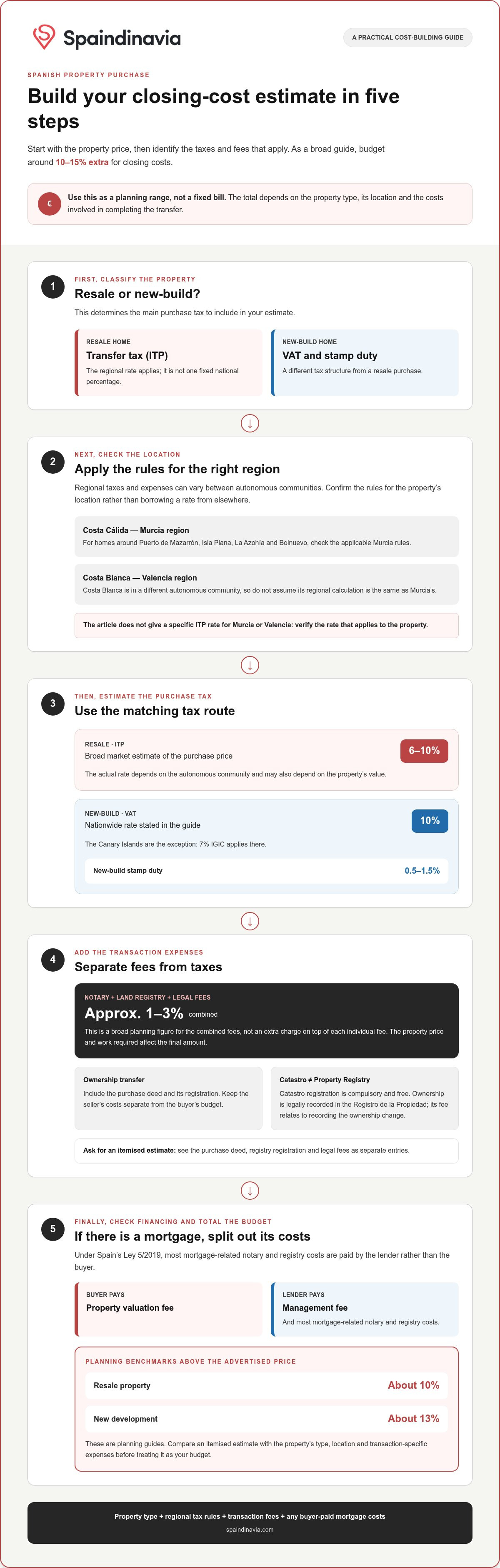
Estimating closing costs for a Spanish property purchase means budgeting around 10-15% of the property price for taxes and fees, in addition to the purchase price. The exact total depends on the property type and autonomous community. Resale homes and new builds are taxed differently, so the headline estimate is a starting point, not a single fixed bill.
It’s natural to focus first on the property price, whether you’re considering a coastal apartment or a villa. To plan your budget with confidence, you also need to account for the taxes and fees involved in the purchase.
This guide explains the main costs, including transfer tax or VAT, notary and registration fees, and the additional expenses that may apply if you use a mortgage. It also highlights the regional difference between Costa Cálida in Murcia and Costa Blanca in Valencia: each is in a different autonomous community, where purchase taxes and expenses can vary. You’ll come away with a clearer way to estimate your total budget before taking the next step.
Key Takeaways
- Identify whether the property is a resale home or a new build, as this determines which purchase tax applies.
- Base your estimate on the autonomous community where the property is located. Costa Cálida is in Murcia, whilst Costa Blanca is in Valencia.
- Separate taxes from notary, land registry and legal fees so you can see what makes up your overall purchase budget.
- If you’re considering a mortgage, include financing-related costs in your planning alongside the purchase costs.
- Use the property price, type and location to build a more relevant estimate before deciding what fits your budget.
Notary and land registry fees
Notary and land registry fees are part of the wider purchase budget, alongside taxes and legal costs.
Buyers should budget for the costs of transferring ownership, including the purchase deed and its registration. The seller’s costs are separate, so keep the two budgets distinct when planning the transaction.
Notary, registry and legal fees together are approximately 1-3% of the purchase price. This is a broad planning figure, not a separate charge: the individual notary, registration and legal amounts make up the total. The property price and the work required to complete the transfer affect the final amount. Ask for an itemised estimate so you can see each cost clearly.
A mortgage changes which party pays certain deed-related costs. Under Spain’s Ley 5/2019, most mortgage-related notary and registry costs are paid by the lender rather than the buyer. The buyer pays the property valuation fee, while the lender pays the management fee, according to Boletín Oficial del Estado.
Unexpected charges can arise if the property has registered charges or a mortgage that needs attention during the conveyancing process. A notary deed and a Land Registry search help establish what is being transferred and what must be dealt with.
Keep the Catastro and the Registro de la Propiedad distinct. Registration in the Catastro is compulsory and free, while ownership is legally recorded in the Registro de la Propiedad. The land registry fee relates to recording the ownership change, not to the free Catastro registration. This distinction matters whether you’re buying in Costa Cálida, in Murcia, or Costa Blanca, in Valencia.
For a clearer estimate, list the purchase deed, land registry registration, legal fees, any mortgage valuation and any power of attorney separately. Then confirm which mortgage costs fall to the lender and which remain in your buyer’s budget. This breakdown makes it easier to compare the total with your purchase price, without overlooking registration or transaction-specific expenses.
What does a property purchase in Spain cost?
As a broad guide, buyers budget around 10-15% of the property price for closing costs; estimates can also fall between 11% and 14%, depending on region and property type. The main difference is whether the home is resale or new-build, and where in Spain it sits.
Resale and new-build cost estimates
A resale purchase generally involves transfer tax, whilst a new-build purchase generally involves VAT and stamp duty. This distinction matters because the tax structure changes the amount to set aside beyond the agreed price. As a planning guide, allow about 10% above the advertised price for a resale property and approximately 13% for a new development.
New-build properties are subject to 10% VAT nationwide, except in the Canary Islands, where 7% IGIC applies. Stamp duty on a new-build purchase typically ranges from 0.5% to 1.5%. These taxes sit alongside transaction expenses, such as notary fees and registry fees, which also form part of your total.
Treat cost estimates as guidance, not universal totals. Taxes and additional expenses depend on the property and the applicable rules.
Regional cost estimates and examples
Regional estimates reflect differences in purchase taxes and expenses between Spain’s autonomous communities. This matters when comparing homes with similar prices in different parts of the country. A property in Costa Cálida is in Murcia, while Costa Blanca is in Valencia, so the applicable regional rules differ.
One national percentage cannot provide an exact budget for every property purchase.
Using a purchase-cost calculator
A purchase-cost estimate starts with the property price and the applicable tax treatment. Enter the details carefully: resale and new-build properties can involve different taxes, while the property’s location determines which regional rules apply.
Use the result to organise your budget, not as a final bill. Notary and registry fees may vary, and purchase taxes and expenses can change between communities. A calculator is guidance rather than legal or professional advice; compare its itemised estimate with the costs relevant to your intended purchase.
Regional transfer tax for resale properties
For a resale home, the main purchase tax is transfer tax, known as ITP. The applicable percentage depends on the autonomous community and, in some regions, the property’s value. Non-resident buyers should also budget for the same kinds of purchase taxes and transaction fees: the property type and location determine the tax treatment, while a mortgage can add financing-related costs.
Spain’s regional transfer tax isn’t one fixed national percentage. A broad market estimate places resale ITP between 6% and 10% of the purchase price, though regional rates and value bands can affect the final amount. Treat the rate for the property’s autonomous community as a key part of your purchase-cost estimate, rather than applying a figure from another region.
For example, resale property transfer tax in Madrid is 6%, whilst residential property transfer tax in the Basque Country is 4%. In Catalonia, property transfers valued at no more than €600,000 are taxed at 10%; higher-value transfers are taxed at an average rate based on the property’s value, according to Agència Tributària de Catalunya. These differences can change the funds needed at completion, even when two homes have similar asking prices.
Location matters along the Mediterranean coast, too. Costa Cálida is in the Murcia region, while Costa Blanca is in the Valencia region. They sit in different autonomous communities, so don’t assume a resale property in Puerto de Mazarrón, Isla Plana, La Azohía or Bolnuevo has the same ITP calculation as a home on Costa Blanca. The region, property value and applicable tax bands are what shape the transfer tax.
Keep ITP separate from VAT and stamp duty. A resale purchase may involve ITP, while a new-build may involve VAT and stamp duty. These are different tax treatments, so don’t add ITP to VAT as if both normally applied to the same purchase. The property type determines which purchase tax belongs in your estimate.
To estimate the ITP element, identify the autonomous community, establish the purchase price used for your calculation, and apply the region’s relevant rate or value bands. Then list other costs separately, such as notary, registry and legal fees. This makes the transfer tax visible within the wider closing-cost budget and helps prevent a national headline percentage from obscuring local differences.
For a resale home in Murcia or Valencia, use the correct regional tax rules before comparing properties. A calculator can provide an initial estimate, but its result depends on the region and property type entered. Keep your ITP figure separate from VAT, stamp duty and transaction fees, so each cost has a clear place in your overall purchase budget.
Lawyer and estate-agent fees
Legal support and representation can add to the overall cost of a property purchase. List legal, administrative and agency services separately so you can see what each fee covers.
Lawyer and conveyancing costs
Conveyancing involves the legal work needed to review and complete a property transfer. Ask for the scope and tax treatment of each charge to be itemised.
A gestoria handles administrative tasks, which differ from a lawyer’s legal review. For foreign buyers and residents alike, keeping these services as separate budget lines makes the total easier to understand. It also helps you distinguish legal advice from paperwork processing.
Estate-agent and buying-agent fees
A buying-agent fee is payment for representation in finding or purchasing a property. Buying-agent fees in Spain typically range from 2% to 3% of the purchase price. The amount can substantially affect your budget, so distinguish this fee from the seller’s estate-agent commission and record who is responsible for each agreed charge.
Estate-agent and buying-agent roles aren’t necessarily the same. An estate agent markets a property, while a buying agent represents the buyer’s interests in the search or purchase. Before including a fee, identify the service it covers, the party paying it and whether VAT is included. That makes comparisons between properties more meaningful.
Utilities also need a place in your completion budget. Count the separate connections required at the property, rather than treating them as one combined fee. The number and type of services being connected affect the total allowance.
If you’re using a mortgage, keep any valuation charge separate from legal and agency costs. A valuation assesses the property for lending purposes; it is not the lawyer’s conveyancing work. Include financing-related expenses only in the mortgage scenario.
List administrative services, any agency fee, utility connections and mortgage-related charges separately, then check what each amount covers.
Estimating total purchase costs
Build your estimate from separate cost lines, rather than relying on one percentage. A useful starting point for government taxes and legal fees is an additional 12-16% of the purchase price. The total involved can differ by region, property type and financing, so keep each assumption visible.
Start with the purchase price, then estimate taxes and transaction expenses for the specific property. Treat that as a broad illustration, not a universal figure: a resale home and a new-build have different tax treatments, and regional rates change the calculation.
Separate the deposit from closing costs if you’re using a mortgage. Spanish banks typically lend non-resident buyers 60-70% of the property price, so buyers generally need a 30-40% deposit before closing costs. That means your cash plan must cover both the deposit and purchase expenses, rather than treating the deposit as the full amount needed.
Mortgage-related expenses need their own line. A Spanish mortgage adds an estimated 2-4% in additional costs to a property purchase, while mortgage fees generally amount to about 1% of the loan value. Banks may charge mortgage bank fees of up to 1.5% of the mortgage amount. These are different planning estimates, so don’t automatically add them together as separate charges.
For a practical worksheet, record the purchase price, applicable tax, notary and registry fees, legal costs, and any mortgage expenses. Add the deposit separately, then include property-specific items such as utility connections. Keep the figures tied to the home’s autonomous community: Costa Cálida is in Murcia, while Costa Blanca is in Valencia, and their regional tax rules differ.
Check the estimate against the details that drive each line. A calculator’s result depends on the price, whether the property is resale or new-build, and the selected autonomous community. Mortgage costs also depend on the loan amount. If you have already paid an earnest deposit under the purchase agreement, make sure it is reflected in your overall purchase budget.
Finally, compare the total cash needed with your available funds, not just the advertised price. This gives you a clearer view of whether a particular house in Spain fits your budget. To explore homes while keeping the purchase budget in view, plan your Spanish property search.
Spaindinavia: New Build Villas
Spaindinavia can help you explore property options once you’ve worked through your purchase budget. If you’re comparing a new-build home with a resale purchase, its portfolio includes New Build Villas, Resale Apartments, Townhouses and Bungalows.
For a Costa Cálida search in Murcia, consider the Mazarrón area, including Puerto de Mazarrón, Isla Plana, La Azohía and Bolnuevo. Costa Blanca is in the Valencia region, with different regional purchase taxes to factor into your estimate. Spaindinavia supports buyers through the purchase process, working alongside independent solicitors, banks and local experts.
If you’re ready to explore your options, contact Spaindinavia or visit spaindinavia.com.
Turn your budget into a confident property search
Estimating closing costs for a Spanish property purchase becomes more useful when you connect your budget to the home and location you truly want. Think about how you’ll use the property, the space that suits your plans, and the day-to-day setting you’re hoping to enjoy. A coastal home in Costa Cálida, Murcia, offers a different regional setting from one on Costa Blanca, Valencia. Within Costa Cálida, explore the character of Puerto de Mazarrón, Isla Plana, La Azohía and Bolnuevo as you shape your shortlist.
Spaindinavia offers New Build Villas, Resale Apartments and Townhouses, giving you different property types to consider as you refine your plans. Share the locations and home styles you have in mind, and take the next step at your own pace. Talk to Spaindinavia about your property plans, and start shaping a move that feels right for you.
Frequently Asked Questions
How to get a full insight into the buyer's costs?
Build an itemised estimate using the property price, property type and autonomous community. Include the relevant purchase tax, notary and land registry fees, legal costs, administrative expenses and any mortgage charges. Keep one version for a cash purchase and another for a mortgage purchase, so financing-related items don’t get mixed into the basic transaction costs. This breakdown makes it easier to see what each amount covers.
Need a precise figure?
A precise estimate comes from calculating each cost against the details of the planned purchase, rather than applying one national percentage. Use the correct autonomous community and distinguish resale from new-build tax treatment. Add transaction fees and any mortgage-related expenses as separate items. A calculator can help organise these inputs, but its output is guidance, not legal or professional advice.
What are the overall costs of buying a property in Spain?
As a broad guide, allow around 10-15% of the property price for closing costs, then add the property price itself to understand the overall purchase budget. That estimate covers taxes and transaction expenses, not the cost of financing over the mortgage term. If you’re a non-resident buyer using a mortgage, plan separately for the deposit, which is additional to closing costs.
What taxes apply when buying a resale property in Spain, and what are the regional rates?
Resale purchases generally incur ITP, or transfer tax, rather than new-build VAT. The rate varies by autonomous community: market estimates usually place it between 6% and 10%, with regional exceptions. Madrid’s rate is 6%, and residential property transfer tax in the Basque Country is 4%. In Catalonia, transfers up to €600,000 are taxed at 10%; higher-value transfers use an average rate based on property value, according to Agència Tributària de Catalunya.
What taxes apply when buying a new-build property in Spain, including VAT and stamp duty?
New-build homes generally incur 10% VAT across Spain; the Canary Islands instead apply 7% IGIC. Stamp duty, known as AJD, typically ranges from 0.5% to 1.5% for new-build purchases. These taxes are distinct from ITP, which usually applies to resale homes. Include the property’s autonomous community in your calculation, because regional purchase expenses can differ.
What are typical notary, land registry, and administrative fees for a Spanish property purchase?
These are separate line items, not one combined charge. Show each amount individually, alongside legal fees, to see which services contribute to the transaction total.
How do closing costs differ by Spanish region and property price?
Both the autonomous community and property value affect the tax calculation, so homes with similar asking prices can produce different closing-cost estimates. Costa Cálida is in Murcia, whereas Costa Blanca is in Valencia, so select the correct region when comparing figures.
How can buyers estimate total upfront costs for a Spanish property purchase?
Start with the purchase price, then add the applicable tax and transaction fees. If you’re a non-resident using a mortgage, Spanish banks typically lend 60%-70% of the property price, so allow for a 30%-40% deposit as well as closing costs. Keep the deposit separate in your budget, and account for any earnest deposit already paid as a credit towards costs and the down payment.


