

A high energy rating does not automatically mean a new-build home in Spain costs more to build. Finding new build homes with high energy efficiency ratings in Spain starts with understanding the A-to-G energy certificate scale and looking beyond the rating to the features that affect comfort and energy use.
It is natural to weigh the purchase price against the prospect of lower energy bills. The right choice depends on more than a letter on a certificate: insulation, windows, heating and cooling systems, and local climate all matter.
This guide explains how build costs and energy bills can shape your decision, what Spain’s rating system tells you, and how to compare homes on Costa Cálida in Murcia, especially around Puerto de Mazarrón, Isla Plana, La Azohía and Bolnuevo, with options on Costa Blanca in Valencia. These are different regional markets, so the best fit depends on the location and lifestyle you prefer. You’ll have a clearer way to assess efficiency alongside the home you want.
Key Takeaways
- Use Spain’s A-G energy certificate as a starting point, then look beyond the letter to the home’s insulation, windows and heating or cooling systems.
- Compare the features that influence energy use before weighing a home’s purchase price against its potential running costs.
- Understand how energy-rating requirements relate to buying or renting, and why the rules can change over time.
- Compare homes in Costa Cálida, including Puerto de Mazarrón, Isla Plana, La Azohía and Bolnuevo, with options on Costa Blanca in Valencia; location and home design both shape your choice.
- Set your priorities around comfort, energy use and maintenance to make it easier to assess new-build options against the lifestyle you want.
Is an energy-efficient home more expensive to build?
Including features such as stronger insulation, efficient windows, solar panels or an aerothermal system can require a larger construction budget. These choices affect materials and equipment, while the home’s design and location also shape what is needed. The useful comparison is not simply the initial cost: consider how the home is designed to use energy, the comfort it offers and the bills its systems may help reduce.
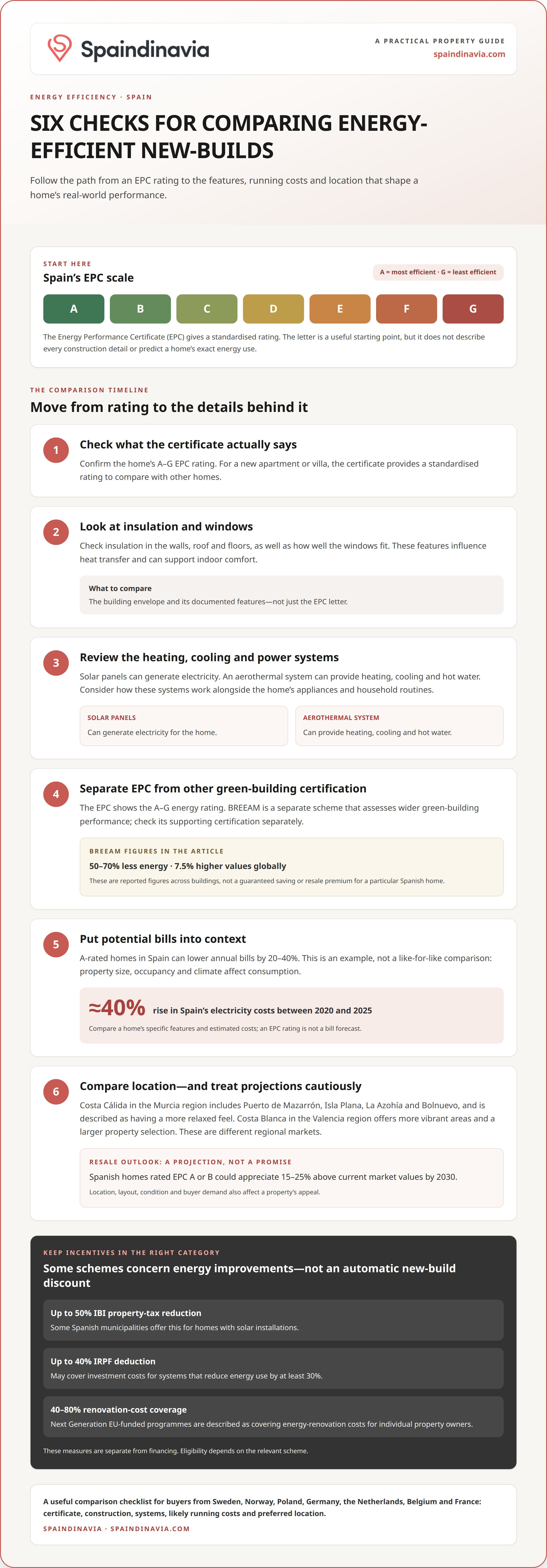
Spain’s Energy Performance Certificate (EPC) gives a home an alphabetical rating from A to G, with A at the efficient end of the scale and G at the least efficient. An energy performance certificate can help buyers and renters understand a home’s energy efficiency. For a new apartment or villa, the certificate provides a standardised rating, but the letter alone does not explain every detail of the building’s construction or likely energy use.
The documents that verify a new home’s energy rating in Spain are its Energy Performance Certificate and the supporting certification for any separate scheme, such as BREEAM. The EPC shows the A-G rating; BREEAM assesses wider green-building performance and is distinct from Spain’s certificate.
BREEAM-certified buildings typically use 50-70% less energy than conventional buildings, and have demonstrated 7.5% higher values globally. Those figures describe reported performance across buildings, not a guaranteed saving or resale premium for a particular home in Spain. For a buyer, the practical next step is to connect a rating or certification to the features behind it: insulation, windows, heating and cooling, and solar generation. A well-insulated building envelope can support everyday comfort before additional technology is considered.
Some financial incentives relate to energy improvements rather than the purchase of a new-build home. Some Spanish municipalities offer up to a 50% reduction in IBI property tax for homes with solar installations. Spanish IRPF deductions may cover up to 40% of investment costs for systems that reduce energy use by at least 30%. Next Generation EU-funded programmes are described as covering 40-80% of energy-renovation costs for individual property owners, so they concern renovation rather than automatically reducing a new-build purchase cost. These measures are separate from financing, and eligibility depends on the relevant scheme.
In short, an efficient specification can affect the build budget, but the EPC helps you compare the result with other homes. When finding new build homes with high energy efficiency ratings in Spain, weigh the certificate alongside the construction features and any applicable incentives. That gives you a clearer picture of upfront choices, future energy use and comfort in your home in Spain.
Energy costs for green and conventional properties
An energy rating can offer a useful starting point, but actual bills depend on how a home is used and equipped. In Spain, A-rated homes can lower annual bills by 20-40%. These are examples, not a like-for-like comparison: property size, occupancy and climate affect consumption.
Look beyond the letter to the features that can influence day-to-day energy use. Insulation in walls, roofs and floors helps limit heat transfer, while well-fitted windows can support indoor comfort. Solar panels can generate electricity, and an aerothermal system can provide heating, cooling and hot water. The combination matters: solar generation works alongside the home’s appliances and household routines, rather than removing the need to consider energy use.
Spain’s electricity costs rose approximately 40% between 2020 and 2025. That change makes running costs an important part of assessing a home, alongside its purchase price. Costa Cálida in Murcia includes the Mazarrón coast, with a more relaxed feel, while Costa Blanca in Valencia offers more vibrant areas and a larger property selection. When comparing homes in Puerto de Mazarrón, Isla Plana, La Azohía or Bolnuevo with Costa Blanca options, consider how each property’s design and local climate may affect energy use.
Energy performance may also matter when selling. The market information projects that Spanish homes rated EPC A or B could appreciate 15-25% above current market values by 2030. That is a projection, not a guaranteed resale result. Location, layout, condition and buyer demand remain part of a property’s appeal. A clear certificate and understandable information about insulation, solar panels and heating systems can help prospective buyers assess likely running costs.
UK buyers may recognise A-rated new-build examples in Norfolk, Essex, Sussex and Scotland. Those examples can help explain the appeal of efficient design, but a UK property is not a direct cost comparison for a home in Spain. Different climates, building designs and household patterns influence energy use. For a fairer comparison, focus on the Spanish home’s EPC rating, documented systems and the annual cost estimate for its specific features.
As you assess options, compare the rating with the systems and construction behind it, rather than treating the certificate as a bill forecast. This helps you weigh sustainability, comfort and potential resale appeal together. You can explore new-build property options with these running-cost considerations in mind.
Minimum energy ratings for home sales and rentals
For buying or renting in Spain, separate the rating a property carries today from future minimum standards. The EU requires existing homes to reach at least an E energy rating by January 1, 2030. This requirement concerns existing housing, so it should not be confused with the energy performance expected of a newly built home.
Spain’s national implementation of the updated Energy Performance of Buildings Directive had a deadline of May 29, 2026. The information available also identifies future mandatory property upgrades arriving in 2033. These dates make timing relevant: a buyer assessing an existing home today may consider future requirements differently from someone choosing a new build designed to meet current construction standards.
Rental rules also deserve attention. Regional draft proposals indicate that landlords leasing uncertified or low-rated properties could face fines of up to €60,000. Because these are draft proposals, they should not be treated as a single confirmed national fine. The practical point for a landlord is to consider certification and the property’s rating when assessing a rental, while recognising that regulations may depend on location and can change.
Market trends provide further context, but they do not determine a home’s energy standard. Sales of newly constructed homes in Spain increased by 21.6% year-on-year in Q4 2024. New-home prices in Valencia’s Valencian Community rose by 7.4% over the past year, compared with 6.9% in Andalusia. Costa Blanca is in Valencia, while Costa Cálida is in Murcia; compare these coastal markets as distinct locations, not interchangeable price areas.
Features that improve efficiency in Spanish new builds include insulation in walls, roofs and floors, airtight construction, and high-performance windows. Solar panels can support self-consumption, while air-to-water heat pumps can provide heating, cooling and hot water. These features can work together: insulation reduces heat transfer, and suitable equipment helps manage the remaining heating or cooling needs.
Orientation and shading also affect thermal comfort. Main windows can be positioned to make use of winter sun, while overhangs, pergolas or shutters can block stronger summer sunlight. In Costa Cálida, consider these design choices around Puerto de Mazarrón, Isla Plana, La Azohía and Bolnuevo; compare them with Costa Blanca locations in Valencia, where the setting and home design may differ. These details help you assess how a property responds to its climate, alongside its rating and applicable regulations.
Buyer priorities when choosing new-build homes
Start with the factors that shape everyday living: comfort, energy use, maintenance and location. Spain’s Código Técnico de la Edificación requires new homes to be nearly zero-energy buildings, but buyers still benefit from understanding how a particular home achieves its performance. Quality insulation and air- or ground-source heat pumps were priority green features for downsizers and first-time buyers in a survey. Low maintenance costs were the most popular reason respondents gave for choosing a new build, while a high Energy Performance Certificate rating ranked second.
A property professional can shortlist new-build homes with an A energy rating and explain how each home’s certificate relates to its design and systems. This helps you compare energy performance with the layout, location and lifestyle you want, rather than relying on a rating alone.
Before purchasing, ask the property professional to review the home’s Energy Performance Certificate and explain the main features behind its rating. Useful points to discuss include the building envelope, heating and cooling systems, and how the home is expected to support comfort and reduce energy use.
- Insulation: ask how the walls, roof and floor are insulated, since the building envelope affects heat transfer.
- Heating and cooling: discuss whether the home uses an air- or ground-source heat pump and how it provides comfort across seasons.
- Energy documentation: ask the professional to explain the certificate’s rating and the systems described in the property information.
- Long-term priorities: compare the features that may influence maintenance and energy use with your own plans for the home.
Set your energy goals early in the buying process and discuss them with the architect before the project is finalised. If lower energy demand is your priority and the budget is tight, consider the building envelope before technological add-ons. That means prioritising insulation and airtight construction over extra equipment. This approach connects environmental aims to the home’s fundamental design, rather than treating technology as a substitute.
Location matters too. Compare Costa Cálida in Murcia, particularly Puerto de Mazarrón, Isla Plana, La Azohía and Bolnuevo, with Costa Blanca in Valencia. They are different coastal regions, and each home’s design and setting will influence how it suits your priorities. For buyers from Sweden, Norway, Poland, Germany, the Netherlands, Belgium and France, the NIE is a separate administrative consideration from a home’s energy rating. Keep NIE-related paperwork and the property’s energy documents as distinct strands of your purchase planning.
Energy efficiency and local ratings
Spain’s A-G certificate rates an individual property, not an entire region or city. New Spanish homes are designed to achieve an A or B rating from the start, while the Technical Building Code provides the foundation for construction standards. From May 2026, Spain’s EPC A rating is reserved for zero-emission buildings. So, rather than choosing a destination based on a supposed regional winner, compare the rating and design of each home you are considering.
There is no single region or city that can be identified as having the most energy-efficient new-build homes from a property’s location alone. Costa Cálida, in Murcia, and Costa Blanca, in Valencia, are distinct coastal markets. On Costa Cálida, you might compare homes around Puerto de Mazarrón, Isla Plana, La Azohía and Bolnuevo; on Costa Blanca, assess the individual development and its certificate. The local setting matters, but it does not replace property-level evidence.
Energy ratings are especially useful when comparing homes with different designs or systems. A certificate helps you compare assessed performance, while the home’s construction and equipment explain how that performance is achieved. Consider insulation, windows, heating and cooling, and any solar generation together. This gives you a more practical picture of energy consumption than relying on a location label or a single feature.
Spain’s existing building stock offers context for that comparison: more than 80% of Spanish buildings are currently rated E or below. This figure covers existing buildings, not a forecast for every town or a rating for each new development. A new-build’s A or B rating therefore helps distinguish its assessed performance from much of the older housing stock. It does not, on its own, tell you the energy use of every household.
Property owners should also distinguish an EPC rating from a separate sustainability standard. Spain’s Technical Building Code is the foundational standard used by leading developers, while a rating describes the energy performance assigned to a property. A development’s location, construction choices and installed systems all contribute context, but each certificate applies to the property it assesses. Treat any wider environmental label as additional information, not a substitute for the EPC.
For a useful local comparison, shortlist homes in your preferred area, then review each property’s rating and the features behind it. Compare Costa Cálida’s Mazarrón coast with Costa Blanca locations in Valencia on the same basis, rather than assuming one is automatically more efficient. This approach keeps real estate decisions grounded in the home itself: its certificate, design, systems and likely pattern of use. The clearest takeaway is simple: choose by verified property performance, then weigh the location and lifestyle that suit you.
Spaindinavia
Spaindinavia offers property options for buyers weighing energy performance, location and lifestyle together. If you are looking for a new build, explore new-build villas and apartments. Resale apartments, townhouses and bungalows offer different alternatives.
Compare Costa Cálida in Murcia, including Puerto de Mazarrón, Isla Plana, La Azohía and Bolnuevo, with Costa Blanca in Valencia. These are distinct coastal areas, so consider the setting as well as each property’s energy rating and features when narrowing your choice.
If you are ready to explore property options in Spain, contact Spaindinavia.
Choose a home that fits the life you want
Your next step in finding new build homes with high energy efficiency ratings in Spain is to turn your priorities into a clear shortlist. Think about how you’ll use the property, the spaces that matter most, and the balance you want between energy performance and everyday comfort. Costa Cálida is in Murcia, with Puerto de Mazarrón, Isla Plana, La Azohía and Bolnuevo among the areas to consider; Costa Blanca is in Valencia, giving you a choice between two different regional markets.
A home is a long-term decision, so give yourself room to compare the details that matter to you. With a clearer sense of your preferred region and lifestyle, conversations about suitable properties can become more focused and reassuring.
Explore your options with Spaindinavia and take the next step towards a home in Spain that feels right for you.
Frequently Asked Questions
Do new Spanish homes automatically meet the 2030 energy regulations?
No. A property being newly built doesn’t, by itself, prove that it meets every future requirement. Spain’s Código Técnico de la Edificación requires new homes to be nearly zero-energy buildings, while the EU’s E-rating target by 2030 concerns existing homes. Treat these as distinct standards and dates. For a specific purchase, the home’s own certificate and applicable requirements are more useful than assuming compliance from its age.
Does energy efficiency increase resale value?
Energy efficiency can support a home’s appeal to future buyers, particularly those who value comfort and predictable running costs. However, a rating does not determine the sale price on its own. Two A-rated homes may attract different interest because of their location, condition, layout or local demand. Consider the certificate as one part of the property’s resale profile, alongside the qualities buyers can see and experience.
Understanding the Ratings: How Does the System Work?
Spain’s property energy rating uses letters from A to G, with A indicating the most efficient end of the scale and G the least efficient. The assessment assigns a rating to an individual property, not to its town or region. When finding new build homes with high energy efficiency ratings in Spain, comparing homes in the same area can help separate property performance from location preferences.
What is an Energy Performance Certificate (EPC) in Spain?
An Energy Performance Certificate, or EPC, is the document that records a property’s energy rating in Spain. It gives buyers a standard way to understand the home’s assessed efficiency, rather than relying only on a developer’s general description. The certificate is valid for 10 years. For a new home, use it to understand the assessed rating, then consider how the property’s design and equipment support everyday use.
What energy efficiency ratings are used for new-build homes in Spain?
New-build homes in Spain use the same A-to-G energy rating scale as other properties. The letter belongs to the home’s Energy Performance Certificate; it is not a separate regional grading system. New homes are designed to achieve an A or B rating from the start, but each property should be assessed using its own certificate. Separate schemes such as BREEAM assess broader environmental performance, not the Spanish EPC letter.
What are Spain's building energy-efficiency requirements for new homes?
Spain’s Código Técnico de la Edificación requires new homes to be nearly zero-energy buildings. This describes a building standard, not a promise that every home will have identical systems or energy use. Design, insulation and installed equipment shape a home’s performance in practice. Buyers can use the certificate and property information together to understand how the development’s construction approach applies to the specific home they are considering.
What is the average price of energy-efficient new-build homes in Spain by region?
There isn’t one useful regional average for every energy-efficient new build. Prices depend on the location, property type, size, specification and development, so a regional figure can conceal substantial differences between individual homes. For a practical comparison, assess properties of a similar type and size in the area you prefer. Costa Cálida in Murcia and Costa Blanca in Valencia are separate markets, each with its own locations and housing choices.
How do A-rated new-build homes compare with lower-rated homes on energy bills?
A-rated homes may have lower energy bills than less efficient properties, but actual costs depend on household use, home size, local climate and installed systems. Homes with different ratings may also have different occupancy patterns or heating and cooling needs. Treat the EPC as a comparison tool, not an exact forecast of future bills. The systems and construction behind the rating help explain the difference.


