

A Spanish home can be sold with an embargo still attached. Understanding what an embargo on a Spanish property means starts with one important point: it secures an unpaid debt, but doesn’t automatically transfer ownership. The creditor may still pursue enforcement after the sale.
It’s understandable to worry that a restriction on a property could put your purchase, or someone else’s home, at risk. The key is to establish what the entry relates to and what it means before money changes hands.
This guide explains how a property embargo works in Spain, how an entry may expire or be cancelled, and what to look for in the nota simple before paying. It also covers why the debt amount, the party enforcing it and the embargo’s priority matter. Understanding these details can help you approach a property purchase with greater confidence.
Key Takeaways
- Understand that an embargo secures an unpaid debt; it doesn’t automatically transfer ownership, but enforcement may continue after a sale.
- Find out whether the entry is judicial or administrative, since the route to cancellation depends on who imposed it and how the debt is settled.
- Use the nota simple to identify registered burdens, then establish who is enforcing the embargo, the amount involved and its priority.
- Before paying, clarify how the debt and cancellation will be handled as part of the sale, so the registry entry is not overlooked.
- Remember that an expired registry entry and an extinguished debt are not necessarily the same thing.
What does embargo mean?
An embargo is a legal measure used in Spain to secure an unpaid debt. If you’re asking what an embargo on a Spanish property is, it’s a restriction that can make the property subject to debt recovery. It doesn’t automatically transfer ownership, but a registered entry can affect a sale.
Meaning of a property embargo
An embargo on a Spanish property is a legal restriction that makes the property available to help recover a debt. It does not, by itself, transfer ownership to the creditor or anyone else.
The entry is recorded in Spain’s Registro de la Propiedad as an anotación preventiva de embargo, or preventive attachment entry. To understand what an embargo on a Spanish property means, identify the property and debt named in the record. The entry signals that a debt claim may affect the home. If you’re considering buying a property with this entry, establish who is enforcing it, the amount involved and its priority before paying a deposit or signing.
Property attachments and seizure proceedings
An attachment identifies assets that may be seized to secure payment, including property, bank accounts, receivables and securities. A court can order an attachment, or a public authority can impose one through an administrative act. The notice tells the debtor which asset has been seized and the amount concerned.
For a tax debt, enforcement may follow if the debtor has not paid within the applicable voluntary payment period. Article 62.5 of Spain’s General Tax Law sets that deadline. The timing matters because missing it can move a debt into enforcement.
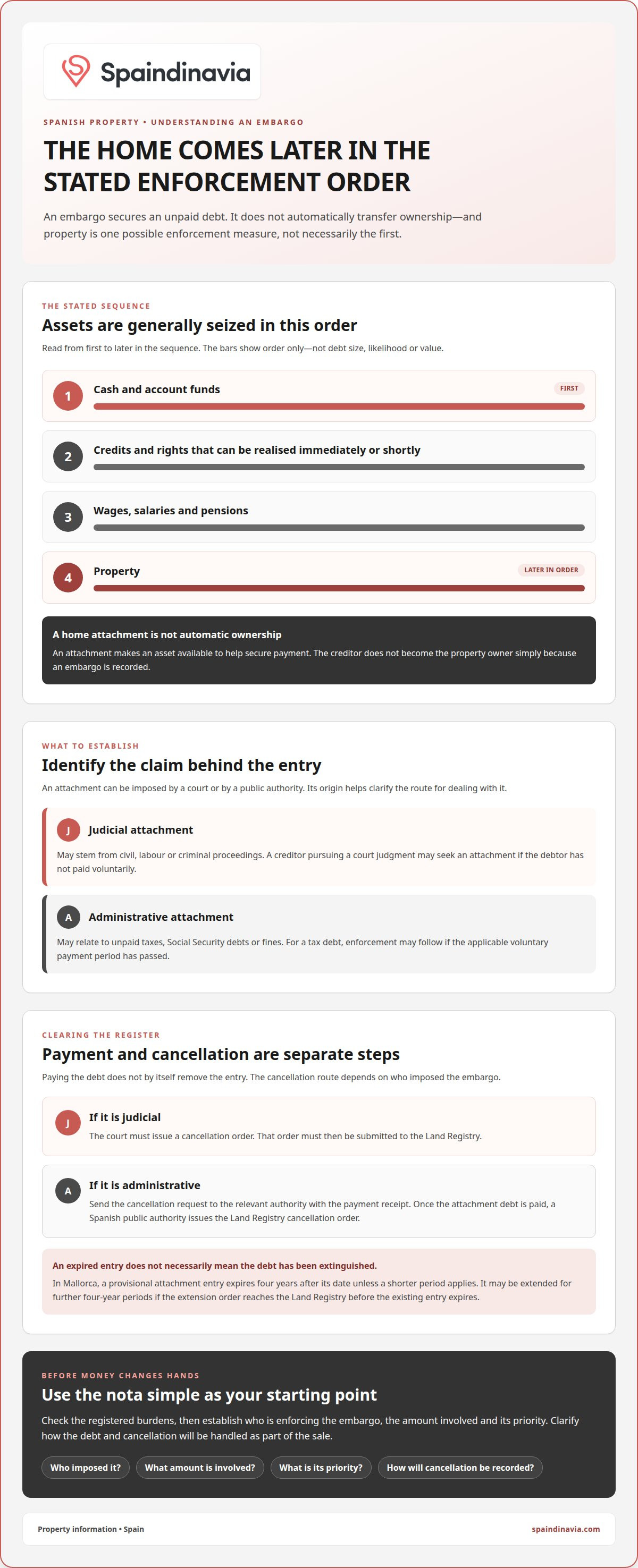
Property is generally seized after cash or account funds, immediately or shortly realisable credits and rights, and wages, salaries and pensions, in that order. An embargo against a home is therefore one possible enforcement measure, not the automatic first step for every debt. A lawyer can explain the documents and proceedings involved in a particular property.
Debts that can lead to an embargo
Several types of unpaid debt can lead to an embargo on property in Spain. Administrative attachments may arise from unpaid taxes, Social Security debts or fines, while judicial attachments can stem from civil, labour or criminal proceedings.
For example, an unpaid tax debt may progress to enforcement if the payment period or notice deadline passes. A creditor pursuing a court judgment for a payment obligation may also seek an attachment if the debtor has not paid voluntarily. In either case, the measure secures the claim against assets; it does not mean the creditor already owns the home.
Before acquiring a property, use the registered information to understand the claim and who imposed it. Distinguishing an administrative measure from a court-ordered attachment helps clarify the enforcement route and the steps needed to address the entry.
How is it cancelled on expiry?
Expiry can remove a registered entry, but it doesn’t necessarily settle the underlying debt. The cancellation route depends on whether the embargo is judicial or administrative, and whether payment or an expiry date applies.
In Mallorca, a provisional Land Registry entry of attachment expires four years after its date, unless the law sets a shorter period. Expiry removes the attachment’s registry priority; it does not extinguish the underlying debt. A former owner may therefore still owe money even if the entry has expired. Check which date applies to the record and whether an extension was lodged before expiry.
A provisional entry can be extended for further four-year periods if the extension order reaches the Land Registry before the existing entry expires. The date alone may not tell you whether an attachment has ended: the record and any extension matter. Expiry is also different from cancellation after payment, which requires a separate process.
For a judicial embargo, paying the debt does not itself remove the entry from the Land Registry. The court must issue a cancellation order, which must then be submitted to the registry. For an administrative embargo, the cancellation request goes to the relevant authority with the payment receipt. Once the attachment debt is paid, a Spanish public authority issues the Land Registry cancellation order.
Keep the payment paperwork together. A receipt can support an administrative cancellation request, while a judicial case requires a court order before the registry record can be cleared. If you’re buying, selling or arranging completion, establish which route applies and how the cancellation will be recorded. Clearing the debt and removing the Land Registry entry are related but separate steps.
At an auction in Mallorca, the successful bidder can obtain cancellation of charges entered after the attachment being enforced. This does not mean every earlier charge disappears. The order of entries matters, so consider the auction result alongside the property record. For an owner selling with an attachment, retaining part of the sale proceeds can cover cancellation-process costs as well as the debt.
Mortgage foreclosure is a separate issue to consider at completion. It usually leaves less time to sell than an embargo for another debt, so the type of enforcement affects the sale timetable. Don’t assume that paying an embargo also resolves a mortgage or other charge: identify each entry and its own cancellation route.
For a property purchase in Spain, explore homes available in Spain alongside the checks needed before completion.
Reviewing the Nota Simple before paying
A nota simple is a Land Registry extract showing registered burdens against a property in Spain. It can list mortgages, tax liens and embargoes, giving you a starting point before you pay a deposit or sign. Article 222 of Spain’s Mortgage Law recognises registry publicity through a nota simple and registry certification. A certification has stronger evidentiary value than the extract.
Read each entry in the nota simple alongside the sale details. For an embargo, establish who is enforcing it, the amount involved and its priority. This helps distinguish a debt secured against the property from other unpaid debts belonging to the debtor. If the entry is unclear, a lawyer can explain its effect before the purchase proceeds.
An embargo doesn’t automatically transfer the seller’s debt to the buyer. However, ownership can transfer while the embargo remains in force, and the creditor may pursue enforcement against the property after the sale. The debtor may still owe the money, while the property remains exposed to the registered measure.
Payment can form part of the sale arrangements. For an attachment imposed by a public authority, the debt can be deducted from the seller’s proceeds at the notary and recorded in the deed. For a court-ordered attachment, a cheque payable to the creditor can be collected at the notary, with the creditor signing to acknowledge payment. A debt certificate should show the principal, interest and costs owed.
A debtor can pay the amount specified in a seizure diligence before the recipient pays it or the property is sold at auction or otherwise realised. Paying the full specified amount can lead to the seizure being lifted. A third party who pays the amount in that diligence is released from the obligation to pay that amount to the debtor. Keep the payment evidence with the cancellation paperwork.
If the creditor accepts instalments, make sure the arrangement explains how payments reduce the outstanding debt. Instalments are not the same as paying the full amount specified in the seizure diligence, which is the stated basis for lifting the seizure. Before relying on a payment plan, establish how it affects enforcement and what remains due.
Also account for debts beyond the embargo entry. Before buying, request a creditor’s debt certificate and a homeowners’ association certificate confirming whether community fees are outstanding. Article 9 of Spain’s Horizontal Property Law addresses the transferor’s certificate of community-debt status, unless the buyer expressly waives it. Together, these records help clarify what the property’s registered burdens and unpaid charges mean before completion.
Attachments imposed by public authorities
A public authority can attach a Spanish property to secure unpaid debts. The measure may be imposed through an administrative act rather than a court order, and the attachment is recorded against the property in the Land Registry. Its purpose is to support debt recovery, not to transfer ownership immediately. For a seller, the authority involved and the type of debt shape the steps needed to clear the entry.
Common examples include debts to the Spanish Tax Agency, Social Security or a town hall. These may involve IBI, refuse charges or municipal capital gains tax. Unpaid fines can also lead to an administrative embargo. Each debt has its own notice and payment record, so identify the authority named on the entry before discussing a sale or settlement.
Tax-related attachments can also concern taxes that burden a transfer, acquisition or import. Article 79 of Spain’s General Tax Law addresses attachment of assets for payment of these taxes, subject to legal protections and exceptions. Spanish seizure procedures must follow proportionality. In practice, this means the measure should relate to the debt being secured, rather than being treated as an unlimited claim against every asset.
A payment letter for a public-authority attachment sets out the amount due, including principal, interest and costs calculated on the date of signing. It allows a few days after signing to pay before additional interest applies. Read the calculation date and payment deadline together: a later settlement may require an updated figure. Keep the receipt, as proof of payment supports the request to cancel the attachment.
After payment, submit the receipt and a cancellation request to the relevant authority. The authority issues the Land Registry cancellation order once the attachment debt is paid. A provisional entry can also expire, but it may be extended for further four-year periods if the extension order is lodged before expiry. Article 86 of Spain’s Mortgage Act is cited as the legal reference for extending provisional attachment entries. An expired entry does not necessarily mean the debt itself has ended.
Notices matter too. A debt warning published in the Boletín Oficial del Estado counts as official notification. Spanish authorities must take the legally necessary steps to inform owners about debts and pending action. Since the Boletín Oficial del Estado publishes notices online and in print, a non-resident seller should ensure official correspondence reaches them and is understood in time to respond.
If someone receives a seizure diligence as a payer, they must respond and, where applicable, pay the specified amount to the State Tax Administration Agency. For a property sale, the seller’s outstanding amount should be addressed in the completion arrangements, with the payment record and cancellation process kept together. A public-authority attachment can also affect jointly owned property, although in Mallorca it may affect only the debtor’s share. This distinction can matter when another owner is selling or refinancing.
What an embargo or lien means for a Spanish property
A registered embargo can affect a Spanish home even after its owner changes. For a buyer, the key question is not only who owes the debt, but whether the creditor can still enforce against the property. A sale does not automatically remove the entry or stop enforcement.
That distinction matters because the debtor’s personal obligation and the property’s registered burden are related, but not identical. The seller may remain responsible for the debt, yet the creditor may pursue the attached home after transfer. In practical terms, buying the property without arranging how the entry will be settled and cancelled can leave you dealing with an unresolved burden.
A judicial embargo can follow a court judgment for a payment obligation the debtor didn’t meet voluntarily. These attachments may arise from civil, labour or criminal proceedings. If the debt remains unpaid, the creditor can seek a court auction. An embargoed property can be sold to recover a debt in less than a year, so a pending process can become a real issue during a purchase.
Where a property has more than one attachment, the order of registration can determine which creditor has priority. In Mallorca, the attachment entered first generally has priority over later entries. That is why the date and position of each charge matter, not just the total outstanding amount. Request the relevant debt details and establish which entry is being enforced before discussing completion.
A property with an embargo can still be sold before the court approves the remate, or auction award, if the debtor pays the amount owed plus costs and interest. For a public-authority attachment, the debt can be deducted from the seller’s proceeds at the notary and recorded in the deed. The arrangements need to cover both payment and cancellation, rather than assuming that signing alone clears the Land Registry.
An auction follows a different path. Once the court approves the remate and the successful bidder pays, the property belongs to that bidder. This can quickly change the situation for an owner who has not resolved the outstanding debt. A court-ordered attachment may also be challenged through a third-party ownership claim, known as tercería de dominio, if the seized property belongs to someone other than the debtor.
For your purchase, connect the registry entry, creditor’s claim and proposed payment at the notary. Ask how each outstanding charge will be handled and what document will support cancellation. Explore Spanish property options with these checks in mind before committing to a home.
Spaindinavia
Once you understand what an embargo may mean for a purchase, Spaindinavia can help you explore Spanish homes. If you’re considering a New Build Villa, Resale Apartment, Townhouse or Bungalow, keep registered burdens and any cancellation arrangements in mind as you weigh your options.
Compare the lifestyle you want with the practical details. Costa Cálida in the Murcia region includes the Mazarrón area, such as Puerto de Mazarrón, Isla Plana, La Azohía and Bolnuevo. Costa Blanca offers a different coastal setting. Spaindinavia can help you explore property in light of your plans, while keeping the legal and registry details central to a considered purchase.
If you’d like to discuss your property search, contact Spaindinavia.
Choose your next step with confidence
Understanding what an embargo on a Spanish property means can help you approach a purchase with clearer priorities. Let the registry findings inform your decision rather than letting the excitement of a viewing or offer rush the process. A home should suit your plans and make sense on paper.
As you continue your search, consider the kind of home and lifestyle you want, and include the property’s legal position in that decision. Whether you’re considering a holiday home or a move to Spain, taking a considered approach gives you room to weigh each property against what matters most to you.
Spaindinavia can help you explore property options as you plan your next move. Share what you’re looking for and take the next step at a pace that feels right for you.
Contact Spaindinavia about your property, and start shaping your search with confidence.
Frequently Asked Questions
What do I do if my home is seized for someone else’s debt?
Act promptly to establish why your home is named and who owes the debt. If the property belongs to someone other than the debtor, a third-party ownership claim, known as tercería de dominio, can challenge the seizure. Gather documents showing ownership and the seizure notice, which should identify the affected asset and amount. If the home is jointly owned, establish which owner’s share the attachment affects.
Can a house in Mallorca with a registered attachment be sold?
Yes, a house in Mallorca with a registered attachment can be sold, but the entry must be addressed as part of the transaction. The usual approach is to pay the debt and arrange cancellation at signing. Check the amount due and the entry’s priority, since other charges may also be registered. Expiry can remove an entry’s registry priority without extinguishing the debt.
Can you appeal?
You can challenge a seizure in certain circumstances. For example, a third-party ownership claim can be used if the attached property belongs to someone other than the debtor. In Mallorca, a court can also lift a registered attachment if it was improper or replaced by another form of security. The appropriate route depends on the basis for the seizure and the evidence about ownership or security.
How might you be informed that an embargo will take place?
You may receive a notice identifying the asset and amount involved, or a debt warning may appear in Spain’s Official State Gazette, the Boletín Oficial del Estado. Publication there counts as official notification. Authorities must take the legally necessary steps to inform owners about debts and pending action. If you live abroad, make sure official correspondence can reach you and is understood promptly.
How to cancel an embargo?
Cancellation depends on whether the attachment is judicial or administrative. For an administrative embargo, submit the payment receipt and a cancellation request to the relevant authority. For a judicial attachment, the court issues a cancellation order, which must then be submitted to the Land Registry. Keep proof of payment and the cancellation order together: paying the debt and clearing the registry entry are separate steps.
How does a Spanish property embargo appear in the Land Registry?
The Land Registry records an embargo as an anotación preventiva de embargo, or preventive attachment entry. A nota simple can show this entry alongside other registered burdens, such as mortgages and tax liens. Check the record for the enforcing party, the amount and the entry’s priority. A registry certification provides stronger evidentiary value than a nota simple.
Can you buy a Spanish property with an embargo registered against it?
Yes, a property with an embargo can be sold before the court approves the auction award, provided the debtor pays the debt, costs and interest. But ownership can transfer while the embargo remains in force, and the creditor may continue enforcement against the home. Before proceeding, clarify the payment and cancellation arrangements, including how the Land Registry entry will be addressed.
How can you check for an embargo before buying property in Spain?
Obtain a current nota simple from the Land Registry and look for an embargo or preventive attachment entry. Establish who is enforcing it, the amount involved and its priority. Also request a debt certificate showing principal, interest and costs, plus a homeowners’ association certificate covering community fees. These documents can reveal registered burdens or related unpaid amounts before you commit.


