

Convenient parking can shape how practical electric driving feels. When searching for Spanish properties with electric car charging points, look beyond the home itself: parking access and nearby public chargers matter too. In Spain, installing a private charging point in an individual parking space in a building’s car park requires prior notification to the homeowners’ association, according to the Boletín Oficial del Estado.
It’s understandable to want charging to fit naturally into everyday life, whether you’re moving, buying a holiday home or considering a property investment. The right setup depends on the property and how you plan to use it.
Discover what to look for in Madrid, how rapid charging can support journeys around Spain, and what charging options may suit residential and business properties. We’ll also explore the practical differences between a private parking space and shared parking, so you can make a more informed choice as you plan your next move.
Key Takeaways
- Parking access varies between Madrid city and the wider province, so assess the specific property and its parking arrangement rather than relying on regional averages.
- Learn what to consider when matching a property charging point with your electric car and choosing between home charging and rapid charging on the road.
- Before relying on an advertised charger, establish whether it is installed, accessible and working for the way you plan to use the property.
- Explore how charging needs can differ between residential and business properties, and which practical details shape each setup.
- Compare property types and locations across Spain, including coastal areas, with your everyday parking and charging needs in mind.
Which regions and cities in Spain have the most homes with EV chargers?
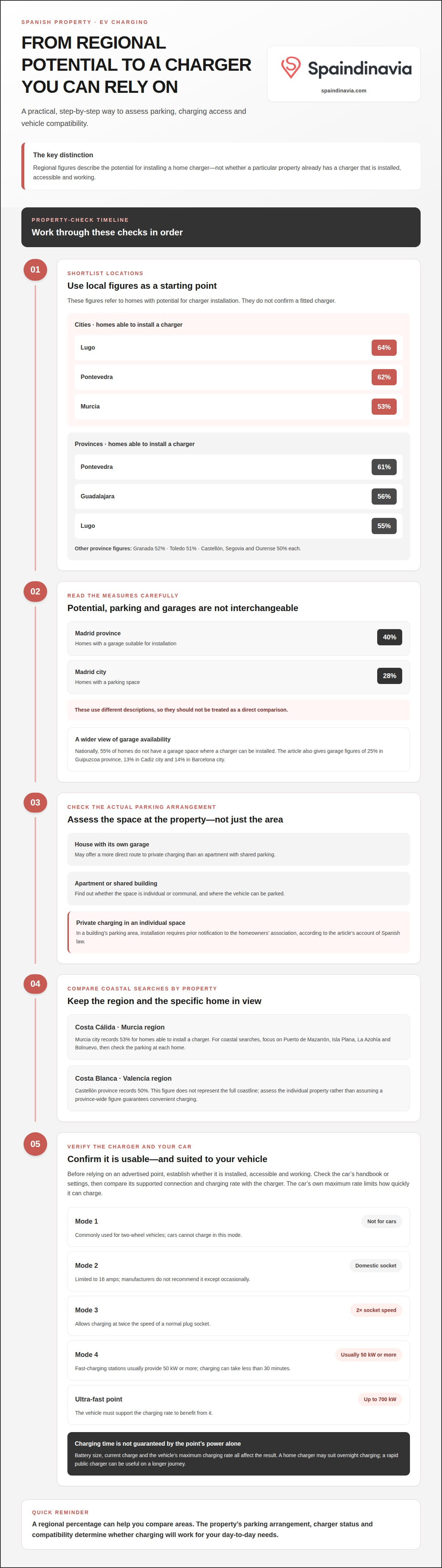
Start by separating homes that already have chargers from homes with parking where a charger could be installed. The available figures describe the second group, not confirmed working charging points. Madrid province, for example, has a garage suitable for installation in 40% of homes. In Madrid city, 28% of homes have a parking space. These figures use different descriptions, so they shouldn't be treated as directly equivalent.
Several provinces and cities show high potential for home charging. Lugo city leads the listed cities, with 64% of homes able to install a charger. Pontevedra city follows at 62%, while Murcia city records 53%. At province level, Pontevedra stands at 61%, Guadalajara at 56%, and Lugo at 55%. These figures can help you shortlist areas, but they don't establish whether a particular property already has equipment.
- 52%: homes in Granada province have parking facilities where a charger can be installed.
- 51%: the figure for Toledo province.
- 50%: the figure for Castellon, Segovia and Ourense provinces.
For coastal searches, distinguish the Murcia region from Costa Blanca in the Valencia region. The Murcia city figure is 53%, while Castellon province records 50%; neither figure represents the full coastline. Along the Murcian coastline, focus your property search on Puerto de Mazarrón, Isla Plana, La Azohia and Bolnuevo, then assess the parking at each home. Costa Blanca buyers should apply the same property-by-property approach rather than assuming a province-wide percentage guarantees convenient charging.
Property type also shapes the options. A house with its own garage may offer a more direct route to private charging than an apartment with shared parking. In a shared building, find out whether the parking space is individual or communal and where the vehicle can be parked. Under Spain's Horizontal Property Law, installing a private electric vehicle charging point in an individual garage space in a building requires only prior notification to the community, according to the Boletín Oficial del Estado.
Use regional figures to guide your shortlist, then assess each listing's parking arrangement and charger status separately. A high potential rate doesn't confirm that an advertised property has an installed or operational point. For homes in Madrid, Murcia or coastal locations, clarify whether parking is private, shared or simply nearby. That distinction helps you compare everyday convenience, not just broad regional potential.
At the national level, 55% of homes do not have a garage space where an electric vehicle charger can be installed, so broad potential figures should not obscure the limits of home charging. The local picture can be more constrained: in Guipuzcoa province, 25% of homes have a garage; in the city of Cadiz, 13% of homes have a garage; and in the city of Barcelona, 14% of homes have a garage. These garage figures offer a useful counterpoint to regional installation potential, but do not confirm that a charger is fitted or functioning.
In Spain, Article 17(5) of Law 49/1960 requires prior notification to the homeowners' association to install a private electric-vehicle charging point in an individual parking space in a building's parking area. The Horizontal Property Law was amended by Law 19/2009, published on 23 November 2009, to facilitate electric-vehicle charging-point installation. For buyers, the practical distinction remains whether the specific space and building arrangements support private charging.
Are EV charging points at Spanish properties compatible with all electric cars?
Not automatically. Compatibility depends on the connection between the vehicle and charging point, plus the charging method and available power. A charger at a property may suit one car but not another, so identify the vehicle and charger details before relying on it. In Spain, ITC-BT-52 is the Low Voltage Electrotechnical Regulation instruction governing electric-vehicle charging infrastructure.
Start with your car’s charging information. The handbook or vehicle settings explain which charging connections and speeds it supports. Compare these with the property’s charger details. A compatible connection is essential, while the car’s charging limit affects how quickly it can take energy. A more powerful charging point cannot make a vehicle charge faster than its own system allows.
Charging mode also matters. Mode 1 is commonly used for two-wheel vehicles, and cars cannot charge in this mode. Mode 2 uses a domestic socket, but manufacturers do not recommend it except occasionally. A conventional household socket is limited to 16 amps. Treat it as a limited fallback, not a substitute for a suitable installed car charger.
For a clearer comparison, check the charging point’s mode and power:
- Mode 3: allows charging at twice the speed of a normal plug socket.
- Mode 4: fast-charging stations usually provide 50 kW or more, and charging can take less than 30 minutes.
- Ultra-fast charging: points can provide up to 700 kW, although the vehicle must support the rate to benefit.
Those figures describe the charging point, not a guaranteed charging time for every car. Battery size, current charge and the vehicle’s maximum charging rate all affect the result. For example, a car with a lower maximum rate won’t use the full output of a higher-powered point. A home charger may suit overnight charging, while a rapid public charger can be useful on a longer journey.
Before booking a stay or choosing a property, ask for the charger’s connection type, charging mode and power rating, alongside the vehicle details it supports. Compare these with your own car’s handbook. For holiday rental properties, matching the charger to the vehicle can make arrival and daily journeys easier. Exploring holiday rental properties is one way to consider accommodation alongside your charging needs.
How can I verify that a property’s advertised EV charging point is installed and operational?
Treat “EV charging available” as a claim to clarify, not proof of a working charger. It might mean a private wallbox, shared garage equipment or a public charger nearby. Ask which option the listing refers to, where the vehicle parks and who can use the point. A charger nearby won’t offer the same convenience as a space beside your home.
Request clear evidence before deciding. Ask for a recent photograph showing the charger in its parking space, along with its make and model. Then request a short demonstration or live video showing the unit powered on and connected to a car. A lit screen alone shows power, not that a vehicle can charge. Ask to see the car’s charging display during the test.
During an in-person viewing, follow a simple test sequence:
- Locate the charger and confirm it sits within the advertised parking space.
- Check that the cable and connector reach the vehicle’s charging port without crossing another space.
- Connect a compatible car and confirm that charging starts on both the vehicle and charger displays.
- End the session normally, then check whether access requires a key, card or mobile app.
For a shared garage, establish how access works in everyday use. Ask whether the charger is assigned to the property or shared with other residents. Clarify how charging sessions start, how electricity use is billed and whether the parking bay is included with the home. A working unit may still be impractical if another resident occupies its space or access depends on a system you can’t use.
Ask to see the charger’s user instructions and installation information. The model details help you compare the unit with your car, while the instructions explain how to start and stop charging. If the seller or manager demonstrates the charger, note any error message, access restriction or step that prevents a session. Keep the written description and responses with your property documents so the advertised arrangement is clear.
For a property that’s still being completed, distinguish planned equipment from an installed unit. Ask for the exact parking bay and charger location shown in the property information, then request a demonstration once installation is complete. For a resale home, arrange the test during a viewing where possible. In either case, record whether the point is private or shared and whether a successful charging session was demonstrated.
Electric vehicle
Spain’s electric-vehicle landscape includes home charging, public networks and long-distance routes. The country has more than 37,000 public electric-vehicle charging points. That network matters when you’re choosing a home without a private charger, or planning journeys beyond your neighbourhood. A property’s parking arrangement and nearby public options together shape how easily charging can fit into daily life.
For a home search, separate the vehicle’s needs from the property’s features. A private parking space can make charging at home more convenient, whilst a shared garage may involve different access arrangements. If you’re considering an apartment, townhouse or villa, note where the car will be parked overnight. Then consider whether public charging nearby would support errands, commuting or longer trips.
Travel plans can help narrow your preferred area. The AP-7 has fast-charging service areas along the Mediterranean corridor between Barcelona and Valencia. From Valencia towards Alicante and Costa Blanca, the AP-7 and A-7 corridors serve as the main routes. Costa Blanca is in the Valencia region, while Costa Calida is in the Murcia region. For Costa Calida, look around Puerto de Mazarrón, Isla Plana, La Azohia and Bolnuevo, and factor in the drive to a suitable charging stop.
Madrid also connects to charging routes beyond the city. The A-2 corridor towards Zaragoza links Madrid and Barcelona, with charging points available along the route. For a journey from Madrid towards Málaga and the Costa del Sol, the A-4 and A-45 corridors have fast and ultra-fast chargers. These examples show why a property’s location can matter even when you usually charge at home.
Coastal travel offers other route choices. The A-92 runs through the Málaga-Seville-Granada touring route in Andalusia. Along the north, the Cantabrian Highway connects Irún in the Basque Country with A Coruña in Galicia across hundreds of kilometres. For residents and visitors, these named corridors make it easier to plan charging around a longer Spanish itinerary rather than focusing only on the destination.
Charging access also varies by accommodation. Tourist accommodation with EV charging points is available in every region of Spain, which can be useful when travelling between homes or exploring a new area. Before setting off, check how the particular point is accessed and whether it suits your car. Some Spanish stations accept contactless card payments, while some local networks are app-only, so plan for the payment method you’ll need.
For people relocating from Sweden, Norway, Poland, Germany, the Netherlands, Belgium or France, a useful first step is mapping regular journeys from the property. Mark the routes you expect to use, such as the AP-7 or A-2, then consider where home and public charging fit. That practical picture can help you choose between Madrid living, a Costa Blanca base or the quieter coastal setting of Costa Calida.
Recharging point
A recharging point’s usefulness depends on its power, location and supply arrangement. At a home, a slower unit may suit overnight charging, while a rapid point supports shorter stops. Spain’s charging plans include 50 kW fast chargers, 150 kW super-fast chargers and 350 kW ultra-fast chargers. Some motorway and coastal hubs offer direct-current charging at up to 350 kW.
For everyday home charging, distinguish a dedicated unit from a household socket. A standard household socket is limited to 16 amps. Occasional charging from a conventional socket is described at 10 A and approximately 2.3 kW, whilst a normal or slow charging point operates at 16 A and about 3.6 kW. Charging from a normal household socket takes six to eight hours. Manufacturers don’t recommend Mode 2 domestic-socket charging except occasionally.
Fast charging uses a different setup. Mode 4 stations usually provide 50 kW or more, and can charge a car in less than 30 minutes. That figure describes the potential charging time, not a guaranteed result for every vehicle. Battery condition, the car’s charging limit and the power available at the point all affect the session. A higher-rated public charger won’t make every car charge at its maximum rate.
At a residential property, cable routing and the parking layout matter as much as the unit. Charging installations in garages associated with homes must comply with Spain’s Low Voltage Electrotechnical Regulation, or REBT. Agree the cable route with the owners’ community, and don’t run it through common conduits or boxes. The owner requesting the point is responsible for the conduit running from the meter room to the parking space.
In a shared garage, check how the charging point will be supplied and metered before installation. The interested owner pays the installation costs and electricity consumed. A new electricity supply may involve a fixed cost billed monthly or every two months. These details affect whether a parking bay offers convenient, separately measured charging or requires a different supply arrangement.
For a property search, note the charger’s power rating, exact parking bay and electricity supply arrangement. Costa Calida is in the Murcia region, with Mazarrón-area options including Puerto de Mazarrón, Isla Plana, La Azohia and Bolnuevo. Costa Blanca lies in the Valencia region, giving you a distinct regional setting to compare. Explore Spanish property options with your charging needs in mind.
Spaindinavia
Spaindinavia can help you explore property options in Spain with your parking and charging priorities in mind. Whether you’re considering a new home or a resale property, compare the location, parking arrangement and your everyday travel needs together. New build villas, resale apartments, townhouses and bungalows each offer different ways to make parking part of your search.
Looking around Costa Calida in the Murcia region? Focus on Puerto de Mazarrón, Isla Plana, La Azohia and Bolnuevo. Costa Blanca, in the Valencia region, offers a different setting for your search. If you’re moving from Sweden, Norway, Poland, Germany, the Netherlands, Belgium or France, clear priorities can help you compare areas and property types at your own pace.
Contact Spaindinavia to discuss your Spanish property search and the features that matter to you.
Make charging part of your next move
Let your daily routine guide your property search. Think about where the car will usually be parked, how often you travel, and whether charging at home or during journeys suits you best. These preferences can help you weigh Spanish properties with electric car charging points against homes where nearby public charging may fit your plans.
Location matters in a different way for everyone. A city home in Madrid may suit a different routine from a coastal base. Costa Calida is in the Murcia region, with Mazarrón-area choices such as Puerto de Mazarrón, Isla Plana, La Azohia and Bolnuevo. Costa Blanca is in the Valencia region, so compare its locations with Mazarrón’s coastal setting and the lifestyle you want.
You don’t need every detail decided before taking the next step. A clear sense of your preferred area, property type and charging routine gives your search a useful starting point. Explore your Spanish property options with Spaindinavia and begin shaping a move that feels right for you.
Frequently Asked Questions
Where can I find Spanish properties with electric car charging points?
Search across Spain, then narrow your shortlist by location, property type and parking needs. For coastal living, compare Costa Calida in the Murcia region with Costa Blanca in the Valencia region. On Costa Calida, explore Puerto de Mazarrón, Isla Plana, La Azohia and Bolnuevo; each offers a distinct setting. Spaindinavia can help international buyers explore property options in these coastal regions and consider how parking fits their plans.
What types of Spanish properties include private or shared EV charging points?
Villas, apartments, townhouses and bungalows may have different parking arrangements, from a private garage to a space in a shared building. The property type alone doesn’t establish whether a charger is present or who can use it. For example, an apartment might have allocated parking in a communal garage, while a villa may have its own parking area. Consider the parking setup alongside the home’s location and your everyday routine.
What should buyers know about shared EV chargers in Spanish apartment buildings?
Clarify whether a shared-garage space and charger are allocated to your home or available to residents collectively. In a building, a private charging point in an individual garage space requires prior notification to the community, according to the Boletín Oficial del Estado. The person arranging a private installation pays its costs and electricity use. Shared access, billing arrangements and the garage’s electricity supply can all affect how practical charging will be.


