
What if the most important step in your move to the Mediterranean isn't choosing between a resale villa in Puerto de Mazarrón or a new build apartment on the Costa Blanca, but mastering the local classroom culture? You've likely spent nights worrying about your children falling behind due to the language barrier or felt overwhelmed by the paperwork required for the Spanish school system. It's completely natural to feel a mix of excitement and anxiety when your child's future and social integration are at stake.
We're here to turn that confusion into a clear, actionable plan. This guide provides everything you need to navigate the 2026 academic year, from understanding the LOMLOE curriculum to meeting strict enrolment deadlines. Whether you're looking at international colleges in the Valencia region or local state schools in the Murcia region's Isla Plana and Bolnuevo, we'll explain the costs and social benefits of each path. You'll discover a step-by-step timeline for the padrón and NIE requirements, giving you the peace of mind that your family's new life in the sun starts on the very best footing.
Key Takeaways
- Learn how the Spanish school system operates across the Costa Cálida and Costa Blanca, including the specific age requirements for compulsory education.
- Discover the differences between state, private, and concertada schools to identify which model best suits your family's budget and integration goals.
- Understand the impact of regional languages in the Valencia region versus the Murcia region and how bilingual programmes support non-native speakers.
- Master the essential paperwork steps, such as securing your padrón in Puerto de Mazarrón or Bolnuevo, to meet strict annual enrolment deadlines.
- Gain confidence in balancing academic rigour with the healthy, outdoor Mediterranean lifestyle found in coastal gems like Isla Plana and La Azohia.
Understanding the Spanish School System: Stages and Structure in 2026
Moving your family to a sunnier climate involves many practical steps. Understanding the Spanish school system is often the most significant part of that journey. In Spain, education is decentralised. This means that whilst the central government sets the broad curriculum, the autonomous communities of Murcia and Valencia manage their own school calendars and regional specificities. If you're settling into a new build villa in Puerto de Mazarrón or a townhouse on the Costa Blanca, you'll find that the local school is often the heart of the community.
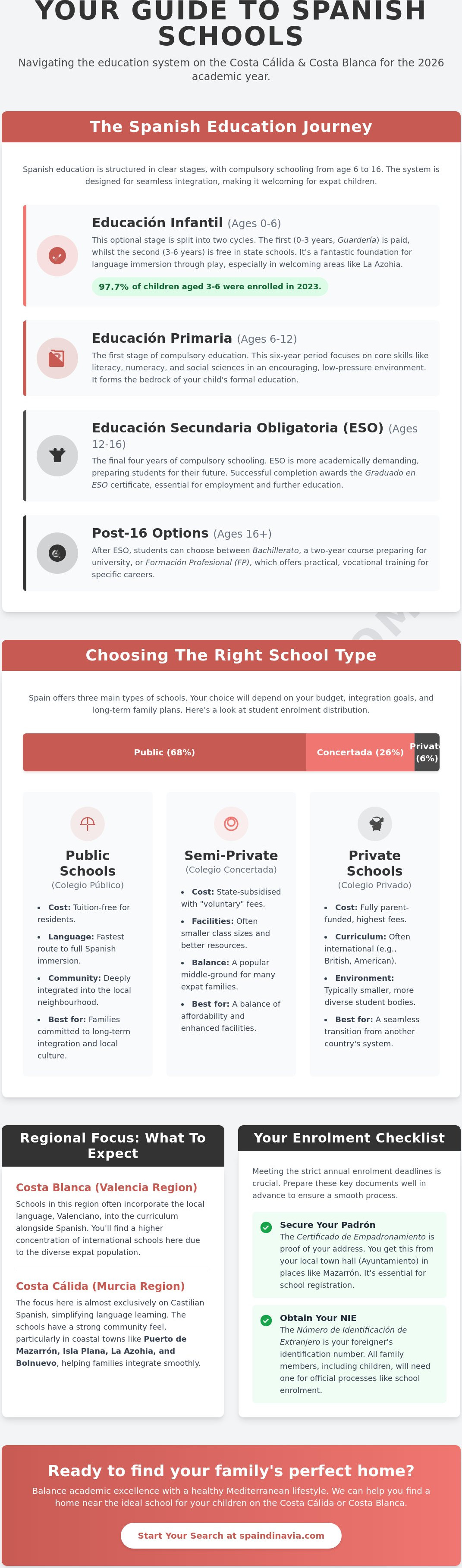
Compulsory education, known as Educación Obligatoria, spans ten years. It begins at age 6 and concludes at 16. The structure is designed to be inclusive and supportive, encouraging children to become active members of society from a very young age. This community-first approach is a hallmark of Mediterranean life. It helps expat children integrate quickly, especially in welcoming coastal areas like Bolnuevo and Isla Plana. The system is built on four main tiers: Infantil, Primaria, ESO, and finally Bachillerato or Vocational Training (FP).
Early Years: Educación Infantil (Ages 0-6)
The early years are divided into two distinct cycles. The first, Guardería, covers ages 0 to 3 and usually involves a fee. The second cycle, for ages 3 to 6, is free in state schools. Whilst this second stage is optional, data shows that 97.7% of children in Spain were enrolled in 2023. it's the perfect time for language immersion. In the preschools of La Azohia and the wider Mazarrón area, children learn through play and social interaction. This foundation makes the transition to primary school much smoother for non-Spanish speakers. For a detailed breakdown of these frameworks, you can review the wider context of Education in Spain to see how the tiers connect.
Compulsory Stages: Educación Primaria and ESO
At age six, children begin Educación Primaria. This stage lasts six years and focuses on core competencies like literacy, numeracy, and social sciences. The atmosphere is generally encouraging rather than high-pressure. Following this, students move into Educación Secundaria Obligatoria (ESO) from ages 12 to 16. This four-year block is more academically rigorous and introduces students to broader vocational options.
Completing this stage successfully leads to the Graduado en ESO certificate. This document is vital. it's the minimum requirement for most jobs in Spain and is the gateway to Bachillerato (university prep) or advanced vocational training. Whether you choose a resale apartment in the Costa Blanca or a bungalow in Bolnuevo, knowing these stages helps you plan your child's academic future with confidence. The transition between these stages is a natural process that focuses on the child's readiness for the next level of independence.
Public, Private, or Concertada? Choosing the Right Fit for Your Family
Securing your dream home is only half the battle. Whether you've settled on a resale apartment in Puerto de Mazarrón or a bungalow in Bolnuevo, your next priority is finding the right classroom. The Spanish school system offers three distinct paths, each catering to different family needs and integration goals. Approximately 68% of students in Spain attend public schools, which provide the fastest route to total language immersion. These state schools are tuition-free for residents, though you'll need to budget for textbooks and uniforms.
Choosing between these options depends heavily on your long-term plans. Families in the Murcia region often appreciate the community feel of local schools, whilst those in the more international hubs of the Costa Blanca might lean towards private options. Each tier has its own merits, and understanding the nuances will help you make an informed choice for your child's future.
The "Concertada" Middle Ground
Many expat families find their perfect fit in the concertada system. These are semi-private, state-subsidised schools that account for about 26% of student enrolments. They offer a unique hybrid model. Whilst the state pays for the basic education, parents contribute "voluntary" fees that typically cover smaller class sizes and improved facilities. These fees are significantly lower than fully private schools, often making them an attractive middle ground.
Most concertada schools have a Catholic heritage. This doesn't mean your child must be religious to attend, but it does influence the school's values and festive calendar. If you're looking for a balance of traditional Spanish culture and a slightly more private environment in areas like Isla Plana or La Azohia, this is an excellent path to explore. It combines local integration with a structured, community-focused atmosphere.
International Schools and the British Curriculum
For families with older children or those planning a shorter stay in Spain, international schools are a popular choice. These institutions are fully private and often follow the British or American curriculum. This is particularly prevalent on the Costa Blanca, where established expat communities have created a demand for familiar academic structures. It ensures your child stays on track with UK exams like GCSEs and A-Levels.
The benefits are clear. Your children can continue their education in English whilst learning Spanish as a second language. However, this comes with a higher price tag. Annual fees for British or IB schools in Spain can range from €14,000 to over €24,000. Finding the right school often goes hand-in-hand with finding the right home. If you're still searching for the perfect base, our local property experts can help you identify locations that offer the best proximity to top-tier education.
Language and Curriculum: Navigating Bilingualism in the Classroom
One of the most common concerns for expat parents is the language barrier. However, the "immersion" method is remarkably effective. Younger children, particularly those under 10, typically adapt within six months of joining the Spanish school system. They don't just learn the language; they absorb the social cues and cultural nuances of their new home. Many state and concertada schools now offer bilingual programmes (Bilingüe), where subjects like science or art are taught in English. This provides a helpful anchor whilst they master Castilian Spanish.
For students arriving with no prior knowledge of the language, many schools provide an "Aula de Enlace." This is a dedicated support system designed to bridge the gap, offering intensive language tuition before the child integrates fully into the standard curriculum. Starting in the 2025/2026 academic year, students will also participate in a new mandatory emergency training plan, reflecting the system's focus on practical life skills alongside academic study. This holistic approach ensures that your child feels safe and capable in their new environment.
Regional Language Requirements: Murcia vs Valencia
Choosing between the Costa Blanca and the Costa Cálida often involves a linguistic decision. In the Valencia region, Valenciano is a co-official language. It's frequently a compulsory subject and sometimes the primary medium of instruction. This adds an extra layer to your child's education. In contrast, the Murcia region focuses almost exclusively on Castilian Spanish. For families looking at townhouses in Puerto de Mazarrón or resale villas in Bolnuevo, this simpler linguistic landscape is often a major draw. It allows children in areas like Isla Plana and La Azohia to focus solely on mastering one new language, making the social transition feel much more manageable.
Academic Standards and the Grading System
Spanish schools use a 1 to 10 grading scale, where a 5 is the minimum pass mark. You might find the approach more traditional than in the UK; there's often a significant emphasis on rote learning and memorisation. A unique feature of the system is the concept of "repeating a year" (repetir curso). If a student doesn't meet the required standards in specific subjects, they may be asked to stay back. This isn't viewed with the same stigma as in other countries; it's seen as a supportive measure to ensure a solid foundation. The Selectividad (PAU) exams are the final, rigorous assessments students sit to determine their entrance into university.
The Enrolment Process: A Step-by-Step Guide for Expat Parents
Securing a place in the Spanish school system requires a blend of patience and precision. The process, known as matriculación, is governed by strict annual windows and a points-based system. Your primary goal is to prove your residency in a specific catchment area, or zona. This is why your choice of location is so vital. Whether you are eyeing a townhouse in La Azohia or a bungalow in Bolnuevo, your proximity to a school directly impacts your priority for admission. If you move mid-term, don't worry; the escolarización extraordinaria process exists to find places for children arriving outside the standard window.
The most critical document you'll need is the Padrón. This is your town hall registration that confirms your address. Without it, state schools cannot process your application. It's a simple step, but it must be done as soon as you arrive in your new home. If you're still in the planning stages, it's worth looking at how your location affects your options. You can browse our latest resale villas and apartments to find a property in your preferred school's catchment area.
Essential Documentation and NIE Requirements
Before you can even begin the application, you must get a Spanish NIE number for both yourself and your children. This identification number is the key to almost every administrative task in Spain. Alongside your NIE, you'll need to provide birth certificates and previous school reports. These often require official "sworn" translations into Spanish to be accepted by the local education authorities.
Health is another priority. Schools will ask for a medical certificate and a copy of your child's vaccination record. Spain has a specific vaccination schedule, and the school will want to ensure your child's immunisations are up to date. Having these papers organised early will save you a significant amount of stress during the busy enrolment period.
Important Deadlines for the 2026 Academic Year
Timing is everything when it comes to the 2026 academic year. The main application window for both the Murcia region and the Valencia region typically opens in March or April. This is when you submit your preferred list of schools. By May or June, the listas de admitidos (admission lists) are published at the school gates and online. You then have a very short window to complete the final enrolment paperwork.
A great actionable tip is to attend the Jornadas de Puertas Abiertas (Open Days) in February. These events allow you to visit schools in Puerto de Mazarrón or Isla Plana to meet the teachers and see the facilities firsthand. It's the best way to get a feel for the school's atmosphere and social environment before committing to an application.
Family Life in the Costa Cálida and Costa Blanca: Education Meets Lifestyle
Choosing a home in the sun is about more than just finding the right number of bedrooms. It's about the life that happens outside those walls. Living on the coast offers a unique balance where academic rigour meets outdoor freedom. In the Spanish school system, the education of your child is inextricably linked to the Mediterranean lifestyle. Whether you're settling in the Murcia region or the Valencia region, you'll find that the school day is designed to respect family time and the local climate. This harmony is a major reason why coastal areas like Puerto de Mazarrón and Bolnuevo have become so popular for "digital nomad" families who want their children to grow up with the sea as their playground.
The daily rhythm in Spain is quite different from what you might be used to in the UK. Many state schools operate from 9am until 2pm, whilst others offer an extended day until 4pm for those who stay for the comedor (school lunch). This lunch culture is a vital part of socialisation. Children enjoy a hot, balanced meal with their peers, which often makes the school run much simpler for working parents. It leaves the late afternoon free for sports, beach visits, or simply enjoying the terrace of your new townhouse or bungalow. This schedule encourages a slower, more intentional way of living that benefits the whole family's well-being.
Educational Hubs in the Mazarrón Area
The Mazarrón area is particularly well-served with a mix of public and concertada options. Puerto de Mazarrón and Isla Plana offer schools that are small enough to feel like a community but large enough to provide excellent facilities. In quieter spots like La Azohia and Bolnuevo, the schools are often the heart of the village. You can integrate into the local community quickly by joining the AMPA (Parent-Teacher Association). These associations are incredibly active and provide a great way for expat parents to make local friends whilst supporting school events and improvements. This grassroots involvement ensures your family feels like part of the neighbourhood from day one.
How Spaindinavia Supports Your Family Move
We believe that finding the right property means finding the right environment for your family to thrive. Our local experts take the time to understand your children's educational needs, helping you identify resale villas or new build apartments within the best catchment areas. We can guide you through the buying property in Spain process with a focus on practical family requirements, such as proximity to school bus routes or local colleges. By choosing the right base in the Costa Cálida or Costa Blanca, you're not just buying a home; you're securing a bright and integrated future for your children in a culture that truly values family life.
Your Family's Mediterranean Journey Starts Here
You've now mastered the essentials of the Spanish school system, from the early years of Infantil to the important ESO qualifications. You understand the unique middle ground of concertada schools and how the linguistic landscape differs between the Valencia and Murcia regions. With a clear grasp of the enrolment windows and the vital padrón requirements, you're ready to turn your family's dream of a life in the sun into a practical reality. Social integration in welcoming communities like Isla Plana or Bolnuevo is much easier when you have a clear roadmap for your children's education.
We're local experts based in Puerto de Mazarrón, and we take pride in being more than just property agents. We're your partners throughout this entire transition. Our team specialises in New Build Villas and family-friendly resale properties across both the Costa Cálida and the Costa Blanca. We provide comprehensive support that covers everything from your NIE application to specific school catchment advice in La Azohia and the wider Mazarrón area. Find your perfect family home in the Costa Cálida or Costa Blanca with Spaindinavia. We'll help you find a base that offers the perfect balance of academic excellence and that enviable coastal lifestyle. Your new life under the Spanish sun is waiting for you.
Frequently Asked Questions
Is school in Spain free for UK expats in 2026?
State school is free for UK expats who are registered residents. Whilst tuition costs nothing, you'll need to budget for textbooks and materials. Optional services like the comedor (canteen) typically cost around €5 per day, whilst extracurricular activities might range from €15 to €20 per month. This applies whether you're living in a bungalow in Bolnuevo or a new build villa on the Costa Blanca.
What is the difference between a Colegio and an Instituto?
A Colegio typically refers to a primary school for children aged 6 to 12, whilst an Instituto is a secondary school for those aged 12 to 18. In the Spanish school system, these are often separate buildings with different schedules. Understanding this distinction helps you navigate the local area in Puerto de Mazarrón or Isla Plana when looking for the right setting for your children's age group.
Can my child attend a Spanish school if they do not speak the language?
Yes, children can enrol without speaking Spanish, and they often adapt with surprising speed. Schools in the Murcia and Valencia regions are well-equipped to support non-native speakers through immersion and specific language support programmes. Younger children usually achieve social fluency within a few months. For older students, dedicated support staff help bridge the gap, ensuring they don't fall behind in core subjects like maths or science.
What are the school hours and term dates in Spain?
The academic year runs from mid-September to late June, with generous breaks for Christmas and Easter. School hours vary; many primary schools in areas like La Azohia follow a jornada continua from 9am to 2pm. Secondary schools often start earlier and finish by mid-afternoon. It's important to check the specific calendar for your region, as the Murcia and Valencia authorities set their own holiday dates and local festivals.
Do Spanish schools have uniforms?
Uniforms are not standard in most state schools, but they are almost always required in private and concertada institutions. If your child attends a local public school in Puerto de Mazarrón, they'll likely wear their own clothes, though a tracksuit is often required for physical education days. This lack of uniform in the state sector can be a welcome change for families moving from the UK, reflecting the relaxed Mediterranean lifestyle.
What is the "concertada" school system exactly?
The concertada system consists of state-subsidised private schools that offer a middle ground in terms of cost and philosophy. They receive government funding for basic tuition but may request voluntary monthly contributions to cover enhanced facilities or smaller class sizes. Many have a religious foundation. They are a popular choice for families in Bolnuevo and the Costa Blanca who want a more private feel without the full cost of international schooling.
How do I choose between the British curriculum and the Spanish Bachillerato?
Choosing depends on your child's future university or career goals. The British curriculum is ideal if you plan to return to the UK or want to keep the GCSE and A-Level path open. The Spanish Bachillerato is excellent for students intending to stay in Spain for higher education. It provides a broad academic foundation that is highly respected across Europe. Consider your long-term family plans in the Spanish school system when deciding between these two robust pathways.
What is the "Empadronamiento" and why do I need it for school?
The Empadronamiento, or padrón, is your registration on the local town hall's census. It's a vital document because it proves you live within a school's specific catchment area. Whether you've purchased a resale apartment in Isla Plana or a townhouse in the Costa Blanca, you must register your address to access local services. It's the first administrative step you should take to ensure a smooth enrolment process for your children.


