

What if the biggest hurdle to your Spanish dream isn't the complex paperwork, but the outdated myths surrounding it? Whether you're looking at a sleek new apartment on the Costa Blanca or a charming villa in the Costa Calida, the question of medical care is likely at the top of your list. It's completely understandable to feel overwhelmed by the changing rules for healthcare in spain for british expats after brexit. You want to know that if you fall ill, you'll be looked after without facing a mountain of debt or a bureaucratic nightmare.
We're here to give you total peace of mind by breaking down exactly how the system works in 2026. You'll discover how to navigate everything from S1 forms for pensioners to the latest universal healthcare laws that prioritise residents based on their home in Spain. We will also provide a clear roadmap for registering in local gems like Puerto de Mazarrón, Isla Plana, and La Azohia. By the end of this guide, you'll feel confident that your health is in excellent hands, whether you're settling in Bolnuevo or exploring the wider Murcia and Valencia regions.
Key Takeaways
- Identify the four primary routes to medical coverage, ensuring you choose the most cost-effective path for your specific residency status in 2026.
- Master the registration process for healthcare in spain for british expats after brexit, from securing your residency card (TIE) to joining the local town hall register.
- Compare public and private options across both the Costa Cálida and Costa Blanca to find the right balance of specialist access and shorter wait times.
- Learn why proximity to modern health centres in Puerto de Mazarrón or Isla Plana should influence your property search and long-term peace of mind.
- Discover how to transition from private insurance to the public system via the "pay-in" scheme once you have settled into your new Mediterranean lifestyle.
Understanding Healthcare Rights for British Citizens in Post-Brexit Spain
Moving to the sun-drenched shores of the Mediterranean is a dream many British families are still making a reality in 2026. Whilst the transition involves more steps than it did a few years ago, the systems for healthcare in spain for british expats after brexit are now well-established and reliable. You don't need to fear being left without support; Spain remains deeply committed to providing high-quality medical care to its residents. Whether you are eyeing a new build villa in Puerto de Mazarrón or a resale apartment in Torrevieja, the path to peace of mind is clearly marked.
The Spanish National Health System is a decentralised system managed by regional authorities. This means that whilst national laws set the framework, your day-to-day experience is shaped by the regional health services in either the Murcia region (Costa Cálida) or the Valencia region (Costa Blanca). Both areas boast modern facilities and a reciprocal agreement with the UK ensures that pensioners and workers continue to have a straightforward route into the public system.
The Withdrawal Agreement vs. New Residency Rules
Your arrival date in Spain determines your specific healthcare rights. If you were legally resident before 31 December 2020, your rights are protected under the Withdrawal Agreement, meaning your access remains largely unchanged. For those arriving in 2026, you'll likely start your journey on a visa, such as the Non-Lucrative Visa or Digital Nomad Visa. These require private health insurance for the first year, but they pave the way for public access later. It's vital to remember that the 90-day tourist rule doesn't grant residency or healthcare rights; it's simply for holidays. Genuine residency is the key that unlocks the door to the full healthcare in spain for british expats after brexit framework.
Quality of Care in the Costa Cálida and Costa Blanca
The standard of medical care in our local areas is exceptional. In the Costa Cálida, residents in the Mazarrón area benefit from modern centros de salud in Puerto de Mazarrón and Bolnuevo, with major hospitals in nearby Cartagena. Similarly, the Costa Blanca offers world-class facilities in hubs like the Orihuela Costa. You'll find that many doctors and nurses in these expat-friendly zones speak excellent English, particularly in Isla Plana and La Azohia, where the international community is thriving. The March 2026 universal healthcare law (Real Decreto 180/2026) has further simplified access by focusing on "habitual residence," ensuring that those who call Spain home can access the care they need with confidence and dignity.
The Four Primary Routes to Accessing Spanish Healthcare
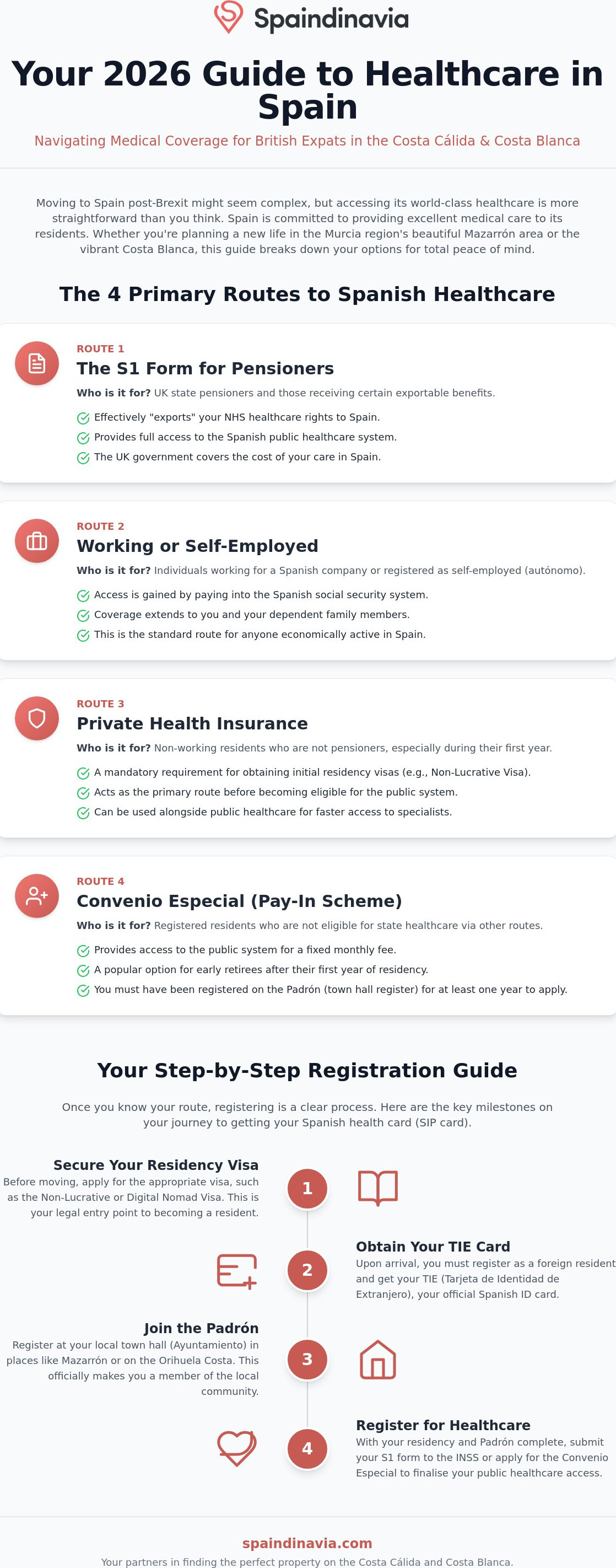
Understanding your options is the first step toward feeling at home in your new community. Whilst the rules changed after the UK left the EU, the pathways to receiving medical care are logical and well-defined. Most people moving to the Costa Cálida or the Costa Blanca will find themselves on one of four specific paths. Whether you are working, retiring, or simply enjoying your savings in a sun-drenched resale villa in Puerto de Mazarrón, there is a system designed to support you.
If you are moving to Spain to work for a Spanish company or to set up your own business as an autónomo (self-employed person), you'll gain access through your social security contributions. This covers you and your dependent family members immediately. For those not working, private health insurance is usually the starting point, especially as it is a mandatory requirement for most initial residency visas. However, many expats eventually transition into the public system once they have settled into their new lifestyle.
The S1 Form for Retirees
For British state pensioners, the S1 form remains the "golden ticket" for healthcare. This document allows you to "export" your healthcare rights from the UK to Spain. You should request your S1 from the NHS Overseas Healthcare Services well before your move. Once you arrive and register it with the Spanish social security office (INSS), you'll have full access to the Spanish public system. The best part is that the UK government compensates Spain for your care, so you don't have to pay extra monthly fees or social security contributions to see a doctor in Bolnuevo or Isla Plana.
The Convenio Especial: Public Healthcare for a Monthly Fee
If you aren't a pensioner and aren't working, the Convenio Especial is a fantastic "pay-in" scheme that grants you access to the public health system. To be eligible, you must have been a registered resident in Spain for at least 12 months. This makes it a popular second-year choice for those who started with private insurance. In 2026, the expected monthly costs are:
- Under 65 years old: €60 per month
- 65 years and older: €157 per month
This scheme covers primary care and hospitalisation, though it's worth noting it doesn't usually include subsidised prescriptions in the same way that the worker or pensioner routes do. It provides a wonderful sense of security for those living in areas like La Azohia or the wider Valencia region, ensuring high-quality care is always available at a predictable, transparent cost. Navigating healthcare in spain for british expats after brexit is simply a matter of choosing the route that best fits your stage of life.
Private Health Insurance vs. Public Healthcare: Which is Right for You?
Choosing between public and private care is often a matter of lifestyle and visa requirements. For those moving to a new build villa in Puerto de Mazarrón or a resale apartment in the Costa Blanca, private insurance is frequently the first port of call. It isn't just about avoiding queues; it's a fundamental part of the legal residency process for many. You'll find that the private sector in Spain is exceptionally well-developed, particularly in regions with large international communities.
If you are applying for a Non-Lucrative Visa or a Digital Nomad Visa, you must have a private policy in place before you even leave the UK. Spanish consulates are very specific about this. Your policy must be "sin copagos," which means there are no co-payments or deductibles for visits or treatments. It has to be a comprehensive policy with coverage equivalent to the Spanish public system. Standard travel insurance or UK-based policies won't work because they don't offer the permanent, full-scale cover required. In 2026, many providers now offer specific "expat" packages that include cover for pre-existing conditions after a waiting period, making the transition smoother for those with ongoing health needs.
Wait Times and Quality of Service
The public system is world-class, but wait times for non-urgent specialist appointments or elective surgeries can be longer than what you might prefer. In the Murcia region, particularly around Bolnuevo and Isla Plana, private clinics allow you to see a specialist or get a scan within days rather than months. Many of these centres are designed with international residents in mind, offering English-speaking GPs and administrative staff who understand the nuances of healthcare in spain for british expats after brexit.
Whilst private clinics offer the luxury of speed and personalised convenience for routine consultations, public hospitals provide a comprehensive safety net for complex, long-term medical needs. In the Costa Blanca, private hospitals like those in Torrevieja or Alicante often feel like five-star hotels, with dedicated translation teams and rapid access to the latest technology. Having "dual cover"—keeping a private policy even after you qualify for public healthcare—is a popular strategy. It gives you the best of both worlds: the speed of private care for day-to-day issues and the robust resources of the state system for everything else. This balance ensures you can enjoy your Mediterranean life in La Azohia with total confidence.
A Step-by-Step Guide to Registering for Healthcare in your Region
Once you have decided on your route to coverage, it is time to tackle the administrative side of your move. The process for securing healthcare in spain for british expats after brexit is a logical sequence of events. It starts with your legal residency and ends with a physical health card in your hand. Whilst it might seem like a lot of paperwork, taking it one step at a time ensures you won't feel overwhelmed as you settle into your new home in Bolnuevo or the Orihuela Costa.
- Step 1: Obtain your TIE. Your Tarjeta de Identidad de Extranjero is your biometric residency card. It is the foundation of your life in Spain and the first document any health official will ask to see.
- Step 2: Register on the Padrón. Visit your local town hall (Ayuntamiento) to register on the municipal census. This certificate proves you live in a specific catchment area and is essential for assigning you to the correct local health centre.
- Step 3: Validate entitlement at the INSS. Take your TIE, Padrón, and proof of healthcare right (like your S1 form or work contract) to the Instituto Nacional de la Seguridad Social. They will issue a document confirming you are entitled to state care.
- Step 4: Visit your Centro de Salud. Present all your documents at your local health centre to receive your SIP card or regional equivalent.
At Spaindinavia, we believe your focus should be on choosing the right new build apartments or villas, so we connect our clients with expert solicitors who can handle these registrations for you.
Navigating the Murcia Health Service (SMS) in Costa Cálida
Residents in the Mazarrón area will interact with the Servicio Murciano de Salud. If you live in Puerto de Mazarrón, Isla Plana, or La Azohia, your primary hub will be the local centro de salud. In this region, your medical ID is simply called the "Tarjeta Sanitaria." The Murcia system is highly efficient; once registered, you can book appointments through the SMS website or mobile app. This digital access is a lifesaver for managing routine check-ups whilst you enjoy the relaxed pace of the Costa Cálida.
Navigating the Valencia Health System in Costa Blanca
Moving slightly north into the Alicante province means you will enter the Valencia health system. Here, the system revolves around the SIP card (Sistema de Información Poblacional). One of the biggest advantages in this region is the "GVA Salud" app. It allows you to carry a digital version of your health card on your phone and track your prescriptions with ease. British expats in the southern Costa Blanca often find this digital-first approach very helpful, especially when coordinating care between different specialists in larger hubs like Torrevieja.
Planning Your Move: How Healthcare and Property Choice Intersect
Your choice of property is the anchor for your new life, but the local infrastructure is what makes that life sustainable. When searching for a home, it's easy to get swept away by sea views and terrace sizes. However, the most successful moves are those where healthcare proximity is considered from the very start. Whether you are looking at the vibrant Costa Blanca or the tranquil Costa Cálida, your home's location dictates which health centre you'll use and how easily you can access specialist support. We've seen that British families who prioritise this early on feel settled much faster than those who leave it as an afterthought.
At Spaindinavia, we don't just help you find a house; we help you build a secure future. We position healthcare registration as a standard part of our support during your property purchase. By connecting you with independent solicitors, we ensure that your residency transition and medical registration are handled with professional precision. Many of our clients choose new build villas because these modern properties are often situated in well-planned developments with excellent road links to major hospitals and local clinics. This is particularly relevant for those on a Non-Lucrative Visa, as having a fixed, high-quality residence simplifies the private insurance application process required for your first year of healthcare in spain for british expats after brexit.
Mazarrón: A Healthcare Hub for Expats
The Mazarrón area is a standout choice for those who value accessible medical care. Puerto de Mazarrón and Bolnuevo are home to modern health centres that are well-versed in assisting international residents. In Isla Plana and La Azohia, the community is incredibly supportive, with local groups often helping new arrivals understand the nuances of the Murcia health system. This local expertise, combined with the proximity to the world-class facilities in Cartagena, provides a level of peace of mind that is hard to beat. Whilst the Costa Blanca offers large-scale hospital hubs, the Costa Cálida provides a more intimate, community-focused approach to wellness that many British expats find deeply reassuring.
Final Checklist for Your 2026 Move
Preparation is the enemy of anxiety. As you prepare for your move, ensure you have your documentation organised well in advance of your house completion date. The March 2026 universal healthcare law has made the system more inclusive, but the paperwork remains precise. Use this checklist to stay on track:
- Legal Documents: Ensure birth and marriage certificates are recently issued and have the Hague Apostille if required.
- S1 Forms: If you are a pensioner, apply for this from the UK at least four weeks before your departure.
- Private Insurance: Secure a "sin copagos" policy that starts on the day you enter Spain.
- Timeline: Aim to register on the Padrón within your first two weeks of moving into your new home.
Taking these steps ensures that your transition to the Mediterranean is as smooth as the coastal breeze. If you are ready to start your journey, you can view our latest New Build Villas in the Costa Cálida and Costa Blanca to find a home that perfectly balances lifestyle and security.
Embrace Your Mediterranean Future with Confidence
Securing your future under the Spanish sun is more achievable than ever in 2026. Whilst the transition requires a little more planning than in years past, the pathways for healthcare in spain for british expats after brexit are clear, logical, and well-supported. From the digital convenience of the Valencia health system in the Costa Blanca to the community-focused care in the Mazarrón area of the Costa Cálida, you'll find a world-class network ready to look after your well-being.
You don't have to navigate these steps alone. We specialise in providing expert guidance across the Murcia and Valencia regions, ensuring your property purchase is just the first step in a seamless lifestyle change. Our hand-picked portfolio of high-quality new build villas is complemented by full support through the legal and residency process via our trusted partners. By choosing the right location in Puerto de Mazarrón, Bolnuevo, or the wider Alicante region, you're investing in both a beautiful home and your long-term peace of mind.
Ready to turn your dream into a reality? Begin your Spanish journey with a secure property investment today. Your new life in the sun is waiting, and we're here to ensure every step is as warm and welcoming as the Spanish coast itself.
Frequently Asked Questions
Can I still use my UK GHIC or EHIC card in Spain after Brexit?
You can use a Global Health Insurance Card (GHIC) or an older EHIC for temporary stays only, such as holidays or short visits to your holiday rental property. It is not a substitute for residency cover. Once you become a resident in the Costa Cálida or Costa Blanca, you must register for the state system or take out a private policy to ensure you have full legal coverage.
How much does private health insurance cost for British expats in Spain?
Costs vary based on your age and medical history, but for residency visas, the policy must be "sin copagos," meaning there are no co-payments or deductibles. These comprehensive policies ensure you have no out-of-pocket expenses for consultations or treatments. Whilst we don't sell insurance, we often find that new build villa buyers prefer these policies for the speed of specialist access they provide in areas like Puerto de Mazarrón.
What happens if I have a pre-existing medical condition?
The Spanish public healthcare system provides full coverage for pre-existing conditions without any exclusions or premium hikes. This makes it an excellent choice for retirees moving to Bolnuevo or Isla Plana. Whilst private insurers may exclude certain conditions or charge higher rates, the state system remains a robust safety net for everyone registered through the S1 form or social security contributions.
Do I need to speak Spanish to visit a doctor in the Costa Cálida?
You don't need to be fluent to receive excellent care, especially in expat-friendly hubs like Mazarrón. Many doctors in the local centros de salud speak a good level of English, and many private clinics in the Costa Blanca specifically hire multilingual staff. For complex appointments, you can always use a professional translation service or the regional health apps which offer digital support in multiple languages.
Is prescription medicine free for British pensioners in Spain?
Prescriptions aren't completely free, but they are heavily subsidised for pensioners. Most retirees pay only 10% of the cost of their medication, and this is capped at a very low monthly amount, usually under €10. This makes healthcare in spain for british expats after brexit very affordable for those on a fixed income living in La Azohia or the wider Murcia region.
What is a SIP card and how do I get one?
A SIP card is the health identification card used in the Valencia region, covering the Costa Blanca. It stands for Sistema de Información Poblacional. You obtain one by taking your residency TIE, your Padrón certificate, and your social security or S1 entitlement document to your local health centre. In the Murcia region, you'll receive a similar document called a Tarjeta Sanitaria.
Can I use the Spanish public healthcare system if I work remotely for a UK company?
Yes, you can access the system by registering as an autónomo (self-employed worker) in Spain. By paying your monthly social security contributions, you and your family gain full access to the public health system. This is a popular route for Digital Nomad Visa holders who choose to live in modern apartments in the Costa Blanca whilst working for international clients.
Does the Golden Visa provide automatic access to free healthcare?
The Golden Visa does not grant immediate access to free public healthcare. Applicants must prove they have a comprehensive private health insurance policy "sin copagos" for the duration of their residency. However, after one year of legal residency, Golden Visa holders can choose to join the public system via the Convenio Especial pay-in scheme, which costs €60 or €157 per month depending on your age.


