
What if the most expensive part of your Mediterranean escape isn't the purchase price, but the quiet months when you aren't even there? It's a question that keeps many aspiring owners awake, wondering if hidden tax bills or sudden utility hikes will turn their dream into a financial burden. Whether you've set your heart on a villa in Bolnuevo or a modern apartment on the Costa Blanca, it's natural to feel a little anxious about "imputed" income tax and those tricky community standing charges.
We believe that owning property abroad should be about peace of mind, not paperwork stress. This guide offers a transparent breakdown of the running costs of a holiday home in spain for 2026, giving you the exact tools to organise a realistic annual budget. From the updated 21% VAT on electricity to the specific municipal waste taxes in Isla Plana, Puerto de Mazarrón, and La Azohia, we've mapped out every detail. You'll discover how to stay compliant with the latest tax reporting whilst ensuring your home in the Murcia or Valencia region remains a rewarding, cost-effective investment for years to come.
Key Takeaways
- Learn why budgeting 1% to 1.5% of your property's value is the gold standard for managing the running costs of a holiday home in spain each year.
- Understand the crucial differences between IBI and non-resident income tax to ensure you remain fully compliant in both the Costa Blanca and Costa Calida.
- Discover how professional key holding in areas like Puerto de Mazarrón and Bolnuevo protects your investment and satisfies insurance requirements whilst you are away.
- Demystify community fees and utility standing charges so you can accurately forecast your monthly outgoings even when the home is unoccupied.
- Explore the legal steps for securing a tourist licence to transform your villa or apartment into a profitable asset that offsets your annual expenses.
What are the Running Costs of a Holiday Home in Spain?
Owning a slice of paradise in Puerto de Mazarrón or along the vibrant Costa Blanca is an incredible lifestyle choice, but it's one that requires a clear financial roadmap. Many owners find themselves surprised by the "standing charges" that accumulate even when the property is empty. Broadly speaking, the running costs of a holiday home in spain can be split into two categories: fixed ownership costs and variable operational costs. Ownership costs include things like Taxation in Spain and insurance, whilst operational costs cover your electricity, water, and general upkeep.
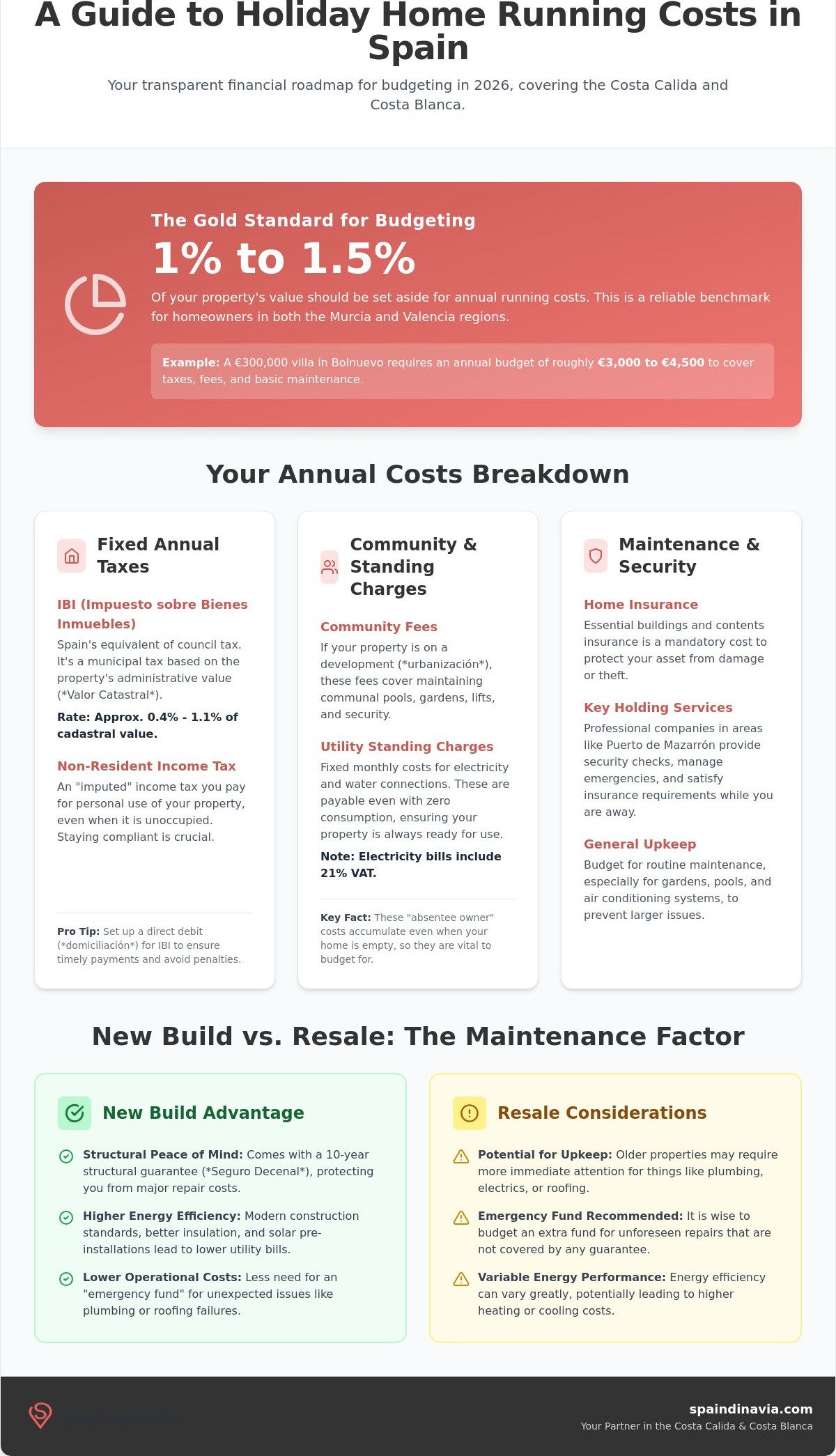
A reliable rule of thumb for 2026 is to budget between 1% and 1.5% of your property's value for annual running expenses. If you own a villa in Bolnuevo worth €300,000, you should set aside roughly €3,000 to €4,500 per year. This figure usually covers your taxes, community fees, and basic maintenance. It's a safe benchmark that ensures you aren't caught off guard by a sudden repair or a revised municipal tax bill. Whether you are looking at the Murcia region or the Valencia region, this percentage remains a consistent guide for savvy investors.
The "Absentee Owner" Budgeting Philosophy
When you aren't living in your Spanish home year-round, your primary financial concern shifts to fixed obligations. These are the costs that persist regardless of whether you've spent a single night in the property. Transparency at the start of your journey is vital because "hidden" fees can quickly dampen the joy of your new lifestyle. Running costs are the total of taxes, community fees, and maintenance required to protect your asset. By focusing on these standing charges, you can ensure your home in Isla Plana or La Azohia remains a sanctuary rather than a source of stress. We always recommend setting up direct debits for these essentials to avoid late payment penalties from local authorities.
New Build Villas: Lowering Your Long-term Expenses
Choosing a new build villa in the Costa Blanca or the Mazarrón area offers significant financial advantages regarding maintenance. These properties come with a Seguro Decenal, a ten-year structural guarantee that protects you from major repair costs in the early years of ownership. In 2026, modern construction standards focus heavily on energy efficiency, which is a major factor in reducing climate control bills during the hot summer months.
- Structural Peace of Mind: New builds rarely require the "emergency fund" that older resale properties in Bolnuevo might need for plumbing or roofing issues.
- Energy Efficiency: Better insulation and solar pre-installations mean lower electricity consumption for air conditioning.
- The Initial Trade-off: Whilst you pay a slightly higher purchase tax (VAT/IVA) on a new build, your monthly operational costs are often considerably lower than a resale equivalent.
By investing in a modern property, you're essentially "pre-paying" for lower maintenance later. This allows you to enjoy the Mediterranean lifestyle without the constant worry of an ageing property's demands.
Fixed Annual Taxes: IBI and Non-Resident Income Tax
Understanding your tax obligations is the most effective way to ensure your Mediterranean retreat remains a source of joy. While the purchase process involves significant one-off costs, your ongoing running costs of a holiday home in spain are anchored by two primary annual taxes. These are the IBI and the Non-Resident Income Tax. Staying on top of these ensures you remain compliant with Spanish authorities and avoid the stress of unexpected letters from the tax office. It's about creating a predictable financial environment so you can focus on enjoying the sun in Puerto de Mazarrón or the Costa Blanca.
IBI: The Local Property Tax
The Impuesto sobre Bienes Inmuebles (IBI) is essentially the Spanish equivalent of council tax. It's a municipal tax paid by every property owner, regardless of whether they are residents. The amount you pay is determined by the Valor Catastral, which is the administrative value of your property. This value is usually much lower than the actual market price. In 2026, IBI rates generally range from 0.4% to 1.1% of this cadastral value.
You will notice regional variations between the Murcia region and the Valencia region. For instance, rates in the Costa Blanca are currently between 0.6% and 0.7%. We always advise our clients in Bolnuevo and Isla Plana to set up a domiciliación (direct debit). This simple step ensures the payment is taken automatically from your Spanish bank account, protecting you from late payment surcharges that can quickly add up.
The "Hidden" Tax: Non-Resident Imputed Income
One tax that often catches newcomers off guard is the Non-Resident Income Tax (IRNR). Even if you don't rent out your home in La Azohia, the Spanish government "imputes" a benefit from your ownership. For British owners and other non-EU residents in 2026, the tax rate is 24% of the taxable base. This base is usually 1.1% of your cadastral value (or 2% if the value hasn't been revised recently).
New reporting requirements introduced by Regulation HAC/623/2026 have tightened the rules for the Modelo 210 form. This means accurate filing is more important than ever. The deadline is December 31st of the following year. Because the calculation involves specific percentages of the cadastral value, many owners choose to work with a professional to handle their property management and fiscal representation.
Finally, don't forget the Tasa de Basura, a mandatory municipal waste tax. While relatively small, it varies by town. For example, owners in Valencia recently saw costs around €287.50, whereas it might be significantly lower in smaller Murcia coastal villages. Wealth Tax (Patrimonio) may also apply if your Spanish assets exceed €700,000, though thresholds can vary between the Valencia and Murcia regions. Keeping these figures in your budget provides the financial clarity needed for a truly relaxed lifestyle.
Community Fees and Essential Utility Standing Charges
Managing the day-to-day expenses of a Mediterranean property involves more than just paying for what you use. When calculating the running costs of a holiday home in spain, you will find that standing charges play a significant role. These are the "invisible" costs that keep your property functional and secure whilst you are back in the UK. Understanding how these fees are structured allows you to organise a precise monthly budget, ensuring your escape in the Murcia or Valencia region remains a stress-free investment.
Comunidad: The Price of Shared Luxury
If your property is part of a complex, you will pay Gastos de Comunidad (community fees). These fees cover the upkeep of shared assets such as swimming pools, manicured gardens, and lifts. Your contribution is determined by your cuota, which is the percentage of the building or urbanisation that you own. For a standard apartment in Puerto de Mazarrón or Isla Plana, these fees typically range from €30 to €150 per month. However, luxury developments with extensive amenities in the Costa Blanca can see monthly costs rise to €300 or even €600.
It is vital to budget for Derramas. These are extraordinary community charges for major repairs, such as repainting the building or fixing a communal roof. Whilst gated communities in areas like Orihuela Costa offer high-end shared facilities, independent villas in Bolnuevo often avoid community fees entirely. The trade-off is that you take full responsibility for your own pool and garden maintenance, which requires its own dedicated budget.
Utilities: Managing the "Potencia"
Spanish electricity bills are divided into the energy you consume and the Potencia Contratada. This is a fixed standing charge based on the maximum power your home can pull at any one time. If you choose a limit that is too high for a small apartment in La Azohia, you will overpay every month. Conversely, a limit that is too low will cause your power to trip when you turn on the oven and air conditioning simultaneously. As of July 2026, the VAT on electricity has returned to the standard rate of 21%, making it even more important to select the correct power level.
- Smart Meters: Most modern homes in the Costa Calida and Costa Blanca now feature smart meters. These allow you to track your energy usage remotely from the UK, helping you spot unusual spikes.
- Water Blocks: Water billing in Spain often uses "minimum consumption" blocks. You will pay a base rate even if no water is used.
- Fibre and Security: High-speed fibre internet and alarm monitoring are essential for modern owners. Expect to pay between €30 and €60 per month for a reliable connection that allows you to monitor security cameras from abroad.
Always check for leaks before leaving your property. A small dripping tap or a running toilet can lead to a surprisingly high bill due to the tiered pricing structure of Spanish water companies. By staying proactive, you can keep the running costs of a holiday home in spain manageable and predictable.
Maintenance, Security, and the "Empty Home" Factor
Owning a home in Bolnuevo or a sleek apartment on the Costa Blanca is a rewarding lifestyle choice, but the periods when the shutters are down require careful planning. Maintenance is not just about aesthetics; it's a core component of the running costs of a holiday home in spain that protects your investment from the elements. Proactive care prevents small issues from becoming expensive disasters, ensuring your Mediterranean escape is ready the moment you turn the key.
Insurance and the Unoccupancy Clause
Standard home insurance policies often contain an "unoccupancy clause" that can void your cover if the property is empty for more than 30 consecutive days. For a holiday homeowner, this is a significant risk that many overlook. You need a policy specifically designed for second homes that permits absences of 90 days or more. These policies also include a mandatory contribution to the Consorcio de Compensación de Seguros, which is a national fund that covers extraordinary risks like floods or natural disasters.
Insurers expect a "duty of care" even when you are away. Utilising Spaindinavia’s maintenance services provides documented proof that the property is being looked after. This regular presence satisfies insurer requirements and ensures that if a leak or structural issue occurs, it is spotted and rectified immediately. It's a simple way to maintain the validity of your policy whilst you are back in the UK.
Professional Property Management: Cost or Investment?
Many owners in Puerto de Mazarrón and Isla Plana view professional key holding as an essential investment rather than a mere expense. In both the Murcia and Valencia regions, we occasionally experience the "Gota Fría", which are heavy flash floods that occur during seasonal shifts. Without regular inspections, a small window leak during one of these storms could lead to extensive mould or structural damage by the time you return for your next holiday.
Beyond storm damage, a well-managed home looks lived-in. Regular visits to air the rooms, flush toilets to prevent pipe smells, and check the security system provide immense peace of mind. For those with villas in La Azohia or independent plots in the Costa Blanca, garden and pool maintenance are equally vital. A neglected pool can quickly become a costly breeding ground for algae, requiring expensive chemical treatments to restore.
Annual servicing for your air conditioning is another non-negotiable task. The intense heat of the Costa Cálida puts these systems under significant pressure, and a quick check-up prevents a breakdown during the hottest weeks of August. If you want to ensure your property remains in peak condition whilst you are abroad, explore our comprehensive property management and key holding packages.
Optimising Your Investment: ROI and Cost Reduction
Owning a Mediterranean property is a dream that should pay dividends, whether in lifestyle quality or financial returns. While we have explored the various running costs of a holiday home in spain, it is equally important to look at how you can mitigate these expenses. By adopting a proactive management strategy, you can transform your villa or apartment from a dormant cost centre into a self-sustaining asset. This final section focuses on the practical steps to reduce your outgoings whilst maximizing the potential of your home in the sun.
Turning Costs into Profit: Rental Management
The most effective way to offset your annual fees is through short-term holiday rentals. High-quality new build villas in La Azohia or Bolnuevo are in particularly high demand, often achieving rental yields that comfortably cover a property's entire annual standing charges. However, you must ensure you have a valid tourist licence before welcoming guests. In the Valencia region, new regulations introduced in 2024 and 2025 mean licences are now valid for five years and require community approval. Following these rules is essential for protecting your investment and staying compliant with local laws.
Professional rental management does more than just find guests. It organises the cleaning, key handover, and emergency repairs that keep your property in peak condition. For many owners, the peace of mind that comes with knowing their home is generating income whilst being professionally supervised is the ultimate goal. If you are still at the start of your journey, our Buying Property in Spain Guide provides a comprehensive roadmap from the initial purchase to long-term ownership success.
Regional Variations: Murcia vs Valencia
When comparing the Costa Cálida and the Costa Blanca, subtle differences in municipal rates can impact your bottom line. The Mazarrón area, including Puerto de Mazarrón and Isla Plana, remains a highly competitive choice for cost-conscious owners. Municipal water and rubbish rates in the Murcia region are often more stable than in the more densely populated areas of the Valencia region. For instance, while a homeowner in Valencia might face a waste tax (Tasa de Basura) of around €287.50, owners in smaller Murcia coastal villages often benefit from lower local levies.
To help you stay ahead of your 2026 budget, use this final checklist to minimise your outgoings:
- Audit your "Potencia": Ensure your electricity power limit is not set higher than you actually need.
- Review Insurance: Switch to a specialist holiday home provider to avoid unoccupancy clause issues.
- Direct Debits: Organise all taxes and utilities through a Spanish bank account to avoid late fees.
- Smart Monitoring: Use smart meters and remote security to spot leaks or power drains from the UK.
- Local Expertise: Work with a property manager who understands the specific municipal deadlines in your town.
By balancing these practical cost-saving measures with a solid rental strategy, you can enjoy your Spanish home with total financial confidence. Whether you are overlooking the bay in Bolnuevo or enjoying the amenities of the Costa Blanca, a well-managed property is always a more rewarding one.
Master Your Mediterranean Lifestyle with Total Confidence
Mastering the running costs of a holiday home in spain doesn't have to be a daunting task. By understanding the 2026 tax landscape and the importance of proactive maintenance, you can ensure your property in Puerto de Mazarrón or the Costa Blanca remains a source of joy rather than stress. Accurate budgeting, from the 1.1% imputed tax base to the communal fees of a gated complex, allows you to enjoy your time in the sun with complete financial clarity. Small, consistent investments in professional care prevent large, reactive costs later, keeping your retreat in peak condition.
Since 2016, we've helped owners across the Murcia and Valencia regions navigate the complexities of Spanish property ownership. Our hand-picked portfolio of high-efficiency new build villas and our comprehensive key holding services are designed to give absent owners absolute peace of mind. We manage the details in Isla Plana, La Azohia, and Bolnuevo so you can focus on the lifestyle you've worked hard to achieve.
Secure your Mediterranean investment with Spaindinavia’s expert management.
Your dream of a warm, vibrant lifestyle along the coast is well within reach when you have a dedicated partner by your side. We look forward to welcoming you home.
Frequently Asked Questions
How much are the average monthly running costs for a 3-bed villa in Spain?
You should budget between €250 and €450 per month to cover the essential running costs of a holiday home in spain. This estimate includes utility standing charges, local taxes, insurance, and basic maintenance. Whilst a villa in Bolnuevo might have higher garden costs, an apartment in the Costa Blanca often trades this for community fees. Generally, setting aside 1% to 1.5% of the property's value annually provides a safe financial cushion for all expenses.
Do I have to pay tax in Spain if I do not rent out my holiday home?
Yes, all non-resident owners must pay an "imputed" income tax (IRNR) even if the property is for personal use only. This is calculated as a percentage of your property's cadastral value, which is the official administrative value. For British owners in 2026, the tax rate is 24% of the taxable base. It is a mandatory annual filing that ensures you remain compliant with the Spanish tax authorities in both the Murcia and Valencia regions.
Are community fees mandatory for all properties in Spain?
Community fees are only mandatory if your property is part of a "Comunidad de Propietarios", such as an apartment block or a gated urbanisation. These fees fund shared services like swimming pools and lifts in areas like Orihuela Costa or Puerto de Mazarrón. If you own an independent villa on a private plot in La Azohia, you won't pay community fees. However, you will be entirely responsible for your own pool and garden maintenance costs.
Can I pay my Spanish utility bills from a UK bank account?
While some companies accept international transfers, it is highly recommended to use a Spanish bank account for all utility payments. Most providers in the Costa Cálida and Costa Blanca prefer the "domiciliación" system, which is a direct debit. This ensures your electricity and water bills are paid automatically and on time. Using a local account prevents service disconnections, which can be difficult and expensive to rectify whilst you are back in the UK.
What is the IBI tax and when is it due?
IBI is the municipal property tax, similar to UK council tax, and it is paid annually to your local town hall. The amount is based on the cadastral value and typically ranges from 0.4% to 1.1% depending on the municipality. Payment windows vary by region; for example, many towns in the Murcia region collect IBI between September and November. Setting up a direct debit is the most reliable way to avoid late payment surcharges.
How much does property management typically cost in the Costa Cálida?
Basic key holding services in areas like Isla Plana and Puerto de Mazarrón typically cost approximately €400 per year. If you require full property management, including regular inspections and cleaning, monthly fees generally range from €50 to €100. Investing in these services is a vital part of the running costs of a holiday home in spain. It ensures your property is secure, aired, and checked for leaks or storm damage whilst you are away.
Is it cheaper to run a new build villa or a resale apartment?
A new build villa often has lower monthly operational costs due to superior energy efficiency and modern construction guarantees. While an apartment in the Costa Blanca might seem cheaper, monthly community fees can quickly add up. New builds in the Mazarrón area benefit from the latest insulation standards, which significantly reduces electricity bills for climate control. However, resale properties may have lower initial purchase taxes, so it's important to weigh up long-term savings against upfront costs.
What happens if I forget to pay my Spanish property taxes?
Missing tax deadlines leads to automatic surcharges, known as "recargos", and accumulating interest on the debt. If taxes remain unpaid for a long period, the authorities have the power to embargo your Spanish bank account to recover the funds. This can cause significant stress and affect your future ability to sell the property. Working with a fiscal representative ensures your Modelo 210 and IBI are paid correctly, providing peace of mind for your Mediterranean investment.


