

Did you know that the traditional route to Spanish residency through property investment has officially vanished? With the Golden Visa abolished as of 2025, many prospective retirees feel stranded, but a more rewarding path awaits those who prepare early. We understand that the shifting landscape of residency rules and tax brackets can feel overwhelming when you're simply dreaming of a terrace with a sea view. This retiring to spain checklist for 2026 is your definitive roadmap, ensuring your transition to the Mediterranean is seamless, legal, and entirely stress-free.
We agree that the move is about more than just paperwork; it's about finding that perfect balance between the vibrant energy of the Costa Blanca and the tranquil, authentic charm of the Costa Cálida. Whether you're drawn to the bustling hubs of the Valencia region or the hidden gems of the Mazarrón area, such as Isla Plana, La Azohia, and Bolnuevo, we'll help you move with total confidence. You'll gain a clear understanding of the updated €2,400 monthly income requirement for the Non-Lucrative Visa and how to manage your healthcare through the Convenio Especial. From securing a modern new build villa in Puerto de Mazarrón to navigating local property taxes, this guide covers every essential detail to make your 2026 retirement a reality.
Key Takeaways
- Navigate the 2026 residency landscape by securing the Non-Lucrative Visa with a confirmed passive income of €2,400 per month, whilst acknowledging that the Golden Visa is no longer an option.
- Organise your healthcare with comprehensive private insurance for your initial application and learn how to transition to the public system via the Convenio Especial after your first year.
- Use our retiring to spain checklist for 2026 to compare the vibrant atmosphere of the Costa Blanca with the tranquil, authentic charm of the Costa Cálida.
- Discover why low-maintenance new build villas in the Mazarrón area, specifically in Isla Plana and La Azohia, offer the best long-term security and modern energy efficiency for your new lifestyle.
- Master the 183-day residency rule and asset reporting requirements to protect your financial standing and ensure you remain fully compliant with Spanish tax authorities.
Securing Your Residency: Visa Options and Legal Requirements for 2026
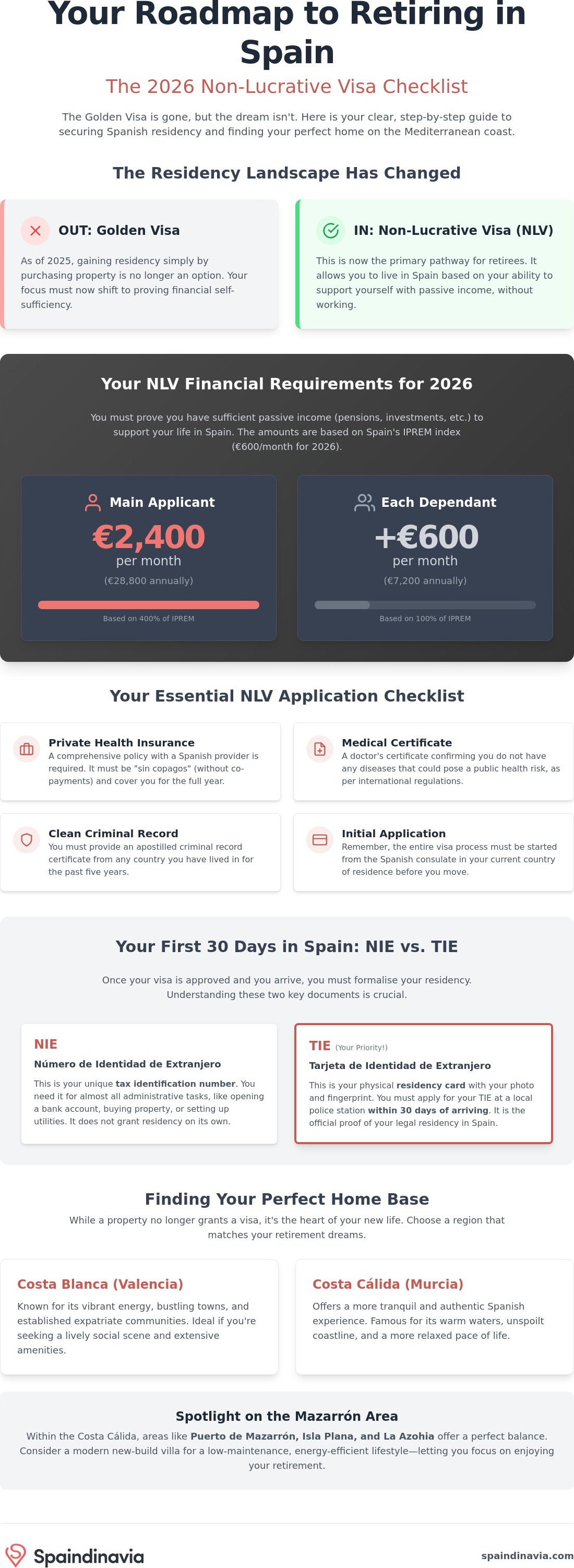
The landscape for Immigration to Spain has evolved significantly recently. If you're building your retiring to spain checklist for 2026, you've likely heard rumours about changing residency routes. Let's clear the air. The most critical change is that the Golden Visa, which previously allowed residency through property investment, was abolished in 2025. This means your focus should now shift to the Non-Lucrative Visa (NLV). It's the primary pathway for those looking to enjoy their retirement without working locally, and it remains a reliable route for many of our clients.
Securing your residency is the first hurdle in your journey to the sun. Whether you're dreaming of the white sands of the Costa Blanca or the rugged, authentic beauty of the Costa Cálida, understanding the legal framework is essential. We've seen many people feel anxious about this stage, but with the right preparation, it's a straightforward process. You'll need to start your application at the Spanish consulate in your home country before you make the physical move to your new home in Puerto de Mazarrón or Bolnuevo.
The Non-Lucrative Visa (NLV) Checklist
To secure an NLV in 2026, you must prove you have the passive financial means to support yourself. The Spanish government uses the IPREM (Indicador Público de Renta de Efectos Múltiples) to set these benchmarks. For 2026, the IPREM is €600 per month. Here is what you need to demonstrate:
- Main Applicant: You need 400% of the IPREM, which is €2,400 per month or €28,800 annually.
- Dependents: Each family member requires an additional 100% of the IPREM, which is €600 per month or €7,200 per year.
- Clean Records: You'll need an apostilled criminal record certificate from the last five years.
- Health Status: A medical certificate is required to confirm you don't carry diseases that could impact public health.
The Golden Visa and Property Investment
As mentioned, the Golden Visa is no longer a viable path for property investors in 2026. Whilst this might seem like a setback, it actually simplifies your decision-making. You can now focus entirely on finding a property that suits your lifestyle rather than meeting a specific investment threshold for residency. At Spaindinavia, we help you identify high-quality new build villas in the Mazarrón area, including Isla Plana and La Azohia. These properties are perfect for retirees because they offer modern energy efficiency and very low maintenance. Even without the Golden Visa, owning a home in the Murcia region or the Valencia region provides a stable base for your NLV application.
Once your visa is approved and you arrive in Spain, you'll encounter two essential acronyms: NIE and TIE. The NIE (Número de Identidad de Extranjero) is your tax identification number, which you'll need to buy property or open a bank account. However, the TIE (Tarjeta de Identidad de Extranjero) is your actual residency card. It's your most important document. You must apply for your TIE within 30 days of arriving in Spain. This card proves you're a legal resident and is necessary for everything from healthcare to travel. Having this card in your hand is the moment your new life truly begins.
Healthcare in Spain: Organising Insurance and Medical Access
Securing high-quality medical care is often the top priority for those planning their move. When you're ticking off items on your retiring to spain checklist for 2026, understanding how the Spanish healthcare system operates will provide immense peace of mind. Spain’s healthcare is consistently ranked amongst the best in the world, offering a blend of efficient public services and world-class private facilities. Whether you choose the bustling healthcare hubs near the Costa Blanca or the more intimate local clinics in the Costa Cálida, you'll find the standard of care is exceptional.
Choosing the Right Private Health Insurance
For your initial Non-Lucrative Visa application, the Spanish authorities require proof of private health insurance. This policy must be "sin copagos" (without co-payments), meaning you don't pay a fee for each doctor visit. It must also offer coverage equal to the Spanish national health system, including hospitalisation and emergencies. According to the U.S. State Department travel information for Spain, having proper documentation for all legal requirements is essential for a smooth entry. In 2026, comprehensive private insurance for retirees over 65 typically costs between €150 and €250 per month, per person. Popular providers like Sanitas and DKV are well-versed in expat needs, but we always recommend comparing policies to ensure they cover your specific medical history.
The Convenio Especial: Paying into the Public System
Once you've been a legal resident for at least one year, you may be eligible for the Convenio Especial. This is a public health "buy-in" scheme that allows you to access the Spanish National Health System (SNS) for a fixed monthly fee. In 2026, this fee is €157 for individuals over 65. It's a fantastic option for those with pre-existing conditions that private insurers might exclude. After registering at your local Centro de Salud in Puerto de Mazarrón or Isla Plana, you'll be assigned a family doctor who manages your long-term care. If you're a UK pensioner, the S1 form remains a vital tool, as it allows the NHS to cover your healthcare costs in Spain directly, though you must still register this form with the local social security office.
Pharmacies in Spain, identified by their distinctive flashing green crosses, operate differently than in the UK. Many medications that require a prescription elsewhere can be bought over the counter here. However, for chronic conditions, your GP at the local health centre will issue an electronic prescription linked to your health card. If you're feeling anxious about these logistics, our team at Spaindinavia can guide you towards local specialists and help you find new build villas located near the best medical facilities in La Azohia or Bolnuevo. Taking these steps early ensures your retiring to spain checklist for 2026 is complete and your health is protected.
Financial Planning: Pensions, Taxes, and the 183-Day Rule
Securing residency and healthcare provides the legal foundation, but your financial strategy is what truly sustains your Mediterranean lifestyle. When you're ticking off your retiring to spain checklist for 2026, it's essential to look beyond the initial move and consider how the Spanish tax system interacts with your UK or international assets. Spain’s tax year runs from January to December, which is a key difference to keep in mind when planning your exit from the UK system. For a detailed breakdown of these obligations, the Official UK Government Guidance for Retiring to Spain remains an indispensable resource for staying compliant whilst you settle in.
One of the most significant hurdles for new residents is understanding the Model 720 requirement. This is an informative declaration of assets you hold outside of Spain, such as bank accounts, investments, or property, if they exceed €50,000 in value. Whilst it is not a tax in itself, the penalties for failing to report these assets can be substantial. Additionally, you'll need to consider how your pension is treated. Most UK pensions are taxed as income in Spain, and for a retiree with a pension of €30,000, you can expect an effective income tax rate between 19% and 22% in 2026.
The tax environment also varies between the Costa Cálida (Murcia region) and the Costa Blanca (Valencia region). For instance, the Murcia region is particularly attractive for retirees because it offers a 100% subsidy on Wealth Tax, effectively exempting most residents from this levy. In contrast, the Valencia region has its own specific thresholds and allowances that might impact those with significant global assets. This makes areas like Puerto de Mazarrón and Bolnuevo not only beautiful places to live but also fiscally strategic choices for your retirement.
Understanding Your Tax Obligations in Spain
If you reside in Spain for more than 183 days during a single calendar year, you are legally classified as a tax resident, meaning your worldwide income and assets become subject to Spanish tax regulations. This status remains regardless of whether you have formally applied for residency. We recommend consulting a professional tax advisor who understands the double taxation agreements between Spain and the UK to ensure your SIPP or state pension is handled correctly and that you aren't paying more than necessary.
Banking and Currency Exchange whilst in Spain
Opening a Spanish bank account is a priority for managing your new life. You'll likely start with a non-resident account, which you can later convert to a resident account once your TIE is issued at the local office in the Mazarrón area. Resident accounts often have lower fees and are essential for setting up direct debits for your utilities and local property tax (IBI), which usually costs between €300 and €500 annually. We suggest using a dedicated currency broker for your retiring to spain checklist for 2026 to manage your pension transfers, as they offer much better rates than traditional banks, helping your retirement fund go much further.
Finding Your Dream Home in the Costa Cálida and Costa Blanca
Choosing where to plant your roots is perhaps the most exciting part of your retiring to spain checklist for 2026. Whilst the Costa Blanca in the Valencia region remains a perennial favourite with its established expat hubs and vibrant coastal cities, the Costa Cálida in the Murcia region is rapidly becoming the choice for those seeking a more authentic Spanish experience. In 2025, property prices in the Costa Blanca rose by approximately 13%, which has led many savvy retirees to look further south to the Murcia region, where your budget often stretches much further without sacrificing the quality of life or the Mediterranean sun.
Deciding between a resale property and a modern development is a pivotal step. Resale apartments can offer traditional charm, but they often lack the insulation and modern amenities required for year-round comfort. To ensure your investment is secure and your transition is smooth, we recommend following a buying property in spain guide to navigate the legal nuances of the 2026 market. Whether you're looking at a sleek penthouse in Alicante or a tranquil retreat in Mazarrón, having a clear roadmap is essential for your peace of mind.
The Appeal of the Mazarrón Area
We consider the Mazarrón area a true hidden gem for British retirees. Puerto de Mazarrón offers a lively marina and a welcoming year-round community, making it easy to build a new social circle. For those who prefer a quieter pace, the coastal villages of Isla Plana and La Azohia provide a stunning blend of mountain views and crystal-clear waters. Bolnuevo is particularly special, famous for its "Enchanted City" rock formations and wide, golden beaches. With over 320 days of sunshine each year, this region allows you to embrace an outdoor lifestyle that simply isn't possible in northern Europe.
New Build Villas: The Modern Choice
In 2026, new build villas are the gold standard for a comfortable retirement. These properties are constructed with the latest energy efficiency standards, which is vital for keeping your home cool during the height of summer and warm during the mild winters. Buying a new build often allows for customisation, meaning you can choose the finishes and layout that best suit your lifestyle needs. At Spaindinavia, we pride ourselves on sourcing the best plots and developments in the Mazarrón area, ensuring our clients receive a home that is both a sanctuary and a sound financial investment.
Ready to start your search? Browse our exclusive portfolio of new build villas and discover why so many retirees are choosing the Costa Cálida for their new life in the sun.
Practical Logistics: From Currency Exchange to Moving Your Belongings
Once you've secured your residency and found your dream villa in Puerto de Mazarrón, the focus shifts to the tangible details of your move. Organising the physical transition is the final, vital hurdle on your retiring to spain checklist for 2026. Whilst the legalities provide the foundation, it's the logistics of moving your life across borders that makes the dream feel real. Whether you're relocating from the UK or elsewhere in Europe, a well-structured plan for your belongings, pets, and transport will ensure you arrive ready to enjoy the Mediterranean sun from day one.
The Moving Day Checklist
Moving your personal effects to Spain in 2026 requires careful documentation to avoid unexpected customs duties. Since the UK's exit from the EU, you must prove that you're moving your primary residence to Spain to claim relief from import taxes. We recommend creating a detailed inventory list of every box and piece of furniture. It's best to choose an international removal firm with specific expertise in the Murcia and Valencia regions. They'll be familiar with the narrow streets of Isla Plana or the coastal access in Bolnuevo. If your new build villa is still undergoing final touches, consider booking temporary accommodation in La Azohia to stay close to the progress whilst your belongings are in secure local storage.
Don't forget your four-legged family members. For 2026, pets must be microchipped and have a valid rabies vaccination administered at least 21 days before travel. You'll need an Animal Health Certificate (AHC) if travelling from the UK, or a standard EU pet passport if moving from within the union. It's a straightforward process, but timing is everything to ensure your pets can join you in your new life amongst the coastal breeze.
Driving and Transport in Spain
Driving remains the most convenient way to explore the distinct differences between the Costa Cálida and the Costa Blanca. In 2026, UK licence holders who have become residents must exchange their licence for a Spanish one within six months of obtaining their TIE. The process is relatively simple but requires a basic medical and eyesight test at a recognised centre. If you're considering importing your favourite car, be prepared for registration taxes based on CO2 emissions and the cost of a technical inspection (ITV). Often, our clients find it more cost-effective to purchase a modern vehicle locally in the Mazarrón area.
- Public Transport: The Costa Blanca (Valencia region) boasts an excellent tram and train network connecting Alicante to the surrounding towns.
- Local Access: The Costa Cálida (Murcia region) offers reliable bus services, though a car is recommended for reaching the more secluded coves of La Azohia.
- Integration: Learning basic Spanish phrases will transform your experience. Whilst expat communities are supportive, greeting your neighbours in Puerto de Mazarrón in their native tongue opens doors to a much richer lifestyle.
Completing these practical steps marks the end of the planning phase and the beginning of your adventure. With your logistics in order and your residency secured, you're ready to embrace the warmth and joy of a Spanish retirement.
Embrace Your Future Under the Spanish Sun
Your journey to a new life doesn't have to be a source of anxiety. By following this retiring to spain checklist for 2026, you've already taken the most important step: preparation. You now understand how to navigate the Non-Lucrative Visa requirements and the benefits of choosing a low-maintenance new build villa in the Murcia region. Whether you're drawn to the vibrant atmosphere of the Costa Blanca in the Valencia region or the tranquil, authentic beauty of the Mazarrón area, including Bolnuevo and Isla Plana, your dream lifestyle is within reach.
At Spaindinavia, we're more than just estate agents; we're your partners in this life-changing transition. With over 10 years of experience in the Mazarrón property market, we collaborate with independent solicitors to ensure every transaction is secure and transparent. We invite you to join us for personalised viewing trips to explore Puerto de Mazarrón and La Azohia firsthand. Explore our hand-picked portfolio of New Build Villas in the Costa Cálida and Costa Blanca today. The Mediterranean lifestyle you've always imagined is waiting for you, and we're here to make it a reality.
Frequently Asked Questions
Can I still retire to Spain after Brexit in 2026?
Yes, you can certainly retire to Spain in 2026, though the process now requires a residency visa since the UK is a third-party country. The Non-Lucrative Visa remains the most popular route for retirees. It allows you to live in beautiful regions like the Costa Blanca or Costa Cálida without being permitted to work locally, provided you meet the financial and healthcare requirements.
How much money do I need to retire to Spain on a Non-Lucrative Visa?
To satisfy the retiring to spain checklist for 2026, the main applicant must demonstrate a passive income of €2,400 per month. This figure is based on 400% of the IPREM, which is set at €600 per month for 2026. If you're moving as a couple, you'll need an additional €600 per month for your spouse, bringing the total requirement to €3,000 per month for a household of two.
Will I lose my UK state pension if I move to Spain?
You won't lose your UK state pension by moving to Spain. It's still payable directly to you, and under current reciprocal agreements, it continues to be uprated annually just as it would be in the UK. This provides a reliable financial base whether you choose to settle in the vibrant Valencia region or the more tranquil Murcia region.
Is healthcare free for retirees in Spain?
Healthcare isn't free immediately upon arrival, as you must hold a private insurance policy with no co-payments for your initial visa application. However, once you're a resident, UK pensioners can access the state system for free by registering an S1 form. Other retirees can join the public system after one year via the Convenio Especial buy-in scheme, which costs €157 per month for those over 65.
Do I have to pay tax on my UK property if I live in Spain?
If you spend more than 183 days in Spain, you're considered a tax resident and must declare any rental income from UK property to the Spanish authorities. You'll also be liable for Spanish Capital Gains Tax if you sell your UK home whilst resident in Spain. It's essential to consult a specialist to understand how double taxation agreements apply to your specific situation.
Can I bring my dog or cat when I retire to Spain in 2026?
Bringing your pets is quite simple as long as you follow the 2026 entry requirements. Your pet must be microchipped and have a rabies vaccination administered at least 21 days before your travel date. You'll also need a valid Animal Health Certificate issued by a vet in the UK or a standard EU pet passport if you're moving from within the union.
What is the best area for British retirees in the Costa Cálida?
The Mazarrón area is the premier choice for British retirees seeking an authentic lifestyle with modern comforts. Puerto de Mazarrón and Bolnuevo offer a perfect mix of stunning beaches and a welcoming year-round community. For those who prefer a more relaxed pace, the nearby coastal villages of Isla Plana and La Azohia provide a beautiful Mediterranean setting with excellent local amenities and easy access to larger cities.


