
What if the most expensive mistake you make when moving into your dream villa isn't the furniture, but forgetting to ask for a "cambio de titularidad"? Many new owners don't realise that simply transferring an existing contract is often far cheaper and faster than requesting a brand-new connection. Learning how to set up utilities in a new spanish home can feel daunting, especially when you're faced with technical terms like "potencia" or navigating the municipal water monopolies common in the Murcia region. We understand that the language barrier and administrative hurdles can sometimes take the shine off your move to the Costa Cálida or the Costa Blanca.
We're here to ensure your transition is as smooth as a sunset in Puerto de Mazarrón. Whether you've purchased a resale apartment in Bolnuevo or a new build villa in Isla Plana, this guide provides a clear roadmap for 2026. You'll find a complete checklist of required documents and expert advice on choosing providers across both the Costa Blanca and Costa Cálida, including specific insights for La Azohia. We'll also break down the June 2026 tax changes, such as the return to 21% VAT on energy, so you can manage your budget with confidence. Let's get your new life started with the lights on and the water running from day one.
Key Takeaways
- Learn why choosing a "cambio de titularidad" (transfer of ownership) is the most efficient way to manage your move and avoid the hefty costs of new connections.
- Discover how to set up utilities in a new spanish home by navigating the electricity market and choosing the right "potencia" to suit your Mediterranean lifestyle.
- Understand the local nuances of water contracts in the Costa Cálida and Costa Blanca, including how to register with municipal providers in areas like Puerto de Mazarrón and Bolnuevo.
- Compare high-speed fibre optic options between national giants and regional providers to ensure you stay connected whilst enjoying your new villa or apartment.
- Identify the essential documents you need to have ready to ensure all services are active before you arrive at your new property in Isla Plana or La Azohia.
Understanding the Basics of Spanish Utility Connections
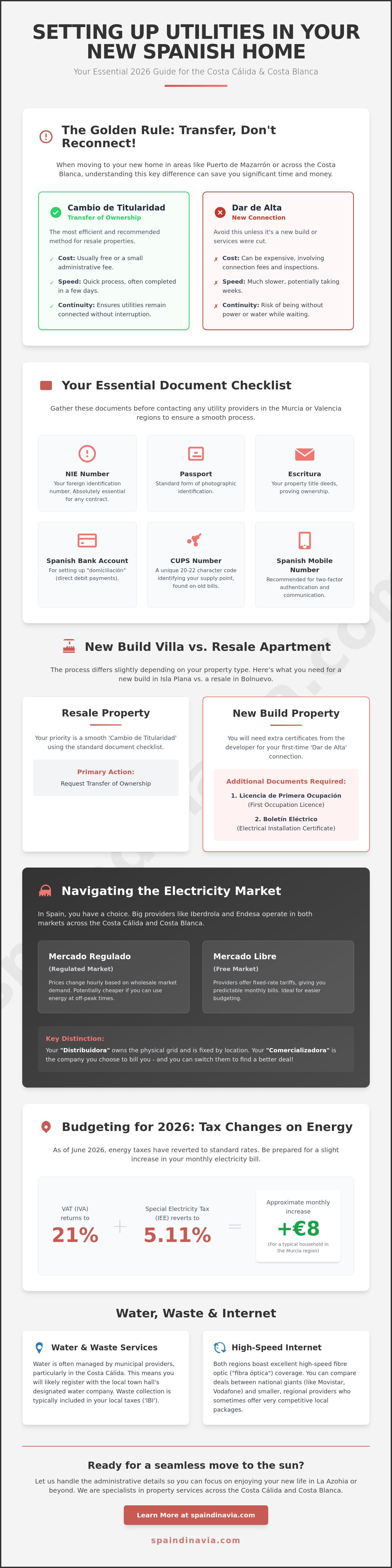
One of the first things you'll discover when learning how to set up utilities in a new spanish home is that the process is heavily focused on administrative transfers rather than physical installations. The most important phrase to remember is "Cambio de Titularidad". This refers to the transfer of ownership for an existing contract. It is the gold standard for most buyers in the Costa Cálida and Costa Blanca because it is usually free or carries a very small administrative fee. Most importantly, it ensures your lights and water stay on without interruption during the handover.
You should generally avoid "Dar de Alta", which signifies a brand-new connection, unless you are moving into a new build property or the previous owner has already disconnected the services. A new connection can be expensive and often requires a fresh inspection of the installation. To make any of this happen, your NIE (Número de Identidad de Extranjero) is your most vital tool. You cannot sign a contract for electricity, water, or gas without this identification number. You will also need a Spanish bank account for "domiciliación", or direct debit payments, as Spanish utility companies rarely accept foreign accounts for monthly billing.
Your "Escritura", or title deeds, serves as the ultimate proof of ownership. Whilst the Spain's electricity sector is highly regulated to ensure safety and reliability, providers still need to see that you are the legal resident before they will transfer a contract to your name. Having a digital copy of your Escritura ready will save you days of back-and-forth emails.
The Essential Documentation Checklist
To ensure a smooth transition, gather these documents before you visit any offices in the Murcia or Valencia regions. You will need your passport, your NIE certificate, and a copy of your Escritura. Most providers also ask for a recent bank statement to verify your IBAN for direct debits. A crucial piece of data you must find is the "CUPS" number (Código Universal de Punto de Suministro). This is a 20 to 22-character alphanumeric code found on a previous bill that identifies your specific supply point. We also recommend getting a Spanish mobile number. Many provider portals use two-factor authentication via SMS, and some systems still struggle to send these codes to international numbers.
New Build vs. Resale Property Procedures
If you've fallen in love with one of the sleek new build villas in Puerto de Mazarrón or Isla Plana, the process differs slightly from a resale apartment in Bolnuevo. For a brand-new property, the developer must provide you with the "Licencia de Primera Ocupación" (First Occupation Licence). This document proves the building meets all municipal standards. You will also need the "Boletín Eléctrico", which is a certificate from a qualified electrician confirming the installation is safe and ready for the grid. Whether you are settling in the quiet coves of La Azohia or the bustling streets of the Costa Blanca, having these certificates ready is the only way to get your first-time connection approved quickly.
Organising Electricity and Gas: Navigating the Market
Once your documents are in order, the next step in understanding how to set up utilities in a new spanish home is choosing your energy provider. Spain's market is split into the "Mercado Regulado" (regulated market) and the "Mercado Libre" (free market). In the regulated market, prices fluctuate hourly based on demand; whilst the free market allows you to lock in fixed rates with various providers. Major companies like Iberdrola and Endesa dominate both the Costa Blanca and Costa Cálida, but you'll also find a growing number of smaller, competitive marketers. It is helpful to distinguish between the "distribuidora", who owns the physical wires and meters, and the "comercializadora", who manages your contract and sends the bill. You can change your marketer to find a better deal, but your distributor is determined by your property's location.
Budgeting for 2026 requires a bit more attention than in previous years. As of June 2026, VAT on electricity has returned to the standard 21%, and the Special Electricity Tax (IEE) has reverted to 5.11%. For a typical household in the Murcia region, this transition adds approximately €8 to the monthly bill. If you are browsing resale apartments in Bolnuevo or La Azohia, you might notice many homes still use the iconic orange "Butano" gas cylinders for cooking or hot water. These cylinders cost roughly €15.60 in 2026 and offer a cost-effective alternative to mains gas, provided you keep a spare bottle to avoid a cold shower.
Choosing Your Potencia: Avoiding the Trip
Your "Potencia Contratada" is the maximum amount of power you can draw at any single moment. If you try to run the air conditioning, the pool pump, and the oven simultaneously, your power will likely trip. For a standard three-bedroom villa in Puerto de Mazarrón, a capacity of 4.6 kW or 5.75 kW is usually sufficient. Increasing this limit involves a small administrative fee and sometimes requires a new safety certificate if the installation is older. It is always best to test your daily habits during your first week before deciding to pay for a higher limit you might not need.
Selecting a Green Energy Provider
With the incredible sunshine levels across the Costa Cálida, solar energy is a fantastic way to lower your carbon footprint and your bills. Many new build villas in Isla Plana now come with solar pre-installations. When selecting a provider, you can opt for companies that guarantee 100% renewable energy. You should also compare "discriminación horaria" (time-of-use) tariffs. These plans offer significantly cheaper rates during "valle" (off-peak) hours, allowing you to run heavy appliances or charge an electric vehicle overnight at a fraction of the daytime cost.
Managing Water and Waste Services: The Municipal Essentials
Managing water services is a different experience compared to electricity because you cannot shop around for the best deal. Water is a municipal monopoly, meaning your provider is determined by where your property is located. If you are settling in the Costa Cálida, specifically within the Mazarrón municipality, you will likely deal with Hidrogea. Across the border in the Costa Blanca, providers like Aqualia or Hidraqua often manage the supply. Because these are local entities, you usually need to visit the local town hall (Ayuntamiento) or the specific water company office in person to finalise your contract. This is a critical step in learning how to set up utilities in a new spanish home because water companies are often less digitised than national energy giants.
Before you sign anything, ensure your legal representative checks for "deudas" or outstanding debts. In Spain, utility debts stay with the property, not the individual. If the previous owner of your resale apartment in Bolnuevo left an unpaid bill, the water company may refuse to transfer the contract until the balance is settled. In 2026, the average monthly water bill for a standard household is approximately €40; however, you should expect a standing charge of between €15 and €25 per month even if the property is empty. This covers the maintenance of the infrastructure and is a standard part of owning a home in the Murcia or Valencia regions.
Setting Up Your Water Contract in Mazarrón
To register your supply in Puerto de Mazarrón, Isla Plana, or La Azohia, you must provide your NIE, passport, and the Escritura. The water authority will also require your Spanish bank details for direct debit. Spain uses a tiered pricing system to encourage water conservation. This means the price per cubic metre increases as you consume more. If you're maintaining a large garden or a private pool at your villa, your bills will reflect these higher tiers. Always check your meter reading on move-in day to ensure you aren't paying for the previous occupant's final weeks of usage.
Understanding the Basura and IBI Taxes
Refuse collection, known as "Basura", is often billed separately from your water usage, though some municipalities combine them. For 2026, the average waste tax ranges from €120 to €180 per year. Alongside this is the IBI (Impuesto sobre Bienes Inmuebles), which is the Spanish equivalent of council tax. In the Costa Blanca, this is often managed by an agency called Suma. We strongly recommend setting up a "domiciliación" or standing order for both these taxes at your bank. Municipalities are strict with deadlines; missing a payment can result in a 5% to 20% surcharge, so automating these payments is the best way to protect your investment and maintain peace of mind.
Connectivity and Regional Nuances in Costa Cálida and Costa Blanca
Staying connected is often the top priority for new arrivals. Fortunately, the infrastructure along the Mediterranean coast has seen massive investment. When researching how to set up utilities in a new spanish home, you'll find that fibre optic (Fibra) is now the standard in most urbanisations. In 2026, packages from major providers like Movistar or Vodafone typically range from €30 to €60 per month. If you're looking for better value, companies like Digi offer plans between €25 and €40 for 300Mbps speeds. For those buying new build villas in more secluded spots like Isla Plana or La Azohia, check local coverage maps first. The coastal mountains can sometimes affect mobile signals in these specific pockets.
Many owners use their property as a second home. If this is your plan, look for "holiday" internet contracts. These specific plans allow you to suspend your service for several months a year whilst you are away. You'll usually pay a small maintenance fee instead of the full monthly rate. This flexibility is perfect for those who spend their summers in Puerto de Mazarrón but return home for the winter. It's a simple way to keep your running costs low without the hassle of cancelling and restarting contracts every year.
Fibre Optic Options in Puerto de Mazarrón and Bolnuevo
In the Mazarrón area, you aren't limited to the national giants. Local providers often offer more personalised service and faster installation times. For resale apartments in Bolnuevo, you can often get connected within 48 hours. New build villas might take slightly longer if the final cabling to the street hasn't been completed. Bundling your internet with a Spanish mobile SIM is usually the cheapest route. Prepaid mobile plans in 2026 start at around €10 for 30GB, which is ideal for guests or short-term stays.
Utility Differences: Costa Blanca vs. Costa Cálida
Water quality varies slightly between the two regions. The Costa Blanca and Costa Cálida both have "hard" water. This means mineral deposits can build up in kettles and boilers. Installing a basic decalcification system is a common upgrade for many homeowners to extend the life of their plumbing. You'll also find that the administrative side differs. In the Valencia region, the Suma office handles most local taxes, whereas the Murcia region uses the Agencia Tributaria de la Región de Murcia. Both systems are efficient, but you'll need to register at the correct regional office based on your property's location. If you are still searching for the ideal spot, explore our latest new build apartments to see which region fits your lifestyle best.
Making Your Move Seamless: Professional Support
Taking the final step into your Mediterranean lifestyle should be a moment of pure joy, not a battle with paperwork. Whilst we have covered the technical details of how to set up utilities in a new spanish home, the most successful transitions often involve a team of local experts. An independent solicitor is your first line of defence. They don't just handle the property transfer; they perform the vital task of verifying that no "deudas" or hidden utility debts are lurking from previous owners. This ensures that when you receive your keys in Puerto de Mazarrón or Torrevieja, you are starting with a completely clean slate.
Spaindinavia acts as a bridge between your expectations and the local administrative reality. We understand that the Spanish system can feel opaque, especially when you are trying to coordinate water connections in Bolnuevo whilst still finishing your move from abroad. Our role is to provide that steady, guiding hand, ensuring your Spanish bank account is correctly linked for "domiciliación" and that every contract is in your name before you even pack your first suitcase.
Property Maintenance and After-Sales Care
The journey doesn't end once the lights are on. If you've purchased one of our new build villas in Isla Plana or La Azohia, you may need ongoing support to manage the "Boletín" process or coordinate with developers for initial inspections. Many of our clients find immense value in local property management. Having a trusted key holder means your home is regularly inspected for leaks or electrical issues whilst you are away. This proactive monitoring is the best way to ensure that your holiday rental property or private retreat remains in peak condition year-round, regardless of whether you are in the Murcia or Valencia region.
Your Next Steps with Spaindinavia
We pride ourselves on being more than just property finders; we are your local partners throughout the entire purchase and settling-in process. To help you prepare for the bigger picture, we invite you to explore our buying property in Spain guide. This resource provides a comprehensive look at the legal and financial landscape for 2026. Whether you are eyeing a resale apartment in the heart of the Costa Blanca or a modern bungalow in the quiet corners of the Costa Cálida, we are here to make your dream a secure reality. Reach out to us today for personalised support and let us handle the bureaucracy whilst you focus on the Mediterranean sun.
Your Mediterranean Lifestyle Awaits
Moving to the Costa Cálida or Costa Blanca is the start of a beautiful adventure. By choosing a transfer of ownership over a new connection, you've already saved yourself unnecessary stress and expense. From securing the right "potencia" for your villa in Puerto de Mazarrón to setting up your municipal water contract in Bolnuevo, you now have the practical tools to manage your property with confidence. Each step you take brings you closer to the relaxed, sun-drenched lifestyle you've been dreaming of.
We know that the administrative side of a move can sometimes feel overwhelming whilst you are trying to settle into a new culture. Now that you understand how to set up utilities in a new spanish home, you can focus on the exciting parts of your relocation. At Spaindinavia, we provide expert local knowledge and comprehensive support throughout the entire buying process. Our professional property management and maintenance services ensure your home in Isla Plana or La Azohia remains in perfect condition, even when you aren't there.
Explore our New Build Villas and let us handle the paperwork. Your dream life under the Spanish sun is closer than you think, and we are here to ensure every detail is handled with professional care and personal warmth. Welcome home.
Frequently Asked Questions
How long does it take to set up utilities in Spain?
Transferring an existing contract through a "cambio de titularidad" typically takes between 2 and 7 working days to process. If you are moving into a new build villa in Puerto de Mazarrón or a property on the Costa Blanca that requires a brand-new connection, the process can take several weeks. We always recommend starting the transfer process at least ten days before your move-in date to ensure the lights are on when you arrive.
Can I set up Spanish utilities before I have my NIE?
No, you cannot sign a utility contract in Spain without your NIE (Número de Identidad de Extranjero). This identification number is mandatory for all legal agreements, including electricity, water, and internet services. Whether you are settling in the Murcia region or the Valencia region, your NIE serves as your primary account identifier. It's one of the first documents our team helps you secure when learning how to set up utilities in a new spanish home.
What is the "CUPS" number on my Spanish electricity bill?
The CUPS (Código Universal de Punto de Suministro) is a unique 20 to 22-character alphanumeric code that identifies your property's specific connection to the energy grid. Think of it as a postcode for your electricity meter. You'll find this number on any previous electricity bill for the property. You must provide this code to the provider whenever you want to change your tariff or transfer the contract into your name.
Is water expensive in the Costa Cálida and Costa Blanca?
Water costs in 2026 average around €40 per month for a standard household, though standing charges of €15 to €25 apply even during periods of no consumption. Prices in the Mazarrón area, including Bolnuevo and Isla Plana, follow a tiered system where the cost per cubic metre increases with higher usage. This makes water conservation important, especially if you're maintaining a private pool or large Mediterranean garden at your new property.
What happens if the previous owner left unpaid utility bills?
Utility debts in Spain are attached to the property rather than the individual person. If you buy a resale apartment in La Azohia or a townhouse on the Costa Blanca with outstanding arrears, the provider may refuse to transfer the contract until the debt is cleared. This is why an independent solicitor is vital during the purchase process. They will verify that all bills are settled before you sign the deeds at the notary.
Do I need a Spanish bank account to pay for utilities?
Yes, having a Spanish bank account is essential because utility companies use "domiciliación" (direct debit) for almost all monthly billing. Most providers won't accept foreign bank accounts for these recurring payments. Setting up your account early ensures that your electricity and water bills are paid automatically. This prevents any risk of service disconnection whilst you are away from your home in the Murcia or Valencia regions.
How do I change the name on a utility bill (cambio de titularidad)?
You can change the name on a bill by contacting the utility provider directly with the property's CUPS number and your personal documentation. You will need to provide your NIE, passport, the property's address, and your Spanish bank details. This process is generally free and is much simpler than cancelling an old contract and starting a new one. It's the most efficient way to manage your transition into your new Mediterranean life.
Can I manage my Spanish utility bills online in English?
Major national providers like Iberdrola, Endesa, and Movistar offer comprehensive online portals and mobile apps available in English. However, local municipal water companies in the Costa Cálida and Costa Blanca often provide services primarily in Spanish. For areas like Puerto de Mazarrón, you might find that local offices require a basic level of Spanish or the assistance of a professional property manager to navigate the more complex administrative tasks.


