
What if your dream of a sun-drenched villa in Bolnuevo turned into a legal headache simply because you trusted a glossy brochure over a background check? It’s a common worry for many buyers looking at the Costa Calida and Costa Blanca, where the excitement of a new build can sometimes cloud the need for rigorous due diligence. You want to feel the warm Mediterranean breeze in Isla Plana or La Azohia whilst knowing your deposit is entirely secure. Learning how to vet a real estate developer in spain is the single most important step you can take to protect your investment and your peace of mind.
We understand that Spanish legal terminology can feel overwhelming, but securing your future shouldn't be stressful. This guide provides a clear, step-by-step process to verify a developer’s reliability, ensuring they have the financial solvency and legal standing to deliver your home. We'll walk you through the essential "Seguro Decenal" structural insurance, the vital role of bank guarantees, and how to verify that all-important Licence of First Occupation. By the end, you’ll have the confidence to choose the right partner for your journey to a new life in Puerto de Mazarrón or the wider Valencia region.
Key Takeaways
- Learn to navigate essential Spanish legal documents, from verifying land ownership with a "Nota Simple" to ensuring a project has its "Licencia de Obra" before you commit.
- Master how to vet a real estate developer in spain by understanding the mandatory bank guarantees and insurance policies that protect your hard-earned deposit.
- Discover why visiting previous phases or finished urbanisations is the best way to look beyond the marketing of a show house and assess long-term build quality.
- Explore the unique developer landscapes across the Costa Blanca and Costa Calida, including why boutique developers in Bolnuevo and Isla Plana offer a different experience to larger projects in the Valencia region.
- Understand how partnering with local experts who know the "local history" of developers in Puerto de Mazarrón can provide an extra layer of security for your investment.
Understanding the Developer Landscape in Spain
Stepping into the Spanish new build market in 2026 is an exhilarating journey. With a structural housing deficit across the country, where 180,000 new households are formed annually but only 140,000 units are started, demand is exceptionally high. This pressure means you might feel rushed to sign for that stunning villa in Bolnuevo or a sleek apartment in the Costa Blanca. However, the current market pace requires a cooler head than ever before. Knowing how to vet a real estate developer in spain isn't just about ticking boxes; it's about ensuring your future Mediterranean lifestyle is built on a foundation of security and trust, whether you're looking at the tranquil Murcia region or the vibrant Valencia region.
The Role of the Promotor vs. Constructor
In the Spanish system, two distinct entities usually bring a project to life. The Promotor is the developer; they own the land, secure the financing, and hold the ultimate financial risk. The Constructor is the building company hired to execute the physical work. It's vital to vet both. A financially stable developer is useless if they hire a builder known for poor finishes. Conversely, a fantastic builder can't save a project if the developer runs out of funds. We often see buyers in the Mazarrón area focusing only on the "brand" name of a development, whilst ignoring the track record of the actual construction firm. You need to ensure the financial plan of the developer in the Costa Calida aligns perfectly with the craftsmanship of the builder, just as you would when researching high-volume projects in the Costa Blanca.
Why Vetting is Non-Negotiable for Off-Plan Success
The history of the Spanish property market provides a sobering reminder of why due diligence matters. Past decades saw "ghost developments" left unfinished, but today's legal framework is significantly more robust. In 2026, developers are legally required to secure your off-plan deposits with bank guarantees. Despite these protections, how to vet a real estate developer in spain remains your primary shield against delays or quality discrepancies. A friendly "vibe" in a Puerto de Mazarrón office is no substitute for a solid legal track record, a rule that applies whether you are buying in the quiet coves of Isla Plana and La Azohia or the busy coastal resorts of the Valencia region.
Your estate agent should act as a bridge, not just a salesperson. We prioritise developers who have a long-standing presence in the community rather than those who appear overnight to capitalise on a trend. Balancing your emotional longing for a sea-view terrace with a cold, practical assessment of the developer's history ensures that your investment remains a source of joy. We believe that a successful purchase starts with asking the difficult questions long before the first brick is laid, ensuring your journey to a new home in the Costa Calida or the Costa Blanca is entirely transparent.
The Legal Checklist: Essential Documentation and Bank Guarantees
Before falling for the architectural renders of a new build villa in Bolnuevo or a penthouse in the Costa Blanca, you must ensure the paperwork matches the promise. Whilst developers are generally transparent, an independent solicitor is your most powerful tool. They will cross-reference official legal guidance for buying property in Spain with the specific project files. This impartial oversight is the gold standard for how to vet a real estate developer in spain, ensuring your interest is the only priority regardless of whether you are buying in the Murcia region or the Valencia region.
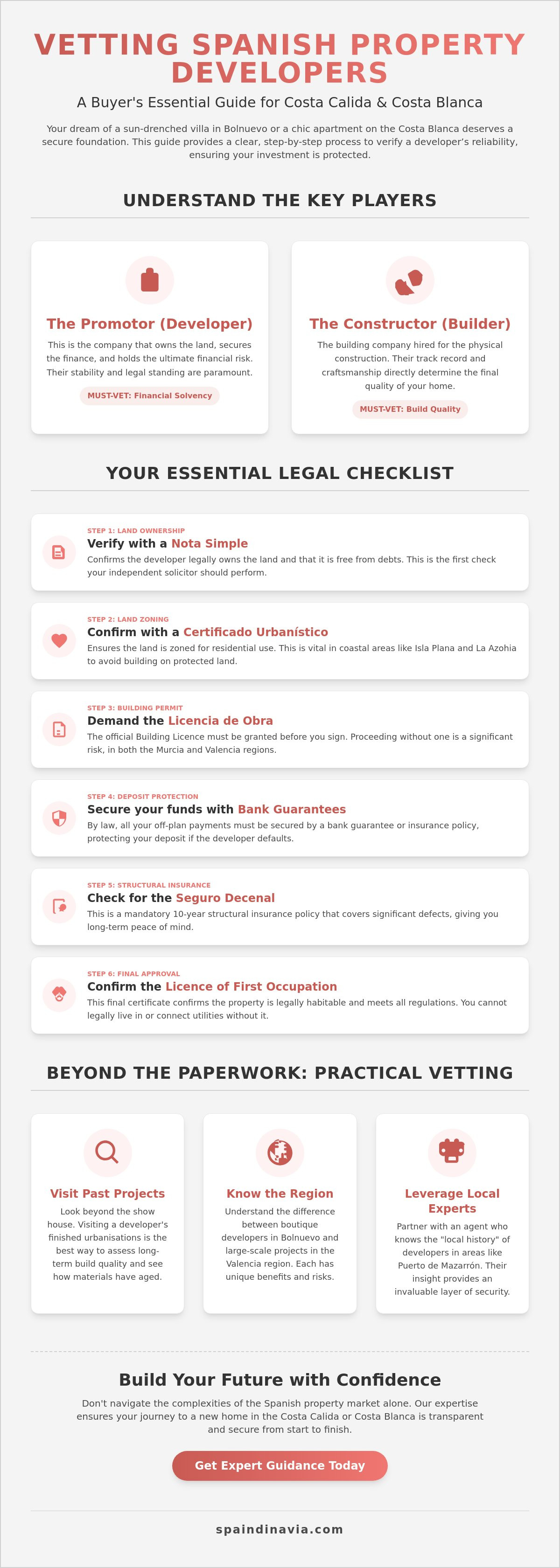
Verification starts with the "Nota Simple" to confirm land ownership and debt-free status. In the Murcia region, particularly in Puerto de Mazarrón and Isla Plana, your lawyer will also scrutinise the "Certificado Urbanístico". This confirms the land is zoned for residential use rather than being part of a protected coastal strip. Similarly, in the Valencia region, they will ensure the "Licencia de Obra" (Building Licence) is fully granted before you sign. Building without this permit is a significant risk, and confirming its existence is a non-negotiable step for buyers in both the Costa Calida and the Costa Blanca.
The "Aval Bancario" (Bank Guarantee) Explained
The Aval Bancario is a mandatory legal protection for all off-plan deposits in Spain. Don't simply transfer funds to a developer's general account. Instead, payments must go into a special, bonded account. You must request an individual certificate for every stage payment you make. This guarantee ensures that if the developer fails to finish the build or goes insolvent, your capital, plus legal interest, is returned to you by the bank. It turns a potential risk into a protected transaction, providing the security you need when buying across the Costa Calida or the Costa Blanca.
Planning Permissions and Land Status
Finally, check for the "Seguro Decenal". This ten-year structural insurance is a legal requirement for developers. It protects your home against major structural defects long after completion, whether you're in La Azohia or a busy resort in the Costa Blanca. Be aware of the regional tax differences too; for 2026, the AJD (Stamp Duty) is 1.4% in the Valencian Community and 1.5% in the Region of Murcia. Having these figures clear from the start prevents any nasty surprises at the Notary. For a clearer picture of these costs, it’s always worth speaking with local experts who understand the nuances of both regions.
Assessing Quality and Track Record: Beyond the Show House
Whilst a show house is designed to dazzle you with mood lighting and designer furniture, it's rarely a true reflection of the day-to-day reality of living in a property. To truly master how to vet a real estate developer in spain, you must look past the staging. A show house is a marketing tool; the "Memoria de Calidades" and previous projects are the actual evidence of a developer’s commitment to excellence. Whether you’re eyeing a sleek villa in the Costa Blanca or a coastal retreat in Bolnuevo, your due diligence should include a physical inspection of what the developer built three to five years ago.
Performing a Physical Inspection of Past Projects
Visit completed urbanisations nearby to see how the buildings have aged. Look for settling cracks in the exterior render or signs of dampness around the base of the walls, which can be common if the "vide sanitaire" (crawl space) wasn't properly ventilated. Pay close attention to communal areas like pools and gardens. If the developer promised lush landscaping in Puerto de Mazarrón but the reality is a patchy lawn, it speaks volumes about their follow-through; the same standard should be applied to the communal facilities of large-scale resorts in the Valencia region. Whilst you are there, don't be afraid to strike up a conversation with current residents. Ask about the developer's behaviour during the snagging process. Did they fix issues promptly, or did they disappear once the final payment was made? Checking hidden elements, such as the neatness of the electrical conduits in the utility room, often reveals more about a builder's pride in their work than a polished kitchen worktop ever could.
Interpreting the Quality Specifications (Memoria de Calidades)
The "Memoria de Calidades" is the legally binding document that lists every material used in your home. It's your blueprint for quality. You should ensure that specific brand names are listed for appliances, air conditioning units, and even the porcelain tiles. If the document uses vague terms like "top quality brands", ask for them to be specified before you sign. In the Murcia region, you might find that standard specifications focus heavily on thermal insulation to combat the summer heat, whilst developments in the Costa Blanca might prioritise different acoustic standards or aesthetic finishes. Use this document as a negotiation tool. If you want to upgrade the flooring in your Isla Plana apartment or change the kitchen layout in La Azohia, doing so at the contract stage is far more cost-effective than trying to retro-fit changes later. A reputable developer will be transparent about these costs and provide a clear list of what is included in the base price.
Regional Nuances: Developers in Costa Cálida and Costa Blanca
The Mediterranean coastline isn't a monolith. Vetting a developer in the high-density areas of the Costa Blanca requires a different set of questions than you would ask in the more rugged, boutique environment of the Costa Cálida. Understanding these regional nuances is a vital part of how to vet a real estate developer in spain. Whilst the Valencia region often hosts large-scale national promotors, the Murcia region, particularly around Mazarrón, is home to specialised builders who understand the unique topography of the local landscape. These smaller firms often provide a level of personal care that gets lost in larger corporations.
Coastal regulations also play a significant role in your due diligence. The "Ley de Costas" (Coastal Law) dictates how close to the shoreline a property can be built. In areas like Puerto de Mazarrón and Bolnuevo, where the mountains meet the sea, vetting the specific plot's compliance with these national and regional laws is essential. You must ensure your solicitor confirms the property doesn't encroach on public maritime-terrestrial zones. You don't want to find that your dream villa sits on a "protected" strip that limits future renovations or, in extreme cases, ownership rights.
The Mazarrón Speciality: Isla Plana and La Azohia
In the charming villages of Isla Plana and La Azohia, developers often work with sloped plots that offer breathtaking sea views. Vetting these promotors involves looking at their experience with complex foundations and retaining walls. Smaller-scale developers in Bolnuevo typically offer a more bespoke level of personalisation compared to the "cookie-cutter" models found in busier hubs. You can often sit down with the architect to tweak the layout of your new build villa, a level of service that larger firms simply cannot provide. This personal touch is a hallmark of the Murcia region's property market, where the relationship between buyer and builder is often more direct and transparent.
Costa Blanca South: Navigating Larger Urbanisations
Conversely, the Costa Blanca South, including Orihuela Costa and Torrevieja, features high-volume developers managing massive urbanisations. Here, the vetting focus shifts towards communal infrastructure. You must check the delivery timelines for pools, parks, and roads. A common pitfall is buying in "Phase 1" only to find yourself living on a construction site for several years whilst later phases are completed. Ensure your contract specifies that your view won't be "boxed in" by future blocks that weren't clearly shown on the initial master plan. If you are feeling unsure about which region suits your lifestyle or how to verify a specific promotor, you can explore our hand-picked portfolio of secure new build villas across both the Costa Blanca and Costa Cálida.
Partnering for Peace of Mind: The Spaindinavia Approach
Choosing a new build villa is more than a financial transaction; it's the start of a new chapter in a warmer, more vibrant climate. We act as a bridge between your aspirations and the local property market, ensuring that every step you take is grounded in security. Whilst the previous sections have detailed the technicalities of how to vet a real estate developer in spain, we believe that having a local partner who already knows the "local history" of every builder in the Murcia and Valencia regions is your greatest advantage. We've spent years building relationships with promotors in Puerto de Mazarrón, Bolnuevo, and across the Costa Blanca, allowing us to filter out anyone who doesn't meet our exacting standards.
Our "Hand-Picked" Selection Process
We don't simply list every project that comes onto the market. Our portfolio is strictly hand-picked based on a rigorous internal vetting process. We exclude developers who cannot demonstrate a clean financial track record or those who are hesitant to provide the mandatory bank guarantees we've discussed. Transparency is our baseline. Whether you are looking at a sleek apartment in the Costa Blanca or a bespoke home in Isla Plana or La Azohia, we ensure the developer's legal documentation is ready for your solicitor's review before we even suggest a viewing. For a deeper look at the safety nets available to you, our Buying Property in Spain Guide offers a comprehensive checklist for a secure investment in 2026.
Beyond the Sale: Property Management and Support
Our commitment to your journey doesn't end when you receive the keys at the Notary. We understand that many of our clients are looking for holiday rental properties or long-term investments. Because we offer rental management services, we vet developers with a focus on long-term durability and "rentability." We know which builds in the Mazarrón area stand up to the coastal salt air and which ones retain their aesthetic appeal year after year. This "boots on the ground" perspective means we can tell you which developments in the Valencia region offer the best communal maintenance and which ones might become a headache for an absentee owner.
We stay by your side from the first inspiration to the final handover and beyond. This holistic approach ensures that your new build villa remains the sanctuary you imagined it to be. If you're ready to explore a secure way to buy in the sun, contact us today. Let's find your perfect home in Puerto de Mazarrón, Bolnuevo, or the stunning Costa Blanca with the confidence that every detail has been checked, verified, and approved by experts who truly care about your journey.
Secure Your Future in the Spanish Sun
Embarking on a new build project should be an inspiring journey, not a source of anxiety. By mastering how to vet a real estate developer in spain, you've already taken the most significant step towards protecting your financial future. Remember to look beyond the polished show house, insist on individual bank guarantees for every stage payment, and always verify land status with an independent solicitor. Whether you're dreaming of a modern apartment in the Costa Blanca or a bespoke villa in Bolnuevo, these practical safeguards turn uncertainty into a confident investment.
We specialise in new builds across both the Costa Calida and Costa Blanca, offering a hand-picked portfolio of developers who meet our strict quality and financial standards. By collaborating with independent legal experts and maintaining a deep understanding of the local landscape in Puerto de Mazarrón, Isla Plana, and La Azohia, we ensure your journey is smooth and secure. Your new life by the Mediterranean is within reach, and we're here to guide you every step of the way.
Find your secure New Build Villa with Spaindinavia today
Frequently Asked Questions
What is the most important document to ask a Spanish developer for?
The "Licencia de Primera Ocupación" (LFO) is the most critical document for finished properties, as it confirms the building is legally habitable. For off-plan projects, you must ensure the developer has a valid "Licencia de Obra" (Building Licence) from the local town hall. Without these, you cannot legally connect to utility services or occupy your home in Puerto de Mazarrón or the Costa Blanca.
Can I get my deposit back if the developer goes bankrupt in Spain?
Yes, you can recover your funds if you have secured an individual bank guarantee, known as an "Aval Bancario". This is a mandatory legal protection that ensures your deposits, plus legal interest, are returned if construction stops or the developer fails. Understanding how to vet a real estate developer in spain involves insisting on these individual certificates for every stage payment you make.
Is it safe to buy off-plan property in Spain in 2026?
Buying off-plan is very safe in 2026 due to robust legal protections and a high demand for energy-efficient homes. With 180,000 new households forming annually against only 140,000 housing starts, the market is stable but requires strict due diligence. Provided you use an independent solicitor and verify all bank guarantees, purchasing a new build in Bolnuevo or the Valencia region is a secure investment.
How do I check if a developer has the correct building licences?
Your independent solicitor should verify all building licences directly with the municipal planning department. They will check the "Licencia de Obra" to ensure the project matches the approved plans and complies with regional urban laws. This is particularly important for coastal plots in Isla Plana or La Azohia, where specific "Ley de Costas" regulations may apply differently than in high-density Costa Blanca areas.
What is the Seguro Decenal and why do I need it?
The "Seguro Decenal" is a mandatory ten-year insurance policy that covers significant structural defects in a new building. It is a legal requirement under Spain's Building Act and provides peace of mind that your investment is protected against major faults. Whether you are buying a villa in the Murcia region or an apartment in the Valencia region, the developer must provide proof of this insurance.
Should I use the developer’s recommended lawyer?
No, you should always appoint an independent solicitor who has no ties to the developer or the estate agent. An independent lawyer works solely in your interest to perform unbiased due diligence and contract reviews. This ensures an impartial perspective when learning how to vet a real estate developer in spain, especially regarding complex land ownership issues in areas like Puerto de Mazarrón or Orihuela Costa.
How long does it typically take to finish a new build villa in Costa Cálida?
A new build villa in the Costa Cálida typically takes between 12 and 18 months to complete once construction begins. Factors such as the complexity of sloped plots in Isla Plana or bespoke finishes in Bolnuevo can influence the timeline. Your contract should always include a specific completion date and details regarding compensation or the return of funds if significant delays occur beyond the agreed period.
Are there differences in building regulations between Costa Blanca and Costa Cálida?
Whilst national building codes apply across Spain, regional urban planning and taxes vary between the Valencia and Murcia regions. For example, the Stamp Duty (AJD) on new builds is 1.4% in the Costa Blanca but 1.5% in the Region of Murcia. Additionally, local town halls in Mazarrón may have specific aesthetic or height restrictions that differ from the high-volume urbanisation rules often found in the Costa Blanca South.


