

What if the dream of passing down your sun-soaked Mediterranean home didn't have to come with a nightmare tax bill for your loved ones? We know that the fear of "double taxation" and the confusion of navigating inheritance tax laws in spain for non-residents can feel like a heavy cloud over your Spanish lifestyle. It's a common anxiety, particularly whilst trying to understand the difference between national rules and the specific regional benefits found in the Costa Cálida and the Costa Blanca.
You'll soon see that with the right guidance, these complexities become manageable steps toward securing your family's future. This guide provides a clear roadmap to the 2026 regulations, highlighting why areas like Puerto de Mazarrón, Isla Plana, and La Azohia are more than just beautiful locations for a resale villa or bungalow. We'll explore the generous 99% tax reductions available in the Murcia region and compare them to the latest allowances in Valencia, ensuring you can move forward with professional expertise and personal peace of mind.
Key Takeaways
- Understand the "Situs" principle and why your assets in both the Costa Cálida and the Costa Blanca are subject to Spanish tax, even if you don't live here.
- Identify which kinship group your heirs belong to, as this directly affects the tax-free allowances for your property in Bolnuevo or along the Costa Blanca.
- Compare the generous 99% tax reductions offered in the Murcia region (Costa Cálida) with the specific allowances found in the Valencian Community (Costa Blanca).
- Follow our roadmap for legal compliance, from securing an NIE to meeting the strict six-month filing deadline to avoid unnecessary penalties.
- Master the inheritance tax laws in spain for non-residents to ensure your investment in a Puerto de Mazarrón villa or a Costa Blanca apartment remains a gift for your heirs.
Understanding Spanish Inheritance Tax for Non-Residents in 2026
When you decide to invest in a resale villa in Bolnuevo or a new build apartment along the Costa Blanca, you're embracing a beautiful new lifestyle. However, it's vital to understand the financial side, specifically the Impuesto sobre Sucesiones y Donaciones (ISD). This is the Spanish tax levied on inheritances and gifts. For many years, non-residents faced higher rates than locals, but the 2026 legal landscape is much fairer. Today, thanks to significant legal shifts, non-residents can access the same generous regional allowances as Spanish residents. Understanding the inheritance tax laws in spain for non-residents before you organise your property purchase ensures your investment remains a secure legacy for your family.
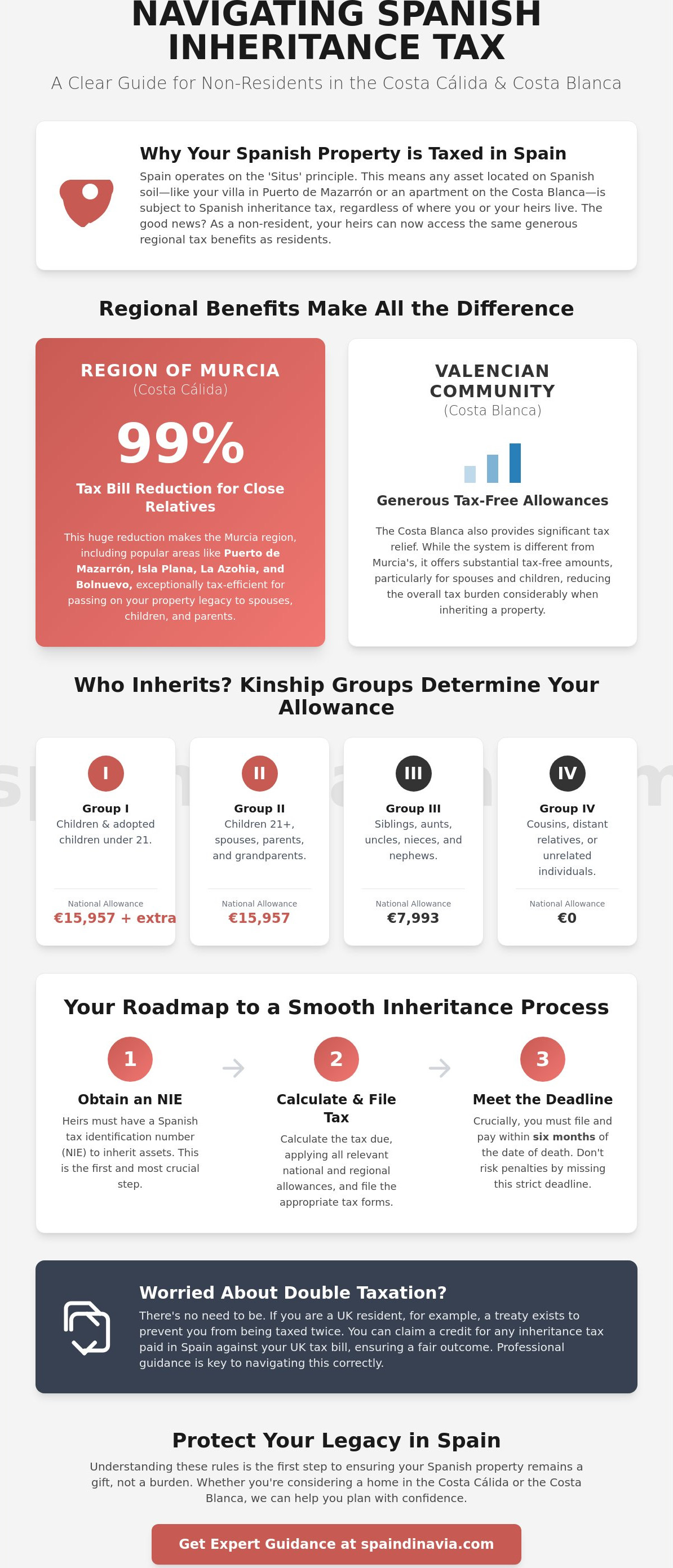
Spain follows the "Situs" principle. This means any asset located on Spanish soil, whether it's a townhouse in Isla Plana or a commercial premise in Valencia, is subject to Spanish tax regardless of where you or your heirs live. While global inheritance tax principles vary by country, Spain's approach is unique because the tax is paid by the person receiving the asset, not the estate itself. This makes your choice of location incredibly important.
National Law vs Regional Allowances
The Spanish state sets a baseline for tax rates, but the autonomous communities have the power to offer substantial discounts. The Agencia Tributaria (the national tax agency) manages the returns for non-residents, but they must apply the rules of the region where the most valuable assets are located. This is excellent news for those looking at the Costa Cálida and Costa Blanca. In the Murcia region, which includes the stunning Puerto de Mazarrón and La Azohia, close relatives often benefit from a 99% reduction in the tax payable. Similarly, the Valencian Community provides its own competitive allowances, meaning the region you choose will determine the majority of your tax liability.
The Reality of Double Taxation
A common fear amongst international buyers is the idea of paying tax twice, once in Spain and again in their home country. If you're a UK resident, a double taxation treaty exists to prevent this. You can typically claim credit for the inheritance tax paid in Spain against your UK inheritance tax bill. It's a straightforward process, but you'll need to keep meticulous records. We always recommend seeking professional advice to ensure you're claiming every available relief. By planning ahead, you can enjoy your Mediterranean home with the peace of mind that your heirs won't face unnecessary financial burdens.
How Inheritance Tax is Calculated: Kinship Groups and Allowances
To understand your potential liability, you must first identify which category your heirs fall into. In Spain, kinship groups act as the primary filter for tax liability, determining the initial tax-free allowances and the rates applied to the inherited assets. Whether you are planning for a townhouse in Isla Plana or a new build villa on the Costa Blanca, these categories dictate how much of your legacy remains with your family.
- Group I: Children and adopted children under the age of 21. This is the most protected category, receiving the highest national allowance of €15,956.87, plus an additional amount for every year the heir is under 21.
- Group II: Children aged 21 and over, spouses, parents, and grandparents. This is the most common group for those purchasing resale apartments or villas. They receive a standard national allowance of €15,956.87.
- Group III: Siblings, uncles, aunts, nieces, and nephews. The allowance drops significantly here to €7,993.46, and higher tax rates usually apply.
- Group IV: Cousins, more distant relatives, and unrelated individuals. This category includes unmarried partners who are not registered as a pareja de hecho. Sadly, this group receives no tax-free allowance at the national level.
Identifying these groups early helps you structure your investment wisely. If you are currently exploring new build apartments or resale villas in areas like Puerto de Mazarrón, considering how these kinship rules apply to your specific family situation is a vital first step.
The Progressive Tax Rate Structure
The inheritance tax laws in spain for non-residents utilise a progressive scale. National rates start at 7.65% for assets up to €7,993 and can rise to 34% for amounts exceeding €797,555. The total value of the inherited asset dictates the initial percentage. However, the final calculation also considers the beneficiary's pre-existing wealth in Spain. If an heir already owns significant property in Bolnuevo or along the Costa Blanca, a "multiplier" may be applied, which can increase the total tax bill further.
State Reductions and Deductions
Whilst the state provides a modest allowance of approximately €15,956 for Group II beneficiaries, this rarely covers the full value of a Mediterranean home. Relying solely on national allowances when planning your estate can lead to unexpected costs. The true value for non-residents lies in the regional legislation of the Murcia region and the Valencian Community. These regions often override the small state deductions with much more substantial bonuses, which we will explore in the next section.
Regional Variations: Costa Cálida vs Costa Blanca Rules
Choosing where to purchase your Mediterranean home is often a balance of lifestyle and logic. Whilst the national inheritance tax laws in spain for non-residents provide a framework, the autonomous communities of Murcia and Valencia have created an environment that actively rewards international investment. These regions compete to attract buyers by offering substantial tax bonuses that can virtually eliminate the tax burden for close family members. This regional "tax competition" is a significant advantage for those looking at resale apartments or new build villas in the south-east of Spain.
For many years, the Murcia region and the Valencian Community have been at the forefront of these generous policies. By 2026, the benefits for non-residents have become even more clear, allowing families to plan their legacy with confidence. Whether you are drawn to the rugged beauty of the Mazarrón area or the vibrant coastlines of the Costa Blanca, understanding these specific regional differences is the key to protecting your assets.
Inheritance Tax in the Murcia Region (Costa Cálida)
The Murcia region remains a favourite for savvy investors, particularly in sought-after spots like Puerto de Mazarrón, Isla Plana, and Bolnuevo. Since 2018, Murcia has applied a 99% reduction in the tax payable for beneficiaries in Groups I and II. This means that if a spouse or child inherits a townhouse in La Azohia, they only pay 1% of the calculated tax bill. This generous allowance applies to all inherited assets in the region, not just the primary residence. For non-residents, this is a game-changer. It ensures that the dream of a family holiday home doesn't become a financial burden for the next generation.
Inheritance Tax in the Valencia Region (Costa Blanca)
The Valencian Community, covering the popular Costa Blanca, offers a similarly attractive landscape. Like Murcia, Valencia provides a 99% tax bonus for spouses, children, and parents. However, they also include a specific tax-free allowance of €100,000 for these beneficiaries. A significant update for 2026 is the phased-in reduction for Group III heirs, such as siblings, nieces, and nephews. Starting June 1, 2026, these relatives receive a 25% reduction, which is set to increase to 50% in 2027. This makes the Costa Blanca an increasingly interesting option for those with wider inheritance plans. Whilst the 'habitual residence' deduction is a common topic in Spanish tax law, it's generally less relevant for non-resident holiday homes, making these broad regional bonuses even more vital for your planning.
Essential Steps for Non-Residents Inheriting Spanish Assets
Moving from the theory of tax rates to the practicalities of probate can feel daunting, especially whilst dealing with a loss. However, following a clear sequence of steps ensures you can claim the generous regional bonuses mentioned earlier without facing unnecessary stress. Whether you are inheriting a charming bungalow in Isla Plana or a modern townhouse on the Costa Blanca, the administrative process remains the same. Every beneficiary must first obtain an NIE (Número de Identidad de Extranjero). This identity number is the key to the Spanish system; without it, you cannot pay taxes, sign title deeds, or register the property in your name.
Time is of the essence when navigating inheritance tax laws in spain for non-residents. You have exactly six months from the date of death to file and pay the tax. Whilst it is possible to request a six-month extension, this must be done within the first five months of the period. Missing these deadlines often results in surcharges and the loss of regional tax benefits. Working with a solicitor to navigate Form 650 and the Agencia Tributaria is the most reliable way to stay on track and ensure your family's future is secure.
The Role of the Spanish Will
Whilst a UK will is technically valid in Spain, relying on one often leads to significant delays and high translation costs. For a foreign will to be accepted, it must be translated by a sworn translator and bear the 'Hague Apostille' to prove its authenticity. We always recommend having a separate Spanish will specifically for your Spanish assets, such as a resale villa in Bolnuevo or an apartment in Puerto de Mazarrón. This simple document streamlines the transfer of ownership and provides much-needed clarity for your heirs during a difficult time.
Valuing the Property for Tax Purposes
Since 2022, the way properties are valued for tax has changed. The Catastro now sets a 'Reference Value' (Valor de Referencia) based on market transactions in the area. This value is the minimum amount you must use for your inheritance tax calculation. It's vital to get this right; under-valuing a property in La Azohia or along the Costa Blanca might save a small amount of inheritance tax now, but it could lead to a massive Capital Gains Tax bill when you eventually decide to sell. If you are currently looking to invest in new build villas or resale apartments, understanding these valuation rules helps you plan for the long term with confidence.
Protecting Your Legacy: Secure Property Investment with Spaindinavia
Securing a piece of the Mediterranean is a journey that begins with a dream and ends with a lasting legacy. When you choose a property, especially one of our new build villas or resale apartments, you aren't just buying bricks and mortar. You're investing in a future asset for your family that should be protected. Understanding the inheritance tax laws in spain for non-residents is a vital part of this process, but it shouldn't be a source of stress. By choosing the right location, whether in the sun-drenched Murcia region or the popular Costa Blanca, you can significantly reduce the tax burden your heirs might face whilst ensuring they inherit a home of growing value.
At Spaindinavia, we act as a reliable bridge between your aspirations and the local reality. Our expertise across both the Costa Cálida and the Costa Blanca ensures that every step of your journey is handled with professional care and personal warmth. We believe that a secure investment starts with the right information. We encourage you to explore our buying property in spain guide to understand the essential 2026 checklist for a safe and successful purchase.
Expert Support in the Mazarrón Area
Our deep roots in the Mazarrón area, specifically in Puerto de Mazarrón and La Azohia, provide a vital safety net for our clients. We don't just help you find a beautiful home; we connect you with a trusted network of independent solicitors who specialise in the nuances of inheritance tax laws in spain for non-residents. This local presence is invaluable. It means you have experts on the ground who understand the specific 99% tax bonuses in the Murcia region and how they compare to the allowances in the Valencian Community. Our goal is to help you choose a property that isn't just a lifestyle choice, but a sound spain property investment that maximises both ROI and your family's future security.
Your Next Steps for a Secure Future
Taking the next step toward your Spanish dream should be an exciting and calm experience. We invite you to request a personalised consultation where we can discuss your specific family situation and long-term goals. Whether you are looking for a bungalow in Isla Plana or want to view our hand-picked portfolio of resale villas in Bolnuevo, we are here to guide you through every legal and financial hurdle. Our commitment to your journey doesn't end at the sale; we're your partners for the long term.
Contact Spaindinavia today to find your secure Spanish home and let us help you build a legacy that your family will cherish for generations to come.
Secure Your Mediterranean Legacy Today
Taking the time to understand the inheritance tax laws in spain for non-residents is the ultimate gift to your future self and your heirs. As we've explored, the journey toward a secure investment is paved with clear regional advantages, particularly within the Murcia region and the Valencian Community. By choosing a home in a welcoming area like Puerto de Mazarrón or Bolnuevo, and following the essential legal steps, you ensure that your Spanish dream remains a source of joy rather than a financial burden.
Since 2016, we've specialised in the Mazarrón area, acting as a dedicated partner for international buyers. Our collaboration with independent legal experts and our comprehensive support for non-resident buyers provide the safety net you need to move forward with confidence. We don't just sell property; we help you navigate the complexities of the local market with professional expertise and personal warmth. Whether you're drawn to Isla Plana or La Azohia, we're here to ensure your legacy is protected at every turn.
Ready to find your perfect sanctuary under the sun? Explore our secure new build villas in the Costa Cálida and let us guide you home. Your Mediterranean lifestyle is within reach, and we're excited to help you make it a reality.
Frequently Asked Questions
Do non-residents pay more inheritance tax in Spain than residents?
No, non-residents now enjoy the same access to regional tax benefits as Spanish residents. This shift ensures that whether you own a bungalow in Bolnuevo or a villa on the Costa Blanca, you're treated fairly. Previously, non-residents were often stuck with higher national rates, but current regulations allow you to apply the specific rules of the region where your property is located.
How much can I inherit in Spain without paying tax as a non-resident?
The tax-free amount depends heavily on where the property is situated. In the Valencian Community, which covers the Costa Blanca, Group II heirs often benefit from a €100,000 allowance. In the Murcia region, including Puerto de Mazarrón and Isla Plana, a 99% tax reduction for close family members effectively removes the tax burden for many, even without a high initial tax-free threshold.
Is there a deadline for paying Spanish inheritance tax for non-residents?
You must file and pay your inheritance tax within six months of the date of death. It's possible to request a one-time extension for another six months, but you must do this within the first five months of the window. Failing to meet these deadlines can result in surcharges, so we always recommend starting the paperwork for your La Azohia or Costa Blanca property as soon as possible.
Do I need a Spanish NIE number to inherit property in Spain?
Yes, every beneficiary must have a Spanish NIE number to complete the inheritance process. This identification number is required to pay the tax, sign the new deeds at the notary, and register the home in your name. Whether you're inheriting a resale apartment in Bolnuevo or a new build villa on the Costa Blanca, this is a non-negotiable legal requirement for all heirs.
Can I use the inheritance tax laws of my home country for my Spanish property?
You cannot choose which country's tax rates apply, as Spanish assets are always subject to Spanish tax. However, you can specify in your will that the succession laws of your home country should govern who inherits your property. This is a vital distinction that helps many of our clients in the Mazarrón area avoid Spanish forced heirship rules whilst still complying with local tax obligations.
What happens if I don't pay the inheritance tax on my Spanish villa?
If the tax isn't paid, the Spanish authorities will apply interest and financial penalties to the outstanding amount. Additionally, you won't be able to formally register the property in your name, which prevents you from selling or legally renting out the home. The inheritance tax laws in spain for non-residents are strictly enforced, and the tax remains a debt attached to the property itself until settled.
Is it better to gift property whilst I am alive or leave it as an inheritance?
In the current 2026 climate, leaving property as an inheritance is often more tax-efficient than gifting it. Whilst both the Costa Cálida and Costa Blanca offer generous reductions, gifting can trigger immediate Capital Gains Tax for the person giving the property. Inheriting a villa in Puerto de Mazarrón or the Costa Blanca usually allows for a step-up in value, which can reduce future tax liabilities when you sell.
Does the location of the villa change the tax rate?
Yes, the specific region where your property is located determines the allowances and bonuses you receive. Murcia offers a 99% reduction for close family, making it highly attractive for those buying in Bolnuevo or Isla Plana. The Valencian Community also offers a 99% bonus plus a €100,000 allowance, so your choice between the Costa Cálida and Costa Blanca will directly impact the final calculation for your heirs.


