

What if the most important part of your move isn't the property itself, but the community you build around it? It's a common worry for many moving to the Mediterranean. You've secured your dream home in a beautiful spot like Isla Plana or Puerto de Mazarrón, yet you fear the language barrier might leave you feeling isolated or stuck with surface-level friendships. We understand that feeling truly at home means more than just a set of keys; it's about having a busy social calendar and deep connections that last.
In this guide, you'll discover the practical steps for making friends as an expat in spain and how to bridge the gap between the expat bubble and local Spanish life. We'll compare the vibrant, international social scenes of the southern Costa Blanca with the more traditional, relaxed lifestyle found throughout the Costa Cálida. From joining padel matches in Bolnuevo or La Azohía to using the latest digital tools for 2026, we're here to help you navigate your new social landscape with confidence and joy. Let's explore how to turn your new neighbours into a lifelong support network.
Key Takeaways
- Embrace the local 'terrazza' culture to understand why Spanish social life flourishes in public squares rather than behind closed doors.
- Discover the most effective digital tools for making friends as an expat in spain, allowing you to build a community in the Costa Cálida or Costa Blanca before you even land.
- Learn why joining a local 'Peña' or a group Spanish class in Puerto de Mazarrón is the ultimate shortcut to authentic integration.
- Explore the distinct social differences between the vibrant, international Costa Blanca South and the tranquil, traditional charm of the Mazarrón region.
- Implement a clear 5-step action plan to fill your social calendar and feel truly at home in your new Spanish community.
The Social Landscape of Spain: What to Expect as a New Expat
Stepping out of your front door in Puerto de Mazarrón or Torrevieja for the first time feels like entering a different world. In Spain, the home is a private sanctuary for family, whilst the street is the living room for everyone else. This 'Terrazza' culture is the heartbeat of the Spanish social landscape. Whether you are sipping a café con leche in Bolnuevo or enjoying tapas in the bustling plazas of the Costa Blanca, you will notice that life happens in public. This is a fundamental shift for those used to hosting dinner parties at home; here, the plaza is where the real connections are made.
Finding the right balance between the 'expat bubble' and local life is essential for long-term happiness. Whilst the international communities in the Costa Blanca South offer immediate comfort and familiar language, immersing yourself in the traditional rhythms of the Costa Cálida provides a deeper sense of belonging. Successfully making friends as an expat in spain requires moving between these two worlds. You might spend your mornings chatting with fellow English speakers at a beach bar in Isla Plana, but your afternoons should be spent navigating local customs, such as the 'dos besos' (two kisses) greeting and the famously relaxed Spanish approach to time.
Managing Your Expectations
Local Spanish social circles are often deeply rooted in family and childhood friendships; they can take time to penetrate fully. Don't be discouraged if invitations to private homes are rare at first. Often, our natural British politeness, such as keeping a respectful distance or being overly formal, can be misinterpreted by locals as being cold or uninterested. To break the ice, look for an 'Intercambio' or language exchange. These meetups provide a low-pressure environment where everyone is there to learn, making it much easier to start a conversation without the fear of making a linguistic blunder.
The First Six Months: The Honeymoon and the Hump
Your first few months will likely feel like a whirlwind of excitement as you explore La Azohía or the vibrant markets of the Valencia region. However, once the 'honeymoon' phase fades, the reality of building deep roots sets in. The most powerful social tool you have is becoming a 'regular'. Frequent the same local cafe at the same time every day. Eventually, the staff and other patrons will recognise you, turning a simple 'hola' into a genuine connection. During your first 90 days, make it a rule to say 'yes' to every invitation, whether it is a padel match or a village festival. This proactive approach is the key to making friends as an expat in spain and ensures your social calendar stays full as you transition into 2026, a year where digital nomad hubs and international communities are more connected than ever.
Digital Doorways: Using Apps and Social Media to Build Your Circle
Start your social journey before you even pack your bags. In 2026, digital platforms are the primary bridge for making friends as an expat in spain, allowing you to build a foundation from your current living room. Facebook remains a cornerstone for local advice. Groups like 'Expats in Costa Cálida' or 'Ladies of Costa Blanca' are invaluable for finding out which local markets in Bolnuevo are best or where to find an English-speaking dentist in the Valencia region. It's often the quickest way to begin making friends as an expat in spain before your arrival.
Whilst Facebook handles the broad questions, platforms like Meetup.com and apps like Bumble BFF or Inner Circle excel at connecting you through shared passions. You might find a group dedicated to hiking the rugged trails of the Sierra Espuña or a book club that meets in the quiet cafes of Isla Plana. These niche circles ensure you meet people who share your values, rather than just your nationality. Understanding how locals interact is also key; looking into Spanish media consumption habits reveals why WhatsApp has become the 'secret' social layer. Almost every street or urbanisation has a neighbourhood group where residents coordinate everything from tapas nights to community security.
Navigating Online Expat Communities
Large forums can sometimes become magnets for negativity. Focus on groups that are strictly moderated and solution-oriented. When searching for communities in the Murcia and Valencia regions, use specific terms like 'International families in Mazarrón' or 'Solo travellers Costa Blanca'. Always prioritise safety by meeting new digital contacts in public spaces, perhaps a well-known chiringuito in La Azohía, until a genuine trust is established.
Niche Interest Groups
The social landscape has shifted significantly in recent years. Padel has become the 'new golf' for socialising in 2026. It is an incredibly accessible sport that bridges the gap between expats and locals. Apps like Playtomic allow you to find matches based on your skill level, making it a fantastic way to meet people without the pressure of a formal introduction. Whether you are a retiree looking for a walking group or a young family seeking playdates, there is a digital doorway waiting for you. Of course, finding your dream home is the first step toward joining these vibrant communities.
Breaking the Bubble: Immersing Yourself in Local Spanish Life
Breaking out of the familiar expat circle is where your Spanish adventure truly begins. It is a common misconception that you need perfect fluency to start making friends as an expat in spain. In reality, locals value the effort far more than the accuracy of your grammar. Learning the local tongue is the ultimate sign of respect; it signals that you are here to stay and contribute to the community. Whilst the UK Government's Guide to Living in Spain provides the essential administrative foundation for your move, the social foundation is built through daily, small-scale interactions.
One of the fastest ways to integrate is by joining a 'Peña'. These are local clubs or associations often centred around a shared interest, such as football, carnival, or even a specific neighbourhood. In areas like Bolnuevo or Isla Plana, these groups are the lifeblood of the community. Similarly, embracing the 'Paseo' ritual is vital. This is the traditional sunset stroll where locals walk the promenade in Puerto de Mazarrón or the town squares of the Costa Blanca. It is a time for seeing and being seen, and it frequently leads to spontaneous chats that can blossom into lasting connections. Volunteering for local charities or animal shelters in the Murcia region also offers a meaningful way to meet altruistic Spaniards and fellow expats who share your passion for giving back.
Language Learning as a Social Activity
Don't hide behind a textbook in a silent room. Opt for group language classes in La Azohía or Mazarrón to maximise your social exposure from day one. These environments naturally foster camaraderie amongst students facing the same challenges. Look for 'Intercambio' evenings in local bars; these are structured events where you spend thirty minutes speaking English and thirty minutes in Spanish. It is an incredibly low-pressure way to meet locals who are just as keen to learn from you as you are from them. You can even start this process before you land by using apps like Tandem to find language partners in the Valencia region.
Hobby-Based Integration
Shared interests act as a universal language. Joining a local 'Coro' (choir) or a 'Gimnasio' (gym) allows you to meet people outside the usual expat circuit. Participation in local 'Fiestas' is also a social must. Whether it is a small village celebration in the Costa Cálida or a major festival in the Costa Blanca, showing up and getting involved proves you are part of the local fabric. When approaching neighbours, a simple 'buenos días' and a genuine smile go a long way. Most Spaniards are incredibly warm and will appreciate you reaching out to bridge the cultural gap.
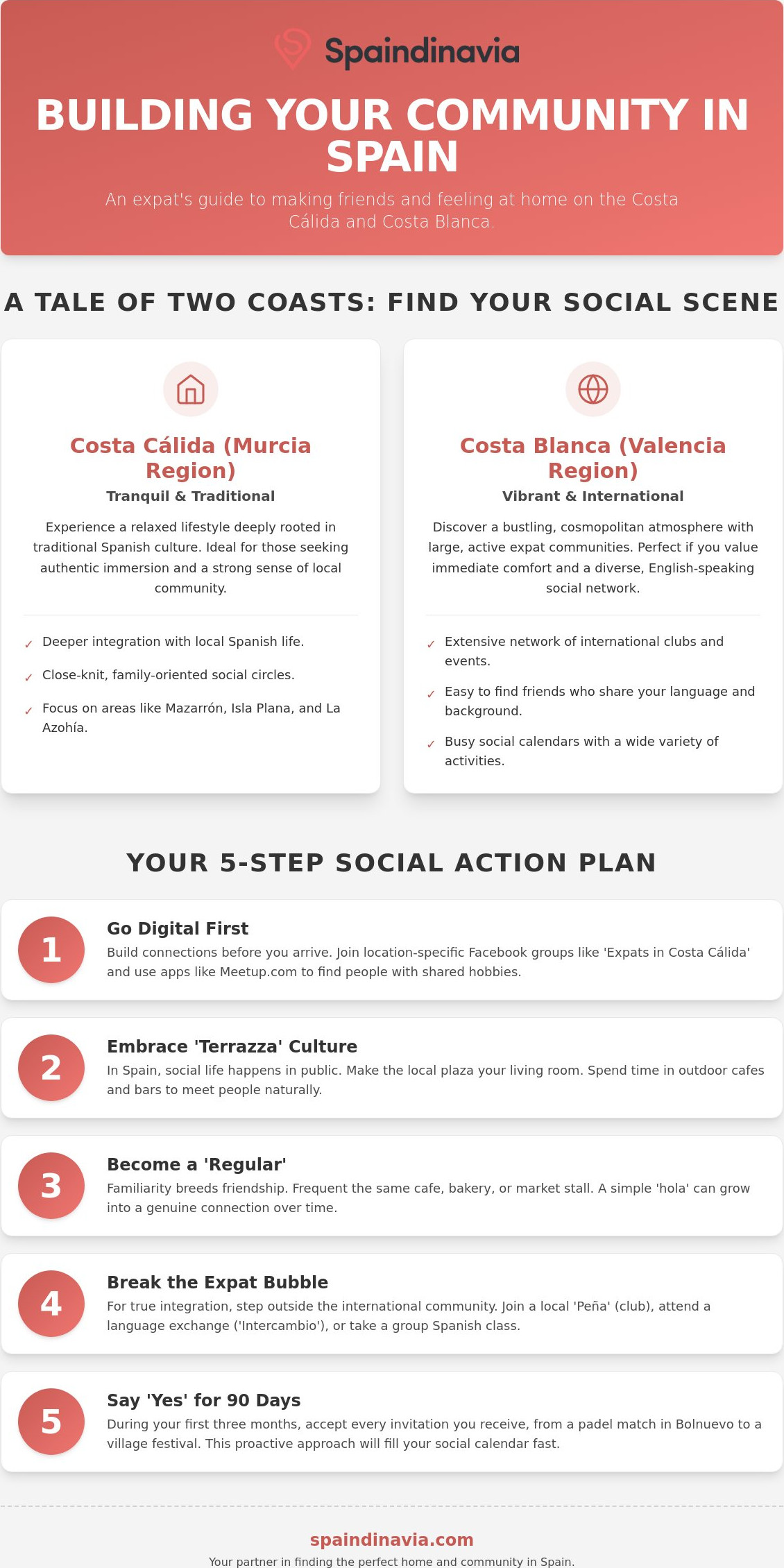
Choosing the Right Location: Social Life in Costa Cálida vs. Costa Blanca
Your choice of location is the foundation upon which your new life is built. In Spain, geography often dictates the social opportunities available to you. The Costa Blanca South, particularly the areas within the Valencia region, offers a vibrant and established international scene. Here, English is widely spoken, and the sheer density of international residents makes making friends as an expat in spain feel almost instantaneous. It is an ideal setting for those who want a busy, cosmopolitan lifestyle with plenty of familiar comforts nearby.
In contrast, the Costa Cálida in the Murcia region provides a more authentic, emerging feel. It attracts a mix of Spanish families and savvy expats who are looking for a more traditional Mediterranean experience. Puerto de Mazarrón is a genuine 'sweet spot' for socialising. Unlike many coastal resorts that become quiet during the winter months, Puerto de Mazarrón remains active year-round. Its diverse population ensures a healthy blend of cultures, offering a more balanced social experience than the purely international hubs found further north.
Social Hubs in the Mazarrón Area
Bolnuevo is a firm favourite for those seeking a relaxed, beach-centric social life. Set against the backdrop of the famous 'Erosions', its beachfront bars and cafes are perfect for casual, low-pressure meetups. If you prefer smaller, tighter-knit communities, Isla Plana and La Azohía are excellent choices. These villages offer a sense of intimacy where everyone eventually knows their neighbour. In all these areas, the Paseo in Puerto de Mazarrón serves as the region's social 'living room'. It is the place where connections are forged over a sunset walk or a spontaneous coffee at a local chiringuito.
Urbanisations vs. Town Living
The specific type of property you choose also plays a massive role in your social integration. New build villa developments and gated urbanisations often provide an 'instant community'. You'll likely meet people who are in exactly the same boat as you, which is one of the easiest ways to start making friends as an expat in spain. On the other hand, choosing a townhouse in a traditional town centre offers immediate immersion into Spanish life. This path requires a bit more 'Spanish courage' but rewards you with deep, authentic local friendships.
At Spaindinavia, we believe that finding the right home is about more than just bricks and mortar; it is about finding your tribe. We help you choose a location based on your desired social pace, ensuring you feel at home from the moment you arrive. Whether you are looking for new build villas or resale apartments, we ensure your move is the first step toward a vibrant and welcoming community.
Your Social Action Plan: 5 Steps to Finding Your Tribe
Success in a new country often comes down to the momentum you build in your first few weeks. Waiting for invitations to arrive rarely works; instead, taking proactive steps ensures you feel settled and supported from day one. Whether you have chosen the bustling coastal towns of the Costa Blanca or the tranquil shores of the Costa Cálida, following a structured approach removes the anxiety of making friends as an expat in spain. It is about creating opportunities for connection rather than waiting for them to find you.
- Step 1: Join the top three Facebook groups for your specific area at least a month before you fly. This allows you to observe the community vibe and even arrange a coffee meetup for your arrival week.
- Step 2: Book a group Spanish class for your first week. As we discussed earlier, these classes provide an immediate peer group of people who are in exactly the same boat as you.
- Step 3: Establish your 'local'. Choose a cafe in Puerto de Mazarrón or your local village and visit at the same time for three days running. Consistency is the fastest way to be recognised as a neighbour rather than a tourist.
- Step 4: Sign up for an activity that requires a partner or group, such as a Padel lesson in Bolnuevo or a local walking group in the Valencia region.
- Step 5: Host a small housewarming for your immediate neighbours. It is a simple gesture that pays huge dividends in long-term community harmony.
The Power of the Housewarming
Inviting your Spanish neighbours for a drink is a powerful ice-breaker that signals your desire to integrate. You don't need to host an elaborate dinner party. Keep it simple with some local wine, 'jamón', and 'queso'. This relaxed approach fits perfectly with the Mediterranean lifestyle and shows respect for local customs. We also recommend an 'open door' policy during your first few months. Spending time in your front garden or on your porch in Isla Plana or La Azohía naturally encourages passing neighbours to stop for a chat. These small, daily interactions are the true building blocks of making friends as an expat in spain.
Building Roots with Spaindinavia
Our commitment to your journey doesn't end when we hand over the keys. We act as a reliable bridge to your new community, helping you build roots that last. Our property management services keep you connected and your home secure, even if you aren't in Spain full-time. Beyond the legalities, our extensive local network is at your disposal. We can introduce you to trusted tradespeople and local experts who often become your first reliable local contacts. We are here to ensure your transition is as smooth and joyful as possible. Ready to find your place in the sun? Explore our new build villas in Costa Cálida and Costa Blanca.
Embrace Your New Life in the Sun
Building a vibrant community is the final piece of the puzzle in your move to the Mediterranean. By embracing the local 'terrazza' culture and staying proactive with digital tools, you'll find that making friends as an expat in spain becomes a rewarding part of your daily rhythm. Whether you are drawn to the international energy of the Costa Blanca or the authentic, year-round charm of Puerto de Mazarrón and Bolnuevo, your social success starts with a willingness to say 'yes' to new experiences.
At Spaindinavia, we've been independent real estate experts since 2016; we specialise in helping you find the perfect foundation for your new life. Our hand-picked portfolio of quality new builds and resale properties across the Costa Cálida and Costa Blanca ensures you are positioned exactly where you want to be. We take pride in being your local partner, guiding you through every step of the journey with warmth and professional care. When you are ready to turn your dream into a reality, start your Spanish journey with our comprehensive buying property in Spain guide. Your new tribe is waiting for you; all you need to do is take the first step.
Frequently Asked Questions
Is it hard for British expats to make local Spanish friends?
Making local friends isn't difficult if you are willing to step outside your comfort zone and adapt to local rhythms. Spanish social life is often built on long-standing family ties, so you may find it takes longer to be invited into a private home than it does in the UK. However, being a regular at a local 'terrazza' in Bolnuevo or La Azohía will quickly make you a familiar face. Patience and a genuine interest in local culture are your best tools.
Do I need to speak fluent Spanish to have a social life in Spain?
You don't need to be fluent to enjoy a vibrant social life, especially in the established international hubs of the Costa Blanca. Whilst English is widely spoken in many southern coastal areas, learning basic phrases is a sign of respect that opens many doors. In the Costa Cálida, even a small effort to speak the language will transform your experience, making the process of making friends as an expat in spain much more authentic and rewarding.
What are the best apps for making friends in Spain in 2026?
For 2026, the most effective digital tools remain WhatsApp, Meetup, and Bumble BFF. WhatsApp is essential for joining neighbourhood groups in Isla Plana or Puerto de Mazarrón, where local events are often coordinated. Meetup is ideal for finding hobby-specific groups, whilst Bumble BFF has seen a surge in popularity for those seeking one-on-one connections. These platforms provide a safe and efficient way to start building your network before you pack your bags.
How can I meet other British expats in the Costa Cálida region?
Meeting other British residents in the Costa Cálida is easily achieved through local Facebook groups and community hubs. Many expats gather at specific beachfront cafes in Puerto de Mazarrón or participate in local charity work. Whilst the Costa Blanca has a more concentrated international population, the Murcia region offers a more spread-out but very welcoming community. Look for 'Expats in Murcia' groups to find scheduled meetups and social gatherings in your specific area.
Are there social groups for solo expats moving to Spain?
Solo expats have access to a wide range of dedicated social groups specifically designed for those moving to the country alone. Many of these communities organise group lunches, hiking trips, and cultural visits to ensure no one feels isolated. In the Valencia region, these groups are particularly active and often host large-scale events. Whether you are in a quiet village or a bustling town, these networks provide a ready-made support system for your new life.
What is an 'Intercambio' and how does it work for socialising?
An Intercambio is a structured language exchange that serves as a fantastic low-pressure social entry point. Typically held in local bars or cafes, participants spend thirty minutes speaking their native language and thirty minutes in their target language. It is a brilliant way to meet locals who are just as eager to learn as you are. These events are common in both the Costa Blanca and the Costa Cálida, offering a balanced way of making friends as an expat in spain.
Can I find social communities in Puerto de Mazarrón during the winter?
Puerto de Mazarrón is a thriving year-round community, making it an excellent choice for winter socialising. Unlike some resorts in the Costa Blanca that become quiet out of season, this area maintains a steady population. You will find that local chiringuitos and social clubs in Bolnuevo and Isla Plana remain open, hosting events and gatherings throughout the cooler months. This consistency is one of the region's most attractive features for those seeking permanent residency.
Is it better to live in an urbanisation or a town to make friends?
Living in an urbanisation provides an 'instant community' of fellow expats, whilst town centre living offers a more traditional Spanish experience. If you want to meet people who are in a similar situation to yourself, an urbanisation in the Costa Cálida is a great starting point. However, if you prefer to be in the heart of local life, a townhouse in a town centre will require more social courage but eventually leads to deeper, more authentic integration.


