

What if the car sitting in your driveway is actually a ticking clock on your dream of Mediterranean freedom? Many expats arriving in the Costa Cálida or the Costa Blanca find that registering a foreign car in spain is the most daunting hurdle of their relocation. You've likely heard whispers about the strict 30-day residency rule or the complexities of post-Brexit imports, and it's natural to feel a bit overwhelmed by the prospect of Spanish bureaucracy.
We know you'd rather spend your time exploring the hidden coves of La Azohia or enjoying a coffee in Puerto de Mazarrón than decoding DGT tax codes. This guide provides a clear, step-by-step roadmap to help you secure your Spanish plates whilst avoiding unnecessary costs. You'll learn how to master the 2026 ITV requirements, such as the mandatory V16 connected beacon, and discover how to claim tax exemptions that could save you thousands. From the shores of Bolnuevo and Isla Plana to the vibrant towns of the Costa Blanca, we'll ensure your journey is as smooth as the coastal roads themselves.
Key Takeaways
- Identify the legal distinction between a tourist and a fiscal resident to ensure you respect the 30-day countdown for starting your vehicle's transition.
- Prepare for the 2026 ITV technical inspection by securing your Certificate of Conformity and the newly mandatory V16 connected emergency beacon.
- Master the financial side of registering a foreign car in spain by calculating CO2-based registration taxes and local road taxes for your specific municipality.
- Explore the 60-day "removal goods" window which allows new residents to potentially import their vehicle entirely exempt from registration tax.
- Enjoy the complete freedom of the Spanish roads, making it easier to travel between your properties in the Mazarrón area and the neighbouring Costa Blanca.
Understanding the Legal Requirements: Do You Need to Re-register?
Imagine driving your own familiar vehicle along the sun-drenched promenade of Puerto de Mazarrón or cruising the scenic coastal routes of the Costa Blanca. It's a key part of the Mediterranean dream. However, registering a foreign car in spain is a legal necessity that often catches newcomers by surprise. The Spanish authorities are increasingly vigilant about vehicles that remain on foreign plates beyond the allowed grace period, especially in popular expat hubs like Bolnuevo and La Azohia.
Residency vs. Non-Residency Rules
The distinction between being a tourist and a resident is the foundation of vehicle law. If you own a holiday home in Isla Plana but spend less than 183 days a year in the country, you are generally considered a non-resident. In this case, you can typically keep your foreign plates for up to six months. Problems often arise for those who transition into full-time life. Once you become a resident, the rules change instantly. Local police in both the Murcia region and the Valencia region use automated number plate recognition and port records to track how long a vehicle has been in the country. Keeping foreign plates as a resident can lead to your car being impounded and the issuance of heavy fines that far exceed the cost of registration.
The 30-Day Rule Explained
The clock starts ticking sooner than many expect. You have a 30-day window to begin the re-registration process from the moment you establish residency. This is usually triggered by obtaining your TIE (Foreigner's Identity Card) or registering on the Padrón at your local town hall. Whilst the Spanish license plate system is the final goal, the initial steps must be taken promptly to avoid penalties.
Fiscal residency in the context of vehicle law is the point where an individual spends more than 183 days per year in Spain or maintains their primary economic or professional interests within the country.
For UK citizens, post-Brexit regulations have added another layer of complexity. Vehicles imported from the UK are now treated as non-EU imports. This means they are subject to a 10% customs duty and 21% VAT, calculated based on the car's current market value. There is, however, a silver lining. If you are moving your primary residence to Spain, you may be eligible for a tax-free import as "removal goods," provided you meet specific deadlines and criteria. This exemption can save you thousands of Euros, making it essential to organise your paperwork before you set off for your new villa in the Costa Cálida.
Step 1: The ITV Technical Inspection and Documentation
The technical inspection, or ITV (Inspección Técnica de Vehículos), is often the most nerve-wracking part of registering a foreign car in spain. Unlike a standard annual check, this initial "matriculación" inspection is a comprehensive review of your vehicle’s DNA to ensure it meets Spanish safety and environmental standards. In 2026, expect to pay between €120 and €170 for this detailed assessment at a station in the Murcia region or the Costa Blanca. A crucial update for 2026 is the mandatory requirement for a DGT-homologated V16 connected emergency beacon. Without this device, your vehicle will not pass the ITV, regardless of its mechanical condition.
To begin, you’ll need the European Certificate of Conformity (CoC). This document proves your car was manufactured to EU standards and simplifies the creation of your Spanish Ficha Técnica (Technical Sheet). If your car is from outside the EU or you don't have a CoC, you'll need a "ficha reducida" prepared by a Spanish engineer. This document essentially translates your car's specifications into the format the Spanish authorities require. Having a legal car makes it so much easier to explore resale apartments in Puerto de Mazarrón or modern townhouses in Orihuela Costa.
Technical Modifications for UK Vehicles
For those moving from the UK to a sunny new home in La Azohia or Isla Plana, specific physical changes are non-negotiable. Your headlights must be adjusted or replaced to ensure the beam pattern doesn't dazzle oncoming traffic when driving on the right. Your speedometer must also clearly display kilometres per hour; whilst a dual display is usually acceptable, it must be legible. Additionally, your rear fog light must be positioned on the left-hand side or in the centre of the vehicle to pass. These small details are where many expats encounter delays, so it's wise to address them before your appointment.
The Engineer’s Report (Homologación)
If you’ve added modifications like a tow bar, non-factory tinted windows, or specific performance parts, these must be officially "homologated" or approved. A standard CoC often won't cover these additions. In such cases, you’ll need a more detailed "Unit Inspection" process. This involves a Spanish engineer certifying that the modifications are safe and meet local regulations. Local experts in the Mazarrón area are well-versed in these requirements and can often help bridge the gap between technical hurdles and the reality of your vehicle, ensuring you can get back to enjoying the Bolnuevo coastline without stress.
Emissions standards have also tightened. Spain now uses the WLTP measurement system, which can be stricter than older tests. Ensure your vehicle is well-maintained and serviced before the inspection to avoid a failure based on exhaust gases, which is a common reason for a "desfavorable" result.
Step 2: Navigating Spanish Taxes and Registration Fees
Understanding the financial side of registering a foreign car in spain is essential for a stress-free transition to your new life. Taxes in Spain are calculated with a focus on environmental impact, meaning the cleaner your car, the lighter the weight on your wallet. While the paperwork might seem dense at first, the system is logical once you break it down into its core components. Managing these costs effectively ensures you can focus your resources on what truly matters, such as furnishing your new home in Bolnuevo or Isla Plana.
The primary tax you'll encounter is the Impuesto Especial sobre Determinados Medios de Transporte, commonly known as the registration tax (IEDMT). For 2026, this one-time fee is strictly tied to your vehicle's CO2 emissions as measured by the WLTP system. If your car emits 120 g/km or less, you'll pay 0%. For vehicles emitting between 121 and 159 g/km, the rate is 4.75%. This rises to 9.75% for emissions between 160 and 199 g/km, and reaches 14.75% for any vehicle emitting 200 g/km or more. These percentages are applied to the vehicle's current market value as determined by official government tables, which account for depreciation based on the car's age.
For vehicles arriving from outside the European Union, including the UK, there are additional fiscal responsibilities. You'll need to account for a 10% customs duty and 21% VAT (IVA). These are calculated based on the purchase price or current market value plus the cost of transport and insurance. It's a significant consideration for those bringing over a cherished vehicle from Britain to the Costa Blanca or the Murcia region.
Qualifying for Tax Exemptions
One of the most valuable tips for new residents is the "Transfer of Residence" exemption. If you're moving to Spain permanently, you can often avoid the registration tax entirely. To qualify, you must have owned the vehicle for at least six months prior to your move and apply within a strict 60-day window of obtaining your residency. You'll need robust proof of your previous life abroad, such as a Baja Consular or evidence that you've ended a tenancy or employment contract in your home country. Missing this window is a common mistake that can lead to paying thousands in unnecessary taxes.
Local Road Tax (IVTM)
Whilst the registration tax is a one-off payment, you must also settle the annual local road tax, known as the Impuesto sobre Vehículos de Tracción Mecánica (IVTM). This tax is paid to the town hall where you are registered on the Padrón. Rates differ significantly between municipalities; for instance, the cost in Puerto de Mazarrón or La Azohia may vary compared to towns in the neighbouring Costa Blanca. The IVTM is a recurring annual cost that ensures your vehicle remains legally permitted to use public roads in your local municipality. Payments are typically managed through the Suma office in the Valencia region or directly via the local town hall in the Murcia region.
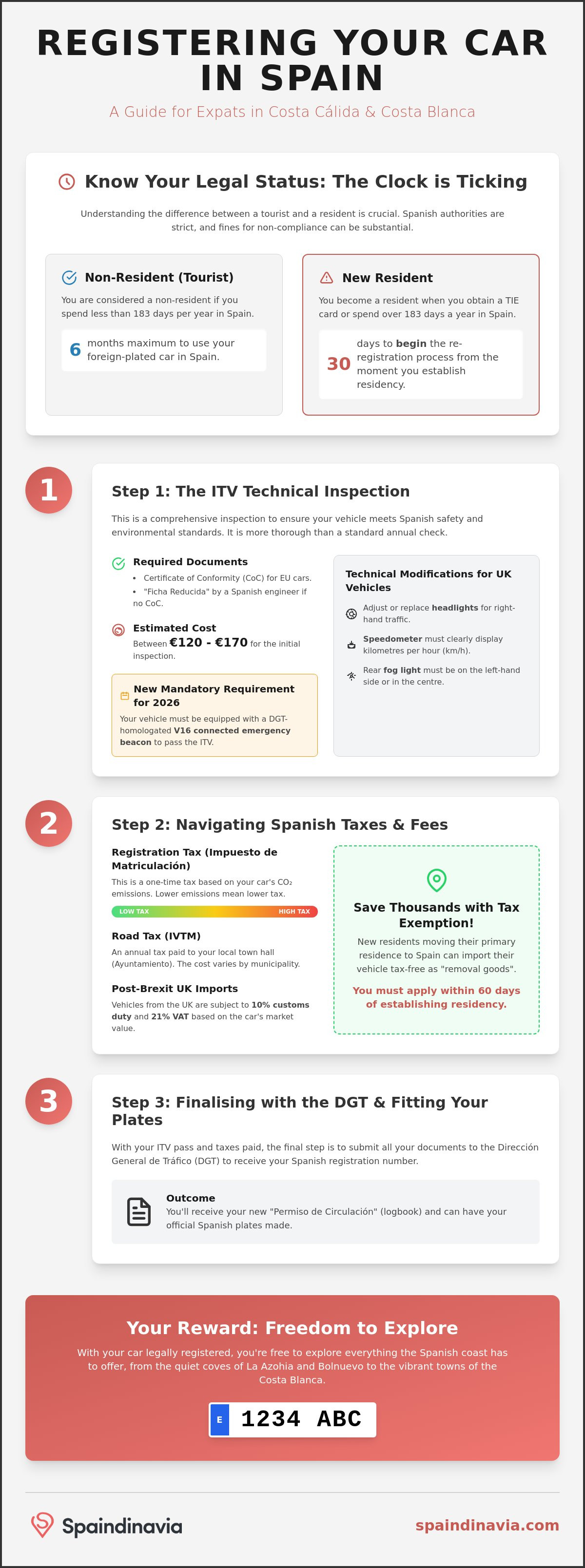
Step 3: Finalising with the DGT and Fitting Your Plates
Once you've navigated the technical inspection and settled your taxes, the final stretch of registering a foreign car in spain involves a visit to the Dirección General de Tráfico (DGT). This is where your hard work pays off and your vehicle officially becomes a Spanish resident. Whether you're settling into a new build villa in La Azohia or a resale apartment in Puerto de Mazarrón, this final step is the bridge to complete peace of mind on the road. The process is now highly digitalised, but a physical appointment at your provincial office in Murcia or Alicante is still a common part of the journey.
Before you head to the DGT, ensure you've compiled what we call the "Golden Folder." This collection of documents is your ticket to a smooth finalisation. You'll need your NIE, your residency card (TIE), the original vehicle registration document from your home country, the Spanish ITV technical sheet, and proof that all registration and road taxes have been paid. Having everything organised in a clear folder makes the official's job easier and reduces the chance of being asked to return for a second appointment. If you are still searching for your dream Mediterranean home, you can view our latest resale villas in Bolnuevo and Isla Plana to find the perfect driveway for your newly registered car.
The DGT Appointment Process
Securing a "Cita Previa" (appointment) can be done online or by calling 060. Once your slot is confirmed, follow these specific steps to cross the finish line:
- Step 1: Pay the DGT registration fee (Tasa 1.5). For 2026, this fee is set at €99.77. It's best to pay this online in advance or via bank transfer to avoid delays at the office.
- Step 2: Present your "Golden Folder" for verification. The official will check the ITV sheet against your tax receipts and residency status.
- Step 3: Receive your new Spanish registration number instantly. The official will print your Permiso de Circulación, which is your new Spanish logbook.
Provisional "Green" Plates
If your foreign plates expire or your insurance becomes invalid whilst you're waiting for the final paperwork, you can apply for temporary "green" plates. These allow you to drive legally in Spain for a limited period, usually 60 days. The administrative cost for these plates (Tasa 1.4) is €20.61 in 2026. It's vital to ensure your insurance provider specifically covers these temporary plates, as some standard policies may not automatically transfer. Green plates provide a useful safety net if there are unexpected delays at the ITV station or the town hall.
The very last step is the most satisfying: purchasing your physical plates. You can take your new Permiso de Circulación to a certified plate maker, often located near the DGT office or in local industrial estates. In 2026, a set of high-quality acrylic plates typically costs between €30 and €50. Once they're mounted, you're ready to explore the stunning coastlines of the Costa Cálida and the Costa Blanca with total freedom.
Life in Spain: Exploring the Coast with Your New Plates
The weight that lifts off your shoulders when you finally mount those Spanish acrylic plates is significant. It's the moment your transition from a visitor to a local feels complete. With the bureaucracy of registering a foreign car in spain successfully navigated, you're no longer looking over your shoulder for traffic patrols or worrying about the 30-day residency clock. Instead, you're free to enjoy the rhythmic hum of the tyres on the smooth Mediterranean asphalt. This legal security is the foundation of a relaxed lifestyle, whether you've chosen a quiet retreat in the Murcia region or a bustling coastal town in the Valencia region.
Your vehicle becomes the ultimate tool for discovery. Whilst public transport has its charms, nothing beats the autonomy of driving yourself to a sunrise viewing of a new build villa in La Azohia. The roads connecting the Costa Cálida and the Costa Blanca South are some of the most scenic in Europe. You can start your morning by the iconic Gredas de Bolnuevo erosions and be exploring the vibrant marinas of the southern Costa Blanca by lunchtime. It's this mobility that allows you to truly compare the distinct characters of different neighbourhoods before making a long-term commitment to a property.
Must-Visit Locations in Your Registered Vehicle
The Mazarrón area is best explored on your own terms. Drive down to the pristine, untouched beaches of Isla Plana or navigate the winding coastal roads towards Puerto de Mazarrón to sample the catch of the day. A car is absolutely essential for viewing property portfolios across the region. It gives you the chance to check the proximity of local schools, medical centres, and your favourite supermarkets in real-time. Whether you're looking for a resale apartment with sea views or a sprawling townhouse, having your own transport makes the search an adventure rather than a chore.
How Spaindinavia Supports Your Relocation
At Spaindinavia, we see ourselves as more than just property brokers. We're your local partners and bridge-builders, helping you settle into every aspect of Spanish life. We recommend integrating your vehicle plans into your broader strategy by consulting our buying property in spain guide. This comprehensive resource ensures your investment is secure whilst you focus on the joys of relocation.
If you're ready to find the perfect driveway for your new plates, contact us today for a hand-picked selection of villas in the sun. We're here to ensure every step of your journey, from registering a foreign car in spain to receiving the keys to your new home, is handled with professional expertise and personal warmth. Your new life by the sea is waiting, and we're ready to help you drive towards it with total confidence.
Take the Wheel of Your New Spanish Life
Securing your Spanish plates is about more than just legal compliance; it's about the freedom to explore every corner of your new home without hesitation. By respecting the 30-day residency window and preparing for the 2026 ITV standards, you ensure a smooth transition. Remember that registering a foreign car in spain is a manageable process when you have the right roadmap and stay organised with your documentation.
At Spaindinavia, we pride ourselves on being more than just property specialists. Whether you're looking for new build villas in La Azohia or resale apartments in the Costa Blanca, our team provides comprehensive support through the entire buying journey. We are local experts in Puerto de Mazarrón and Bolnuevo, acting as a bridge to help you settle into the Mediterranean lifestyle you've always imagined.
Find your dream home in the sun with Spaindinavia and let us help you turn those coastal driving dreams into a daily reality. The sun is shining, the roads are open, and your new life is ready for you.
Frequently Asked Questions
Can I register a right-hand drive UK car in Spain in 2026?
Yes, you can legally register a right-hand drive vehicle in 2026. You must ensure the headlights are adjusted for driving on the right and that the rear fog light is correctly positioned on the left or centre. These modifications are essential to pass the ITV inspection in the Murcia region or the Costa Blanca. Many UK expats successfully bring their cherished cars to Puerto de Mazarrón by following these technical steps.
How much does it cost to change foreign plates to Spanish ones?
The total cost for registering a foreign car in spain typically ranges from €700 to €1,500 for an average vehicle. This includes the DGT fee of €99.77, ITV inspection fees between €120 and €170, and physical plates. The largest variable is the registration tax, which is based on CO2 emissions. If you choose to use a gestoría for the paperwork, expect to pay an additional €200 to €400 in professional fees.
Do I need to pay import duty on my car if I am moving from the UK?
UK vehicles are generally subject to 10% customs duty and 21% VAT as they are now treated as non-EU imports. However, you can often claim a total exemption if you are moving your primary residence to Spain. You must apply for this "removal goods" status within 60 days of obtaining your residency card. This is a vital saving for anyone moving their life to Isla Plana or La Azohia.
What is a Certificate of Conformity (CoC) and where do I get one?
A Certificate of Conformity is an official manufacturer's document proving your car meets EU technical and safety standards. You can usually obtain one by contacting the vehicle manufacturer's customer service department directly. If a CoC is not available for your specific model, you will need a Spanish engineer to prepare a "ficha reducida." This alternative document is widely accepted at ITV stations throughout the Valencia and Murcia regions.
Can I drive my foreign car in Spain while the registration is being processed?
You can continue to drive whilst the process is underway, provided your foreign insurance and registration remain valid and legal. If your foreign plates expire or the insurance becomes invalid, you should apply for temporary "green plates" from the DGT for €20.61. These are valid for 60 days and allow you to drive legally whilst your Spanish registration is finalised, ensuring you can still travel easily around Bolnuevo.
Is it cheaper to sell my car at home and buy a Spanish one instead?
It is often more practical to sell your vehicle at home and buy a Spanish car upon arrival. The combined costs of import duties, VAT, and technical modifications can quickly exceed the vehicle's value. Spanish vehicles also maintain a high resale value in the Mazarrón area. However, if your car is high-spec, the effort of registering a foreign car in spain may be a worthwhile investment for your new Mediterranean lifestyle.
What happens if I miss the 30-day deadline for car registration?
Missing the 30-day deadline after becoming a resident can lead to significant fines and the potential impoundment of your vehicle. Authorities in both the Costa Cálida and Costa Blanca are increasingly using automated cameras and port records to track foreign plates. Once you are a legal resident, the grace period for foreign plates ends. It is essential to start the process promptly to ensure your transition remains stress-free.
Do I need a Spanish driving licence to register a car in my name?
You do not need a Spanish driving licence to register a vehicle in your name. You will, however, need a valid NIE and proof of your Spanish address, such as your residency card or Padrón certificate. Whilst you can own and register the car with a UK or EU licence, remember that residency rules will eventually require you to exchange your foreign licence for a Spanish one to remain fully legal.


