
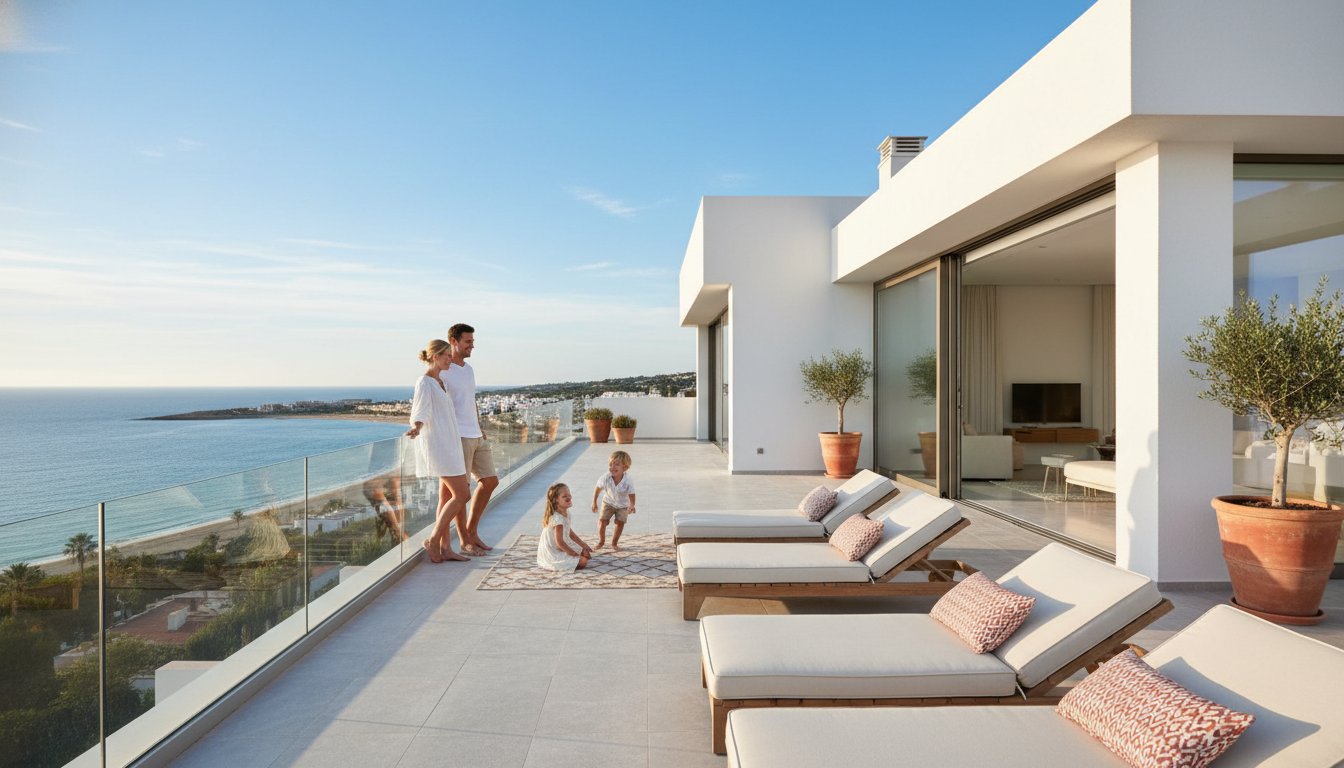
Imagine watching your children run across the golden sands of Puerto de Mazarrón, chatting fluently in Spanish with their new friends whilst the Mediterranean sun warms your back. You've likely dreamt of this lifestyle for years, yet the practicalities of moving to Spain with children can often feel overwhelming. It's completely natural to feel anxious about how they'll adapt to a new language or how you'll navigate the complexities of the Spanish school system and residency requirements after Brexit.
We're here to provide the clarity you need to make your family's transition seamless. You'll discover the essential steps for school enrolment ahead of the March 2026 deadlines and understand the latest financial requirements for the Non-Lucrative Visa, which currently requires €4,200 per month for a family of four. We'll explore the differences between the bustling Costa Blanca and the tranquil, authentic beauty of the Costa Calida. From finding a secure resale villa in Bolnuevo to choosing between local education in Isla Plana or La Azohia, we'll give you the confidence to find your perfect family home and a lifestyle you'll love.
Key Takeaways
- Learn how to involve your children in the relocation process to foster a sense of adventure whilst easing the emotional transition to your new Mediterranean life.
- Understand the school enrolment options available across both the Costa Blanca and the Costa Cálida to ensure your children receive the best possible start in their new environment.
- Compare the vibrant, international atmosphere of the Costa Blanca (Valencia region) with the authentic, relaxed charm of the Costa Cálida (Murcia region), specifically around family-favourite areas like Puerto de Mazarrón, Isla Plana, and Bolnuevo.
- Discover the essential administrative steps for moving to Spain with children, from securing the correct residency visa to registering for local healthcare.
- Identify why choosing a property within an established community, such as a new build villa or a townhouse, can provide your family with an immediate and supportive social circle.
Moving to Spain with Children: Preparing for a Life-Changing Adventure
Deciding to move your family abroad is a bold, inspiring step towards a more fulfilling life. Moving to Spain with children offers a unique opportunity to trade the morning rush for a slower, sun-drenched pace of life. To make this dream a reality without the stress, we recommend beginning your planning journey at least 12 months before your intended move date. This timeframe allows you to navigate school applications, residency visas, and property viewings with a sense of calm. As foreign interest in the Mediterranean grows, as noted in recent figures regarding Immigration to Spain, being well-prepared is your greatest advantage.
We often suggest that families undertake a 'trial run' before committing to a permanent move. Spend a summer exploring the vibrant, high-energy towns of the Costa Blanca or the tranquil, authentic villages of the Costa Cálida. Stay in a holiday rental property in Puerto de Mazarrón or Isla Plana to see how the local rhythm suits your family. Can you see your children playing in the plaza whilst you enjoy a coffee? Testing the waters in La Azohia or Bolnuevo helps you feel certain about your chosen base before you invest in a resale villa or a new build apartment.
Why Spain is the Ultimate Family Destination in 2026
Spain remains a top choice for families because of its deeply rooted culture of 'la familia'. Children aren't just tolerated here; they're celebrated. With over 320 days of sunshine annually, your children's lives will shift outdoors. Whether they're joining a local football club on the Costa Blanca or learning to sail in the calm waters of the Mar Menor, the health benefits of an active Mediterranean lifestyle are immense. You'll find world-class infrastructure and high-ranking international schools in both the Valencia and Murcia regions, ensuring their education remains a priority whilst they embrace a new language.
Setting Realistic Expectations for Integration
Integration is a journey, not a race. When moving to Spain with children, be prepared for the 'silent period' in language acquisition. This is a natural phase where children observe and listen before they feel confident enough to speak Spanish. Don't worry; they're learning more than you realise. You'll also need to adjust to the Spanish 'horario', where meal times are later and the afternoon siesta provides a quiet break from the heat. To help everyone settle, start building a support network early. Join local parent groups in areas like Bolnuevo or look for expat communities on the Costa Blanca to share experiences and advice.
Navigating the Spanish Education System: Schools and Curriculum
One of the most significant steps when moving to Spain with children is deciding where they'll spend their school days. The Spanish education system is robust and welcoming, but it operates quite differently from what you might be used to in the UK. To ensure your children settle quickly, you'll need to choose between three main types of institutions: State (Público), State-subsidised private (Concertado), or fully private International schools. Whilst the Costa Blanca is home to a high density of international colleges following the British Curriculum, the Costa Cálida offers a wonderful opportunity for total immersion in the Spanish Bachillerato system, particularly in family-oriented areas like Puerto de Mazarrón.
Before you commit, we recommend following these practical steps to find the right fit:
- Research the Curriculum: Decide if you want the continuity of the British system or the long-term benefits of the Spanish curriculum.
- Secure your Empadronamiento: You must register at the local town hall (ayuntamiento) in Mazarrón or your chosen Costa Blanca municipality. This certificate is mandatory for enrolling in any state-funded school.
- Visit during term time: Walk through the hallways of schools in Isla Plana or Bolnuevo to observe the social atmosphere and how the teachers interact with international pupils.
- Budget for extras: Even in state schools, you'll need to factor in the cost of the comedor (school lunch) and extraescolares (after-school clubs), which are essential for social integration.
International Schools vs State Schools: The Great Debate
Choosing between systems often depends on your children's ages. Total immersion in a state school in La Azohia can be a gift for younger children, as they often pick up the language within months. However, for teenagers approaching GCSE or A-Level age, the established international schools in the Costa Blanca region might provide a smoother academic transition. Private options offer familiar structures but come with monthly fees, whilst state schools provide a direct route into the heart of the local community. If you're still weighing up which region offers the best balance for your family, exploring a resale villa or a modern townhouse in these areas can help you visualise your new daily routine.
The Enrolment Process and Key Deadlines
Timing is everything in the Spanish system. For the 2026/2027 school year, the primary application window for state and concertado schools runs from March 1st to March 31st, 2026. Missing this 'Admisión' window can make it much harder to secure your first-choice school. You'll need to gather your documentation early, including birth certificates with official translations, immunisation records, and previous school reports. If you're moving mid-term, don't panic. Spanish law ensures every child has a right to an education, and local authorities will find a place for your child, though it may not be in your nearest school.
Choosing Your Region: Family Life in Costa Cálida vs Costa Blanca
Deciding where to plant your roots is perhaps the most exciting part of your journey. The Mediterranean coast offers two distinct personalities for families, each with its own unique charm. The Costa Blanca, located in the Valencia region, is famous for its vibrant energy and established international communities. In contrast, the Costa Cálida in the Murcia region provides a more authentic, tranquil atmosphere where the pace of life slows down significantly. Moving to Spain with children often involves balancing the need for familiar comforts with the desire for a true cultural shift.
Your choice will likely depend on your family's daily rhythm. Are you looking for a high-energy environment with every imaginable amenity on your doorstep? Or do you crave a quiet coastal village where your children can walk to the local bakery? Both regions boast exceptional child-friendly amenities, from blue-flag beaches to modern sports clubs. However, the cost of living can vary. For instance, renting a two-bedroom apartment on the Costa Cálida typically costs between €450 and €650 per month, whilst similar properties in Torrevieja on the Costa Blanca often range from €600 to €800.
The Allure of Costa Cálida and the Mazarrón Area
For families seeking a genuine Spanish experience, the Mazarrón area is a standout choice. Puerto de Mazarrón serves as a safe, year-round hub with a stunning promenade perfect for evening strolls. If you prefer a closer connection to nature, the quieter coastal villages of Isla Plana and La Azohia offer a serene environment amongst rugged hills and crystal-clear waters. Bolnuevo is another favourite, famous for its unique rock formations and family-run restaurants that welcome children with open arms. The sense of community here is palpable, making it easier for new arrivals to feel at home quickly.
The Vibrant Lifestyle of Costa Blanca South
The Costa Blanca South is ideal if you value established expat infrastructure. With roughly 26% of British residents in the province of Alicante, finding English-speaking doctors, dentists, or hairdressers is incredibly simple. This region is also exceptionally well-connected, with Alicante airport providing frequent flights for visiting relatives. You'll find a wide variety of new build villas and modern developments specifically designed for family living, often featuring communal pools and play areas. Whilst it feels more international than the Costa Cálida, it still retains that essential Spanish warmth that makes the Mediterranean so attractive.
The Essentials: Visas, Healthcare, and Administrative Requirements
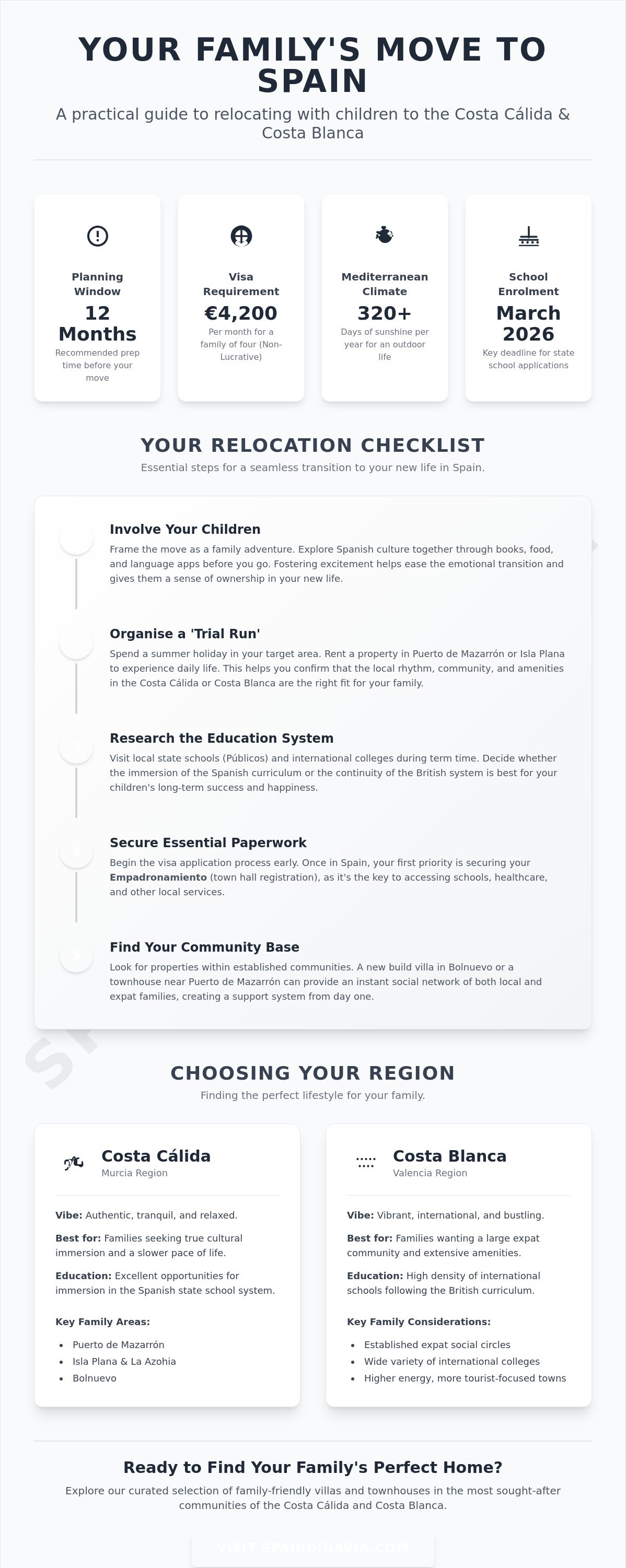
Securing your legal right to reside is the cornerstone of a successful move. Since the UK left the EU, the process has become more structured; however, it remains entirely achievable with the right preparation. For many families moving to Spain with children, the Non-Lucrative Visa (NLV) is the most common path if you don't intend to work for a Spanish company. In 2026, the financial requirements are tied to the IPREM indicator, which sits at €600 per month. For a family of four, this means demonstrating a reliable monthly income of at least €4,200. It's also vital to note that the property-based Golden Visa was officially abolished on 3 April 2025, so families now focus on the NLV or the Digital Nomad Visa (DNV) for remote-working parents.
Administrative success also requires two key acronyms: the NIE and the TIE. The NIE (Número de Identidad de Extranjero) is your tax identification number, essential for everything from opening a bank account to setting up Wi-Fi in your new home. Once you arrive in Spain, you'll exchange your entry visa for a TIE (Tarjeta de Identidad de Extranjero), which is the physical biometric residency card for every family member. Having these documents in order allows you to focus on the more enjoyable aspects of coastal life, such as exploring the local markets in Puerto de Mazarrón or the bustling plazas of the Costa Blanca.
Residency Routes for British Families Post-Brexit
The application process begins at the Spanish Consulate in the UK, where you'll need to provide apostilled and translated documents, including criminal record checks and medical certificates. Whilst the financial bar for the NLV is higher than in previous years, it provides a clear roadmap to permanent residency after five years of continuous living in Spain. For those working remotely, the DNV offers a more flexible tax regime, often referred to as the "Beckham Law", which can provide significant savings for eligible families during their first six years.
Healthcare and Social Security
Access to quality medical care is a top priority for parents. For your initial visa approval, you must hold a comprehensive private health insurance policy with no co-payments. A healthy family of four can expect to pay between €200 and €500 per month for this coverage. Once you're settled, you might consider the Convenio Especial, a public health scheme that, in 2026, costs approximately €60 per month for individuals under 65. Whether you're looking for English-speaking paediatricians in the Mazarrón area (including Isla Plana and La Azohia) or specialist clinics in the Costa Blanca, the standard of care is exceptionally high.
Once you have your visa strategy in place, the next logical step is finding a home that meets the residency requirements for your family. You can browse our latest new build villas and resale apartments to find a property that fits your family's needs in the Murcia or Valencia regions.
Finding Your Perfect Family Base: New Build Villas and Community
The final, and perhaps most rewarding, step in moving to Spain with children is choosing the house that will become your family's sanctuary. Whilst the charm of a traditional townhouse is undeniable, many families find that new build villas offer the security and modern comforts necessary for a stress-free transition. These homes are designed for year-round living, featuring high-quality insulation and energy-efficient systems that keep your family comfortable through both the peak summer heat and the cooler winter evenings. Selecting the right property type is just as important as the location for your long-term happiness.
We often recommend 'urbanisation' living for families. These residential communities are designed to foster social interaction, often featuring shared green spaces, playgrounds, and communal pools where children naturally meet and make friends. Whether you're looking at a gated development on the Costa Blanca or a friendly neighbourhood in Puerto de Mazarrón, these environments provide an immediate social circle for both parents and children. To ensure your purchase is secure and legally sound, we suggest you consult our buying property in spain guide, which details the essential 2026 checklist for secure family investments.
Why New Build Villas are Ideal for Families
Modern villas prioritise open-plan layouts, making it much easier to supervise younger children whilst you're busy in the kitchen or relaxing in the lounge. The seamless flow between indoor and outdoor spaces is a hallmark of Mediterranean architecture, allowing your kids to enjoy their private pool and garden safely within your sight. In coastal gems like Isla Plana and La Azohia, these properties often combine contemporary luxury with easy access to quiet, shallow beaches, creating an ideal environment for nature-loving families to thrive.
Building Your Life with Spaindinavia
At Spaindinavia, we don't just help you find a house; we help you establish a lifestyle. Our hand-picked portfolio focuses on quality and proximity to the amenities that matter most to parents, such as reputable schools and safe parks. We view your purchase as a significant spain property investment that should offer both financial growth and a high quality of life for your children's future.
Our role is to act as your local bridge, introducing you to trusted professionals who specialise in family relocations. From solicitors in Bolnuevo who understand the nuances of the Murcia region to school consultants on the Costa Blanca, we ensure you have the right support at every stage. We're passionate about helping you find a base where your children can grow up with the sun on their faces and the sea at their doorstep.
Embrace Your New Life on the Spanish Coast
The journey of moving to Spain with children is a profound investment in your family's happiness and well-being. By understanding the education system early and choosing a location that matches your lifestyle, whether that's the vibrant Costa Blanca or the tranquil shores of Puerto de Mazarrón and Bolnuevo, you've already taken the most important steps. Remember to keep the March school enrolment deadlines in mind and ensure your residency paperwork is prepared with precision. The Mediterranean lifestyle is no longer just a distant dream; it's a practical reality waiting for you.
At Spaindinavia, we pride ourselves on being your local experts across both the Costa Cálida and the Costa Blanca. We offer comprehensive support through the entire buying process, backed by our independent legal and banking collaborations to ensure your move is secure. Whether you're drawn to the authentic charm of Isla Plana and La Azohia or the modern infrastructure of the Valencia region, we're here to guide you home. Start your family journey by browsing our New Build Villas today. We can't wait to welcome you to the neighbourhood.
Frequently Asked Questions
Is it difficult for children to learn Spanish if they move at an older age?
Learning a new language is certainly more challenging for teenagers than for toddlers, but it's far from impossible with the right support. Younger children often reach fluency within a year through total immersion in a local school. Older children usually benefit from intensive language courses or attending international schools on the Costa Blanca where Spanish is taught as a primary subject alongside the British curriculum.
Can my children attend a Spanish state school if we are not yet residents?
Yes, every child in Spain has a legal right to an education regardless of their current residency status. You simply need to be registered on the padrón, which is the municipal register at your local town hall in Mazarrón or your chosen Costa Blanca municipality. This registration allows you to apply for a school place whilst your residency visa is being processed by the authorities.
What are the average costs for international schools in Costa Blanca?
Monthly fees for international schools in the Valencia region typically range from €500 to €1,000 per child. It's important to budget for additional expenses such as initial registration fees, school bus transport, uniforms, and the comedor, which is the daily school lunch. These costs vary depending on the age of the student and the specific facilities the school offers.
Do I need a separate NIE number for my child?
Yes, every family member, including infants, requires their own NIE, which is the Foreigner Identity Number, for administrative purposes. This number is essential for school registration, accessing the healthcare system, and eventually obtaining their TIE residency card. You should apply for these numbers at the same time as your own application to keep the family's paperwork organised and synchronised.
How does the Spanish healthcare system work for expat children?
Expat children access healthcare through private insurance or the public system if a parent is paying into Spanish social security. Since moving to Spain with children requires private health insurance for the initial visa, your children will have immediate access to specialists. Once you become a permanent resident, your children are entitled to the same high standard of free public care as Spanish nationals.
What are the safest areas for families in the Costa Cálida region?
The Mazarrón area is widely considered one of the most secure and family-friendly locations in the Murcia region. Specifically, Puerto de Mazarrón, Isla Plana, and La Azohia offer very low crime rates and a welcoming, close-knit community feel. Bolnuevo is also highly recommended for its pedestrian-friendly promenade and safe, shallow beaches that are perfect for young children to enjoy under supervision.
Are there many English-speaking extracurricular activities for kids?
You'll find an abundance of English-speaking clubs in the Costa Blanca due to its established international population. In the Costa Cálida, whilst many sports like football or sailing are conducted in Spanish, there's a growing number of international groups in Puerto de Mazarrón. These activities provide a fantastic way for children to socialise whilst picking up the local language in a relaxed, fun environment.
How long does the visa application process usually take for a family?
The entire process typically takes between three and six months from the moment you start gathering your documents to the visa being issued. You should allow at least eight to twelve weeks for the Spanish Consulate in the UK to process your application once it's submitted. Starting your journey for moving to Spain with children at least a year in advance ensures a calm and organised transition.


