

What if your peaceful retreat in Bolnuevo or a chic apartment in Orihuela Costa became a source of stress simply because of an overlooked piece of paper? Many owners believe that paying their annual IBI council tax is the end of their fiscal responsibilities in Spain. It's a common misconception that often leads to unexpected letters and fines from Hacienda, especially when navigating the system in a second language. Our non-resident tax in spain for property owners form 210 guide simplifies this process, ensuring you stay compliant whilst protecting your Mediterranean lifestyle.
We understand that the dream of owning a villa in Puerto de Mazarrón or a bungalow on the Costa Blanca shouldn't be clouded by tax anxiety. Whether you're enjoying the quiet coves of Isla Plana and La Azohia or the vibrant life of the Costa Calida, staying on top of your self-assessment is vital. This guide covers everything from the 24% tax rate for UK residents to the specific 31 December 2026 deadline for 2025 imputed income. You'll learn how to distinguish between rental and personal use declarations so your Spanish home remains the joyful investment you always intended it to be.
Key Takeaways
- Understand why all non-resident owners, whether in Bolnuevo or across the Costa Blanca, must file Form 210 even if the property is only used for personal holidays.
- Learn how to distinguish between imputed income tax and rental income tax to ensure you meet the correct annual filing obligations for your Spanish home.
- Use this non-resident tax in spain for property owners form 210 guide to navigate the 2026 deadlines and tax rates, including the 24% rate for UK-based owners.
- Discover the essential documentation you need, such as your NIE and IBI receipts, to successfully submit your declaration via the Agencia Tributaria electronic portal.
- Find out how professional fiscal representation provides security for your investment in Puerto de Mazarrón, Isla Plana, or La Azohia, whilst also maintaining your property interests on the Costa Blanca.
Understanding Non-Resident Tax in Spain: An Essential Guide to Form 210
Owning a slice of paradise in Puerto de Mazarrón or along the sun-drenched Costa Blanca is a dream for many. However, with that dream comes a few practical responsibilities to the Spanish tax office, known as Hacienda. Form 210, or Modelo 210, is the primary document used to declare Non-Resident Income Tax (Impuesto sobre la Renta de no Residentes). This non-resident tax in spain for property owners form 210 guide is designed to help you understand why this filing is a non-negotiable part of your journey as a homeowner.
You might wonder why you owe tax if you aren't actually making a profit from your property. In the eyes of the Spanish authorities, simply owning a home for your own use is considered a "benefit" that must be taxed. This is known as imputed income tax. Staying compliant isn't just about following the rules today; it's about protecting your future. When you eventually decide to sell your resale villa in Bolnuevo or pass your apartment in Orihuela Costa to your children, Hacienda will check your tax history. Unpaid Form 210 filings can lead to significant delays, interest charges, and complications during the sale or inheritance process. Understanding the broader context of Taxation in Spain helps clarify how these local obligations fit into the national system.
Who is Classified as a Non-Resident in 2026?
Determining your tax status is the first step toward peace of mind. For most British homeowners, the 183-day rule is the deciding factor. If you spend fewer than 183 days in Spain during a calendar year, you're generally considered a non-resident. It's also vital to consider where your "centre of economic interests" lies. If your main income or family life remains in the UK whilst you enjoy long summers in La Azohia, you'll likely remain a non-resident. Your NIE number (Número de Identidad de Extranjero) acts as your tax identity throughout this process. It's the key that unlocks your ability to file Form 210 and ensures your payments are correctly recorded against your property in the Murcia or Valencia regions.
Why Your Spanish Property Choice Matters
The type of property you choose can subtly influence your tax experience. Whether you've invested in a sleek new build villa in Isla Plana or a charming resale apartment on the Costa Blanca, the cadastral value (valor catastral) of that specific property determines your tax base. IRNR is a mandatory self-assessment for non-residents. This means the government won't send you a bill. You must take the initiative to calculate what you owe. By staying proactive, you ensure that your investment in the Mazarrón area remains a source of joy rather than a bureaucratic hurdle.
Imputed vs Rental Income: Identifying Your Tax Obligations
Distinguishing between personal use and letting your property out is the cornerstone of any non-resident tax in spain for property owners form 210 guide. Whether you own a bungalow in Puerto de Mazarrón or a sleek townhouse on the Costa Blanca, the Spanish tax office looks at your property through two distinct lenses. The starting point for both is always your property's "Valor Catastral". You'll find this figure on your annual IBI (council tax) receipt. It acts as the official administrative value of your home and serves as the base for your calculations. If you're looking for a Spanish Tax Agency guide to confirm the technical specifics, you'll see it's the fundamental metric for non-resident obligations.
The "Ghost Rent": Understanding Imputed Income
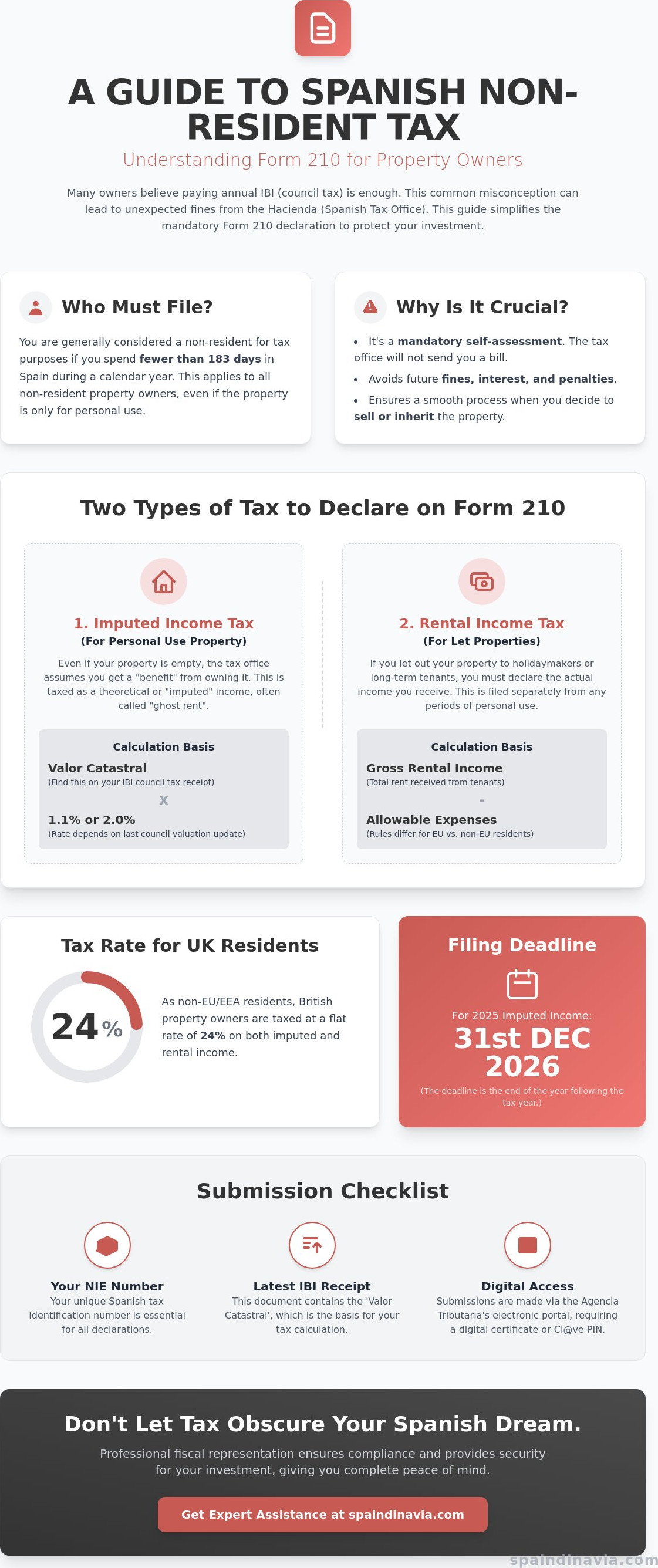
Even if your villa in Bolnuevo sits empty whilst you're back in the UK, Hacienda assumes you're receiving a "benefit" from owning it. This is often called "ghost rent". You calculate it by taking either 1.1% or 2% of the cadastral value, depending on when the local town hall last updated its records. If you own a resale apartment in Isla Plana or La Azohia, checking your last IBI receipt will tell you which rate to apply. This imputed income is then taxed at your applicable rate, ensuring your holiday home stays fully compliant with Spanish law.
Declaring Rental Income in 2026
If you decide to let out your property to holidaymakers, the rules shift. Since 2024, the process has become much simpler for owners. Instead of quarterly filings, you now group your rental income into a single annual declaration. This must be submitted between 1st and 20th January of the year following the income. For example, any rent collected during 2025 must be declared in early 2026. This change has reduced the administrative burden for owners by 75%, making it easier to manage investment properties across both the Costa Calida and the Costa Blanca.
Tax rates differ based on where you live. EU and EEA residents pay 19% on their net income and can deduct expenses like maintenance, insurance, and utility bills. However, UK residents and other non-EU owners are taxed at 24% on the gross income with no deductions allowed. If your property saw "mixed use" during the year, you simply split the days. You'll pay rental tax for the period it was let and imputed tax for the days it was available for your personal use. Keeping a simple log of your arrival and departure dates makes this calculation straightforward and stress-free.
2026 Deadlines and Tax Rates for Non-Resident Owners
Keeping your Mediterranean dream on track means staying ahead of the Spanish tax calendar. Whether you're relaxing in your villa in Bolnuevo or managing a townhouse on the Costa Blanca, knowing your dates is the best way to avoid unnecessary stress. This non-resident tax in spain for property owners form 210 guide highlights the specific windows you need to watch to ensure your investment remains a source of pleasure rather than paperwork. For many owners, the most important date to remember is 31 December 2026, which is the final deadline to submit your imputed income tax for the 2025 tax year.
Mark Your Calendar: Key Dates for 2026
One of the most significant improvements for property owners in Isla Plana and La Azohia is the simplification of rental income declarations. You no longer need to file every quarter. Instead, all rental income earned during 2025 must be declared in a single annual grouping between 1 January and 20 January 2026. If you prefer to pay via direct debit, you'll need to act even faster, as that deadline falls on 15 January. Missing these windows can be costly. The legal interest rate for late tax payments is currently set at 3.25% annually, often accompanied by additional surcharges from Hacienda.
If you're planning to sell your property in the Murcia or Valencia regions, the timeline changes. When a non-resident sells a home, the buyer withholds 3% of the purchase price to pay directly to the tax office. You then have exactly four months from the date of the sale to file your Form 210 and settle any capital gains tax. Staying organised with these dates ensures a smooth transition and protects your financial interests throughout the process.
Tax Rates and Deductions
Since the UK left the European Union, British owners are classified as non-EU residents. This means you'll pay a flat tax rate of 24% on your Spanish income. Whilst EU and EEA residents enjoy a lower 19% rate and can deduct expenses like cleaning, management fees, and repairs, non-EU owners are taxed on the gross amount. This makes understanding your potential returns even more vital. To see how these costs fit into your broader financial picture, explore our Spain Property Investment Guide for deeper insights into maximising your ROI.
Thankfully, the Double Taxation Treaty between Spain and the UK prevents you from being taxed twice on the same income. You can usually claim the tax paid in Spain as a credit on your UK self-assessment. This treaty provides a vital safety net for owners in Puerto de Mazarrón and across the Costa Blanca, ensuring that your lifestyle in the sun remains as affordable as it is beautiful.
How to Complete Form 210: A Step-by-Step Submission Guide
Organising your paperwork is the first step toward a stress-free submission. Before you log on, ensure you have your NIE (Tax Identification Number) and your latest IBI receipt to hand. This receipt contains your "Referencia Catastral", a unique 20-digit code that identifies your property in Puerto de Mazarrón or on the Costa Blanca. You'll also need your bank details (IBAN and BIC/SWIFT) if you plan to pay directly. This non-resident tax in spain for property owners form 210 guide recommends double-checking that the name on your bank account matches the name on your NIE to avoid validation errors during the final steps.
Access the Agencia Tributaria electronic office (Sede Electrónica) to begin the digital process. You'll need to select the correct "Accrual" (Devengo) period. For the imputed income tax we discussed earlier, the accrual year is the calendar year being taxed. For example, when filing in 2026 for the 2025 tax year, you select "2025" and the "Annual" frequency. If you're managing multiple holiday rental properties, remember that each property requires its own separate form. This ensures every investment in the Murcia and Valencia regions is accounted for individually.
The Digital Submission Process
Most owners find using a digital certificate or the Cl@ve system the most efficient way to file. These tools verify your identity instantly and save you a trip to a physical office. When filling in the form, you'll see fields for "Taxpayer" and "Representative". If you're filing yourself, you'll focus on the taxpayer section. A common pitfall occurs in the "Property Description" box; ensure the address matches exactly what's written on your deeds, whether it's a seaside apartment in Isla Plana or a villa in the hills of Bolnuevo. Each joint owner must file a separate Form 210. If you and your partner own a bungalow in La Azohia together, you'll each submit a form for 50% of the property value.
Payment Options and Confirmation
If you have a Spanish bank account, direct debit is the simplest choice, though you must meet the earlier mid-January deadlines mentioned previously. If you don't have a local account, you can select the option to pay via bank transfer or take the printed document to a Spanish bank in person. Once the payment is processed, always download and store your "Justificante". This PDF receipt is your legal proof of compliance. It provides essential security should you ever decide to sell your home or expand your portfolio of investment properties across the Costa Calida and Costa Blanca.
Managing Your Spanish Property Investment with Professional Ease
Owning a home in Isla Plana or a resale apartment in Bolnuevo should be about sunsets and sea breezes, not stressing over tax codes. Whilst this non-resident tax in spain for property owners form 210 guide provides the framework you need, many owners find that professional oversight is the secret to true peace of mind. Partnering with a fiscal representative ensures you never miss a deadline or miscalculate a cadastral value, allowing your Spanish investment to flourish without the administrative weight. It's about transforming a legal obligation into a simple, automated part of your Mediterranean lifestyle.
At Spaindinavia, we believe your property journey shouldn't end at the notary's office. We act as a reliable bridge between your life in the UK and your property in the sun, offering a blend of professional expertise and personal warmth. By integrating tax compliance with active property management, we ensure that your villa in Puerto de Mazarrón or your townhouse on the Costa Blanca remains a secure, high-performing asset. Whether you're dealing with the 24% tax rate for non-EU residents or managing annual rental groupings, having a local partner makes all the difference.
Why Local Expertise Matters
The Murcia and Valencia regions share the same beautiful coastline, but their local tax offices often have different administrative rhythms. Navigating these regional nuances requires more than just a translation; it requires a deep understanding of local behaviour and procedures. Professional key holding and oversight provide an extra layer of security, especially for owners who aren't in Spain year-round. For those just starting their journey, our Buying Property in Spain Guide offers an essential checklist to ensure total security from day one. This local presence is particularly vital in areas like La Azohia and the wider Mazarrón area, where personal relationships with local authorities can often speed up bureaucratic processes.
Next Steps for Secure Ownership
As we move through 2026, being proactive is your best strategy. Start by organising your 2025 records now, ensuring your IBI receipts and NIE details are easily accessible for your next filing. Review your rental strategy to see if your current occupancy rates justify the tax obligations, or if you could improve your ROI with better management. Remember, this non-resident tax in spain for property owners form 210 guide is a tool to help you stay compliant, but the ultimate goal is to enjoy your home. If you'd rather spend your time on the beach than on the Agencia Tributaria portal, we're here to help. Contact Spaindinavia for professional property management and sales support to ensure your Spanish retreat remains your favourite escape for years to come.
Secure Your Spanish Dream with Confidence
Mastering your fiscal duties ensures your holiday home remains a sanctuary rather than a source of worry. We've explored how distinguishing between personal use and rental income, whilst respecting the strict 2026 deadlines, keeps your investment safe in the eyes of Hacienda. This non-resident tax in spain for property owners form 210 guide provides the clarity you need to navigate these requirements with ease, whether your property is nestled in the quiet coves of Isla Plana or along the vibrant Costa Blanca.
Since 2016, Spaindinavia has acted as a trusted bridge for owners, offering expert guidance from NIE acquisition to full rental management. Our local presence in Puerto de Mazarrón, Bolnuevo, and La Azohia means we're always on hand to protect your interests across both the Murcia and Valencia regions. Discover how Spaindinavia can help you manage your Spanish property investment with ease and enjoy the peace of mind you deserve. Your future under the Spanish sun is bright; let's make sure it stays that way.
Common Questions About Non-Resident Tax in Spain
What is the deadline for filing Form 210 for imputed income tax in 2026?
The deadline for submitting your imputed income tax for the 2025 tax year is 31 December 2026. This date applies to all non-residents who used their property for personal enjoyment rather than letting it out. Whether your villa is in Bolnuevo or on the Costa Blanca, ensuring your form is filed by this date avoids late payment surcharges and keeps your investment secure.
Do I have to file Form 210 if my Spanish property is not rented out?
Yes, you must file Form 210 even if your property is never rented out. The Spanish tax office views property ownership as a benefit that must be taxed, which is known as imputed income. This non-resident tax in spain for property owners form 210 guide emphasizes that staying compliant is essential for future property sales in areas like Isla Plana or La Azohia, as Hacienda checks tax history during the transaction.
Can I deduct expenses from my Spanish rental income as a UK resident?
No, UK residents cannot deduct expenses from their Spanish rental income. Since the UK is no longer part of the EU or EEA, British owners are taxed at a flat rate of 24% on their gross rental income. In contrast, EU residents pay 19% and can deduct costs like maintenance. This remains a key difference for investors choosing between the Costa Calida and the Costa Blanca regions.
What happens if I forget to file my non-resident tax return in Spain?
Forgetting to file can lead to financial penalties, including interest charges and surcharges on the unpaid amount. The legal interest rate for 2025 is 3.25% annually. Beyond the immediate costs, unpaid taxes can block the sale of your bungalow in Puerto de Mazarrón or complicate inheritance procedures for your family later on. Hacienda can claim unpaid taxes for up to four years plus interest.
Is the tax rate different for properties in Costa Cálida versus Costa Blanca?
The tax rate for non-residents is the same across all regions of Spain because it's a national tax. However, the actual amount you pay might differ because the "Valor Catastral" is set by local town halls. This means a townhouse in Mazarrón and a similar property on the Costa Blanca may have different tax bases, even though the 19% or 24% rate remains identical.
Do both spouses need to file a separate Form 210 if they own a property jointly?
Yes, each joint owner is required to submit their own separate Form 210. If a husband and wife own a resale apartment in Bolnuevo as a 50/50 split, they must each file a return for half of the taxable amount. This is a common area of confusion that this non-resident tax in spain for property owners form 210 guide aims to clarify to ensure total compliance for every owner.
What is the "Valor Catastral" and where can I find it for my tax return?
The "Valor Catastral" is the administrative value assigned to your property by the Spanish government. You can find this figure on your annual IBI (council tax) receipt, which is issued by your local town hall in the Murcia or Valencia regions. It's the most important number for your tax return because it determines whether you calculate your tax base at 1.1% or 2% of that value.
How has the 2024 change affected quarterly rental income declarations?
The 2024 regulatory change replaced the old quarterly filing system with a single annual declaration for rental income. You now group all income from the previous year into one filing window between 1 January and 20 January. This has simplified life for owners in La Azohia and across the Costa Blanca by reducing the administrative workload by 75%, making property management much more straightforward.


