

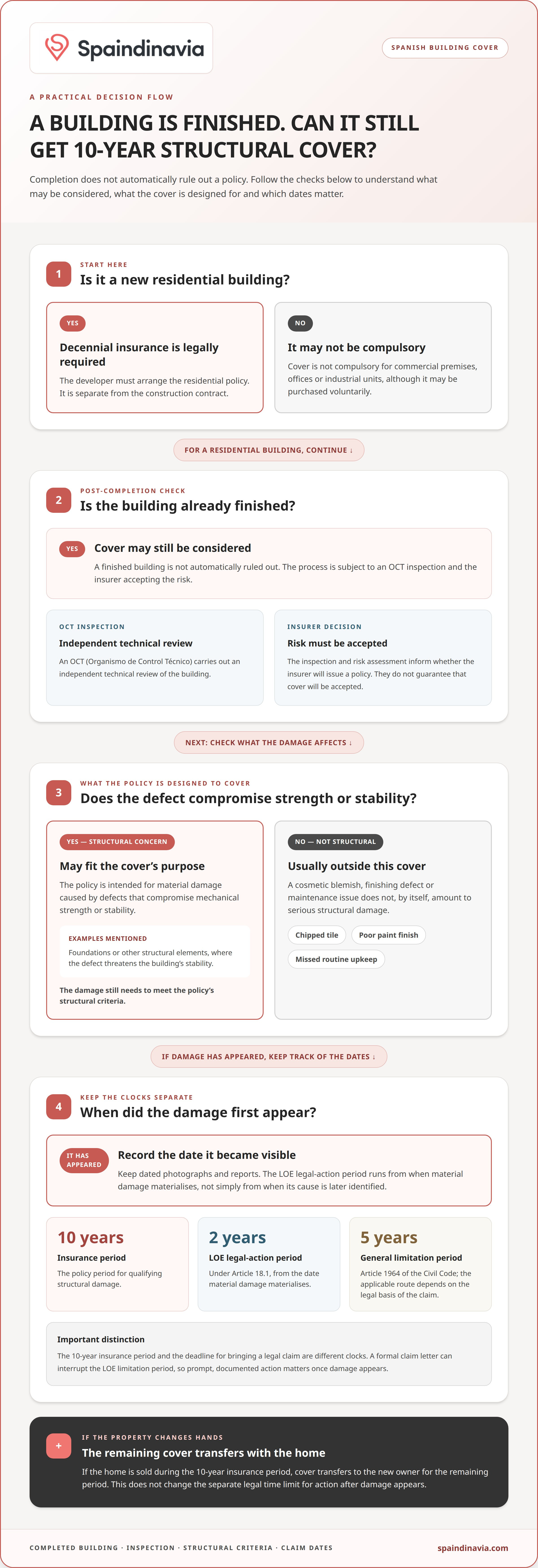
A finished building doesn’t automatically rule out cover. In Spain, getting a ten-year build guarantee (seguro decenal) after completion may still be possible, subject to an OCT inspection and the insurer accepting the risk. The policy is intended to cover material damage caused by defects that compromise a building’s mechanical strength and stability, rather than every snag or cosmetic flaw.
It’s understandable to assume the insurance must be arranged before construction begins, so discovering the issue after completion can feel like a setback. This guide explains when cover may be arranged, what the inspection and insurer’s decision mean, and how Spain’s building warranties and liability rules fit together. You’ll also learn how ten-year structural cover differs from protection for habitability and finishing defects, helping you understand what may apply when assessing a completed home.
Key Takeaways
- Cover may still be arranged after a building is finished, subject to an OCT inspection and the insurer accepting the risk.
- Separate serious structural damage from habitability problems and finishing defects, as Spain’s new-build warranties treat them differently.
- Use the formal handover date to understand the warranty periods that may apply to different types of defects.
- Keep clear records of when damage appeared, as the time limit for a legal claim can differ from the insurance coverage period.
- Understand which construction professionals may be liable, and how their responsibilities can affect a claim.
Is latent defects insurance compulsory?
For new residential buildings in Spain, ten-year latent defects insurance is legally required. The developer must arrange the policy, which protects buyers against specified serious structural damage.
Purpose and structural protection
Seguro decenal is insurance for material damage caused by serious building defects that compromise mechanical strength or stability. It focuses on the structure, including foundations and load-bearing elements, rather than every fault in a finished home.
For example, damage linked to a foundation defect may be covered if it threatens the building’s stability. A cosmetic blemish or maintenance problem is different: by itself, it does not show structural damage. This distinction helps buyers understand what the insurance is designed to protect, rather than assuming it covers every repair or snag.
Spanish insurance requirements
Spain’s Building Act, Ley de Ordenación de la Edificación (LOE), provides a legal basis for this requirement under statute 38/1999. Article 19 requires the promoter to take out decennial insurance before registering a new residential building at the Property Registry, the official record of property ownership and rights. The developer must obtain the cover and provide proof for the relevant registration process.
This obligation applies to new residential construction. A dwelling sold to a third party within ten years of completion is also among the stated cases where insurance is legally required. Cover is not compulsory for commercial premises, offices or industrial units, although it may be purchased voluntarily. The issue may also arise during a renovation if it changes a residential building’s structure and is declared as a new build.
The developer, not the builder or homeowner, must arrange the residential policy and pay its single premium. The insurer is an independent third-party property insurance company, separate from the builder and developer. A broker may help arrange cover, but the insurer issues the policy and carries the insured risk. So a ten-year build guarantee (seguro decenal) involves an insurance arrangement separate from the construction contract.
According to the Boletín Oficial del Estado, proof of the required insurance is needed to register public deeds and liquidate developer companies. Spain’s Civil Code Article 1591 is also identified as a legal basis for construction warranty liability, alongside the LOE. This makes the policy part of the legal framework for new residential buildings, not simply a private promise from the construction team.
It may still be possible to get a ten-year build guarantee (seguro decenal) after a building is finished, subject to an OCT inspection and the insurer accepting the risk. An OCT (Organismo de Control Técnico) inspection is an independent technical review of the building. Completion alone does not rule out a policy, but the inspection and risk assessment must support its issue.
How long do I have to claim for building defects in Spain?
In Spain, the ten-year insurance period and the deadline for bringing a legal claim are different clocks. The policy covers qualifying structural damage during its coverage period, while Article 18.1 of the Building Act sets a separate time limit for actions concerning construction damage.
Under Article 18.1, actions for material damage arising from construction defects prescribe two years from the date the damage materialises. The key date is when the damage appears, not simply when someone later identifies its cause. For example, if serious cracking appears, record when it first became visible and keep dated photographs and reports. Those details can help establish the timeline.
That two-year period concerns a legal action, not the ten-year insurance term. The policy covers material damage caused by defects that compromise the building’s mechanical strength and stability. Examples may involve foundations or other structural elements when the defect threatens stability. A defect in an architect’s design or construction work is not automatically covered simply because it concerns the building. The damage must meet the policy’s structural criteria.
Cover is connected to the residential property, not only to the first buyer. If the home is sold during the 10 years of insurance, the cover transfers to the new owner for the remaining insurance period. A buyer therefore needs to distinguish the policy’s remaining term from the separate legal deadline for taking action after damage materialises.
The type of damage matters too. Seguro Decenal does not cover aesthetic damage, finish defects or maintenance issues. A chipped tile, poor paint finish or repair needed because routine upkeep was missed does not, by itself, amount to serious structural damage. By contrast, damage linked to a foundation fault may warrant assessment against the policy’s structural terms. Be specific in your description: identify what is damaged, when it appeared and how it affects the building.
Article 1964 of the Spanish Civil Code sets a five-year general limitation period for personal actions. That is distinct from the two-year period under Article 18.1, so the applicable route depends on the claim’s legal basis. A formal claim letter can interrupt the LOE limitation period, making prompt, documented action important once damage appears.
A building completed without cover may still be considered for insurance after completion, subject to an OCT inspection and the insurer accepting the risk. This is not the same as extending a deadline for damage already discovered. For a completed residential project, the inspection and risk assessment inform whether a policy can be issued; they do not change the legal time limits for a claim.
Construction agents’ liability and joint-and-several responsibility
Responsibility for construction defects can involve several professionals, depending on their roles and the damage involved. In Spain, OCT oversight and written project records help show how structural work was checked and where problems arose. An OCT is an independent technical body that checks parts of a building project and the construction work.
Claim limitation period
Under Article 18.1 of Spain’s Building Act, actions for material damage arising from construction defects prescribe two years from the date the damage materialises. This deadline matters because the clock starts when the damage appears, not simply when someone later identifies its cause.
A formal claim letter can interrupt the two-year limitation period for claims under the LOE. Keep a dated record of the damage, photographs and correspondence, then describe the defect and requested remedy clearly in writing. For example, a dated report describing a crack and its effect on a load-bearing element creates a clearer record than a general complaint about poor construction.
Liability for minor flaws
For one year after the sale of a new-build property in Spain, consumer protection laws make the developer and constructor jointly liable for minor construction flaws. This period concerns issues such as finishing defects, not the serious structural defects addressed by ten-year cover.
That joint responsibility means a buyer’s concern may involve both the developer and the constructor, not only the trade professional who carried out a particular task. A written record should describe each flaw plainly, such as a poorly fitted door or uneven finish, and distinguish it from damage affecting stability. The contract and sale documents can help identify the parties and project involved.
An OCT, or technical control body, checks structural aspects of a project. Before construction, it reviews structural drawings and the geotechnical report. This report describes the ground beneath the site and helps assess how it may affect the building’s foundations. During the works, the OCT inspects parts that affect the structure, including foundations, slabs and load-bearing components. If inspections identify problems, they must be corrected before work proceeds.
At completion, the OCT issues a final report required to formalise the Seguro Decenal policy. For a completed building seeking cover retrospectively, that report and the earlier inspection record are relevant to the insurance process. The OCT’s technical checks do not replace construction agents’ liability; they document checks and findings at key stages.
To obtain the policy, the project’s structural drawings and geotechnical report are reviewed, structural work is inspected during construction, and an OCT final report is required. The insurer also requires the OCT inspection process to be completed and must accept the risk before cover is issued. These records connect the approved project, construction-stage checks and finished residential building.
Liability is not automatically settled by naming one party or pointing to an OCT inspection. The nature of the defect, its effect on stability, the project documents and each agent’s role all matter. Keep notices, inspection findings and contract records together, especially if a defect appears near the end of the one-year period or raises concerns about structural safety.
Spain’s 1-, 3- and 10-year new-build guarantees
Spain’s new-build framework groups defects by type, with a different protection period for each. Understanding these categories can help you make sense of a property’s handover records and insurance documents.
Spain’s new-build warranty tiers
The three tiers cover finishing defects, defects affecting habitability and structural defects. Their periods are 1 year, 3 years and 10 years respectively, calculated from the formal handover date.
A fault in a finish is different from a problem that affects whether a home is suitable to live in, or a defect that compromises its structural stability. The category matters because a ten-year policy is not a general promise to repair every fault. When arranging a ten-year build guarantee (seguro decenal), check whether the damage meets the criteria for structural cover, rather than simply whether the home has a defect.
Building-law background
Spain’s Ley de Ordenación de la Edificación (LOE), introduced in 1999, established the framework for these new-build guarantees. The rules make ten-year insurance mandatory for new residential construction, to cover qualifying structural damage.
Without the required policy, the declaration of a new-build deed cannot be authorised or registered in the ordinary way. This can prevent a normal sale, division into flats or mortgage. For buyers, the insurance policy is therefore relevant both to structural protection and to the building’s registration paperwork.
Selling a newly built home without the required cover can obstruct the usual sale and registration process. The requirement also applies in the stated case of a dwelling sold to a third party within ten years of completion. A ten-year build guarantee (seguro decenal) is therefore relevant to the project’s legal paperwork as well as the buyer’s protection.
Seguro decenal costs
An indicative premium in Spain is 0.5% to 1.5% of the material construction budget, plus OCT fees. Another estimate puts the typical premium at around 1% of the total construction cost.
The premium depends on project size, foundation type, land location, developer background and construction quality. These factors help determine the level of risk covered. For example, a project’s foundations and location can affect the insurer’s assessment, so indicative percentages are not a guaranteed quote.
Applying for cover
The developer arranges the insurance, with an OCT reviewing and inspecting the project. An OCT is an independent technical control body that checks the building work. The policy is taken out before construction begins; after construction, the OCT issues the final report needed to formalise the insurance.
For a completed building, an OCT inspection and the insurer’s acceptance of the risk are required before cover can be arranged. Inspection findings and project records help the insurer assess the risk. There is no single approval schedule for every project, so the process depends on the technical review and the insurer’s decision.
What Counts as a Defect Affecting Habitability?
Spain’s Ley de Ordenación de la Edificación, or LOE, separates new-build defects by their effect and warranty period. For an apartment, this distinction helps you identify whether an issue concerns finishing, ordinary habitation or structural safety.
The LOE provides a 1-year warranty for finishing defects, a 3-year warranty for habitability defects and a 10-year warranty for structural defects. Each period runs from formal handover. A loose finish, a problem affecting the home’s usual use and damage to a load-bearing element belong to different categories. Seguro decenal concerns serious structural damage, not every defect recorded after completion.
A habitability defect directly affects a new home’s suitability for usual habitation during the first three years. It differs from a cosmetic imperfection and from a structural defect that compromises stability. For example, consider whether a fault affects ordinary residential use, rather than simply the appearance of a wall. Describe the issue and its impact when reporting it.
Build a clear record for each defect. Note when it first appeared, where it is and what has changed; take dated photographs and keep relevant reports and correspondence together. If a crack appears near a bearing element, describe its location and visible development without assuming its cause. These records help distinguish an emerging problem from a finish issue already visible at handover.
Before completion, walk through the property and record visible faults room by room. A snag list can note issues such as a damaged surface, a door that does not close properly or incomplete finishing. Ask for the list and any agreed repair dates to be recorded in writing. In Spain, a buyer may complete the purchase despite defects and an unsigned snag list, while preserving the right to claim afterwards.
Finishing defects must be reported within 12 months of handover under the stated warranty deadlines. Habitability defects must be reported within 36 months, while the structural warranty period is 10 years from formal handover. A written snag list helps capture issues early, but it does not turn a finishing fault into structural damage or replace the separate requirements for a claim.
You and the developer may agree in writing to a repair deadline of 30, 45 or 60 days for snag-list work. A buyer cannot unilaterally require every developer to complete repairs within 30 days. Keep the agreed deadline with your defect report, and record whether the repair resolves the problem. If a fault persists or worsens, update the record with its new condition and date.
For a home purchase, keep the handover date, inspection notes and written defect reports together. These details help you track which LOE period may apply and explain how the issue affects the apartment. A finish concern, a fault affecting habitability and serious structural damage call for different assessments under Spain’s warranty framework.
Spaindinavia
Spaindinavia can help you explore property options in Spain while you consider how building warranties fit into your purchase. Whether you’re looking at a new-build villa or apartment, or a resale home, keep the property’s documentation and insurance questions in view as part of your decision.
For Costa Cálida in the Murcia region, explore Puerto de Mazarrón, Isla Plana, La Azohía and Bolnuevo; Costa Blanca is in the Valencia region, with a different local property market. Understanding the distinction can help you focus your search and assess which home suits you.
If you’re planning a property search alongside your research into seguro decenal, contact Spaindinavia to discuss your next step.
Make your next property decision with confidence
If getting a ten-year build guarantee (seguro decenal) is part of your decision, let it inform how you compare homes without overwhelming the wider choice. Keep the property’s paperwork in view alongside its condition, location and suitability for your plans. This gives you a clearer basis for discussing a particular home and deciding what matters most before moving forward.
For a Mediterranean home, consider whether the Costa Cálida in Murcia or the Costa Blanca in Valencia better matches your preferred setting. On the Costa Cálida, explore Puerto de Mazarrón, Isla Plana, La Azohía and Bolnuevo; the Costa Blanca offers a different regional setting. Your preferred location and property type can help shape a focused search, whether you’re considering a new home or a resale property.
Spaindinavia can help you explore property options as you plan your next step. Contact Spaindinavia for guidance and take your search forward at a pace that feels right for you.
Frequently Asked Questions
Can it be taken out once the building is finished?
Yes, a completed building may still be considered for Seguro Decenal. The process requires an OCT inspection. OCT means an independent technical inspection of the building, and the insurer must accept the risk before issuing cover. The OCT’s final report is needed to formalise the policy. This may be relevant when a residential project was completed without insurance being arranged earlier, but an inspection does not automatically result in retrospective cover.
How do these guarantees work in practice?
They connect the defect, the relevant warranty period and the party responsible for responding. For an insurance claim, a buyer can contact the decennial insurer directly about damage. The insurer has 30 days to respond after a claim is submitted. Keep a dated record of when damage appeared and describe its effect clearly, as the date of material damage matters when assessing the claim route.
If I sell the home, does the insurance pass to the buyer?
Yes. If the property is sold during its ten-year insurance period, the cover transfers to the new owner for the remaining term. For example, a buyer who purchases a home partway through that period receives the remaining cover, not a fresh ten-year term. If damage occurs, the owner can contact the decennial insurance company directly to make a claim.
What Is the Seguro Decenal?
Seguro Decenal is a Spanish insurance policy for qualifying material damage caused by serious structural defects. It covers damage that compromises a building’s mechanical strength or stability, rather than every defect in a home. The policy is issued by a property insurer separate from the builder or developer. Structural cover is therefore not simply a promise made by the construction company.
What if I build my own house to live in?
If you build a home as a self-developer and later sell it within the ten-year period, the notary requires proof of Seguro Decenal coverage. The sale may therefore depend on having the required policy documentation. Keep the completion and insurance records with the property documents. The key point for a future sale is whether the home is transferred to a third party during that period.
What is seguro decenal in Spain and what does it cover?
It is ten-year building insurance for specified structural damage in Spanish residential buildings. Cover concerns material damage caused by defects that compromise mechanical strength and stability, such as qualifying damage involving foundations or load-bearing elements. The policy is tied to the property and can pass to a new owner during its insurance period. It is not a substitute for suitable home insurance.
Which new buildings in Spain legally require ten-year structural insurance?
Seguro Decenal is mandatory for new residential construction in Spain. The developer must obtain the policy before registering the new building at the Property Registry, the official record of property ownership and details. A dwelling sold to a third party within ten years of completion is also among the stated cases where cover is legally required. Commercial premises, offices and industrial units are not subject to the same compulsory requirement.
What structural defects are covered or excluded by seguro decenal?
Cover concerns material damage from defects that compromise the building’s mechanical strength and stability, including qualifying problems affecting foundations or load-bearing elements. The involvement of a structural component is not enough on its own; the damage must meet that threshold. Aesthetic damage, finish defects and maintenance issues are excluded. For example, a poor paint finish differs from damage that threatens the building’s stability.


