

Did you know that the price tag on your dream home is only the first chapter of your financial journey? When you're looking at a sun-drenched terrace on the coast, it's easy to forget that buyers should budget an additional 10% to 15% of the property price just to cover initial taxes and fees. Many people find themselves caught out by the hidden costs of owning a villa in Spain, whether it's the shifting property transfer taxes or the unexpected reality of annual pool maintenance whilst they're away.
We believe that moving to the Mediterranean should feel like a warm welcome, not a confusing encounter with foreign bureaucracy. You're likely excited about your future home but perhaps a little uncertain about non-resident tax obligations or the rising costs of waste collection. This 2026 guide will provide you with a clear monthly and annual budget, detailing everything from the new 1.4% stamp duty rate in the Valencian Community to the €450 annual waste fees. You'll learn the vital differences between new build and resale costs so you can plan your investment with confidence and avoid any legal fines.
Key Takeaways
- Learn why applying the "10-13% rule" is essential for accurately budgeting your total investment beyond the initial purchase price.
- Identify the specific taxes, such as ITP or AJD, that contribute to the hidden costs of owning a villa in Spain based on the property type.
- Discover how to manage recurring running costs, including community fees and electricity contracts, to maintain a predictable monthly budget.
- Understand your annual fiscal obligations as a non-resident to ensure you remain fully compliant and avoid unexpected legal fines.
- Explore strategic ways to offset ownership expenses through professional property management and the potential of the holiday rental market.
Beyond the Purchase Price: Understanding the True Cost of Spanish Villa Ownership
The dream of owning a sun-drenched villa on the coast is a beautiful ambition, but the advertised price is rarely the final figure you'll see on your completion statement. We want your journey to be as smooth as possible, which means looking clearly at the numbers from the very start. Understanding the hidden costs of owning a villa in spain is the first step toward a secure and joyful investment. Whilst many online guides suggest a flat 10% buffer, the reality of 2026 requires a more nuanced approach. You'll need to distinguish between one-off transactional fees, which are paid at the point of sale, and recurring annual expenses that maintain your Mediterranean lifestyle.
Current economic trends in 2026 show that while property values remain resilient, regional tax adjustments are playing a larger role in your final budget. For instance, the Spanish tax system allows autonomous communities to set their own rates for property transfers. This means a villa in Andalusia might have a different "entry cost" compared to one in the Valencian Community. We're here to help you organise these details so you can focus on choosing your favourite view rather than worrying about the fine print.
The Rule of Thumb for 2026
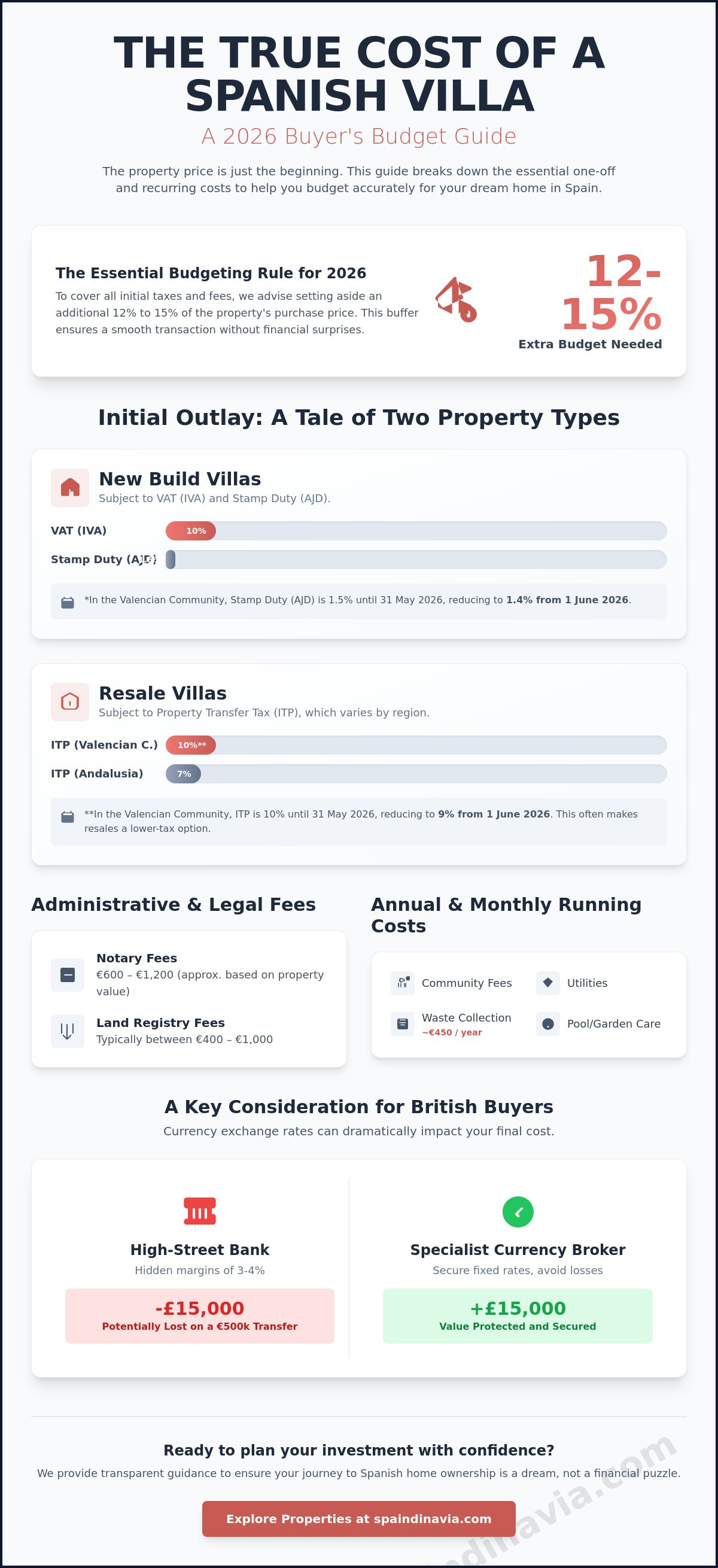
For 2026, we recommend a safer buffer of 12% to 15% for new build villas. This slightly higher estimate accounts for the 10% VAT (IVA) and the regional Stamp Duty (AJD). In the Valencian Community, the AJD rate is set to reduce to 1.4% on 1 June 2026, offering a slight saving for summer buyers. It's also vital to establish an "emergency fund" for the first six months of ownership. This fund should cover initial utility connection fees, property insurance, and any immediate furnishing needs. Having this liquid capital ready prevents "completion day" stress and ensures your first night in your new home is spent celebrating, not calculating.
The Hidden Cost of Currency Fluctuation
British buyers face a unique challenge that our Euro-based clients don't: currency exchange volatility. Transferring hundreds of thousands of pounds via a high-street bank can be a costly mistake, as they often hide margins of 3% to 4% within the exchange rate. On a €500,000 villa, this could mean losing nearly £15,000 to the bank's profit margin. To protect your investment, consider using a specialist currency broker. They offer forward contracts, which allow you to secure a fixed exchange rate for up to 12 months. This is especially beneficial when buying new build villas with staged payments, as it ensures the price you agreed upon at the start remains the price you pay at the end, regardless of how the pound behaves.
The Initial Outlay: Taxes and Transactional Fees You Must Budget For
While our previous section highlighted the general 12% to 15% buffer, it's vital to understand exactly where those funds are allocated. The hidden costs of owning a villa in spain often stem from the distinction between new build and resale properties, as each path carries a unique tax burden. Choosing between a modern, turnkey project and a charming resale villa isn't just a lifestyle decision; it's a fiscal one. We've seen many buyers surprised by how regional variations can shift their final balance by thousands of euros, making early research a cornerstone of a secure purchase.
New Build vs Resale Tax Implications
If you're drawn to the sleek lines of our new build villas, you'll pay 10% Value Added Tax (IVA). However, new builds also incur a "hidden" Stamp Duty known as AJD. In the Valencian Community, this rate is 1.5% until 31 May 2026, after which it reduces to 1.4%. Conversely, resale villas are subject to Property Transfer Tax (ITP) instead of IVA. This rate varies significantly by region. For instance, Andalusia maintains a flat 7% ITP, while the Valencian Community currently charges 10%, though this is set to drop to 9% on 1 June 2026. For a 2026 investor, resales often present a lower initial tax outlay, though new builds typically offer better energy efficiency and lower immediate maintenance needs.
Administrative and Legal Costs
Beyond taxes, government-regulated fees play a significant role in your budget. Notary fees, which cover the official witnessing of the deed signing, typically range from €600 to €1,200 depending on the property's value and the complexity of the document. Once signed, your "Escritura" must be filed with the Land Registry. These fees are based on an official tariff and generally fall between 0.1% and 0.25% of the purchase price. For an average villa, you should expect to pay between €400 and €650 to ensure your ownership is legally protected and correctly recorded.
Hiring an independent solicitor is your most important insurance policy in this process. They don't just handle the paperwork; they conduct essential due diligence to ensure the property is free of debts and has all the correct building licences. This is particularly important for understanding non-resident tax obligations in Spain, which begin the moment you become an owner. Most reputable solicitors charge around 1% of the purchase price plus VAT. If you're ready to start your search with a partner who prioritises your security, you can browse our latest villa listings to see the quality and value available in today's market.
Maintaining Your Dream: Ongoing Running Costs and Community Fees
Once the keys are in your hand and the celebratory cava has been poured, your financial focus shifts from one-off taxes to the monthly rhythm of Mediterranean life. It's here that many owners encounter the true hidden costs of owning a villa in spain, particularly when balancing the desire for a pristine home with the reality of non-resident ownership. While the sun is free, keeping a villa "rental ready" or simply prepared for your next visit requires a structured approach to monthly budgeting. We've found that the most successful owners are those who plan for these lifestyle costs with the same precision they applied to the initial purchase.
If your villa is situated within a "Comunidad de Propietarios", community fees will be a significant part of your annual outlay. These fees cover the maintenance of shared infrastructure, from 24-hour security patrols to the landscaping of communal gardens. For a villa in an exclusive gated development, you should expect to pay between €500 and €1,000 per month. Additionally, every owner must budget for the municipal waste collection tax, known as the "Tasa de Basura". Following the national framework changes in 2025, this mandatory tax now ranges from approximately €200 to over €450 annually for a typical villa.
Utilities and Service Contracts
Spanish utility bills contain a unique element called "potencia", which is a fixed capacity charge. Many owners fall into the trap of paying for a higher power capacity than they actually need, leading to inflated monthly bills even when the property is vacant. Conversely, if your potencia is too low, your fuses will trip when the air conditioning and pool pump run simultaneously. For a villa with a private pool, monthly electricity bills can range from €180 to over €400 during the peak of summer, with consumption often exceeding 1,500 kWh. Water bills are generally more modest, typically paid quarterly and averaging around €60 to €70 for a standard household.
Maintenance and Key Holding
A private pool is the crown jewel of any villa, but it requires year-round professional care to remain safe and inviting. Chemical balancing and cleaning services usually cost between €100 and €150 per month. For our clients who don't live in Spain full-time, a key-holding service is an essential investment. These professionals perform regular inspections whilst you're away, ensuring that minor issues like a dripping tap or a tripped breaker don't escalate into expensive repairs. Beyond weekly visits, we recommend budgeting for biennial air conditioning servicing and a fresh coat of exterior paint every five to seven years to protect your property's structural integrity and aesthetic appeal.
The Taxman and the Villa: Non-Resident Obligations and Wealth Tax
Transitioning from the physical upkeep of your home to your fiscal responsibilities is a vital step in securing your Mediterranean lifestyle. Many owners are surprised to learn that their tax obligations continue even when their property sits empty for months at a time. These hidden costs of owning a villa in spain are often the most misunderstood part of the process, yet they're easily managed with the right guidance. We believe that clarity is the best way to ensure your peace of mind, allowing you to enjoy your home without the fear of unexpected letters from the Spanish Tax Agency. Understanding these recurring costs early ensures that your dream remains a source of joy rather than a source of stress.
Modelo 210: The "Hidden" Non-Resident Tax
If you don't rent out your villa, the Spanish government still expects a contribution based on "imputed income". This tax, filed via Modelo 210, is essentially a tax on the benefit of owning a second home. The calculation is based on a small percentage, usually 1.1% or 2%, of the property's *valor catastral* (rateable value). Post-Brexit, the rate for UK residents is 24%, whilst EU and EEA residents benefit from a lower rate of 19%. It's a recurring annual obligation that must be filed by 31 December for the previous year. Failing to comply can lead to interest charges and may complicate the future sale of your property, so keeping your filings up to date is essential.
Local Taxes: IBI and Basura
Your local Town Hall will issue two main charges: IBI and Basura. IBI is the equivalent of UK council tax and is calculated using the *valor catastral* found on your municipal records. We always recommend setting up a direct debit for this payment; late payments can trigger surcharges ranging from 5% to 20%. Alongside this is the "Tasa de Basura", or rubbish collection fee. Following the national framework changes introduced in 2025, this cost has risen significantly. You should now budget between €200 and €450 annually for a typical villa, depending on the specific municipality.
For owners of high-value properties, the Wealth Tax is another consideration for 2026. Generally, a national tax-free allowance of €700,000 per person applies, with an additional €300,000 exemption for a primary residence. However, regions like Andalusia and Madrid currently offer 100% relief from this tax, although the national Solidarity Tax may still apply to net assets over €3 million. Navigating these regional nuances is part of the expert service we provide to all our clients. If you're ready to find a property that fits both your lifestyle and your financial goals, contact us today for a personal consultation and let us guide you through a safe and transparent purchase.
Strategic Management: How to Offset Costs and Protect Your Investment
Owning a villa doesn't have to be a constant drain on your resources. By adopting a strategic approach, you can effectively mitigate the hidden costs of owning a villa in spain and even transform your property into a self-sustaining asset. In 2026, the demand for high-quality holiday rental properties remains robust across the coast. Many owners are discovering that letting their villa for just 10 to 12 weeks during the peak summer season can generate enough income to cover their entire annual running costs, including those community fees and municipal taxes we discussed earlier. It's about making your capital work for you whilst you're not there to enjoy the sun yourself.
Successful letting requires more than just listing a property online; it involves navigating specific fiscal responsibilities. For rental income, the tax rate is 19% on net income for EU and EEA residents, who can also claim various deductions for maintenance and management. For non-EU residents, such as those from the UK, the rate is 24% on gross income. To ensure your investment remains profitable and legally sound from day one, it's essential to follow a Buying Property in Spain Guide that prioritises security and transparency. This foundation allows you to build a rental strategy with total confidence.
Maximising Your Rental Yield
Calculating your net return involves looking at the full picture. You must factor in professional cleaning, laundry services, and the commission for rental platforms. Professional marketing is the key to ensuring high occupancy during the shoulder seasons, not just the busy weeks of August. We've observed that high-quality new build villas often command a significant premium, sometimes earning 20% to 25% more per week than older resale properties. This is due to their modern aesthetics, superior climate control, and the "turnkey" experience that today's luxury travellers expect.
The Spaindinavia Advantage
We pride ourselves on being more than just brokers. We're your local partners for the entire journey. Our end-to-end support means we don't just help you find the villa; we help you manage the guests and the upkeep. We collaborate closely with independent solicitors to ensure every aspect of your purchase and subsequent rental activity is fully compliant with local laws. This "hands-off" approach for you means that every guest is vetted and every maintenance issue is resolved before it becomes a costly repair. If you're ready to start your journey, contact Spaindinavia for expert villa guidance and discover how we make owning a home in the sun a truly rewarding and secure experience.
Secure Your Future in the Sun
Owning a Mediterranean retreat is a life-changing decision that brings immense joy and long-term value. By preparing for the 12% to 15% initial tax buffer and understanding your annual Modelo 210 obligations, you ensure your investment is built on a solid foundation. We've explored how navigating the hidden costs of owning a villa in spain becomes a manageable, transparent process when you have the right local experts by your side. From managing your electricity capacity to offsetting upkeep through high-yield holiday rentals, every strategic choice you make today protects your lifestyle for years to come.
At Spaindinavia, we're dedicated to simplifying every stage of your journey. Our hand-picked portfolio of high-yield investments is supported by our established partnerships with independent legal experts and comprehensive property management services. Explore our hand-picked portfolio of New Build Villas and let us help you find a home where the only surprise is how much you love the Mediterranean life. Your dream of a secure, sun-drenched future is within reach, and we're ready to guide you home.
Frequently Asked Questions
What is the most unexpected cost when buying a villa in Spain?
The most unexpected expense is often the 10% to 15% additional buffer required on top of the purchase price for taxes and fees. Many buyers also overlook the "Valor de Referencia", which is the official value used by tax authorities to calculate property transfer tax. If the purchase price is lower than this official valuation, your tax bill will be higher than anticipated.
Do I have to pay tax in Spain if I don't rent out my property?
Yes, non-residents must pay an "imputed income tax" via Modelo 210 even if the property remains empty for your personal use. The Spanish government calculates this based on a small percentage of the property's cadastral value. For 2026, the tax rate is 19% for EU residents and 24% for those from the UK or other non-EU countries.
How much are typical community fees for a villa in a gated development?
For a villa within a gated community with shared amenities, you should expect to pay between €500 and €1,000 per month. These fees cover essential services like 24-hour security, professional landscaping, and the maintenance of communal infrastructure. In less exclusive developments, these costs are generally lower but vary significantly depending on the specific services provided.
Is it cheaper to buy a new build or a resale villa in terms of taxes?
Resale properties generally have a lower initial tax burden because they are subject to Property Transfer Tax (ITP), which is 7% in Andalusia and reducing to 9% in the Valencian Community on 1 June 2026. New builds require 10% VAT plus an additional Stamp Duty (AJD) of up to 1.5%, making the entry cost for new properties slightly higher.
Do British citizens pay more tax in Spain since Brexit?
British citizens do pay a higher rate of non-resident income tax compared to EU residents. Since Brexit, the rate for UK residents has been 24%, whereas EU and EEA residents pay 19%. Additionally, UK residents cannot deduct property-related expenses from their rental income, which is one of the hidden costs of owning a villa in spain for British investors.
How often do I need to pay the IBI (Council Tax) in Spain?
IBI is an annual tax paid to your local Town Hall. It's calculated using the property's rateable value and is typically due between September and November, though specific deadlines vary by municipality. Setting up a direct debit is the most effective way to avoid the 5% to 20% surcharges that are automatically applied to late payments.
What happens if I forget to pay my non-resident taxes?
Forgetting to file your Modelo 210 or IBI will result in automatic interest charges and potential financial penalties from the Spanish Tax Agency. In the long term, unpaid taxes are recorded as a debt against the property. This will complicate the legal process when you eventually decide to sell and may prevent you from obtaining necessary tax certificates.
Are utility bills more expensive in Spain than in the UK?
Electricity costs can be higher in Spain during the peak summer months, with bills for a villa with a pool often ranging from €180 to over €400. However, water bills are typically lower than in the UK, usually paid quarterly and averaging around €60 to €70. Ensuring you have the correct "potencia" or power capacity is the best way to keep your electricity costs manageable.


