

What if the secret to a successful Spanish retirement isn't just the size of your savings, but how you navigate the new residency landscape? You've likely spent many evenings asking, can I afford to retire to Spain from the UK 2026, while watching the Spanish IPREM (Public Multi-Purpose Income Indicator) climb by over 3% in recent years. It's a common worry; the fear that your 25% tax-free pension lump sum might be taxed differently or that private healthcare costs will eat into your morning cafe con leche budget.
We understand that a move of this magnitude requires more than just inspiration; it needs a "trygg affär," a secure and transparent plan. In this guide, you'll discover the precise income requirements for the Non-Lucrative Visa and how to plan your property investment to minimize long-term costs. We'll walk you through a clear framework to determine your affordability, ensuring you approach 2026 with a strategy that protects both your capital and your dream of a life in the sun.
Key Takeaways
- Learn how the latest IPREM levels dictate your visa eligibility and how to accurately calculate the "sufficient means" required for residency.
- Compare essential monthly expenses side-by-side to determine can I afford to retire to Spain from the UK 2026 while maintaining your desired lifestyle.
- Discover why strategic property ownership serves as a vital anchor for long-term financial sustainability in the 2026 Spanish market.
- Identify the specific windows of time that protect your 25% tax-free pension lump sum before triggering Spanish tax residency.
- Follow a structured 12-month roadmap that guides you through every milestone from financial audits to securing your NIE number.
The 2026 Financial Thresholds for Spanish Residency
Securing your place in the sun begins with understanding the legal framework of the Non-Lucrative Visa (NLV). Since the UK left the European Union, this residency permit has become the primary pathway for retirees. It's designed for those who don't intend to work in Spain but have the financial means to support themselves. The British population in Spain has adapted well to these changes, proving that while the rules are stricter than they once were, they're entirely manageable with the right preparation. The process is straightforward if you approach it with a clear financial roadmap.
To answer the question, can I afford to retire to Spain from the UK 2026, you must first look at the IPREM. This is the Public Multi-Purpose Income Indicator, a benchmark the Spanish government uses to determine "sufficient means" for expats. Because this figure is adjusted by the government, your 2026 planning must account for potential increases in these thresholds. Consulates use this number to ensure you can live comfortably without relying on the Spanish state, making it the most critical number in your retirement plan.
Projected 2026 Income Requirements (IPREM)
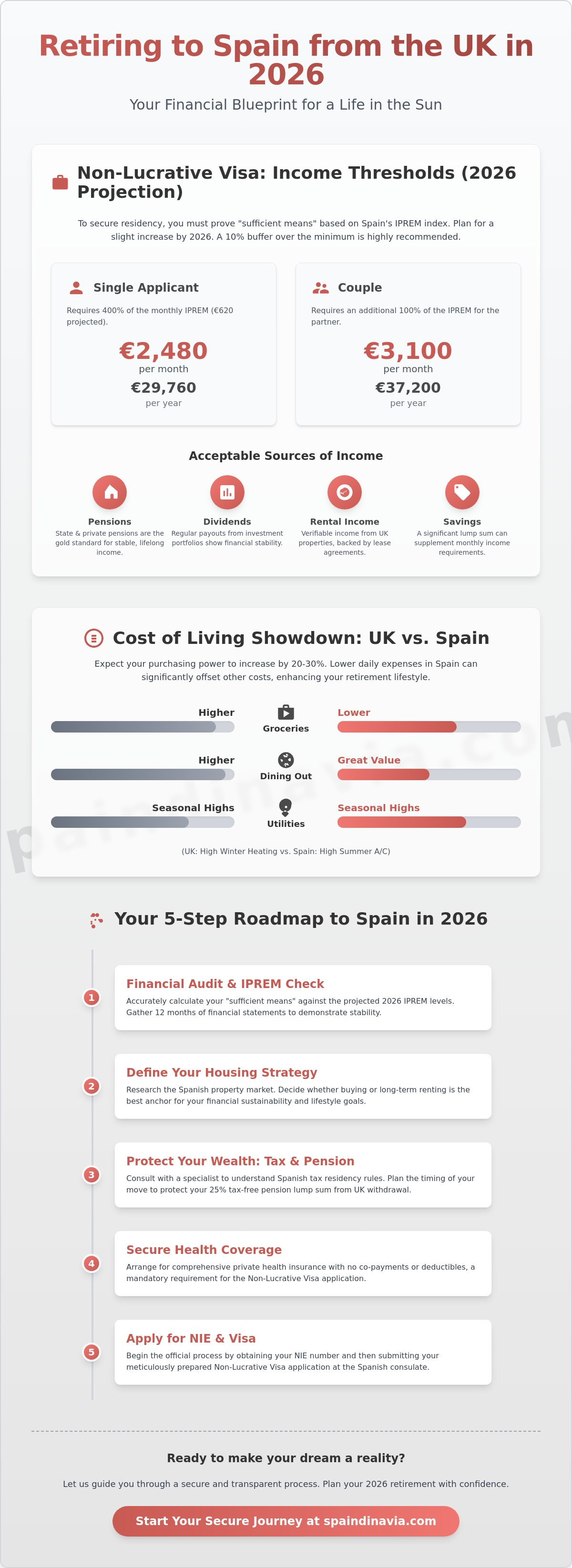
Spain requires the main applicant to demonstrate a monthly income of at least 400% of the IPREM. In 2024, the IPREM was set at €600 per month, meaning a single applicant needed €2,400 monthly. For 2026, it's wise to budget for a modest increase in these thresholds. If the IPREM rises to €620, a single retiree would need approximately €2,480 per month, or €29,760 annually. Adding a spouse requires an additional 100% of the IPREM. For a couple in 2026, this translates to roughly €3,100 per month. We always recommend maintaining a 10% buffer above these minimums; this creates a sense of security and ensures your application is viewed favorably by the consulate.
Acceptable Sources of Retirement Income
Consistency is key when presenting your finances to Spanish officials. State and private pensions are considered the gold standard because they provide a guaranteed, lifelong income stream. However, you aren't limited to pensions alone. Other acceptable sources include:
- Investment Dividends: Regular payouts from well-managed portfolios.
- Rental Income: Income from UK properties, supported by formal lease agreements and tax returns.
- Significant Savings: If your monthly income falls slightly short, showing a large lump sum in a liquid bank account can often satisfy the requirements.
The consulate typically reviews the last 6 to 12 months of bank statements. They're looking for stability and a pattern of wealth, not just a one-time deposit before the application. By organizing these documents early, you create a clear path toward a successful residency approval and a worry-free life on the coast.
Cost of Living Comparison: UK vs. Spain in 2026
Comparing your current monthly outgoings in the UK to a future life in Spain requires looking beyond the exchange rate. While many retirees find their purchasing power increases by 20% to 30% after moving, the financial landscape of 2026 introduces new variables. Energy costs and lifestyle inflation are the two biggest factors. In the UK, the "Price Cap" system provides a predictable but often high ceiling for utility bills. In Spain, the focus shifts. You'll likely spend significantly less on heating during the mild winters, but you must budget for air conditioning during the peak summer months of July and August. This isn't a "Sun Tax" in the legal sense, but rather a seasonal shift in how you consume energy.
To accurately answer can I afford to retire to Spain from the UK 2026, you need to account for your personal lifestyle choices. If you plan to travel back to the UK frequently or explore the hidden gems of the Costa Blanca, transport and leisure will take up a larger portion of your budget. For those looking for a secure and fulfilling lifestyle, understanding these daily nuances is the first step toward a successful transition.
Daily Expenses: Groceries, Dining, and Transport
Spain's competitive advantage remains firmly rooted in its local markets and produce. A "supermarket basket" in Spain for 2026 is projected to remain lower than the UK equivalent, particularly for fresh fruit, vegetables, and olive oil. Dining out also offers incredible value through the "Menu del Dia." This three course meal, often including wine, typically costs between €12 and €18. Public transport is equally affordable; many regions offer significant discounts for residents over the age of 65, making it easy to leave the car at home and enjoy the local scenery without the burden of high fuel costs.
Healthcare Costs for UK Retirees
Healthcare is a primary concern for anyone moving abroad, and the rules are clear for British citizens. If you've reached the UK state pension age, the S1 form is your gateway to the Spanish public healthcare system. This form ensures the UK government covers your healthcare costs. For early retirees under the age of 66, private health insurance is a mandatory requirement for your visa application. You can find detailed UK government guidance on living in Spain regarding these reciprocal agreements. Alternatively, after one year of residency, you may apply for the "Convenio Especial," a monthly subscription that allows you to pay into the Spanish public system regardless of your age or pre-existing conditions.
Housing Strategy: Buying vs. Renting in the 2026 Market
Choosing between renting and buying is a pivotal decision that shapes your long-term financial security. While renting offers initial flexibility, it exposes you to annual inflation and the rising demand of the 2026 rental market. Owning your home acts as a hedge against these fluctuations. It provides a permanent anchor for your residency and eliminates the risk of unexpected rent hikes. When asking, can I afford to retire to Spain from the UK 2026, your property strategy often dictates whether your budget remains sustainable over two or three decades. A well-chosen home isn't just a place to live; it's a cornerstone of your "trygg affär."
The 2026 outlook for the Spanish property market suggests continued interest in coastal regions like the Costa Blanca and Costa del Sol. We see a clear trend where UK buyers prioritize high-quality construction over sheer square footage. To navigate these choices effectively, we recommend reviewing our Buying Property in Spain Guide, which provides a detailed checklist for a secure investment. Understanding the difference between a modern villa and a traditional resale home is essential for accurate budgeting.
The Financial Case for New Build Villas
New build properties offer distinct financial advantages that resales often lack. Most new villas carry an "A" or "B" Energy Performance Certificate (EPC) rating. This high level of energy efficiency directly reduces the cooling and heating costs we discussed in the previous section. Additionally, Spanish law requires developers to provide a ten-year structural guarantee (Seguro Decenal). This protection ensures you won't face the "hidden costs" of roof repairs or plumbing overhauls during your first decade of retirement. Modern designs also incorporate features like open-plan layouts and walk-in showers, supporting your comfort as you age without the need for expensive future renovations.
Taxes and Fees When Purchasing
You must budget for "closing costs," which typically range between 10% and 13% above the agreed purchase price. If you choose a new build, you'll pay 10% IVA (VAT) plus a Stamp Duty (AJD) that varies by region, usually around 1.2% to 1.5%. Resale properties are subject to ITP (Transfer Tax), which also depends on the specific autonomous community. Beyond the initial purchase, you'll pay the IBI (Council Tax) annually. This tax is generally much lower than UK Council Tax, often costing between €400 and €900 per year for a standard villa. Planning for these specific figures ensures your capital remains protected from the very first day of your move.
Protecting Your Wealth: Tax and Pension Planning
Understanding the transition from the UK tax system to the Spanish one is vital for your long-term peace of mind. Spain determines tax residency using the 183-day rule. If you spend more than 183 days in the country during a calendar year, you're typically considered a tax resident on your worldwide income. This makes the timing of your move a critical factor in your financial planning. For many, the central question is: can I afford to retire to Spain from the UK 2026 without losing a significant portion of my hard-earned savings? The answer often lies in how you handle your pension assets before you catch your flight.
One of the most significant considerations for UK retirees is the 25% tax-free pension lump sum. In the UK, this is a standard benefit. However, once you become a Spanish tax resident, Spain views this lump sum as taxable income. To protect this capital, many retirees choose to draw their lump sum while still UK residents. Balancing these tax implications with your property search requires a coordinated approach. You can find more on balancing lifestyle and capital growth in our Spain Property Investment Guide.
Managing Your UK Pensions in Spain
The UK-Spain Double Taxation Treaty is a powerful tool that prevents you from being taxed twice on the same income. Most private and state pensions are taxed only in Spain once you're a resident. Government service pensions, such as those for teachers or civil servants, usually remain taxable in the UK. For some, transferring a pension to a Qualifying Recognised Overseas Pension Scheme (QROPS) in 2026 might offer currency flexibility, though this requires specialist advice. You'll also need to comply with Modelo 720, a mandatory declaration of foreign assets worth over €50,000 held outside of Spain. This is an informative exercise, not a tax in itself, but it's a step you can't afford to skip.
Inheritance and Succession Planning
Securing your legacy in Spain involves more than just a UK will. While your UK will covers your British assets, a Spanish will specifically for your Spanish property simplifies the probate process for your heirs. Spain has "forced heirship" rules that dictate how assets are distributed. However, as a UK national, you can use the EU Succession Regulation (Brussels IV) to elect the law of your nationality to govern your estate. Regional differences in inheritance tax are also significant. In 2026, regions like Andalusia and the Valencian Community continue to offer substantial allowances that often eliminate the tax burden for close family members. To ensure your transition is seamless, consult with our team of local experts who can guide you through these regional nuances.
A 5-Step Roadmap to Retiring in Spain in 2026
Transforming your dream into a reality requires a disciplined timeline. By following a structured approach, you ensure that every financial and legal box is checked well before your departure date. Many prospective expats ask, can I afford to retire to Spain from the UK 2026, and the answer often depends on how early you begin your preparations. A 12 month lead time allows you to navigate the Spanish bureaucracy with confidence and poise. This roadmap is designed to remove the stress from the process, leading you toward a "trygg affär" and a seamless transition to the Mediterranean lifestyle.
- Months 12 to 9: Start with a comprehensive financial audit. Review your 2026 pension projections and cross-reference them with the projected IPREM requirements. This is also the perfect time to begin your property research, identifying which coastal areas align with your lifestyle goals.
- Months 9 to 6: Focus on the paperwork. You'll need to acquire your NIE (Número de Identidad de Extranjero) and begin gathering the documents for your Non-Lucrative Visa. These include medical certificates and criminal record checks, which must be translated by a sworn translator and apostilled.
- Months 6 to 3: Plan your property viewing trips. This stage is about more than just aesthetics; it's about legal due diligence. Ensure your chosen home has a valid "Licencia de Primera Ocupación" and no outstanding debts.
- Months 3 to 0: Finalize your property purchase and submit your visa application to the Spanish Consulate in the UK. Coordinate your move and ensure your 25% pension lump sum is handled according to the timing strategy discussed in section four.
- Post-Arrival: Once you arrive in Spain, you have one month to apply for your TIE (Tarjeta de Identidad de Extranjero), your physical residency card, at the local police station.
The Legal and Administrative Essentials
Find a solicitor who is fluent in both UK and Spanish legal systems. They will act as your eyes and ears on the ground, ensuring every contract protects your interests. Simultaneously, establish a currency exchange strategy. Using a specialist broker instead of a high street bank can protect your pension from market volatility, ensuring your monthly income remains stable despite exchange rate fluctuations. Once you've moved, register on the "Padron" at your local town hall. This registration is essential for accessing local services and proves your residency within the municipality.
Building Your Support Network
Låt oss hjälpa dig (Let us help you) navigate this transition. Partnering with a dedicated agency like Spaindinavia ensures you have local experts who care about your entire journey, not just the transaction. Integration is the final piece of the puzzle. Join local expat groups and attend Spanish language classes to build a social circle that spans both cultures. Before you board your flight, run through a final checklist: is your healthcare coverage active, is your tax strategy in place, and is your dream home ready? With these steps complete, you aren't just moving; you're starting a new chapter with total security.
Step Into Your New Life in the Sun
Retiring abroad is a significant life decision, but it's entirely achievable with a clear financial strategy. We've explored how understanding the 400% IPREM income thresholds and the 183-day tax residency rule allows you to protect your wealth while embracing a higher quality of life. The 2026 landscape offers unique opportunities, particularly through energy-efficient new build villas that minimize long-term running costs. Ultimately, the answer to can I afford to retire to Spain from the UK 2026 lies in the quality of your planning and the partners you choose to guide you through the process.
We're here to ensure your journey is a "trygg affär" from start to finish. Our team provides expert guidance through the 2026 residency process, supported by our partnerships with independent legal and financial specialists. We specialize in finding homes that support your long-term goals, from modern penthouses to sustainable villas. Discover your dream retirement home in our 2026 property portfolio and take the first step toward your Mediterranean future. Your life in the sun is closer than you think, and we're ready to help you make it happen.
Frequently Asked Questions
Can I still retire to Spain after Brexit in 2026?
Yes, you can certainly retire to Spain, although the process now requires a formal residency visa. British citizens are treated as third country nationals, meaning you'll typically apply for a Non-Lucrative Visa (NLV) or a Golden Visa if you're investing over €500,000 in property. These pathways are well established and provide a clear legal route for retirees to enjoy their life in the sun just as they did before 2021.
How much monthly income do I need for a Spanish Non-Lucrative Visa in 2026?
You'll need to demonstrate a monthly income equal to 400% of the Spanish IPREM indicator. While the exact 2026 figures depend on government adjustments, a single applicant should budget for approximately €2,480 per month, while couples should aim for roughly €3,100. Showing a consistent income stream from pensions or investments is the most reliable way to satisfy the consulate that you can support your lifestyle without local employment.
Is my UK State Pension taxable in Spain?
Yes, your UK State Pension is taxable in Spain once you become a tax resident. Under the UK-Spain Double Taxation Treaty, you won't be taxed twice on the same income, but you must declare it on your annual Spanish tax return. Most private and state pensions are taxed solely in Spain, whereas government service pensions, such as those for civil servants, are usually taxed at the source in the UK.
Do I need private health insurance to retire in Spain?
You'll need a comprehensive private health insurance policy for your initial visa application if you're under the UK state pension age. This policy must have no co-payments and provide coverage equivalent to the Spanish national health system. If you're 66 or older, you can use the S1 form to access public healthcare, which is funded by the UK. This ensures you have medical peace of mind from the day you arrive.
Can I work in Spain if I have a Non-Lucrative Visa?
No, the Non-Lucrative Visa strictly prohibits you from carrying out any professional activity or work within Spain. This residency permit is specifically designed for retirees and individuals with passive income who don't intend to enter the Spanish labor market. If you're wondering, can I afford to retire to Spain from the UK 2026 while still working, you might consider the Digital Nomad Visa instead, which allows for remote employment.
What happens to my UK property if I move to Spain?
You're free to keep, sell, or rent out your UK property, but each choice has tax implications. If you rent it out, the income is taxable in Spain as part of your worldwide earnings, though you'll receive credit for any tax paid in the UK. If you sell the property while a Spanish resident, you may be liable for Spanish Capital Gains Tax, unless you're over 65 and the property was your main residence.
Is the cost of living in Spain rising in 2026?
While inflation affects all of Europe, Spain's cost of living is projected to remain approximately 20% lower than the UK's in 2026. Everyday essentials like fresh produce, public transport, and property taxes continue to offer better value. Even with moderate price increases, the question of can I afford to retire to Spain from the UK 2026 remains positive for most retirees who plan their budgets around local Spanish prices rather than UK benchmarks.
How much money should I have in savings to retire in Spain?
You should aim to have at least €30,000 in liquid savings as a single applicant if you're using savings to meet visa requirements. Spanish consulates prefer to see a "cushion" that proves you can handle unexpected costs or currency fluctuations. Beyond the visa minimums, we recommend a separate fund of 10% to 13% of your property's value to cover the initial purchase taxes and legal fees, ensuring your retirement starts on a secure footing.


