

Eco-friendly new build villas for sale in Spain include contemporary homes designed to use energy more efficiently, with features such as solar panels, effective insulation, energy-saving equipment and efficient ventilation. Premium designs may also make use of large windows, open-plan spaces and smart climate controls. Together, these features can help you compare a home’s comfort and environmental credentials as well as its style.
Location matters too. On the Costa Cálida in the Murcia region, you can explore areas including Puerto de Mazarrón, Isla Plana, La Azohía and Bolnuevo. The Costa Blanca is in the Valencia region, with its own towns and developments to consider. Comparing both coasts helps you weigh the homes and settings that suit your plans.
This guide explains the sustainable features available in premium new builds and how they can shape everyday living. You’ll also learn how asking prices are presented for different properties, and what to look at alongside the price, including location, size, layout and specification. Whether you’re considering a home for holidays or a longer-term move, you’ll have a clearer starting point for your search.
Key Takeaways
- Compare insulation, ventilation and energy-saving features to understand how a villa may support comfort and efficiency throughout the year.
- Explore how orientation, natural materials and design connect a home with its Mediterranean setting.
- Look beyond headline asking prices by considering each property’s location, size, layout and included features.
- Learn how solar panels and rainwater collection can contribute to a more resource-conscious home.
- Weigh the distinct settings of the Costa Cálida in the Murcia region and the Costa Blanca in the Valencia region as you narrow down your search.
What kind of new-built houses of the premium segment can be purchased in Spain?
Premium new builds range from energy-efficient villas to homes designed around solar power and careful use of natural light. Compare each property’s stated features and energy rating to understand its environmental performance.
Energy efficiency and environmental features
Look for details about solar panels, insulation, energy-saving equipment and ventilation in the property specification. Consider the features together rather than treating one item as proof of overall efficiency. A clear specification helps you compare what each home includes.
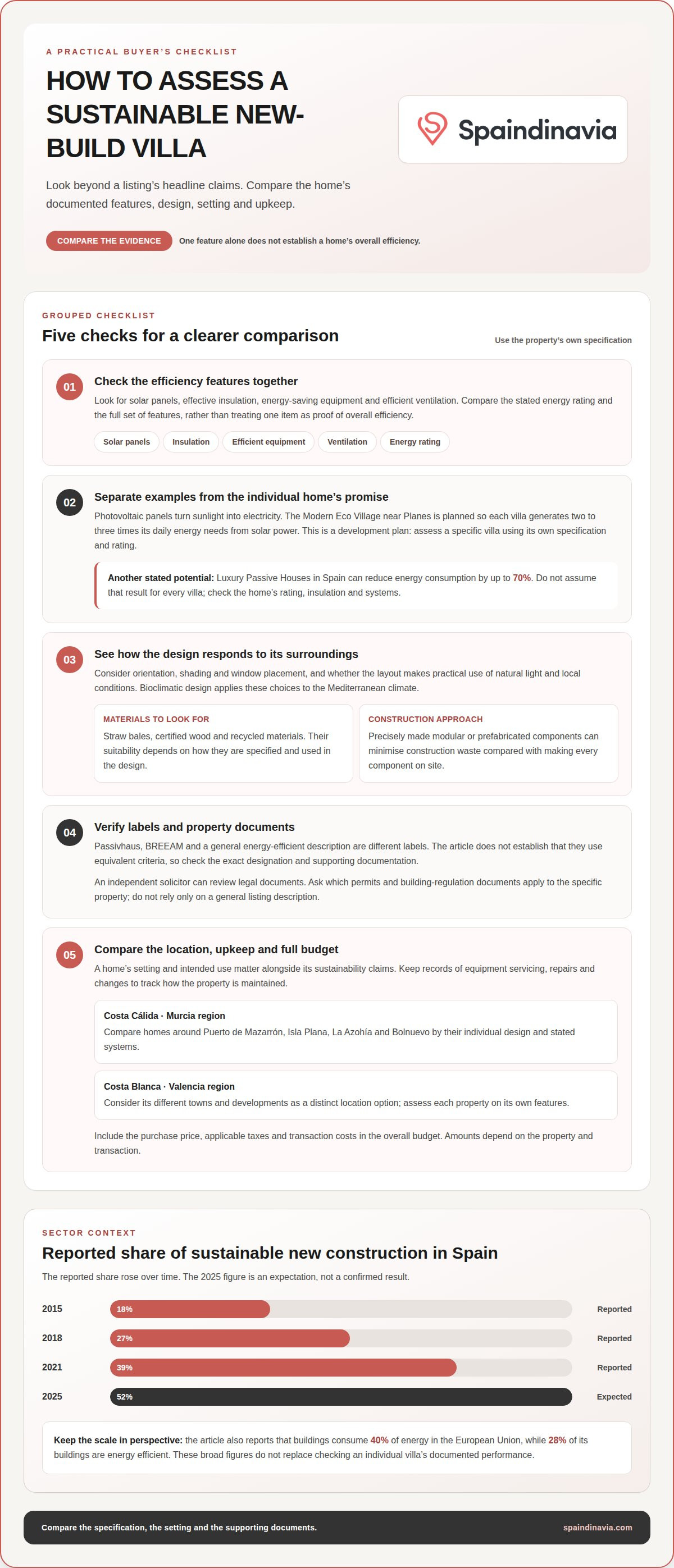
The wider context is significant: buildings consume 40% of energy in the European Union, while 28% of its buildings are energy efficient. For your comparison, focus on the individual villa’s documented performance and equipment, not broad claims about new homes as a category.
Solar production and energy ratings
Photovoltaic panels turn sunlight into electricity, and a villa’s energy rating gives another point of comparison. The Modern Eco Village near Planes is planned so that each villa generates two to three times its daily energy needs from solar power. This is a development plan; assess an individual home using its own specification and rating.
Luxury Passive Houses in Spain can reduce energy consumption by up to 70%. Treat this as a potential associated with that type of home, not an assumed result for every villa. Compare the stated rating with the systems and insulation described for the property.
Regional energy-efficient villa options
Energy-efficient homes are not limited to one Spanish coast. Bioclimatic homes on the Costa Blanca, in the Valencia region, can use solar orientation, natural ventilation and Mediterranean light. The Costa del Sol has more than 300 days of sunshine per year, which can support solar generation, though a home’s design and equipment also matter.
On the Costa Cálida in the Murcia region, explore Puerto de Mazarrón, Isla Plana, La Azohía and Bolnuevo. Compare homes by their individual design and stated systems rather than assuming a region alone determines efficiency. The Costa Blanca and Costa Cálida offer different locations to consider.
Sustainability standards and certification checks
Passivhaus, BREEAM and standard energy-efficient descriptions are different labels buyers may encounter. The available property details do not establish that these labels use equivalent criteria, so compare the exact designation and documentation for each home. A Passivhaus claim can be considered alongside its stated energy rating and features, including insulation and ventilation.
An independent solicitor can review the property’s legal documents as part of the purchase checks. For permits and building regulations, ask the solicitor to identify the documents and requirements relevant to the specific property, rather than relying only on a general description in a listing.
Sustainable architecture and environmental integration
Sustainable design connects a villa’s architecture with its climate, materials and surroundings. In Spain, compare how each development approaches construction, everyday upkeep and the full purchase budget.
Sustainable villa design and architecture
Orientation, shading and window placement can help a home make practical use of natural light and local conditions. Bioclimatic design applies these choices to the Mediterranean climate, rather than relying on one feature to make a whole house sustainable.
Materials also shape a building’s environmental footprint and comfort. Straw bales, certified wood and recycled materials are examples used in Spanish homes; their suitability depends on how they are specified and incorporated into the design. Modular or prefabricated components, made precisely in workshops, can minimise construction waste compared with producing every component on site.
Environmental integration in new construction
Environmental integration considers how a development relates to its site, landscape and natural resources. Spain’s reported share of sustainable new construction projects rose from 18% in 2015 to 27% in 2018 and 39% in 2021. The expected share for 2025 was 52%, indicating a growing focus in the sector.
For a buyer, look beyond the word “sustainable” in a property description. Consider whether the design responds to its setting, what materials are described, and how the home’s layout supports daily living. A villa near Puerto de Mazarrón, Isla Plana, La Azohía or Bolnuevo sits in the Costa Cálida, in the Murcia region; Costa Blanca developments belong to the Valencia region and offer a different local context.
Ongoing maintenance is part of caring for a property. Keeping a record of equipment servicing, repairs and changes can help you track how the home is maintained and whether its environmental features remain part of its everyday operation.
If you are considering a villa as an investment, weigh its location, design and maintenance needs alongside its sustainability claims. A clear specification helps you understand what is included, while the property’s setting and intended use determine how well it fits your plans. Compare these factors before choosing a coastal home or one for longer stays.
Buying a new-build villa in Spain involves the purchase price, applicable taxes and transaction costs. The amounts depend on the property and transaction, so include them in your overall budget before comparing homes.
Modern amenities in new developments
Modern amenities shape how a new home works day to day, not just how it looks. In Spain, compare the written specification for each development, paying attention to heating, cooling and how these systems fit your plans. A villa used for winter stays may call for different priorities from a home occupied mainly during warmer months.
A listed new-build villa in San Juan de los Terreros includes underfloor heating and central air-conditioning. These are distinct features: one provides heating through the floor, whilst the other conditions air throughout the home. Review how each is described in the property specification, and consider which rooms and seasons matter most to your household.
When a listing names an energy system or heating feature, check the specification to see how it is used in that particular property. Consider the features together rather than assuming a system name alone tells you how the home will feel or operate.
For buyers comparing homes across Spain, a practical approach is to make a short list of the amenities that affect everyday comfort:
- Heating and cooling systems, including the areas they serve.
- Insulation details alongside the stated heating and cooling equipment.
- Whether the property is a detached villa or an apartment, and how its layout supports your routine.
- The written specification for included equipment and finishes.
That list can help you compare like with like. For example, the San Juan de los Terreros villa and Torrevieja apartments both include underfloor heating, but their other listed systems differ. A clear comparison focuses on what each property actually describes, rather than assuming that similar names mean identical specifications.
Location also shapes your choice. Puerto de Mazarrón, Isla Plana, La Azohía and Bolnuevo are in the Costa Cálida, Murcia region; Torrevieja is on the Costa Blanca, Valencia region. If you’re considering homes on either coast, compare the specific property and its stated amenities, not just the regional label. Buyers from Sweden, Norway, Poland, Germany, the Netherlands, Belgium and France may also weigh how they expect to use a home across different seasons.
Before deciding, ask for the property specification and note which amenities are explicitly included. A named feature can be useful, but its location, coverage and role in the home matter too. The details for a San Juan de los Terreros villa, for instance, should be read as that property’s specification, not as a promise about every new development in Spain.
New-build property listings and asking prices
Listings for eco-friendly new build villas for sale in Spain show homes with different locations, sizes, layouts and specifications. Compare those details together to understand what an asking price refers to.
New-build property listings
Listings include sustainable villas in Balcón de Finestrat, new villas in Polop and properties in San Juan de los Terreros. The Balcón de Finestrat villas start at 207 m² and are offered with three, four or five bedrooms. These details help you judge whether a home’s size and layout suit your plans.
Asking prices are property-specific, so compare each listing with its location, floor area, bedroom count and stated features. A villa and an apartment can sit in the same area yet have very different layouts and specifications. For a particular property, its asking price depends on its location, size, design and specification, and is provided after a quote request.
Use a consistent comparison when reviewing listings: note the asking price shown, then record the home’s size, bedrooms, bathrooms and included amenities. Polop, for example, has a new comfortable villa listed with 294 m², three bedrooms and three bathrooms. That combination gives you a clearer basis for comparing it with another home than a headline price alone.
Eco-friendly villa locations across Spain
For eco-friendly new build villas for sale in Spain, listings include homes in Balcón de Finestrat and Polop on the Costa Blanca, in the Valencia region, as well as properties in San Juan de los Terreros. You can compare coastal settings and inland options rather than treating Spain as one uniform property market.
On the Costa Cálida, in the Murcia region, explore Puerto de Mazarrón, Isla Plana, La Azohía and Bolnuevo as distinct coastal locations. Costa Blanca towns such as Balcón de Finestrat offer a different regional setting. The areas named here are useful starting points for comparing locations; each property’s own listing gives its specific position.
Ask where a development sits in relation to the nearest town, coast and everyday amenities, then compare that setting with your intended use. A holiday home in Bolnuevo may suit different plans from a villa near Polop. Buyers from Sweden, Norway, Poland, Germany, the Netherlands, Belgium and France can weigh their travel preferences alongside property details.
Across Spain, listings include 7,560 new-build properties, covering more than one property type and location. That figure is a broad listing count, not a count of eco-friendly villas alone. Narrow your shortlist by location first, then compare villa size, layout, sustainability features and the asking price shown for each specific home.
Solar panels and rainwater collection
Photovoltaic panels and rainwater collection can form part of an eco-conscious home in Spain. They address different resources: panels generate electricity from sunlight, while collection systems capture rainfall. For a Mediterranean property, consider both features separately and as part of the home’s overall design.
A solar system’s contribution depends on its panels, orientation, shading and household electricity use. If a property description mentions panels, check the specification to understand the system and its role in the home’s energy setup. Compare those details with the other equipment listed.
Roof design matters. A villa’s roof space, angle and exposure affect where panels can be placed and how much direct sunlight they receive. Nearby buildings or trees may also cast shade. For example, compare the roof layout of a detached villa with the roof arrangement in a shared development; their panel placement may differ.
Rainwater collection is a separate system. Roof surfaces can direct rainfall into a collection system for storage and suitable uses around the property. The design determines how water is collected, stored and distributed. Check the property specification to see whether collection is included and how the system is intended to work.
- Panels: Review their stated position and how the home uses the electricity they produce.
- Collection: Identify where roof water is gathered, stored and directed around the property.
- Design: Compare roof form, surrounding shade and the location of equipment in each villa.
Location helps frame the comparison, but it does not tell the whole story. On the Costa Cálida, in the Murcia region, Puerto de Mazarrón, Isla Plana, La Azohía and Bolnuevo each offer a different setting. The Costa Blanca, in the Valencia region, is another Mediterranean choice. For either coast, assess the individual home’s orientation and system details rather than assuming all locations or developments perform alike.
Before choosing, read the listing alongside the technical specification. Note which systems are described, where they are located and what role each has in the home. This gives you a clearer basis for comparing solar generation and rainwater collection without treating either feature as a complete measure of environmental performance.
For buyers from Sweden, Norway, Poland, Germany, the Netherlands, Belgium and France, intended use also matters. A home occupied throughout the year has a different daily energy pattern from one used mainly for holidays. Consider your likely routines, then weigh the stated solar and water systems against the way you expect to live in the villa.
Spaindinavia
Spaindinavia can help you explore property options once you have identified the features, location and style that matter to you. Its portfolio includes new-build properties, resale apartments, townhouses and bungalows, giving you different property types to compare.
Start with your preferred setting and how you plan to use the home. On the Costa Cálida in the Murcia region, you might focus on Puerto de Mazarrón, Isla Plana, La Azohía or Bolnuevo; the Costa Blanca is in the Valencia region and offers a different coastal setting. Clear priorities make it easier to discuss suitable options.
When you are ready to take the next step, contact Spaindinavia to discuss your property search.
Choose a home that fits your next chapter
As you consider eco-friendly new build villas for sale in Spain, think beyond the property itself. The right choice should suit how you want to spend your time, whether that means peaceful coastal living, regular visits or a longer-term move. Your preferred pace of life can help narrow the locations and property types worth exploring.
Consider which setting feels right for you. The Costa Cálida is in the Murcia region, with Puerto de Mazarrón, Isla Plana, La Azohía and Bolnuevo among its coastal locations. The Costa Blanca is in the Valencia region and offers a different setting to explore. A clear sense of place and priorities can make your next property conversation more focused.
Spaindinavia can help you explore property options and take the next step at a pace that feels comfortable. If you’re ready to discuss your plans, contact Spaindinavia about Spanish villas. Your search can begin with a straightforward conversation about the home and lifestyle you have in mind.
Frequently Asked Questions
What is the price range for sustainable new-build villas in Spain?
Asking prices vary by location, size, layout and the specification of each villa. Listings present individual asking prices, so compare homes with similar features and floor areas rather than relying on one broad range. Also consider how the property’s intended use affects your priorities: a home for year-round living may call for different features from a holiday property. The overall budget should account for purchase costs as well as the asking price.
What eco-friendly features and energy ratings do Spanish villas offer?
Features can include solar panels, insulation, efficient ventilation and energy-saving equipment. The property’s energy certificate gives you a formal reference point for its energy performance. Read it alongside the specification and check that the described systems match the home being sold. For example, a listing may mention solar panels, while the certificate and supporting documents help you assess the villa’s overall performance rather than one feature alone.
How can a property professional guide foreign buyers through purchasing a new-build villa in Spain?
Spaindinavia supports buyers throughout the purchase process, including introductions to independent lawyers, notaries and banks, and assistance with reservation, legal checks, the purchase contract and completion. An independent solicitor can review transaction documents and explain issues specific to the property. Keep communication and paperwork organised, especially when buying from abroad.
What are the risks of buying an off-plan eco-friendly villa in Spain?
With an off-plan purchase, you are buying before the finished home can be inspected, so the plans and written specification matter. Review the stated layout, materials and sustainability features, and understand the completion arrangements. An independent solicitor can review the contract and explain its protections and commitments. Keep a record of the documents and agreed details so you can compare the completed property with what you agreed to purchase.
What ongoing maintenance and utility costs should villa owners expect in Spain?
Owners should allow for property tax, home insurance, utilities and, where relevant, community fees. Electricity, water and internet use vary with occupancy and household habits. Optional upkeep, such as maintaining a private pool or garden, is another consideration. A villa used occasionally may have different day-to-day consumption from a home occupied throughout the year. Build your budget around the property’s facilities and how often you expect to use them.
What is the difference between Passivhaus, BREEAM, and standard energy-efficient villas in Spain?
Passivhaus, BREEAM and standard energy-efficient descriptions are distinct labels, and their criteria are not established as equivalent. Compare each villa’s exact designation, documentation, energy rating and features; Luxury Passive Houses can reduce energy consumption by up to 70%.


