

Could community rules affect how you use a home in Spain? Useful questions to ask an estate agent in Spain include whether the property belongs to a community of owners, what fees and rules apply, and whether repairs or extra charges are planned. Also ask who the agent represents and what paperwork relates to permissions, seasonal conditions and tourist rentals.
Buying a home is about more than the viewing: clear answers can help you understand how a property may suit your everyday life and plans. Whether you’re buying from Sweden, Norway, Poland, Germany, the Netherlands, Belgium, France or elsewhere, this guide offers practical questions to raise before you commit. Explore agent support, community costs, building permissions and rental restrictions, with details to consider in Costa Cálida in the Murcia region and Costa Blanca in the Valencia region. For Costa Cálida, the focus includes Puerto de Mazarrón, Isla Plana, La Azohía and Bolnuevo.
Key Takeaways
- Clarify who the estate agent represents, how they support negotiations and which documents relate to the property before making an offer.
- Ask about community rules, regular fees and any planned repairs or extra charges that could affect your ongoing costs.
- For a new-build, find out about planning permissions, licences, guarantees and snagging before completion.
- Compare seasonal conditions and local amenities across Costa Cálida in Murcia, including Mazarrón, and Costa Blanca in Valencia to see which setting suits your plans.
- If you may rent the property to holidaymakers, ask about licence requirements, community rules and local restrictions.
1. How agents support property searches and negotiations
Start by asking whether the agent represents you, the seller or both. Their role affects whose interests they represent, so clarify how they handle offers and communicate with the seller or developer. Ask whether they can explain how the home compares with similar properties and what the seller has shared about moving. An agent can assist with negotiations, but the decision about what to offer is yours.
Ask about credentials in the property’s region. Spain has no centralised licensing system for estate agents. In the Valencia region, the Valencian Community has required mandatory registration for estate agents since 2023; ask for the agent’s registration details there. In Costa Calida, Murcia region, don’t assume the same regional registration requirement applies. Regional rules and practices can differ.
Before a viewing, ask whether the property is listed through other agencies and whether the details match. Spanish property portals may show the same home more than once, sometimes with different prices or descriptions. Request the address, asking price, known condition issues and available documents. Ask about damp, insulation and planned community repairs before arranging another visit.
For ownership and registration, ask to review the title deed, or Escritura, and a recent Nota Simple from the Land Registry. These documents help establish ownership and registered property details. Ask whether building works were approved, whether debts are linked to the home, and what occupancy or first-occupation paperwork applies. For a resale, check the planning status and any alterations. Treat missing paperwork as a point to investigate carefully.
As a non-resident, ask which documents the agent needs from you, how offers and updates will be shared, and who will explain each contract. Arrange for an independent Spanish lawyer to represent your interests. An agent who discourages you from using your own lawyer, dismisses missing documents or pressures you to pay before receiving legal advice is a cause for concern.
Before making an offer, clarify when money becomes binding, which conditions can be included, and what happens if legal checks uncover an issue. A purchase may involve a reservation agreement followed by a Contrato de Arras, the formal deposit contract. Ask who holds each payment and what paperwork you will receive. Avoid paying into a personal account. Put important promises made during a viewing into the written offer or contract.
In Costa Blanca, within the Valencia region, ask about the agent’s required registration. In Costa Calida, focus on the specific property and municipality, including Puerto de Mazarrón, Isla Plana, La Azohia and Bolnuevo. Their local conditions and property records may differ from those in Costa Blanca, so ask which regional paperwork applies to your chosen home.
2. Is There A Homeowners Association?
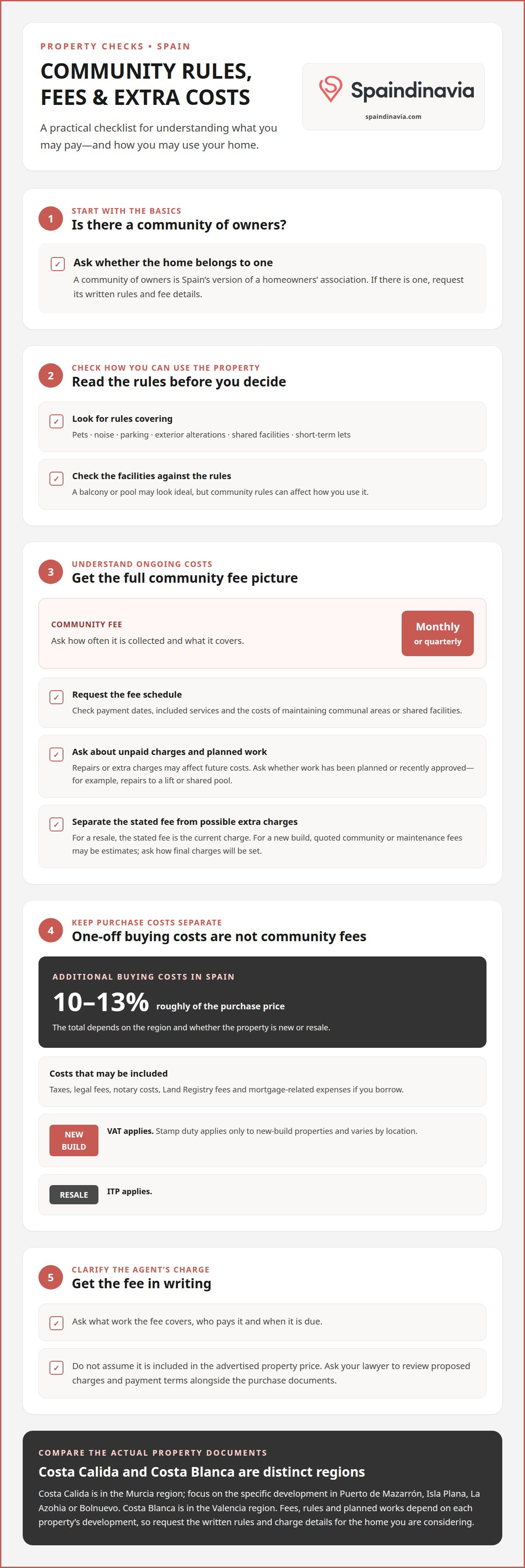
Ask whether the property belongs to a community of owners, Spain’s version of a homeowners’ association. If it does, request its rules, fee amount, payment dates and details of planned or recently approved extra charges. Rules may cover pets, noise, parking, exterior alterations, shared facilities and short-term lets. A balcony or pool may look ideal during a viewing, but community rules affect how you can use it.
Find out whether fees are collected monthly or quarterly and what they cover. Shared-building costs may include maintaining communal areas, while developments can have different facilities and expenses. Ask about unpaid charges linked to the property and planned repairs. For example, work on a lift or shared pool could affect your future costs even if the home needs no immediate repairs.
Ask the agent to distinguish the stated community fee from possible extra charges. For a resale, the stated fee is the current charge; for a new build, quoted community or maintenance fees may be estimates. Ask what services the estimate includes and how the community will set its final charges. In either case, request the fee schedule and details of extra charges before deciding whether the ongoing costs suit your budget.
Keep purchase taxes and transaction expenses separate from community fees. Additional buying costs in Spain are roughly 10-13% of the purchase price, depending on the region and whether the property is new or resale. The total can include taxes, legal fees, notary costs, Land Registry fees and mortgage-related expenses if you borrow. VAT applies to new builds, while ITP applies to resales. Stamp duty applies only to new-build properties and varies by location.
Ask the estate agent to explain their fee in writing: what work it covers, who pays it and when it is due. Do not assume the fee is included in the advertised property price. Ask your lawyer to review any proposed charge or payment term alongside the purchase documents, especially before signing an agreement or transferring money.
Compare the actual property and community documents, not just the coastal label. On Costa Cálida in the Murcia region, ask about the specific development in Puerto de Mazarrón, Isla Plana, La Azohía or Bolnuevo. On Costa Blanca in the Valencia region, ask the same questions about that home’s own community. These are distinct regions, and fees, rules and planned works depend on the property’s development. Ask for the written rules and charge details before moving ahead.
3. Planning permission and new-build licences
Before choosing a new build, ask which permissions and licences apply to the home and development. Request the available paperwork and ask whether it reflects the property as built, rather than only the original plans. A change to a terrace, room layout or another feature can make the finished home differ from the plans. Ask your independent Spanish lawyer to review the documents before you commit.
Clarify the status of the building work and whether alterations have been approved. For a completed home, ask how its registered details compare with the construction and what occupancy or first-occupation paperwork applies. For a home still being built, ask which stages remain and how progress will be documented. This helps you understand what you are agreeing to rather than relying only on a viewing or brochure.
Ask what guarantees apply to the new build and what each covers. Where relevant, ask whether bank guarantees protect stage payments and how you will receive the paperwork before paying. Do not rely on a verbal summary: request written details for your lawyer to review alongside the payment schedule. Consider the documents, construction progress and payment terms together before deciding whether to proceed.
Plan a snagging inspection before completion, even if the property looks finished. Walk through each room and record visible defects, unfinished work and items that do not match the agreed specification. For example, test doors and windows, inspect tiles and finishes, and check that fitted items appear complete. Ask how the findings will be recorded, who will address them and how outstanding work affects completion arrangements.
Consider the building as well as the individual home. Ask what maintenance remains in shared areas and whether work is planned before handover. A finished apartment may be part of a development where access routes, communal facilities or landscaping are still being completed. Ask the agent to distinguish finished work from planned work, and get promised completion details in writing. This clarifies what the purchase includes.
Apply the same questions on Costa Cálida, in the Murcia region, and Costa Blanca, in the Valencia region; local paperwork and planning status relate to the specific property and municipality. In Costa Cálida, ask about the development around Puerto de Mazarrón, Isla Plana, La Azohía or Bolnuevo. On Costa Blanca, ask for the equivalent property-specific documents. Answers should identify the home, its works and its approvals clearly.
Finally, ask the agent to explain any differences between the plans, permissions and finished property. Have your lawyer examine those points before reservation or completion rather than treating them as minor snags. Clear documents, written answers and a pre-completion inspection help you assess the home’s condition and identify what remains to be done.
4. Seasonal conditions and local amenities
A viewing offers a snapshot of a home and its surroundings. Ask what may change between the season of your visit and the months you expect to use the property. If you plan to stay outside the busiest holiday period, ask which shops, cafés, medical services and transport options operate year-round. Ask the seller about their experience, then request specific details rather than relying on general impressions.
If your schedule allows, visit at different times of day. At a home in Puerto de Mazarrón, for example, notice traffic, nearby activity, parking and noise during your visit. Ask whether these conditions differ at other times of year and what the agent or seller has observed. Repeat the same checks in Isla Plana, La Azohía or Bolnuevo if you are comparing homes in Mazarrón.
For Costa Cálida in the Murcia region, focus your comparison on the particular Mazarrón-area location and its daily services. Costa Blanca is in the Valencia region, so compare the specific town and neighbourhood there rather than assuming the same seasonal pattern. Ask the agent to identify nearby amenities on a map and confirm which are accessible on foot, by car or through public transport. The answer should relate to the home’s exact location.
Ask about practical details that affect your routine, not just the views. Is a supermarket easy to reach? Where are the nearest health services, and what transport connects the property with surrounding areas? Ask the agent to distinguish nearby facilities from those that require a drive. If you are considering a longer stay, check the route to everyday services during your viewing and note any hills, steps or road crossings.
Development can change the feel of a neighbourhood. Ask whether construction or infrastructure work is planned nearby, and request the location and expected scope of any known project. For a property in Bolnuevo or another area, compare the agent’s answer with what you can see from the home and on the route to it. Ask the seller about work already noticed locally, and request written confirmation of specific details that affect your decision.
Before deciding, make a location checklist for each property: essential services, seasonal access, noise, parking and travel routes. Use it to compare Puerto de Mazarrón, Isla Plana, La Azohía and Bolnuevo with your preferred neighbourhood. Ask the agent which points are based on property-specific information and which reflect your own viewing. This keeps the comparison focused on your plans, whether you want a permanent home or a seasonal retreat.
5. Tourist rental licensing and restrictions
If you plan to rent the property to holidaymakers, ask whether it has a tourist rental licence and whether the licence transfers to a new owner. If it does not, ask whether a new application is needed under current rules. Treat this as part of your purchase decision: rental potential depends on permitted use, not simply on the property’s appeal to visitors.
Ask for details of community rules that affect short-term lets. A community of owners may prohibit them, and local restrictions may also affect how a property can be used. Request the relevant written rules and ask whether changes have been approved or proposed. A flat that appears suitable for holiday guests may not be usable that way if the community prohibits short-term rentals.
Keep the agent’s licence separate from the property’s tourist rental licence. Since October 2022, estate agencies in Spain’s Valencia region, including Costa Blanca, have been required to hold a licence and insurance. This concerns the agency, not permission to let a particular home. Ask which documents relate to the property itself, and have your independent lawyer review them before relying on rental income.
Location matters across the two regions. Costa Blanca is in the Valencia region, whilst Costa Cálida is in the Murcia region. Ask about the rules affecting the specific municipality and property, rather than assuming requirements are identical along the coast. In Costa Cálida, this means asking about the home in Puerto de Mazarrón, Isla Plana, La Azohía or Bolnuevo. For Costa Blanca, focus on the property’s own locality and community.
When considering resale value, think about how permitted use may affect a future buyer’s plans. Ask whether the home can be used personally, for holiday letting or both under the rules that apply. A short-term rental restriction may matter to buyers seeking rental use, while clear documentation about permitted use helps describe the property accurately. Do not treat an agent’s estimate of rental potential as proof that letting is allowed.
Before making an offer, ask the agent to identify the licence status, any transfer or application steps, community restrictions and local rules. Ask your lawyer to review the documents and include important conditions in the written agreement. These checks can help you decide whether the property fits your plans, whether you’re considering a resale apartment, villa or holiday rental property. Explore coastal property options with your intended use in mind.
Spaindinavia
Spaindinavia can help you explore property options once you’ve clarified your priorities and the questions you want answered. Whether you’re weighing a new-build against a resale home, or comparing different layouts, you can consider New Build Villas, New Build Apartments, Resale Apartments, Townhouses and Bungalows.
Turn to Spaindinavia when you’re ready to narrow your search around the type of home and lifestyle you have in mind. Keep your own Spanish lawyer involved in legal checks and contract advice, so you understand the paperwork before committing. A clear shortlist of preferred locations, property styles and intended use can make the next conversation more focused.
If you are ready to discuss your property search, contact Spaindinavia.
Take your next step with confidence
Turn what matters most to you into a clear property brief. Think about how you will use the home, what kind of setting feels right and which practical details you want resolved before committing. Keep these questions to ask an estate agent in Spain close at hand as you move from browsing to a focused search.
If you’re drawn to Costa Cálida in the Murcia region, consider the character of Puerto de Mazarrón, Isla Plana, La Azohía and Bolnuevo. If Costa Blanca in the Valencia region feels like a better fit, let that preference guide your shortlist. The right location is the one that suits the everyday life you imagine, not simply the first home that catches your eye.
When you’re ready to discuss your search, contact Spaindinavia. Take your time, ask clearly, and look forward to finding a home that feels right for you.
Frequently Asked Questions
Is There A Homeowners Association?
Some Spanish properties belong to a community of owners, particularly homes in shared buildings or developments. Ask the agent to confirm whether the property is included and provide the community’s written rules and current charges. When comparing homes, note which facilities and responsibilities come with each. This helps you decide whether shared spaces, community decisions and recurring contributions suit how you plan to use the property.
What Is The Property Worth?
An agent can explain how a property compares with similar homes currently on the market, but the decision about what to offer is yours. Ask how the asking price reflects its condition, location, layout and included features. Your questions to ask an estate agent in Spain should include whether comparisons use asking prices or other evidence. Treat an estimate as one input, not a substitute for your budget and legal checks.
Why Is The Owner Selling?
Ask whether the seller has shared a reason for moving, then consider the answer alongside the property and its surroundings. The seller’s circumstances may be personal, so the agent might not know every detail. Focus on useful follow-up questions: how long the home has been offered for sale, whether its condition has changed and whether anything about the area influenced the decision. Keep these answers separate from verified property documents.
What fees and commission do estate agents charge in Spain, and who pays them?
Do not assume that every transaction has the same agent commission. Ask for the fee, what work it covers, who pays it and when it is due, all in writing. The agent may represent the seller, buyer or both, so clarify their role before discussing payment. Keep the agent’s charge separate from purchase taxes, legal costs and other transaction expenses in your budget.
What questions should I ask about a property’s title, debts, and legal status in Spain?
Request the title deed and a recent Nota Simple, then have your independent Spanish lawyer review them. Check whether the seller’s ownership matches the registered details, whether charges or debts are attached, and whether the property description matches the home being sold. Ask how any discrepancy will be resolved before signing. Your lawyer can explain what the documents mean for your transaction.
How do I check planning permission, building permits, and property registration in Spain?
Ask for paperwork relating to the building and any extensions or alterations, then have your lawyer compare it with the property’s registered details. For a home with an enclosed terrace, for example, ask whether the change appears in the relevant records and has the necessary approval. Occupancy or first-occupation paperwork may also matter, depending on the property and municipality. Resolve gaps in the documents before committing to purchase terms.
What questions should I ask about community fees, IBI property tax, and utility costs?
Request the latest community charge information, an IBI receipt and recent electricity, water and internet bills. These documents help you understand actual running costs rather than rely on broad estimates. Ask whether utilities are billed to the owner or based on individual use, and whether the home has services you may not need. For a resale, check which accounts or arrangements need to change after completion.
What should I ask about the property’s condition, inspections, and needed repairs?
Ask what defects or maintenance needs the seller has disclosed, and arrange an independent inspection if you want a closer assessment. During a viewing, note visible signs such as damp patches, cracked finishes, stiff windows or plumbing that does not work properly. Request written details of completed repairs and any supporting paperwork. For a new build, arrange a snagging inspection before completion and clearly record any unfinished work.


