

Imagine standing in your beautiful new villa in Puerto de Mazarrón, watching a kitchen pipe leak, and suddenly realising you don't know the word for "plumber" or "urgent repair". It's a common feeling of helplessness that many homeowners face when they first settle into life on the Costa Calida or the Costa Blanca. You've secured your dream property, yet the language barrier can make simple management tasks feel unexpectedly daunting. To help you feel confident and in control, we have gathered the most common Spanish phrases that is good to know as a property owner in Spain.
Build genuine rapport with your neighbours in Isla Plana or Bolnuevo and handle your home's upkeep with ease by mastering a few key terms. This guide provides the practical vocabulary you need to communicate effectively with local tradespeople and navigate the technical terminology of your property deeds. From managing maintenance in La Azohia to understanding your utility bills across the Murcia and Valencia regions, you'll soon have the tools to handle every situation with professional poise and personal warmth. Our goal is to ensure your transition to Spanish homeownership is as smooth and secure as possible.
Key Takeaways
- Master local etiquette and greetings to build lasting rapport with your neighbours in Bolnuevo and the wider Costa Calida region.
- Understand essential legal terms like "Escritura" and the role of the "Notario" to feel more secure during administrative appointments.
- Learn the most common Spanish phrases that is good to know as a property owner in Spain to accurately describe maintenance issues like "goteras" to local tradespeople.
- Navigate your "Comunidad de Propietarios" meetings in the Costa Blanca or Mazarrón by recognising key terms used in official minutes.
- Discover how "Llave en mano" services can simplify your journey, providing peace of mind for those owning new build villas or resale apartments.
Essential Social Etiquette and Neighbourly Greetings
Stepping into your new home in Puerto de Mazarrón or a sunny apartment on the Costa Blanca is a thrilling milestone. To truly feel part of the community, you'll want to embrace the local social fabric. Mastering the most common Spanish phrases that is good to know as a property owner in Spain begins with how you greet those around you. In Spain, social interactions are the heartbeat of daily life, and a little effort goes a long way in building trust.
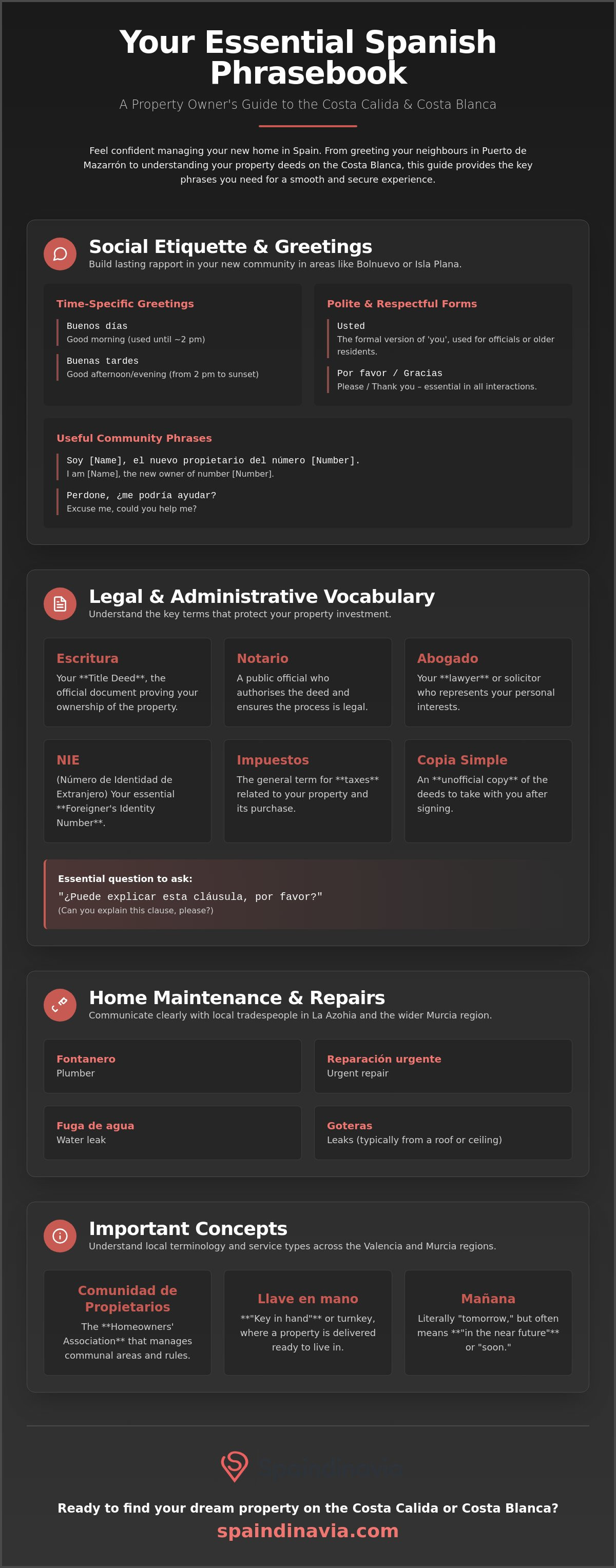
Whilst a quick "Hola" works well amongst friends, it can feel a bit abrupt in more formal or traditional settings. Using time-specific greetings like "Buenos días" (until about 2 pm) or "Buenas tardes" (from 2 pm until sunset) shows a deep respect for Spanish culture and etiquette. It signals that you aren't just a visitor; you're a committed member of the neighbourhood. This small gesture often opens doors to more helpful advice and warmer welcomes from your Spanish neighbours.
When you're dealing with officials or meeting older residents in La Azohia or Bolnuevo, stick to "Usted" instead of "Tú". It's the formal version of "you" and carries significant weight in showing respect to those in authority or of a different generation. Similarly, you'll likely encounter the concept of "Mañana". In the property context of the Costa Calida, this doesn't always mean "tomorrow" in a literal sense. It often means "in the near future" or "soon". Don't let it cause anxiety; it's simply a different rhythm of life that you'll gradually come to appreciate as you settle into your Mediterranean lifestyle.
Greetings for the Urbanisation and Community
Whether you're lounging by the communal pool in the Costa Blanca or tending to your terrace in Isla Plana, meeting neighbours is inevitable. Try introducing yourself by saying, "Soy [Name], el nuevo propietario del número [Number]" (I am [Name], the new owner of number [Number]). If you need a hand finding the local bin collection point or the nearest pharmacy, "Perdone, ¿me podría ayudar?" is a polite and effective way to ask for assistance whilst showing you value their local expertise.
Polite Requests and Gratitude
Kindness is a universal language, but "Por favor" and "Gracias" are your most valuable tools. If a vendor knocks on your door in Puerto de Mazarrón, a firm but kind "No, gracias, ahora no me interesa" (No thanks, I'm not interested right now) is perfectly acceptable. To end a chat gracefully at the local market, use "Ha sido un placer, que tenga un buen día" (It's been a pleasure, have a good day). These phrases ensure you maintain goodwill throughout the Murcia and Valencia regions.
Navigating Legal and Administrative Property Vocabulary
Managing the administrative side of a home in Bolnuevo or a townhouse on the Costa Blanca (Valencia region) requires more than just goodwill. It demands a clear understanding of specific legal terms that protect your investment. When you step into a professional office, having the most common Spanish phrases that is good to know as a property owner in Spain at your fingertips will instantly lower your stress levels. It transforms a complex transaction into a manageable, transparent process where you feel truly in charge of your journey.
The most vital word in your vocabulary is the "Escritura". This is your title deed, the official document that proves you own the property. You'll sign this in front of a "Notario", a public official who ensures the entire process follows Spanish law. Whilst your "Abogado" (lawyer) represents your interests, the Notary is an impartial figure who authorises the deed. Address them politely as "Señor Notario" or "Señora Notaria" to maintain a professional tone. Before you reach this stage, you'll need your "NIE" (Número de Identidad de Extranjero), which is your golden ticket for everything from paying "Impuestos" (taxes) to setting up your Wi-Fi.
The Notary and Solicitor Appointment
During your appointment, don't be afraid to speak up. Use the phrase "¿Puede explicar esta cláusula, por favor?" (Can you explain this clause, please?) to ensure total clarity. Once the signing is complete, always ask for a "Copia Simple". This is an unofficial copy of the deeds that you can take home immediately whilst the original is being registered in the local land registry. For a deeper dive into these requirements, it's helpful to consult a comprehensive buying property in Spain guide to stay ahead of the paperwork.
Banking and Utility Basics
Once you've collected the keys to your new build villa in La Azohia, you'll need to organise your monthly outgoings. Terms like "Luz" (electricity), "Agua" (water), and "Basura" (refuse collection) will soon become second nature. Knowing the most common Spanish phrases that is good to know as a property owner in Spain helps you manage these accounts without any fuss. Ask your bank manager about "Domiciliación" to set up a direct debit from your "Cuenta Bancaria". This ensures your bills are paid automatically whilst you are away from your property in the Costa Calida (Murcia region). If you are still searching for the perfect location, we can assist in finding your dream resale apartment or villa.
Maintenance and Home Improvements: Communicating with Tradespeople
Owning a resale apartment in Isla Plana or a stunning new build villa in the Costa Blanca (Valencia region) brings immense joy, but physical upkeep is an inevitable part of the journey. When a pipe bursts or the lights flicker, the ability to communicate clearly with local experts is your best defence against stress. Understanding the most common Spanish phrases that is good to know as a property owner in Spain ensures that your home remains the sanctuary you intended it to be.
The first step is identifying the right professional for the task. If you have a plumbing issue, you need a "Fontanero". For wiring or power problems, call an "Electricista". If you're looking to knock down a wall or repair masonry in your Bolnuevo home, an "Albañil" (builder) is the person to contact. Before any work begins, always ask for a "Presupuesto". This is a formal quote that outlines the scope of work and the expected cost. It's a standard practice across the Murcia and Valencia regions that protects both you and the tradesperson.
When discussing the work, be specific about whether you want to "Arreglar" (fix) something or "Cambiar" (replace) it entirely. This distinction is vital; "arreglar" might imply a temporary patch, whilst "cambiar" ensures a fresh start with new materials. Being clear about your expectations from the start helps build a professional relationship based on mutual understanding and respect.
Emergency Repairs and Urgent Requests
In a crisis, speed is everything. Use the phrase "Es una emergencia" (It's an emergency) followed by "Lo antes posible" (As soon as possible) to convey the gravity of the situation. You might need to describe a "Gotera" (leak) or a "Cortocircuito" (short circuit) over the phone. If your "Aire acondicionado" fails during a heatwave or your "Persianas" (external shutters) get stuck, these specific terms will help the technician arrive prepared. Always confirm the final "Precio" and ask if it includes "IVA" (VAT) to ensure there are no surprises when the invoice arrives.
Renovations and New Build Customisation
If you're planning "Reformas" (renovations) for your property in Puerto de Mazarrón or La Azohia, you'll likely work with a project manager. Knowing the most common Spanish phrases that is good to know as a property owner in Spain allows you to discuss "Suelo" (flooring), "Pintura" (paint), and "Cocina" (kitchen) details with confidence. For those awaiting a new build villa, asking "¿Cómo va la obra?" (How is the work going?) is a friendly way to check on progress and stay involved in the creation of your dream Mediterranean lifestyle.
Understanding the Comunidad and Local Governance
Joining a Comunidad de Propietarios is a standard step if you own a resale apartment in Bolnuevo or a bungalow in the Costa Blanca (Valencia region). This legal entity manages the shared areas of your building or urbanisation, ensuring that everything from the entrance gates to the communal lighting remains in top condition. Understanding how this system works is essential for a peaceful life, as it ensures your property value is maintained and your voice is heard amongst your neighbours. The Administrador handles the paperwork and finances, whilst the Presidente represents the owners. Knowing the most common Spanish phrases that is good to know as a property owner in Spain will help you during these vital interactions.
Regular financial contributions are a standard part of community living. You'll primarily deal with "Gastos de comunidad", which are your standard monthly or quarterly fees covering insurance and maintenance. Occasionally, the community might vote on a "Derrama". This is an extraordinary charge for unexpected repairs or major improvements, such as a new roof or a significant pool renovation. Learning the most common Spanish phrases that is good to know as a property owner in Spain empowers you to participate fully in these discussions and manage your budget with confidence.
Attending the Annual General Meeting (AGM)
Participation in the annual meeting, or Junta General, is your chance to influence community life. If you agree with a proposal, say "Estoy de acuerdo". If not, use "No estoy de acuerdo". During the official vote, you'll use "A favor" (for), "En contra" (against), or "Abstención" (abstain). These results are recorded in the "Acta", which are the official minutes of the meeting. If you're unsure about the "Normas de la comunidad" (community rules) regarding pets or noise in your Puerto de Mazarrón complex, don't hesitate to ask for clarification.
Common Areas and Facilities
Your enjoyment of the "Piscina" (pool) and "Jardines" (gardens) depends on proactive management. If you notice a flickering bulb in the "Ascensor" (lift) or issues with the "Limpieza" (cleaning) in your Isla Plana or La Azohia complex, reporting it promptly is helpful. You might ask, "¿Cuándo empiezan las obras?" to find out when planned works are starting. Being involved helps keep your community in top shape and fosters a friendly environment. If you are looking to join a well-managed community, explore our latest resale apartments and villas in the Murcia and Valencia regions today.
Beyond the Basics: Professional Support for Your Spanish Home
Mastering the most common Spanish phrases that is good to know as a property owner in Spain is a fantastic way to feel more at home in Puerto de Mazarrón or along the Costa Blanca. However, there comes a point where your time and peace of mind are more valuable than your dictionary. Transitioning from a hands-on holiday home owner to a sophisticated spain property investment expert often involves delegating technical and logistical tasks to the professionals. This is where a "Llave en mano" (turnkey) service becomes invaluable, especially for those investing in new build apartments or villas.
At Spaindinavia, we act as your dedicated bridge between the local market and your lifestyle goals. We understand that whilst you may know how to greet your neighbours in Bolnuevo, managing complex legal filings or major renovations from abroad is a different challenge. By providing professional support, we ensure your investment remains secure and your Mediterranean experience stays stress-free. Whether you are based in the UK or elsewhere, our team helps navigate the nuances of the Murcia and Valencia regions so you don't have to do it alone.
Property Management and Key Holding
For non-resident owners, "Custodia de llaves" (key holding) is a vital service that offers total security. You might need to arrange a "Limpieza de entrada" (check-in cleaning) for your rental guests or ensure the garden in La Azohia is tended to whilst you're away. Communicating these needs to a rental manager is much simpler when you have a trusted partner on the ground. It allows you to enjoy the benefits of property ownership without the constant worry of maintenance emergencies.
Finding Your Next Dream Property
Now that you've grasped the most common Spanish phrases that is good to know as a property owner in Spain, you can browse "Villas de obra nueva" (new build villas) or "Segunda mano" (resale) properties with a fresh perspective. Whether you're drawn to the coastal charm of Isla Plana or the vibrant "Promoción nueva" developments in the Costa Blanca, your new vocabulary will help you ask the right questions. Ready to use your Spanish? Contact Spaindinavia today to explore our latest portfolio of townhouses, bungalows, and investment properties across the Costa Cálida.
Embrace Your Mediterranean Lifestyle with Confidence
Mastering a few key expressions transforms your experience from a nervous observer to a confident homeowner. By using the most common Spanish phrases that is good to know as a property owner in Spain, you've taken the first step towards building genuine connections in Bolnuevo and managing your residence with ease. Whether you're navigating a "Comunidad" meeting in the Costa Blanca or describing a repair to a local tradesperson in Puerto de Mazarrón, your efforts will be met with warmth and respect by the local community.
With over 10 years of experience in the Murcia and Valencia regions, we are here to ensure you never feel lost in translation. We specialise in the legal and administrative details of Puerto de Mazarrón, Isla Plana, and La Azohia, providing the expert support you need for a secure investment. If you're ready to find your perfect sanctuary, explore our latest New Build Villas in Costa Cálida and Costa Blanca today. Your dream lifestyle is well within reach, and we're honoured to be part of your journey.
Frequently Asked Questions
What is the most important Spanish word for a new property owner?
The most vital term is "Escritura", which refers to your official property title deeds. It's the document that legally confirms your ownership and is signed before a Notary. Having this term in your vocabulary is part of the most common Spanish phrases that is good to know as a property owner in Spain, especially when dealing with banks or utility companies in Bolnuevo. It provides the legal foundation for your new life in the sun.
Do I need to speak fluent Spanish to own a house in Spain?
You don't need to be fluent to own a home in the Costa Blanca or Costa Calida regions. Whilst many professionals speak English, learning basic greetings and property terms will significantly enhance your experience. It helps you build trust with locals and gives you a sense of security when managing your resale apartment or villa. Most owners find that their vocabulary grows naturally as they spend more time in their new community.
How do I say "I have a water leak" in Spanish?
To report a water leak, you should say "Tengo una fuga de agua" or "Tengo una gotera" if it's coming through the ceiling. This is one of the most common Spanish phrases that is good to know as a property owner in Spain during maintenance emergencies. Being able to explain the issue clearly to a "fontanero" in Puerto de Mazarrón ensures a much faster response and prevents potential damage to your home.
What does "Escritura" mean in a property context?
In a property context, "Escritura" means the public title deeds of your home. This document is the ultimate proof of ownership and is registered at the local Land Registry. Whether you own a townhouse in Isla Plana or a bungalow in the Costa Blanca, you'll need to keep this document safe for all future legal transactions. It's the most important piece of paperwork you'll receive during the purchase process.
How do I ask for a repair quote in Spanish?
To ask for a repair quote, simply say "¿Me puede dar un presupuesto, por favor?" (Could you give me a quote, please?). It's standard practice across the Murcia and Valencia regions to request this before any work begins on your villa or apartment. This ensures you understand the "precio" and "IVA" involved before committing to a project, giving you total financial clarity and peace of mind for your home improvements.
What are community fees called in Spanish?
Community fees are known as "gastos de comunidad" in Spain. These are the regular payments made by owners in an urbanisation or apartment block to cover the upkeep of shared areas like the "piscina" and "jardines". If you own property in La Azohia or Bolnuevo, these fees are essential for maintaining the value and appearance of your complex. They ensure that shared facilities remain clean and functional for everyone to enjoy.
Is it better to use a translator for the Notary appointment?
Yes, it's highly recommended and often legally required to have an official translator if you aren't fluent in Spanish. The Notary must ensure you fully understand every clause of the "Escritura" before you sign. This provides an extra layer of security for your investment in the Costa Calida or Costa Blanca. Having a professional by your side ensures that no detail is missed during this critical final step.
How do I tell my neighbours I am the new owner?
You can introduce yourself by saying "Hola, soy el nuevo propietario del número [X]" (Hello, I'm the new owner of number [X]). This is a polite and warm way to start building rapport with your neighbours in Puerto de Mazarrón or Isla Plana. Following up with a friendly "Encantado" (Pleased to meet you) sets a positive tone for your new life and helps you integrate quickly into the local Spanish culture.


