

What if the key to your Mediterranean dream isn't just the villa you choose, but the legal structure behind it? You've likely spent hours browsing properties in the vibrant Costa Blanca or the serene, rugged retreats of the Costa Cálida, yet the paperwork often feels like a shadow over the sun. It's natural to feel anxious about double taxation or the notorious hurdles of opening a bank account as a foreign entity. You're probably asking yourself: what are the benefits of having a Spanish company vs keeping a company in my home country?
We understand that making the right choice is about more than just numbers; it's about securing your future and your peace of mind. In this article, you'll discover how incorporating a Spanish Sociedad Limitada (S.L.) can significantly reduce your tax liability, especially with the 15% rate for the first two profitable years, and provide a clear path to residency through the Entrepreneur Visa. We'll explore how local incorporation makes managing investments in Bolnuevo, La Azohia, or Isla Plana much smoother, whilst ensuring your transition to the Spanish lifestyle is as calm and rewarding as a sunset over the Puerto de Mazarrón.
Key Takeaways
- Understand how a Spanish S.L. unlocks a reduced 15% corporate tax rate for your first two profitable years and provides a clear path to residency.
- Evaluate the benefits of having a Spanish company vs keeping a company in my home country? specifically for managing investment properties across the Costa Blanca and the Costa Cálida.
- Find out how a Spanish entity eases the process of securing financing for new build villas in the Costa Blanca or townhouses in the Mazarrón area, including Puerto de Mazarrón and La Azohia.
- Discover the strategic advantages of holding assets through a local structure to mitigate inheritance tax and avoid 'Permanent Establishment' risks whilst living in Bolnuevo or Isla Plana.
- Gain practical advice on working with a local Gestor to organise your business affairs and determine if your turnover justifies the transition to a Spanish entity.
The Entrepreneur's Dilemma: Spanish SL vs. Foreign Entity
Imagine waking up in Puerto de Mazarrón, coffee in hand, looking out over the Mediterranean from your terrace. You've finally secured one of those stunning investment properties you've been dreaming of, but your business is still technically "back home." This is where the dilemma begins. You're balancing the comfort of your home-country systems with the reality of your new life in the sun. It's a psychological shift. You're moving from being a visitor who happens to work here to a resident business owner who truly belongs.
Many investors ask us: what are the benefits of having a Spanish company vs keeping a company in my home country? It's a vital question. Whilst keeping your original entity feels easier, it often creates a lingering "visitor" mindset that can clash with your long-term goals. The Costa Blanca and Costa Cálida aren't just holiday destinations; they're thriving regions for international trade. Gaining a clearer perspective on Spain's economic overview helps you see that the country is built to support active entrepreneurs. Whether you're looking at the bustling infrastructure of Valencia or the authentic, growing potential of the Murcia region, your corporate structure needs to keep pace with your ambition.
What is a 'Permanent Establishment'?
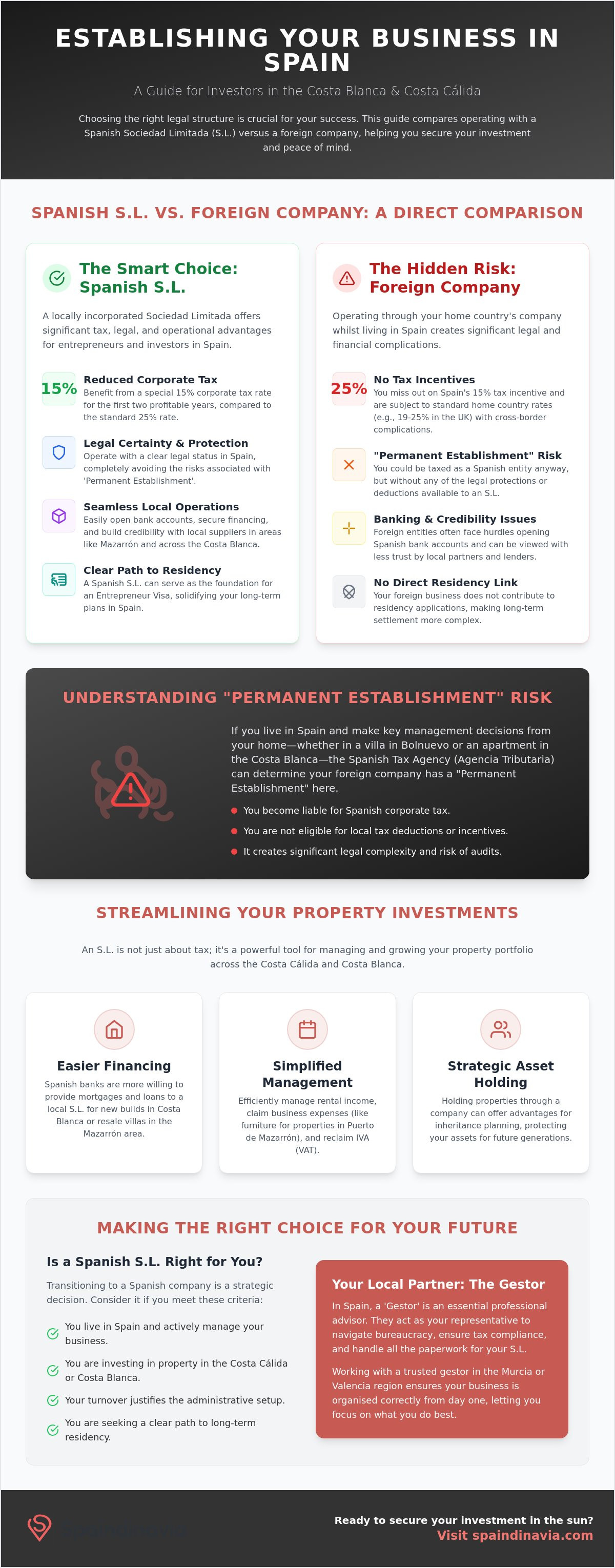
The Spanish Tax Agency, the Agencia Tributaria, is very specific about where a business is actually managed. If you're living in Isla Plana and making every strategic decision from your home office, they may decide your foreign company has a "Permanent Establishment" in Spain. This is a significant risk. It means you could be taxed as a Spanish entity anyway, but without any of the local deductions or legal protections. Incorporating a Spanish S.L. provides a clean break. It gives you legal certainty and ensures you aren't accidentally falling foul of complex cross-border tax rules.
The Lifestyle Factor in Murcia and Valencia
Your business structure should always align with your lifestyle. If you've invested in resale villas in Bolnuevo or new build apartments in the Costa Blanca, you want your professional life to be as streamlined as your morning swim. Professional peace of mind is essential for enjoying your new life. You don't want to be tethered to home-country bureaucracy whilst trying to integrate into the local community in La Azohia. Working with local experts in the Mazarrón area ensures your affairs are organised correctly from the start. This allows you to focus on your investments whilst we handle the heavy lifting of compliance and local regulations.
- Legal Certainty: Avoid the stress of "Permanent Establishment" tax audits.
- Local Integration: Build stronger relationships with Spanish banks and suppliers.
- Operational Ease: Manage your property portfolio in the Costa Cálida with a local entity.
Tax Efficiency and Legal Standing: A Direct Comparison
When you sit down to crunch the numbers, the immediate question is often about the headline tax rates. In the UK, Corporation Tax is currently set at a standard rate of 25% for companies with profits over £250,000, with a small profits rate of 19% for those below £50,000. Spain follows a similar standard corporate tax rate of 25%. However, looking only at these figures misses the broader picture. One of the major benefits of having a Spanish company vs keeping a company in my home country? is the ability to access local incentives that are specifically designed to welcome new investment into regions like the Costa Blanca and the Costa Cálida.
Managing your tax affairs through a local Sociedad Limitada (S.L.) also simplifies how you handle Value Added Tax, known locally as IVA. If you're purchasing furniture for new build apartments in Puerto de Mazarrón or renovating resale villas in Bolnuevo, having a Spanish entity allows you to reclaim IVA on business expenses much more efficiently than a foreign firm could. Protecting your income is equally straightforward thanks to robust double taxation treaties. These agreements ensure you aren't taxed twice on the same euro, providing a secure bridge for your capital between Spain and your home country.
The 15% Incentive for New Spanish Companies
To encourage growth, the Spanish government offers a reduced corporate tax rate of 15% for newly created companies. This rate applies during the first two years in which your business records a profit. To qualify, the company must be a fresh venture and not part of a pre-existing corporate group. Compared to the standard rates in many European jurisdictions, this incentive provides a significant cash-flow advantage whilst you establish your presence in the Mazarrón area. In 2026, the Spanish S.L. remains a superior vehicle for new ventures by offering a reduced 15% corporate tax rate that directly supports cash flow during those critical first two years of profit.
Managing Dividends and Personal Income
Balancing your personal income with corporate profits requires a bit of planning. As a director of a Spanish S.L., you'll typically pay into the "Autónomo" system, which is the Spanish social security scheme for the self-employed and business owners. This monthly payment provides you with access to the national healthcare system and contributes towards a state pension. You can choose to take a regular salary, which is an expense for the company, or receive dividends from the remaining profit. For those looking to invest in property along the coast, a local Gestor can help you organise these payments to ensure you're meeting your obligations whilst minimising your overall tax liability. This strategic approach is particularly useful if you're managing multiple holiday rental properties in Isla Plana or La Azohia, where income can fluctuate throughout the year.
- Standard Rate: 25% corporate tax for established firms.
- New Entity Rate: 15% for the first two profitable years.
- IVA Reclaims: Easier processing for local business-related purchases.
- Social Security: Access to Spanish healthcare through Autónomo payments.
Operational Ease: Banking, Credibility, and Local Infrastructure
Establishing a business in a new country is as much about logistics as it is about vision. If you've spent any time on expat forums, you've likely seen the frustration regarding Spanish banking. Many international investors find that opening a corporate account for a foreign firm is a significant bottleneck, often involving weeks of rigorous "Know Your Customer" checks. However, when you approach a bank as the director of a Spanish S.L., the conversation changes. Spanish banks favour local companies because the regulatory framework is familiar and the risk is easier for them to audit. When weighing up the benefits of having a Spanish company vs keeping a company in my home country? the operational reality of banking is often the deciding factor.
Beyond the initial setup, a local company allows you to build a Spanish credit history. This is a vital step if you plan to finance future investments, such as new build villas in the Costa Blanca or a portfolio of holiday rental properties in the Costa Cálida. A local entity with a solid track record is far more likely to secure competitive mortgage terms than a foreign company with no domestic footprint. This "local" status also extends to your everyday operations. Dealing with utility companies, internet providers, and local suppliers in Puerto de Mazarrón or Bolnuevo becomes significantly smoother when you're using a Spanish CIF (Tax Identification Number) rather than a foreign equivalent.
Financial Fluidity in the Spanish Market
Operating through a Spanish structure provides a level of financial fluidity that foreign entities struggle to match. Managing your quarterly IVA (VAT) returns and processing local payments becomes a routine task rather than a bureaucratic hurdle. This local integration also simplifies the practical steps outlined in our buying property in Spain guide, ensuring your capital moves efficiently when a prime opportunity arises in La Azohia or Isla Plana. Furthermore, a Spanish S.L. can often access regional business grants; you might find specific tourism-led incentives within the Murcia region that differ significantly from the technology and innovation grants frequently offered in the Costa Blanca (Valencia region).
Establishing Local Professional Networks
Credibility is the currency of the Spanish business world. By incorporating locally, you signal a long-term commitment to the region, which helps build trust with independent solicitors, architects, and banks. To ensure your brand makes a strong first impression, you can find out more about professional corporate photography and video production to elevate your local presence. If your plans involve hiring local staff to manage your investment properties or negotiating for commercial premises in the heart of the Mazarrón area, being a local entity is a major advantage. It allows you to navigate Spanish employment law and commercial contracts with much greater ease. This professional standing ensures that you aren't just another foreign investor, but a respected member of the local business community, whether you're based in the vibrant urban centres of the Costa Blanca (Valencia region) or the tranquil coastal stretches of the Costa Cálida (Murcia region).
- Mortgage Access: Local companies generally find it easier to secure financing for Spanish property.
- Utility Setup: Simplify contracts for electricity, water, and high-speed fibre in your properties.
- Regional Support: Compare Murcia-specific business incentives against those available in the Valencia region.
- Staffing: Legally hire and manage local contractors or property managers in Puerto de Mazarrón.
Strategic Property Investment via a Spanish Company
Whilst many casual buyers are advised to purchase in their own name, the strategic investor understands that property is more than just bricks and mortar. It's a business asset. One of the primary benefits of having a Spanish company vs keeping a company in my home country? is how a local S.L. allows you to treat your property portfolio as a professional enterprise. This is particularly true if you're looking at new build villas in the Costa Cálida or high-value residential complexes in the Costa Blanca. By holding these assets through a Spanish company, you can protect your personal wealth from potential business liabilities, creating a legal firewall between your private life and your investments.
Using a corporate structure also opens the door to significant operational savings. You can deduct property maintenance, cleaning services, and professional management fees directly from your corporate profits. If you're managing resale villas in Bolnuevo or townhouses in Isla Plana, these costs add up quickly. Offsetting them against your income ensures your net returns are as healthy as possible. You can explore our latest investment properties to see how these structures could apply to your next acquisition.
Maximising ROI in Costa Blanca and Costa Cálida
A local company structure is a powerful tool for anyone serious about spain property investment. In the Costa Blanca, where rental demand is consistently high, being able to offset management fees against corporate profits can significantly boost your bottom line. The same applies to the Mazarrón area. Whether you're focused on holiday rental properties in Puerto de Mazarrón or luxury estates in La Azohia, a company allows for a more sophisticated approach to ROI. You aren't just collecting rent; you're running a tax-efficient business that can scale with your ambitions.
Long-term Planning and Exit Strategies
Thinking about the future is where the Spanish S.L. truly shines. When the time comes to pass on your legacy, transferring shares in a company is often much simpler and more tax-efficient than transferring the physical deeds of a property. This can provide substantial inheritance tax advantages for your family. Additionally, if you decide to exit an investment, selling the company that owns the property can sometimes be more attractive to certain buyers than selling the physical asset itself. This flexibility makes the company a superior vehicle for family wealth management and long-term capital growth amongst the unique markets of Murcia and Valencia.
- Asset Protection: Separate your personal home from your business risks.
- Expense Deductions: Offset repairs and management costs against profit.
- Inheritance Ease: Simplify the transfer of wealth to the next generation.
- Capital Gains: Access corporate tax treatments on property appreciation.
Making the Transition: How to Choose Your Path
Deciding to move your business structure is a significant milestone. It represents the bridge between being a property owner and becoming a true resident entrepreneur. When evaluating the benefits of having a Spanish company vs keeping a company in my home country? it's essential to look at your long-term roadmap. For some, the familiar systems of home provide comfort; however, for those serious about integrating into the local market, the S.L. is often the superior choice. It's not just about the tax rates or banking ease we've explored; it's about making your daily life in both the Costa Blanca and the Costa Cálida as frictionless as possible.
If your long-term roadmap includes building a diverse international presence, you can discover Konradian to explore how they support property buyers in other key European locations like Hungary.
You don't have to make this journey alone. In Spain, the "Gestor" is a central figure in your professional life. A Gestor is more than an accountant; they act as a vital bridge between you and the Spanish administration. They organise your tax filings and social security registrations, ensuring you're compliant with the specific regional laws of the Murcia region whilst also navigating the distinct administrative requirements of the Costa Blanca (Valencia region). This local guidance is invaluable when you're searching for investment properties in Puerto de Mazarrón or Bolnuevo, allowing you to focus on the lifestyle rather than the paperwork.
Cost-Benefit Analysis for the Expat Entrepreneur
Setting up an S.L. involves an initial investment in formation costs and ongoing maintenance, such as monthly accounting fees and social security. Whilst the law now allows for a lower share capital, most advisors still recommend the traditional threshold to ensure operational stability. A self-contained sentence for your planning: Industry experts generally suggest that a Spanish S.L. becomes financially viable once your annual net profit exceeds €40,000 to €50,000. For many investors managing multiple holiday rental properties or commercial premises, these costs are quickly offset by the tax savings and operational ease gained from being a local entity.
Your Journey with Spaindinavia
Our role at Spaindinavia is to be your local partner throughout this entire process. We don't just help you find new build villas in the Costa Blanca or resale apartments in the Mazarrón area; we connect you with the right professional network to handle your incorporation. Whether you're drawn to the authentic charm of La Azohia and Isla Plana or the vibrant lifestyle found across the Valencia region, we ensure your business structure supports your dream. Finding the perfect property to house your new Spanish venture is the first step towards a more rewarding life under the sun. Contact us to explore new build villas and investment opportunities today, and let's start organising your future in Spain.
- Expert Network: Access trusted solicitors and Gestors who understand international needs.
- Strategic Locations: Find properties in high-growth areas like Puerto de Mazarrón and the Costa Blanca.
- Tailored Advice: Determine if an S.L. or a branch structure suits your specific turnover.
- Full Support: We guide you from the first viewing to the final business registration.
Secure Your Mediterranean Future Today
Choosing the right corporate structure is the final piece of the puzzle in your relocation or investment strategy. We've explored how a Spanish S.L. provides a robust legal shield for your assets whilst unlocking significant tax incentives, such as the 15% corporate rate for new ventures. Whether you're eyeing a sleek apartment in the Costa Blanca or a tranquil retreat in Bolnuevo or Isla Plana, your business structure should be as solid as the foundations of your new home. When you weigh up the benefits of having a Spanish company vs keeping a company in my home country? it's clear that local incorporation offers the most seamless path to long-term residency and financial growth.
At Spaindinavia, we specialise in hand-picked new builds and high-yield investment properties across the Costa Cálida and Costa Blanca. Our team provides comprehensive support throughout your entire journey, from securing your NIE to the final completion of your purchase in Puerto de Mazarrón or La Azohia. Start your Spanish investment journey with Spaindinavia and embrace a lifestyle defined by professional security and Mediterranean sunshine. We're here to ensure your transition is smooth, secure, and inspiring.
Frequently Asked Questions
Is it cheaper to run a company in Spain or the UK?
Direct administrative costs are typically higher in Spain than in the UK, primarily due to mandatory monthly social security (Autónomo) payments for directors and professional Gestor fees. However, when you factor in the 15% reduced tax rate for new ventures, the long-term savings often make Spain more attractive for those investing in Puerto de Mazarrón or the Costa Blanca. It is a balance between higher monthly maintenance and significantly lower corporate tax liabilities during your growth phase.
Can I keep my UK Ltd company whilst living in Spain permanently?
You can, but it is often a tax trap that leads to the "Permanent Establishment" issues we discussed earlier. If you are making strategic decisions from your villa in Bolnuevo or your apartment in the Costa Blanca, the Spanish tax office may claim your UK company is actually a Spanish resident entity. One of the main benefits of having a Spanish company vs keeping a company in my home country? is avoiding these aggressive audits and ensuring you only deal with one tax jurisdiction.
What is the minimum capital required to start a Spanish SL in 2026?
Legally, you can now start an S.L. with just €1, but you must build a legal reserve until you reach the traditional €3,000 threshold. In practice, most investors in the Costa Blanca (Valencia region) and the Costa Cálida (Murcia region) choose to deposit €3,000 from the start. This not only avoids restrictive reserve rules but also provides a much stronger profile when applying for business bank accounts or credit lines for property acquisitions.
Does having a Spanish company help me get a Golden Visa?
No, because the real estate Golden Visa was officially abolished on 3 April 2025. You cannot obtain residency simply by buying property anymore, regardless of whether you use a company or your own name. However, your Spanish company can be the foundation for an Entrepreneur Visa, which is a popular route for those looking to settle permanently in La Azohia or Isla Plana whilst operating a genuine business venture that benefits the Spanish economy.
How long does it take to incorporate a company in Spain compared to my home country?
Incorporation in Spain usually takes 8 to 12 weeks for non-residents, which is significantly longer than the 24-hour setup often found in the UK. This timeframe accounts for obtaining your NIE and navigating the rigorous banking checks required to fund your venture, whether you are setting up in the Murcia region (Costa Cálida) or the Valencia region (Costa Blanca). Whilst the wait is longer, it ensures your business is fully compliant for high-value acquisitions in Puerto de Mazarrón or La Azohia.
Can my Spanish company own my primary residence?
Yes, but it is rarely the most tax-efficient route for a personal home. If your company owns your residence in the Costa Blanca or the Costa Cálida, you are legally required to pay a market-rate rent to that company, which then becomes taxable income. This structure is far more effective for managing a portfolio of holiday rental properties, where you can deduct maintenance costs and management fees that wouldn't be deductible as an individual owner.
Do I need to speak Spanish to run a Sociedad Limitada?
Fluency isn't required, but you must have a reliable local partner. All official communications from the Spanish tax office and the Mercantile Registry are in Spanish, so working with a bilingual Gestor in Puerto de Mazarrón or the Costa Blanca is essential. They act as your translator and representative, ensuring that your business in Isla Plana or Bolnuevo remains compliant whilst you focus on the operational side of your investments.
What are the main taxes a Spanish company must pay annually?
Your company will primarily deal with Corporate Tax (Impuesto sobre Sociedades) and quarterly IVA (VAT) filings. Additionally, you must account for local property taxes (IBI) for any assets held in the Costa Blanca or the Murcia region. These annual obligations are the trade-off for the strategic asset protection and inheritance tax advantages that a local S.L. provides for your Mediterranean property portfolio.


