

What if the administrative maze of Spanish bureaucracy was actually the gateway to your most inspired life under the sun? It's perfectly normal to feel a sense of hesitation when faced with the complexities of a new legal system, especially whilst you're dreaming of a terrace in Bolnuevo or a chic apartment on the Costa Blanca. You're likely wondering, what are the regulations and rules to become Autonomo and work in Spain? It's a question that carries the weight of your future lifestyle, and we understand that the fear of high monthly social security fees or choosing the wrong tax structure can feel like a significant hurdle.
We're here to act as your reliable bridge, turning that confusion into a clear and actionable plan. This guide promises to help you master the legal requirements and tax tranches for 2026, including the €80 flat rate for new starters and the nuances of the Beckham Law. We'll explore the distinct advantages of the Costa Cálida, specifically the charming coastal pockets of Puerto de Mazarrón, Isla Plana, and La Azohia, alongside the bustling opportunities of the Costa Blanca. You'll gain the confidence to navigate the registration process and choose the perfect region to launch your new professional journey with peace of mind.
Key Takeaways
- Understand how the RETA system organises self-employed professionals into specific income-based brackets to ensure your social security contributions are accurate for 2026.
- Discover exactly what are the regulations and rules to become Autonomo and work in Spain, including the essential steps of securing a NIE and your digital certificate.
- Learn how to manage your monthly social security costs and quarterly tax filings whilst taking full advantage of the reduced flat rate available to new starters.
- Explore how to balance your professional life with the tranquil lifestyle of the Costa Cálida in areas like Puerto de Mazarrón or Bolnuevo, contrasted with the vibrant energy of the Costa Blanca.
- Gain practical insights into the documentation you'll need and how expert guidance ensures a smooth move to either the Murcia region or the neighbouring Valencia region.
Understanding the Autónomo System in Spain for 2026
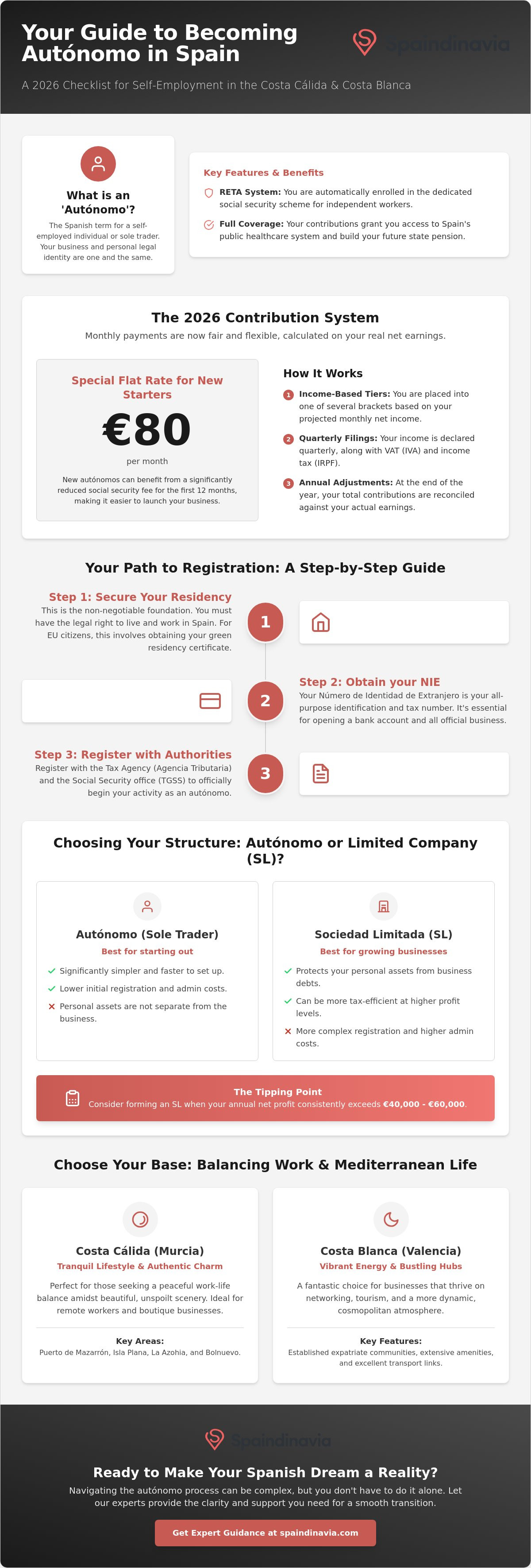
Embarking on a self-employed journey in the Mediterranean is a dream many share, but success begins with a clear grasp of the administrative landscape. An 'autónomo' is the Spanish term for a self-employed individual or sole trader. Unlike a limited company, you and your business are seen as one legal entity. This status organises you into the RETA (Régimen Especial de Trabajadores Autónomos), which is the specific social security system for independent workers. Understanding this framework is the first step toward securing your peace of mind whilst you settle into a new life in the sun.
The year 2026 marks a significant chapter for freelancers because the income-based contribution system is now fully established. Your monthly payments are no longer a choice but are calculated based on your actual net earnings. To get a broader perspective on how these obligations fit into the wider fiscal environment, you might find this Overview of Taxation in Spain helpful. If you are asking yourself, what are the regulations and rules to become Autonomo and work in Spain?, remember that the system is designed to provide you with access to the national healthcare system and a future pension, mirroring the benefits of traditional employment.
Who qualifies as an Autónomo in Spain?
This path is incredibly versatile and suits various lifestyles. You might be a digital nomad providing specialised consulting services to international firms whilst enjoying the quiet beauty of Isla Plana or La Azohia. Alternatively, you could be a skilled tradesperson or a small business owner looking to open a shop in the bustling Puerto de Mazarrón or perhaps a boutique in the popular Costa Blanca. Whether you are moving to the Murcia region for its authentic charm or the Valencia region for its vibrant coastal hubs, the autónomo registration remains the standard gateway for those who wish to work for themselves.
Freelancing vs. Sociedad Limitada (SL)
A common dilemma for newcomers is whether to register as an individual or form a limited company, known as a Sociedad Limitada (SL). Registering as an autónomo is significantly simpler and involves lower initial costs, which is why most people start here. However, an SL provides a layer of liability protection, as your personal assets remain separate from the business. Most experts suggest that the "break-even" point, where the tax benefits of an SL outweigh the administrative costs, typically occurs when your net annual profit exceeds €40,000 to €60,000.
Your choice also plays a role when you decide to buy property in Spain. Lenders often look for a stable track record of earnings, whether from your individual activity in Bolnuevo or a corporate structure in the Costa Blanca. By choosing the right setup early, you ensure a smoother transition into your Mediterranean home, allowing you to focus on the joy of your new surroundings.
Essential Residency and Visa Rules for Self-Employed Workers
Your journey to self-employment begins long before you issue your first invoice. Residency is the absolute prerequisite. You cannot legally register as an autónomo without the verified right to live and work in Spain. For EU and EEA citizens, the process is underpinned by the freedom of movement, yet it still requires a formal administrative step. You'll need to obtain your NIE and the green residency certificate to prove your status. This foundational step ensures you can access local infrastructure, from healthcare to property markets in both the Costa Cálida and the Costa Blanca.
If you're asking yourself, what are the regulations and rules to become Autonomo and work in Spain?, the NIE (Número de Identidad de Extranjero) stands out as your most vital tool. It's your personal identification number for all tax and legal matters. Without it, you cannot open a Spanish bank account, sign a lease for a commercial premise, or purchase a home in Puerto de Mazarrón or La Azohia. Securing this number early is the smartest move you can make to avoid delays in your business launch.
The Digital Nomad Visa and the Beckham Law
The Digital Nomad Visa remains a standout choice for international professionals in 2026. To qualify, you must demonstrate a minimum monthly income of €2,849. The real magic happens when you combine this visa with the Beckham Law, a special tax regime offering a 24% flat tax rate on income up to €600,000. It's essential to understand that these are two separate applications. You have a strict six-month window after your social security registration to opt into the Beckham Law. If you're dreaming of working from a sun-drenched terrace in Isla Plana, synchronising these applications is key to your financial success.
The Self-Employed Work Permit for Non-EU Residents
For those looking to open a local business, the traditional Self-Employed Work Permit is the path forward. This requires a detailed business plan, often validated by a professional body, and proof that you have sufficient funds to support yourself and your venture. The application begins at the Spanish Consulate in your home country. Once you arrive and settle into a community like Bolnuevo or a coastal town in the Costa Blanca, you'll apply for your TIE (Tarjeta de Identidad de Extranjero). This biometric card is your physical proof of residency and is essential for daily life. If you're currently searching for a place to call home whilst you prepare your application, you can explore our curated selection of resale apartments and villas along the coast.
Step-by-Step Registration: From NIE to RETA
Once you have secured your residency, the administrative sequence begins in earnest. You might be wondering, what are the regulations and rules to become Autonomo and work in Spain when it comes to the actual paperwork? The process is a logical progression that moves from digital identification to tax registration and finally social security enrolment. It's a journey that transforms you from a resident into a registered professional, whether you are opening a creative studio in Isla Plana or a consultancy on the Costa Blanca.
Success lies in the order of operations. Before you can file a single document with the tax office, you must organise your digital presence. This isn't just about a website; it's about your legal digital identity. You will also need a dedicated Spanish bank account. This account will handle your quarterly tax payments and the monthly social security debits, keeping your professional expenses separate from your personal life in Puerto de Mazarrón or La Azohia.
Securing Your NIE and Digital Certificate
The Digital Certificate (Certificado Digital) is the most important tool for any autónomo in 2026. It's a secure file installed on your computer that allows you to sign official documents and communicate with authorities online. To obtain it, you apply online through the FNMT website and then verify your identity in person. You can do this at various authorised centres, including local social security offices or town halls in the Murcia region and the Valencia region. Once active, this certificate allows you to manage your entire business from your home in Bolnuevo without ever standing in a physical queue again.
The "Alta" Process: Hacienda and Social Security
The actual registration involves two distinct steps, often called the "Alta". First, you register with the Tax Agency (Agencia Tributaria) using Modelo 036 or the simplified Modelo 037. Here, you will choose your IAE (Impuesto de Actividades Económicas) code, which defines your business activity for tax purposes. It's a vital choice that dictates which taxes you collect and pay.
Within 30 days of your tax registration, you must enrol in the RETA (Régimen Especial de Trabajadores Autónomos) through the Social Security office. During this step, you'll select a CNAE code, which is the social security equivalent of your professional category. For 2026, you must provide an estimate of your expected net annual income. This projection determines your monthly contribution bracket. Accuracy is important here, as the system includes an annual regularisation process where your payments are adjusted based on your actual earnings at the end of the fiscal year. This ensures you only pay what is fair, providing a safety net for your new Mediterranean lifestyle.
Managing Your Taxes, Social Security, and Deductions
Managing your finances is the heartbeat of your new venture. Once you've settled into your new home, whether it's a modern apartment in the Costa Blanca or a coastal villa in Bolnuevo, understanding your ongoing fiscal obligations is essential. When people ask, what are the regulations and rules to become Autonomo and work in Spain?, the answer often centres on the monthly social security contribution, known as the 'cuota'. For 2026, these rates remain based on 15 income brackets, with monthly payments ranging from approximately €200 to €590. A small but mandatory addition to this is the Mecanismo de Equidad Intergeneracional (MEI), which has increased to 0.9% for 2026, adding a few extra euros to your monthly debit.
Your tax responsibilities are handled through quarterly filings due on the 20th of January, April, July, and October. You'll typically collect 21% VAT (IVA) from Spanish clients, which you hold and pay back to the state. Simultaneously, you'll make advance payments on your Personal Income Tax (IRPF), usually at a rate of 20% of your quarterly profits. This system ensures you don't face a massive bill at the end of the year, keeping your finances stable whilst you enjoy the local lifestyle in Puerto de Mazarrón or La Azohia.
The Flat Rate Incentive (Tarifa Plana)
New arrivals have a significant advantage through the 'Tarifa Plana'. This incentive allows you to pay a reduced flat rate of just €80 per month for your first 12 months of activity. If your net annual income remains below the minimum wage, you can often extend this for a second year. It's worth noting that regional variations exist; for instance, certain autonomous communities in the Murcia region or the Valencia region may offer additional subsidies that effectively reduce this cost even further. This breathing room is invaluable whilst you build your client base from your base in Isla Plana.
What Expenses Can You Deduct?
One of the perks of being an autónomo is the ability to deduct legitimate business expenses, which reduces your taxable profit. If you work from your Spanish property, you can often deduct a percentage of your utilities, such as electricity and water. Other common deductions include:
- Professional equipment like laptops and office furniture.
- Professional insurance (Seguro de Responsabilidad Civil) to protect your activity.
- Travel costs and subscription fees for professional software.
Balancing Work and Life: Choosing Your Base in Costa Cálida or Costa Blanca
The administrative journey is merely the first step toward your new Mediterranean life. Once you understand what are the regulations and rules to become Autonomo and work in Spain, the focus shifts to the most rewarding part of the process: deciding where to plant your roots. Unlike traditional employment, your status as an autónomo allows you to prioritise your surroundings. You're no longer tied to a city centre office or a commute. Instead, you can choose a home based on the view from your terrace or the proximity to your favourite beach.
The Costa Cálida, located in the Murcia region, is a haven for those who seek authenticity and a slower pace. It offers a lower cost of living and over 320 days of sunshine each year, making it perfect for outdoor-loving professionals. In contrast, the Costa Blanca in the Valencia region provides a more established expat infrastructure with a wide range of international schools and bustling coastal hubs. Successfully navigating the legalities of self-employment effectively supports a long-term property investment, turning your professional ambition into a secure family legacy.
Why Puerto de Mazarrón is the Ideal Hub for Remote Professionals
Puerto de Mazarrón has emerged as a vibrant centre for international freelancers. Along with the neighbouring areas of Isla Plana and La Azohia, it offers a unique balance of work-from-home peace and coastal leisure. You'll find a growing community of like-minded professionals who have traded grey skies for the blue horizons of the Murcia coastline. High-speed fibre optic internet is now widely available, especially in the modern new build villas across Bolnuevo, ensuring you stay connected to your global clients whilst enjoying the tranquil local atmosphere.
Finding the Perfect Property to Match Your New Career
Your property needs to do more than just house your family; it needs to inspire your work. When you've mastered what are the regulations and rules to become Autonomo and work in Spain, you can focus on finding a home that features a dedicated office space or a sun-drenched terrace for remote sessions. We specialise in identifying properties that meet these specific professional requirements whilst fulfilling your lifestyle dreams. Whether you're looking for a resale apartment with sea views or a spacious townhouse, we're here to guide you through every step of the purchase. Explore our new build villas in the Costa Cálida and Costa Blanca today.
Your New Professional Chapter Under the Spanish Sun
You've now gained a clear roadmap for your self-employed journey, from mastering the income-based contribution brackets to securing your digital certificate. Whether you're drawn to the vibrant energy of the Costa Blanca or the serene coastal charm of Bolnuevo, Isla Plana, and La Azohia, you're equipped with the knowledge to make an informed decision. By understanding the fiscal landscape for 2026, you've turned a complex administrative process into a manageable path toward your Mediterranean dream.
Grasping exactly what are the regulations and rules to become Autonomo and work in Spain? is the essential foundation for a secure and confident move. We're here to act as your local partners, offering expert guidance across the Mazarrón and Costa Blanca regions. From your initial NIE application to the final key handover, we specialise in identifying new build villas and resale apartments that perfectly accommodate your professional needs. Find your dream work-from-home base with Spaindinavia and start your new life in the Murcia or Valencia region with peace of mind. Your future by the sea is waiting for you.
Frequently Asked Questions
Do I need a Spanish bank account to become Autónomo?
Yes, you absolutely need a Spanish bank account to manage your professional activity. The social security office requires a Spanish IBAN to set up the mandatory SEPA direct debits for your monthly contributions. Having a local account also makes it much simpler to pay your quarterly taxes and manage business expenses whilst you are settling into your new life in Puerto de Mazarrón or the Costa Blanca.
How much is the monthly Autónomo fee in 2026?
For 2026, the monthly social security contribution is based on your net earnings and typically ranges from approximately €200 to €590. If it's your first time registering, you can access the 'Tarifa Plana' incentive, which fixes your fee at just €80 per month for the first year. This reduced rate is a fantastic way to support your initial months in the Murcia region or the neighbouring Valencia region.
Can I work as an Autónomo while still employed by a UK company?
Yes, it's a common path for expats, but you must register as an autónomo to invoice your UK employer as a client. This ensures you are paying your social security and income tax correctly in Spain. Many remote professionals asking, what are the regulations and rules to become Autonomo and work in Spain?, find this structure allows them to enjoy the lifestyle in Bolnuevo or Isla Plana whilst maintaining their existing professional connections.
What happens if I don’t earn any money in a particular month?
You must still pay your monthly social security fee even if you don't have any income in a specific month. The system is based on your projected annual earnings, so the 'cuota' is a fixed monthly obligation. However, you can adjust your income bracket up to six times a year if your business reality changes whilst you are working from your base in La Azohia or the Costa Blanca.
Is the Beckham Law still available for self-employed people in 2026?
The Beckham Law is available to those on a Digital Nomad Visa, but it generally excludes traditional freelancers who provide services to multiple clients within Spain. If you qualify, you'll benefit from a 24% flat tax rate on your earnings. It's a complex area, so it's vital to check your eligibility before you commit to a property in the Murcia or Valencia regions.
Do I need an accountant (Gestor) to manage my Autónomo status?
Whilst you can technically manage the paperwork yourself, almost all successful autónomos use a 'gestor'. These specialists handle your quarterly tax returns and ensure you are compliant with the new VeriFactu digital invoicing rules. For a typical fee of €60 to €100 per month, they provide the security you need to focus on your business in Puerto de Mazarrón.
What is the "Modulós" system and does it apply to me?
The 'módulos' system is a simplified tax regime based on fixed indicators like the size of your commercial premises rather than actual profit. It's usually reserved for specific trades like taxi drivers or small shop owners. Most digital professionals and consultants moving to the Costa Blanca or Costa Cálida will use the 'estimación directa' system, which calculates tax based on real income and expenses.
Can I register as Autónomo before I have my physical TIE card?
You generally need your NIE and proof of residency to start the registration, but you don't always have to wait for the physical TIE card to arrive. As long as you have your favourable residency resolution and your NIE, you can often begin the tax agency registration. This helps you start working and invoicing sooner as you establish yourself amongst the coastal communities of the Murcia and Valencia regions.


