

Owning a slice of Mediterranean paradise shouldn't come with the weight of tax-related anxiety. It's completely natural to feel a bit apprehensive about the Spanish tax office, Hacienda, especially whilst managing your property from the UK. You might be asking yourself: "What taxes do I need to pay as a property owner and non resident in Spain?" and feeling unsure about where local rates end and national obligations begin. Whether you've fallen in love with a villa in Puerto de Mazarrón or a modern apartment on the Costa Blanca, understanding your financial responsibilities is the first step toward total peace of mind.
We know that the dream of a sun-drenched lifestyle in the Costa Calida or the Valencia region is about relaxation, not paperwork. This guide provides a clear, comprehensive roadmap to handling Spanish non-resident taxes, ensuring your holiday home remains a secure and stress-free investment. We'll explore the essential differences between local IBI and national Modelo 210 filings, explain how rules vary between the Murcia region and its neighbours, and provide a practical calendar of deadlines. From the quiet coves of Isla Plana and La Azohia to the golden sands of Bolnuevo, we're here to help you protect your investment with confidence.
Key Takeaways
- Understand the 183-day rule to ensure you maintain your non-resident status whilst enjoying your villa in the Costa Calida or your apartment on the Costa Blanca.
- Clear up the confusion surrounding "What taxes do I need to pay as a property owner and non resident in Spain?" by distinguishing between local council rates and national income obligations so you don't get caught out.
- Learn how the Valor Catastral affects your annual IBI bill in areas like Puerto de Mazarrón and Bolnuevo within the Murcia region, whilst comparing how local rates might differ across the Valencia region.
- Discover the requirements for filing Modelo 210, including the "imputed income" tax that applies even if your property in Isla Plana or La Azohia isn't rented out, a rule that stays consistent from the Costa Calida to the Costa Blanca.
- Gain confidence in your investment by understanding the 3% retention rule and how a local gestor can help you organise your finances without the stress.
Understanding Your Tax Status: The 183-Day Rule in Spain
Owning a resale villa in Puerto de Mazarrón or a modern apartment on the Costa Blanca is a lifestyle choice that brings immense joy. However, before you settle into your new Mediterranean routine, you must be clear about your tax status. A common question we hear is: What taxes do I need to pay as a property owner and non resident in Spain? The answer starts with a simple number: 183.
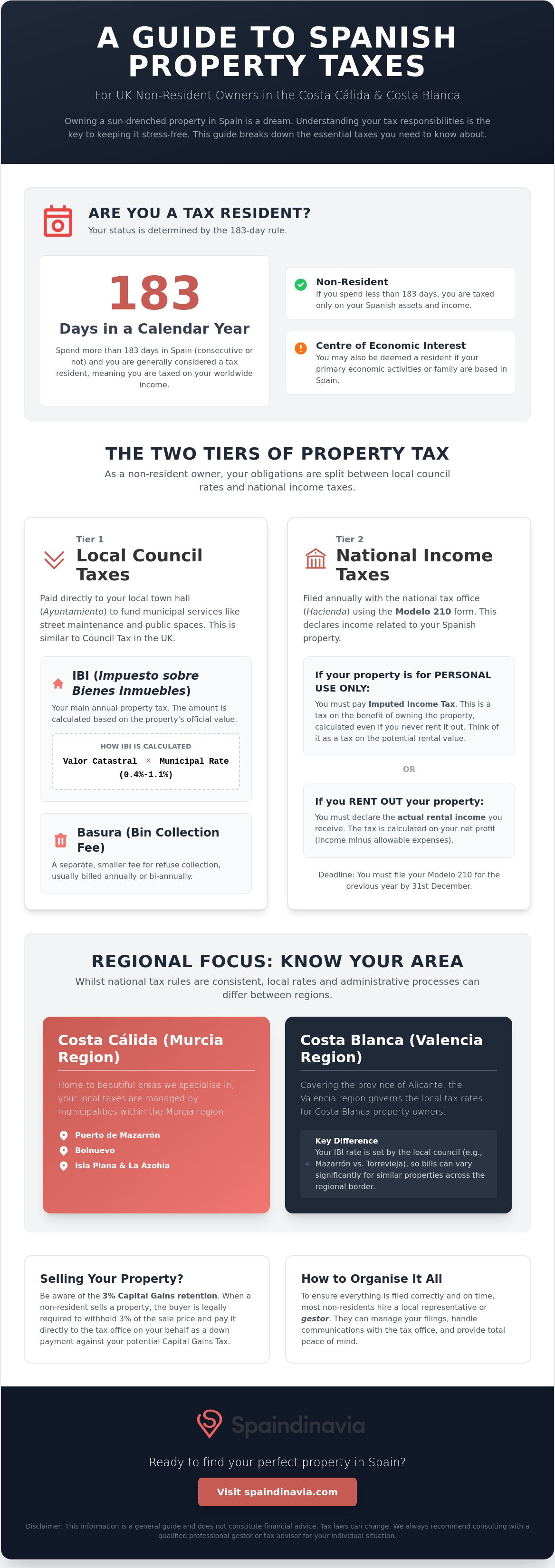
In 2026, the Spanish tax office, Hacienda, remains firm on the 183-day rule. If you spend more than 183 days in Spain during a calendar year, you're generally considered a tax resident. These days don't have to be consecutive. Even partial days count toward your total. Hacienda has become increasingly sophisticated in how it tracks presence, often cross-referencing digital footprints like utility usage, local card transactions, and flight records. For those seeking a broader Overview of Spanish Taxation, it's clear that your residency status dictates whether you're taxed on your worldwide income or just your Spanish assets.
It isn't just about days on the calendar. You could still be deemed a resident if your "centre of economic interest" is in Spain. This happens if your spouse and children live here, or if your primary source of income is generated within Spanish borders. Simply owning a holiday home in Bolnuevo doesn't make you a resident, but it does trigger specific obligations that you need to organise correctly to keep your investment secure.
The Legal Distinction Between Resident and Non-Resident
Your NIE (Número de Identidad de Extranjero) is the key to your life in Spain. It's the unique identification number you'll use for everything from buying your property to filing your annual tax returns. Whilst your NIE stays the same, your tax status can change. If you decide to transition from a holiday homeowner in Isla Plana to a full-time resident, you must notify the tax office. Failing to update your status can lead to administrative headaches and potential penalties from Hacienda.
Taxes Across the Regions: Costa Cálida vs. Costa Blanca
Spain is divided into autonomous communities, and where your property sits matters. Property owners in the Costa Cálida fall under the Murcia region's jurisdiction, whilst those on the Costa Blanca are governed by the Valencia region. If you own a home in La Azohia or Puerto de Mazarrón, you'll follow Murcia-specific local rules. These regional differences often impact wealth tax thresholds and the efficiency of local tax offices. Understanding which community you belong to ensures you're looking at the right rates and deadlines for your specific location.
Local Property Taxes: IBI and Basura Explained
Securing your dream home is just the beginning of your Spanish adventure. Once the keys are in your hand, you'll need to manage the local costs that maintain the infrastructure around your property. When clients ask us, "What taxes do I need to pay as a property owner and non resident in Spain?", we usually start with the local council tax, known as IBI (Impuesto sobre Bienes Inmuebles).
IBI is very similar to the UK’s Council Tax. It’s an annual fee paid to the local town hall (Ayuntamiento) that funds local services like street lighting, road maintenance, and public parks. The amount you pay is based on the Valor Catastral, which is the official administrative value of your property as registered with the Spanish authorities. This value is usually significantly lower than the market price you paid. Alongside IBI, you'll also encounter the Basura fee. This is a separate charge for rubbish collection, often billed twice a year or annually depending on your specific municipality.
Calculating Your IBI in 2026
Your IBI isn't a flat rate across Spain. Each municipality sets its own percentage, typically ranging between 0.4% and 1.1% of the cadastral value. If you've chosen one of the stunning resale villas in Bolnuevo, your initial valuation might take a little longer to appear on the official registers than a long-established home. You'll find your property's specific details on the Referencia Catastral, a unique twenty-digit code found on previous tax receipts or in the property deeds. It's vital to check this because rates in the Mazarrón area can differ from those in popular Costa Blanca spots like Torrevieja or Orihuela Costa.
Payment Deadlines and Local Town Halls
Timing is everything for avoiding surcharges. In the Murcia region, specifically for owners in Puerto de Mazarrón, Isla Plana, and La Azohia, tax windows are set by the local town hall. Generally, you can expect the payment period to open in the summer or autumn. In contrast, if your property is in the Valencia region, you'll likely deal with the SUMA office, which handles tax collection for most of the Costa Blanca. They have their own specific calendars and digital portals.
Missing a deadline can result in an immediate 5% surcharge, which increases if the debt remains unpaid. We always recommend setting up a domiciliación (standing order). This ensures the funds are automatically debited from your Spanish bank account each year. It's a simple way to keep your investment stress-free whilst you're back in the UK. If you feel your Valor Catastral is unfairly high, you can appeal the valuation, though this usually requires professional assistance from a local expert who understands the regional nuances.
National Taxes: The Modelo 210 for Imputed and Rental Income
Whilst local town halls handle your IBI, the Spanish national tax office, Hacienda, requires its own set of filings. This is often the point where the most confusion arises for homeowners. When asking, "What taxes do I need to pay as a property owner and non resident in Spain?", you must look beyond the local council. Every non-resident owner is required to file a Modelo 210 return. This form covers two distinct scenarios: the time you spend enjoying the property yourself and the periods when you might rent it out to holidaymakers.
The system is designed to ensure that the Spanish state receives a contribution from all property assets within its borders. Whether you own a modern apartment in Puerto de Mazarrón or a traditional townhouse on the Costa Blanca, you'll need to navigate these national obligations annually. Failing to do so doesn't just risk fines; it can create significant complications when you eventually decide to sell or bequeath your home.
Imputed Income Tax (Deemed Tax) for Personal Use
Spain applies a unique concept known as imputed income tax, sometimes called "phantom rent." Hacienda assumes that you derive a financial benefit from owning a second home, even if it sits empty for most of the year. To calculate this, you start with your property’s Valor Catastral. If this value has been updated by the municipality within the last 10 years, the tax base is 1.1% of that value. If it hasn't been updated, the base rises to 2%.
The actual tax rate depends on your country of residence. EU and EEA residents benefit from a 19% rate. However, following Brexit, British residents are taxed at 24%. It's a common oversight for owners in Bolnuevo or Isla Plana to forget this annual filing, but Hacienda tracks these debts. If they remain unpaid, they will be flagged during the 3% retention process when you sell the property, potentially delaying your capital gains clearance.
Declaring Rental Income and Deductible Expenses
If you decide to offer your home as a holiday let in La Azohia or along the vibrant coast of the Valencia region, your tax obligations shift. You must declare any income earned from rentals. For EU residents, the system is relatively generous, allowing a 19% tax rate on net income after deducting expenses like mortgage interest, community fees, and maintenance.
For UK residents, the rules are stricter. You're taxed at 24% on the gross rental income, with no deductions permitted for property-related costs. Meticulous record-keeping is essential for a successful property investment in Spain. A significant change for 2026 is the full transition to annual reporting. Whilst rental income was previously declared quarterly, the system has been streamlined to allow for a single annual filing for most non-resident income types, making it much easier to manage your finances from abroad.
Capital Gains and Wealth Tax: Long-Term Obligations
Whilst local IBI and annual income declarations keep your property running smoothly, you must also consider the taxes associated with high-value assets and the eventual sale of your home. When you ask, "What taxes do I need to pay as a property owner and non resident in Spain?", the answer must include long-term capital obligations. These taxes are designed to capture the growth in your investment's value and ensure that high-net-worth individuals contribute to the national economy.
Managing these obligations correctly is the difference between a profitable exit and a stressful administrative hurdle. Whether you're enjoying a townhouse in Isla Plana or a spacious villa in the Costa Blanca, understanding how Hacienda views your wealth is essential for long-term security. The Spanish system is thorough, but with the right preparation, it remains entirely manageable for international owners.
Selling Your Property: The CGT Breakdown
Selling your Spanish home triggers Capital Gains Tax (CGT) on any profit you've made. In 2026, the rate for all non-residents is 19%. To calculate your gain, you subtract the original purchase price (plus associated costs like notary fees and taxes) from the final sale price. One unique aspect of the Spanish system is the 3% retention rule. When you sell, the buyer is legally required to withhold 3% of the total purchase price and pay it directly to the tax office on your behalf. This acts as a security deposit against your CGT liability.
If you sell your property in Bolnuevo at a loss, or if your actual CGT bill is less than the 3% withheld, you're entitled to a refund. Reclaiming this money requires you to be fully up to date with your annual non-resident tax filings (Modelo 210). If your paperwork isn't in order, Hacienda may keep the retention. Before you even list your home for sale, we recommend reading our buying property in Spain guide to ensure you have all the necessary records from your initial purchase.
Wealth Tax Thresholds in Murcia and Valencia
Spain also levies a Wealth Tax (Patrimonio) on assets located within the country. For non-residents, the national tax-free threshold is €700,000 per person. If you own a property in Puerto de Mazarrón or La Azohia with a partner, you can effectively double this threshold to €1.4 million before any tax is due. This makes joint ownership a very efficient strategy for managing your tax exposure in the Murcia region.
Whilst the Valencia region (Costa Blanca) and the Murcia region (Costa Calida) both follow the national €700,000 allowance, you should stay informed about the national Solidarity Tax. Introduced to harmonise wealth taxation, this applies to net assets exceeding €3 million. It ensures that even in regions with high local exemptions, high-value portfolios contribute a minimum rate starting at 1.7%. If you're considering expanding your portfolio with high-value investment properties, our team can help you understand how these thresholds apply to your specific situation.
How to Organise Your Spanish Taxes Without the Stress
Managing a property from the UK shouldn't feel like a second job. Once you understand the answer to "What taxes do I need to pay as a property owner and non resident in Spain?", the next logical step is creating a system that runs on autopilot. The secret to a stress-free investment in the Costa Calida or the Costa Blanca isn't doing it all yourself; it's about building a reliable local network. By delegating the administrative heavy lifting, you can focus on what really matters: enjoying your morning coffee on a terrace in Puerto de Mazarrón or exploring the coves of La Azohia.
For 2026, staying organised means keeping a close eye on the calendar. Whilst the transition to annual reporting has simplified things, missing a deadline still carries weight. Your tax year follows the calendar year, and you generally have from 1st January until 31st December to file your Modelo 210 for the previous year's imputed income. Local IBI windows in the Murcia region often fall between September and November, whilst the SUMA office in the Valencia region may operate on a different schedule. Setting reminders for these periods ensures you never face the 5% late payment surcharge mentioned earlier.
The Value of Professional Representation
Hiring a "Fiscal Representative" or a local solicitor is often the best investment a non-resident can make. These experts do more than just crunch numbers; they act as your official liaison with Hacienda. In 2026, the Spanish tax office is utilising advanced digital tracking to cross-reference utility bills and rental platform data. A professional ensures your filings are accurate and compliant, keeping you off any "black lists" that could complicate a future sale. When choosing a partner, look for someone who understands the specific UK-Spain double taxation treaties and speaks your language fluently, ensuring nothing is lost in translation.
Actionable Tips for New Owners in Mazarrón
If you've recently collected the keys to a new build villa in Bolnuevo or a resale apartment in Isla Plana, your first priority should be obtaining a Digital Certificate (Certificado Digital). This allows you or your representative to access town hall virtual offices and Hacienda’s portal securely from anywhere in the world. It’s also vital to ensure your property is correctly registered at the Catastro office shortly after purchase. At Spaindinavia, we pride ourselves on being more than just property experts; we're your local partners who care about your entire journey. We help bridge the gap between two cultures, ensuring your Spanish retreat remains the peaceful sanctuary you always dreamed it would be.
Secure Your Mediterranean Investment with Confidence
Navigating the Spanish tax system doesn't have to be a barrier to your dream lifestyle. You've now gained a clear understanding of the distinction between local IBI rates in Puerto de Mazarrón and national Modelo 210 obligations. This knowledge is the foundation of a secure investment. Whether you're relaxing in Isla Plana or exploring the Costa Blanca, staying compliant ensures your focus remains on the Mediterranean sun rather than administrative hurdles. By organising your finances early, you protect both your capital and your peace of mind.
You no longer need to wonder, "What taxes do I need to pay as a property owner and non resident in Spain?" because you have a roadmap to success. Since 2016, we've specialised in the Costa Cálida and Costa Blanca, helping owners in Bolnuevo and La Azohia maintain stress-free homes. Through our partnerships with independent, English-speaking solicitors and our full property management and rental support, we ensure every detail is handled with care. We're dedicated to being the reliable bridge between your current home and your new Spanish sanctuary.
Explore our hand-picked portfolio of properties and let us guide you through the buying process. Your journey to a new life in the sun should be filled with excitement and inspiration. We're here to make sure it stays that way.
Frequently Asked Questions
Do I have to pay tax in Spain if I don’t rent out my property?
Yes, you must pay what is known as "imputed income tax" even if your property is for personal use only. The Spanish authorities treat your second home as a source of potential benefit, and you're required to file a Modelo 210 annually. This applies to all owners, whether you have a quiet retreat in Isla Plana or a holiday apartment on the Costa Blanca.
What is the deadline for filing Spanish non-resident income tax in 2026?
For imputed income related to the 2025 tax year, your deadline is 31st December 2026. If you're renting out your villa in Bolnuevo or your townhouse in the Valencia region, the system has shifted to annual reporting. This means you no longer need to worry about quarterly filings, allowing you to organise your affairs once a year instead.
How much is the non-resident property tax in Spain for UK citizens?
British residents are taxed at a rate of 24% on both imputed and rental income. This is a key part of the answer when people ask: "What taxes do I need to pay as a property owner and non resident in Spain?" Whilst EU residents pay a lower rate of 19%, UK citizens must budget for this 24% rate following the change in status after Brexit.
Can I pay my Spanish property taxes from a UK bank account?
Whilst it's technically possible to make international transfers, it's far more practical to use a Spanish bank account. Most owners in Puerto de Mazarrón and the Costa Blanca set up a "domiciliación" or standing order. This ensures that local IBI and Basura bills are paid automatically by the council, preventing any unexpected late payment surcharges whilst you're back in the UK.
What happens if I forget to pay my IBI or Modelo 210?
Missing a payment triggers an immediate surcharge, which typically starts at 5% and increases the longer the debt remains unpaid. Hacienda also has the power to embargo your Spanish bank account to recover the funds. Additionally, any outstanding tax debts will be flagged during the sale of your property in La Azohia, potentially delaying the process and complicating your 3% retention refund.
Are there any tax deductions for British non-residents renting out property?
No, British residents are currently unable to claim any tax deductions on rental income. You're required to pay the full 24% tax on the gross amount you receive from tenants. This is a significant difference compared to EU residents, who can deduct expenses like community fees and maintenance before paying 19% on their net profit.
Is Wealth Tax applicable to all non-resident property owners in Spain?
Wealth Tax only applies if your net assets in Spain exceed the national threshold, which is generally €700,000 per person. If you own a property in Bolnuevo or the Costa Blanca jointly with a partner, your combined tax-free allowance is €1.4 million. Most owners find they fall well below this limit, though high-value investments may also be subject to the national Solidarity Tax.
What is the 3% retention when selling a property in Spain?
The 3% retention is a legal requirement where the buyer withholds 3% of the purchase price and pays it to the Spanish tax office on your behalf. It acts as a guarantee that you'll settle your Capital Gains Tax. If your actual tax liability is less than the 3% held, you can apply for a refund once the sale is finalised, provided your annual tax filings are up to date.


