

What if your Spanish investment didn't just provide a sunny retreat, but also a stress-free monthly income without the constant worry of "okupas" or unpaid rent? We know that for many owners, the distance makes vetting potential renters feel like a daunting task, especially when you're trying to decipher foreign financial documents. Learning how to find reliable tenants for a spanish property is the vital first step in protecting your asset, whether you have a sleek new build apartment in the Costa Blanca or a charming resale villa in the Costa Calida.
You deserve the peace of mind that comes from knowing your home is in good hands whilst you aren't there. This guide will help you master the art of tenant screening and navigate the 2026 rental landscape with confidence. From the sun-drenched shores of Puerto de Mazarrón and Isla Plana to the quiet beauty of La Azohia and Bolnuevo, we'll show you how to secure high-quality renters. You'll learn about the latest 2% rent increase caps, the legal limits on security deposits, and how to ensure your rental contract is completely watertight. We're here to bridge the gap between your dream investment and a flourishing, secure reality.
Key Takeaways
- Understand why choosing between long-term "vivienda" and seasonal "temporada" contracts is the foundation for attracting the specific tenant profile you desire.
- Discover how a minimalist, high-quality aesthetic acts as your first filter, ensuring your property in the Costa Blanca or Costa Calida appeals to conscientious renters.
- Master our rigorous 5-step screening process to learn exactly how to find reliable tenants for a spanish property by verifying financial stability and residency status.
- Secure your income with a legally watertight contract and explore the benefits of rental default insurance to protect your investment in 2026.
- Learn how professional management in areas like Puerto de Mazarrón and Isla Plana provides remote landlords with essential peace of mind and property maintenance.
Understanding the Spanish Rental Market: Long-Term vs Short-Term
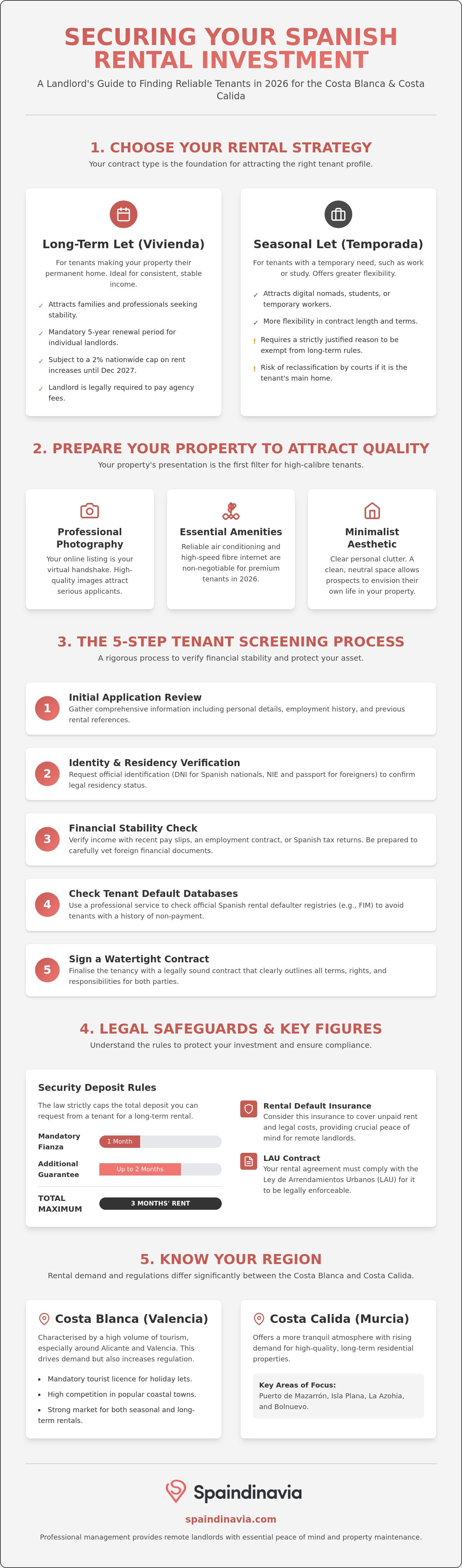
Choosing your rental model is the very first step in mastering how to find reliable tenants for a spanish property. In the current 2026 market, your choice isn't just about income; it's about the legal framework you step into. Long-term rentals, known as vivienda, are designed for tenants making your property their permanent home. Seasonal rentals (temporada) and holiday lets serve different needs entirely. Each path attracts a distinct tenant profile, from families seeking stability in the Costa Blanca to digital nomads looking for a winter escape in the Costa Calida.
This strategic approach to temporary housing is a global trend; for instance, MOT Rentals specialise in this high-demand corporate and temporary rental sector in major urban centres, providing a blueprint for successful property management.
The 2026 update to the Ley de Arrendamientos Urbanos (LAU) has brought significant changes. For instance, a nationwide 2% cap on annual rent increases is now in effect until 31 December 2027. This applies to all residential leases across Spain. If you're looking for a reliable monthly income, long-term lets offer consistency, but you must be prepared for mandatory renewal periods of five years for individual landlords. Conversely, seasonal contracts offer more flexibility. However, as of January 2026, these require a strictly justified reason, such as a temporary work assignment or studies, to remain exempt from long-term protections. If a tenant proves the property is their permanent home, courts will often reclassify these as long-term contracts.
The Legal Framework for Landlords in 2026
Your safety as a landlord relies on a robust, written contract. The Spanish Civil Code underpins these agreements, but the LAU dictates the specific rights of your tenants. Today, landlords are legally required to pay real estate agency fees for long-term residential leases. You cannot pass these costs to the tenant. Security deposits are also strictly capped at a maximum of three months' rent. This includes one month of mandatory fianza and up to two months of additional guarantee. These rules ensure a fair balance, but they make thorough vetting essential from the very start to ensure you attract the right people.
Regional Licensing Requirements
Demand varies between regions. The Costa Blanca, particularly around Valencia and Alicante, has a high volume of holiday seekers. Here, obtaining a tourist licence is mandatory and increasingly regulated. In the Murcia region of the Costa Calida, the vibe is often more tranquil. Areas like Puerto de Mazarrón, Bolnuevo, and Isla Plana are seeing a rise in demand for high-quality residential rentals. Whether you are in La Azohia or the heart of Valencia, renting without the correct regional registration is a risk you shouldn't take. Local authorities have increased inspections, and the fines for non-compliance are substantial. Always ensure your property is registered correctly to protect your investment and your peace of mind.
Preparing Your Property to Attract High-Calibre Renters
Finding the right person for your home begins long before the first viewing. In the competitive markets of the Costa Blanca and the Costa Calida, "the look" of your property acts as your first silent filter. High-calibre tenants, those who value stability and take pride in their surroundings, are naturally drawn to spaces that feel premium and well-considered. Understanding how to find reliable tenants for a spanish property means presenting a lifestyle, not just a floor plan.
A minimalist approach is often your best friend here. In Spanish rentals, less is almost always more. Clear away personal clutter to allow prospective renters to envision their own lives within the walls of your investment property. This doesn't mean the space should feel cold; rather, it should balance "holiday vibes" with the "residential functionality" needed for day-to-day life. In 2026, high-paying tenants expect specific amenities as standard. Reliable air conditioning and high-speed fibre internet are no longer luxuries; they are essential requirements for the growing number of remote workers choosing the Mediterranean coast.
The Power of Professional Presentation
Never underestimate the impact of professional photography. For a high-end villa in Bolnuevo or a sleek apartment in Puerto de Mazarrón, your online listing is your handshake. High-quality images that capture the golden hour light in La Azohia or the sea views from Isla Plana create a narrative that speaks to a tenant's aspirations. When your property looks like a well-maintained sanctuary, you're already halfway to securing a tenant who will treat it as such. This level of care signals that you are a professional landlord who respects the Spanish rental laws and expects the same level of respect in return.
Maintenance and Landlord Reputation
A well-maintained property is a magnet for responsible behaviour. Tenants are far more likely to report a small leak or look after the garden if they see you've invested in the property's upkeep. Conduct a thorough pre-rental inspection to check the essentials. This includes testing every light switch, ensuring the boiler is serviced, and checking that communal areas in townhouses or apartments are tidy. Whether your property is in the bustling Valencia region or the tranquil Murcia region, showing that you care about the small details sets the tone for the entire tenancy. It builds a foundation of trust that encourages long-term, reliable occupancy.
The 5-Step Screening Process for Spanish Tenants
Once your property is looking its best, the real work of vetting begins. Knowing how to find reliable tenants for a spanish property isn't just about a gut feeling; it's about a methodical approach to verification. The stakes in 2026 are higher than ever. With high demand for quality housing in both the Costa Blanca and the Costa Calida, you'll likely have several applicants. Your goal is to filter out the noise and find someone who offers both financial stability and personal integrity.
The first step is always verifying identity. Never accept a tenant without a valid passport and, if they're already resident, their NIE (Número de Identidad de Extranjero). This number is the key to almost every legal process in Spain. Without it, you can't verify their employment history or set up rental insurance. It's the foundation of a secure agreement, whether you're renting out a townhouse in Bolnuevo or a beachfront apartment in Isla Plana.
Financial Vetting: The Spanish Paperwork
You should request the last three nóminas (payslips) to ensure their monthly income comfortably covers the rent. A common benchmark used by professionals is that the rent shouldn't exceed 35% of their net income. However, the most vital document in your arsenal is the Vida Laboral. This official report from the Spanish Social Security office shows their entire work history. It's the ultimate "truth" document, revealing if they've had frequent gaps in employment or if their current job is as stable as they claim. For autónomos (self-employed individuals), ask for their recent tax returns to confirm their earnings. These checks are essential, especially given the 2026 rental law changes, which place more emphasis on the landlord's duty to conduct due diligence correctly whilst adhering to new tenant protections.
The "Human" Element of Screening
Paperwork tells half the story; behaviour tells the rest. During viewings, pay attention to how prospective tenants communicate. Are they punctual? Do they ask sensible questions about the local area or property maintenance? If a tenant is pushy or evasive about their past, take it as a red flag. Local references carry immense weight in the close-knit communities of Puerto de Mazarrón and La Azohia. If they've rented in the region before, a quick call to a previous landlord can provide more peace of mind than any bank statement. It's this combination of hard data and personal intuition that ensures your Spanish investment remains a source of joy rather than a burden.
Legal Safeguards: Contracts and Rental Insurance
Once you've identified a promising candidate, the next stage of how to find reliable tenants for a spanish property involves anchoring that trust in a legally binding agreement. A handshake isn't enough in the 2026 Spanish rental market. Your contract must be drafted in strict accordance with the latest Ley de Arrendamientos Urbanos (LAU). This document protects your interests whilst ensuring your tenant knows exactly what is expected of them, whether they are living in a seaside bungalow in Isla Plana or a modern townhouse in the Costa Blanca.
One of the most effective ways to secure your income is through a Seguro de Impago. This rental default insurance acts as a secondary vetting layer. If an insurance company refuses to cover a tenant, it's a clear signal that you should reconsider. It provides a level of security that bank statements alone cannot match, especially for remote landlords who cannot easily visit their property in Puerto de Mazarrón to resolve disputes personally.
The "Seguro de Impago" Strategy
Using rental default insurance is a brilliant move for anyone seeking a stress-free investment. The insurer conducts their own rigorous financial check, often requiring that the rent does not exceed 40% of the tenant's net income. Generally, the cost of this insurance is around 3% to 5% of the annual rental income, which is a small price to pay for total peace of mind. If you are looking to grow your portfolio, exploring investment properties with this strategy in mind is a wise choice. Typical coverage includes:
- Legal expenses and court fees for eviction proceedings
- Compensation for lost rent for up to twelve months
- Protection against vandalism or intentional damage to the property
Deposit Management and Legal Filings
Managing the security deposit, or fianza, is a legal obligation that requires specific steps. In Spain, you are required to request one month's rent as a mandatory deposit for residential leases. You must also deposit this amount with the relevant regional authority, such as the Caja de Depósitos in the Murcia region or the equivalent body in the Valencia region. Failing to do so can lead to heavy fines and prevent you from claiming tax deductions. To protect your assets further, create a detailed inventory. We recommend using high-definition photos and video evidence to document the property's condition in areas like La Azohia or Bolnuevo. This makes it much easier to distinguish between natural wear and tear and actual tenant damage when the contract eventually ends.
Professional Management for Remote Landlords
Managing a rental from thousands of miles away brings a unique set of challenges. You might have started as an "accidental landlord" after purchasing a holiday home, or perhaps you've purposefully built a portfolio of secure investment properties. Either way, the physical distance can make the day-to-day reality of property management feel overwhelming. Learning how to find reliable tenants for a spanish property is only half the battle; keeping them happy and ensuring your home is respected requires a local presence that you simply cannot provide from abroad.
Professional management bridges this gap. It ensures that whether your property is in the vibrant Costa Blanca or the serene Costa Calida, it remains a source of income rather than a source of stress. Expert marketing and local knowledge are the most effective tools for how to find reliable tenants for a spanish property and maximising occupancy throughout the year. A dedicated team doesn't just fill the space; they manage the relationship, ensuring your investment is nurtured and protected.
The Spaindinavia Advantage in Mazarrón
We pride ourselves on being more than just a bridge between cultures; we are your feet on the ground. Our deep roots in Puerto de Mazarrón, Isla Plana, and La Azohia allow us to offer a level of oversight that generic agencies simply cannot match. We handle everything from the initial guest communication to the complex administrative oversight required by Spanish law. By choosing a partner who understands the specific nuances of the Mazarrón area, you ensure your property is managed with the same care and personal warmth you would provide yourself. We take the weight of guest relations and maintenance off your shoulders, leaving you to enjoy the rewards of your investment.
Peace of Mind for Your Spanish Home
Routine inspections are your best defence against property neglect. We don't just hold your keys; we actively monitor your investment to catch small issues before they become expensive repairs. Whether it's coordinating emergency plumbing in Bolnuevo or organising routine maintenance for a townhouse in the Costa Blanca, we use a trusted network of local tradesmen. This proactive approach protects your ROI and maintains your reputation as a top-tier landlord. If you're just starting out and want to ensure every step is handled correctly, our essential buying checklist is the perfect place to begin your journey toward a successful and secure rental business.
Secure Your Mediterranean Investment Today
Your journey to a successful rental business in Spain is built on the foundation of preparation and professional vetting. By focusing on high-quality presentation and understanding the nuances of the 2026 legal landscape, you've already taken the most important steps in learning how to find reliable tenants for a spanish property. Whether your home is a modern apartment in the Costa Blanca or a charming villa in Bolnuevo, Isla Plana, or La Azohia, the right approach ensures your property remains a cherished asset rather than a source of worry.
We're here to help you navigate every stage of this process with confidence. With our hand-picked portfolio of quality properties and expert local knowledge of the Mazarrón area, we provide the security you need when managing from afar. Our team offers comprehensive support, working alongside solicitors and banks to protect your interests. Explore our Professional Rental Management Services to see how we can help you achieve a reliable income whilst you enjoy the Mediterranean lifestyle. Your dream of a stress-free Spanish investment is well within reach, and we're excited to be your partner on this rewarding path.
Frequently Asked Questions
What documents should I ask for when renting my property in Spain?
You should always request a valid passport, NIE, the last three payslips (nóminas), and a current employment contract. For the highest security, ask for a "Vida Laboral" report, which provides an official history of the tenant's social security contributions. This ensures you are following the best practices for how to find reliable tenants for a spanish property in areas like Bolnuevo or Isla Plana.
Is it better to rent my Spanish property long-term or for holidays?
The choice depends on whether you prioritise stable monthly income or higher potential yields during the peak summer months. Long-term rentals offer consistency and lower turnover in residential spots like Puerto de Mazarrón. Holiday lets in the Costa Blanca or Costa Calida can be more lucrative but require a mandatory tourist licence and involve more intensive management and routine maintenance.
How does the 2026 Ley de Arrendamientos Urbanos (LAU) affect landlords?
The 2026 LAU updates include a nationwide 2% cap on annual rent increases until the end of 2027 and a requirement for landlords to pay all estate agency fees for long-term leases. These regulations aim to protect tenants whilst providing a structured framework for owners. It's vital to ensure your contracts are legally watertight to navigate these changes safely in both the Murcia and Valencia regions.
Can I refuse a tenant with pets in Spain?
You can legally refuse tenants with pets as long as a specific "no pets" clause is included in your written rental agreement. Whilst many owners in La Azohia or the Costa Blanca prefer pet-free properties to avoid additional wear and tear, some choose to allow them to attract a wider pool of applicants. If you do permit pets, ensure the contract outlines the tenant's responsibility for any potential damage.
What is a Seguro de Impago and do I really need it?
A Seguro de Impago is a rental default insurance policy that covers lost rent and legal fees if a tenant stops paying. Whilst it isn't a legal requirement, it's an essential tool for anyone learning how to find reliable tenants for a spanish property. The insurer performs a rigorous financial audit of the applicant, providing a vital extra layer of protection for your Mediterranean investment.
How do I handle the security deposit (fianza) legally in Murcia or Valencia?
You must legally collect one month's rent as a mandatory deposit and lodge it with the relevant regional authority. In the Murcia region, this is handled by the Caja de Depósitos, whilst in the Valencia region, it goes to the IVACE. Failing to deposit these funds correctly can result in substantial fines and prevent you from claiming specific landlord tax benefits at the end of the year.
What happens if a tenant stops paying rent in Spain?
You should initiate a formal legal eviction process through a qualified solicitor as soon as a payment is missed. Never attempt to cut off utilities or change the locks, as these actions can lead to criminal charges against the landlord. Having a professional management team in the Mazarrón area helps monitor payments closely and ensures that any disputes are handled through the correct legal channels.
Should I rent my Spanish property furnished or unfurnished?
Most tenants in the Costa Calida and Costa Blanca expect coastal properties to be at least partially furnished, especially for seasonal or holiday lets. Providing a minimalist, high-quality furniture package can help you attract a better calibre of renter who respects the space. If you're targeting long-term families in Puerto de Mazarrón, they may occasionally prefer an unfurnished space to bring their own belongings.


