

The era of "handshake" rental agreements in Spain has officially ended, replaced by a landscape where professional compliance is the only way to protect your investment or your home. If you're feeling overwhelmed by the constant updates to long term rental regulations in spain 2026, you certainly aren't alone. Whether you're looking at a sleek new build apartment in Puerto de Mazarrón or a charming resale villa in the Costa Blanca, the shift towards "regulated stability" brings a lot of questions. We understand that the fear of legal penalties or the confusion over "stressed zone" designations can make the dream of Mediterranean living feel a bit daunting.
You deserve to feel secure, whether you're a landlord organising your portfolio or a tenant searching for a long-term sanctuary in Isla Plana, La Azohia, or Bolnuevo. We're here to act as your local bridge, ensuring you handle these changes with complete confidence and peace of mind. This guide provides a clear roadmap through the latest housing laws, from the 2% rent increase caps to the strict rules on who pays agency fees. We'll explore how these regulations apply across both the Costa Calida and the Costa Blanca, providing the specific insights you need to make informed decisions for your future under the Spanish sun.
Key Takeaways
- Learn how the updated long term rental regulations in spain 2026 replace standard inflation-linked increases with a new, more stable reference index to limit price volatility.
- Secure your peace of mind by understanding the mandatory contract renewals that grant tenants up to seven years of residency in regions like the Costa Blanca and Costa Calida.
- Clarify exactly who pays for what, including the 2026 rules that require landlords to cover agency management fees and contract drafting costs.
- Identify whether your property in Puerto de Mazarrón, Isla Plana, or Bolnuevo falls within a "stressed market zone" and what that means for your rental income.
- Discover how professional property management helps you navigate complex legal frameworks whilst protecting your resale villas or new build apartments from non-payment risks.
Understanding the 2026 Spanish Rental Law Framework
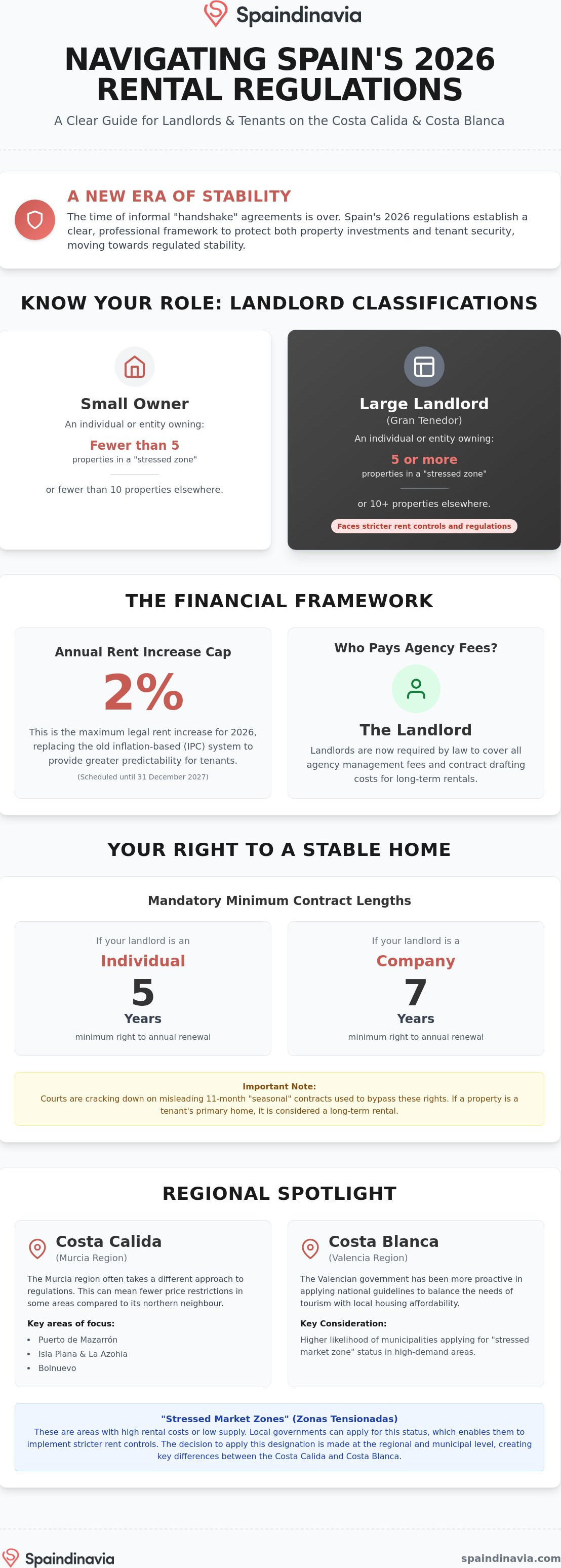
The full implementation of the 2023-2025 Housing Law (Ley de Vivienda) makes 2026 a landmark year for the Spanish property market. It's the moment when many transitional measures have become permanent fixtures of the legal landscape. The primary goal of these long term rental regulations in spain 2026 is to provide stability for residents whilst ensuring a fair environment for property owners. One of the most significant shifts involves the distinction between small owners and "Large Landlords" (Gran Tenedor). In most regions, a large landlord is defined as an entity or individual owning five or more residential properties in a "stressed zone", or ten properties elsewhere. This distinction is vital because large landlords face stricter rent controls and different negotiation requirements during contract renewals. By Understanding Rent Control and how it applies to your specific status, you can manage your investment with much greater clarity and avoid the pitfalls of non-compliance.
The Definition of a Long-Term Rental in 2026
A long-term rental, or "vivienda habitual", is specifically designed to be the tenant's primary home. This year, the Spanish authorities are looking much more closely at seasonal lets to ensure they aren't being used to circumvent the law. Many owners previously used 11-month contracts to bypass tenant rights, but courts are now regularly reclassifying these as long-term agreements if the tenant has no other residence. It's a risky strategy that can lead to unexpected legal obligations for owners of resale apartments or townhouses. Staying compliant with long term rental regulations in spain 2026 means being transparent about the property's use from the very first day. Under the 2026 rules, a habitual residence contract grants the tenant the right to annual renewals for a minimum of five years if the landlord is an individual, or seven years if the landlord is a company.
Regional Variations: Costa Blanca vs Costa Cálida
While the national framework sets the stage, your experience will vary depending on where your property is located. In the Valencian Community, which covers the popular Costa Blanca, the regional government has been proactive in interpreting these guidelines to balance tourism with local housing needs. Conversely, the Murcia Region, home to our beloved Costa Cálida, often takes a different stance on the declaration of "stressed zones" (zonas tensionadas). If you own a resale villa in Puerto de Mazarrón or a bungalow in Isla Plana, you might find fewer price restrictions than in high-demand pockets of the Costa Blanca. However, local politics in areas like Bolnuevo and La Azohia continue to evolve; this influences whether a municipality decides to apply for "stressed" status. This regional autonomy means that a new build apartment in the Murcia region might have different indexing rules compared to a similar property in the Alicante province.
Rent Caps and the New 2026 Indexing System
One of the most significant shifts you'll encounter within the long term rental regulations in spain 2026 is the move away from traditional inflation-linked rent reviews. For years, the Consumer Price Index (IPC) dictated how much more a tenant would pay each year. Today, that system has been replaced to foster a more predictable and calm environment for everyone involved. The new Rental Reference Index aims to decouple housing costs from the volatility of general consumer goods. As outlined in the Official 2026-2030 Housing Plan, this indexing system is designed to keep rent growth sustainable and fair. For the duration of 2026, all residential rent increases are capped at a maximum of 2%. This specific limit is scheduled to remain in effect until 31 December 2027, providing a sense of security for families and individuals settling into their new lives by the sea.
If you're beginning your journey and looking for investment properties that align with these updated rules, we can help you find the perfect fit in a compliant and secure way.
Calculating Annual Rent Increases
Even with a 2% cap in place, you must follow a specific legal procedure to adjust the price. You can't simply send a quick text message or make a verbal agreement. Landlords are required to provide a formal, written notification to the tenant at least one month before the contract's anniversary date. If you're a tenant in Bolnuevo or La Azohia and your landlord attempts to push for a higher increase, remember that anything above the 2% statutory limit is currently unenforceable. It's all about ensuring transparency and maintaining the warm, trusting relationship that makes the Mediterranean lifestyle so attractive.
Identifying Stressed Zones in Popular Coastal Areas
The designation of "Stressed Zones" (Zonas Tensionadas) is a key pillar of the 2026 framework. These are specific neighbourhoods or municipalities where the cost of living has become disproportionately high compared to local wages. Specifically, an area qualifies if the average mortgage or rent payment exceeds 30% of the median household income. Whilst bustling hotspots on the Costa Blanca, such as Orihuela Costa or Torrevieja, are often the first to be considered, the Costa Calida offers a different perspective. In the Mazarrón region, including Puerto de Mazarrón and Isla Plana, the application of these zones depends heavily on regional policy. If your property is in a stressed zone, the rent for new contracts cannot exceed the price set by the government's reference index. It's a vital detail to check before you list your property, as it directly impacts your potential return on investment.
Mandatory Contract Lengths and Renewal Rights
Security in a rental agreement is about more than just the monthly price; it's about knowing you have a place to call home for years to come. Under the long term rental regulations in spain 2026, the duration of a lease is heavily weighted in favour of tenant stability. If you're an individual landlord renting out a resale apartment in Puerto de Mazarrón or a townhouse in Bolnuevo, you're legally bound to a five-year mandatory minimum term. This means that even if you sign a one-year contract, the tenant has the right to renew it annually until that five-year mark is reached. For corporate owners or companies investing in new build apartments across the Costa Blanca, this mandatory period extends even further to seven years.
The Official Spanish Urban Lease Law (LAU) serves as the foundation for these protections, ensuring that the dream of living by the Mediterranean isn't cut short by unexpected contract terminations. Once the initial five or seven-year period concludes, a process known as "tacit renewal" (tácita reconducción) can take place. If neither party expresses a desire to end the agreement, the contract automatically extends for up to three additional years. This long-term framework is designed to help residents truly integrate into local communities, whether they've chosen the tranquil shores of Isla Plana or the vibrant atmosphere of the Valencia region.
The Right to Extension: What Tenants Should Know
Tenants hold significant power when it's time to talk about extensions. The 2026 rules are specifically designed to prevent "no-fault" evictions, where a tenant might be asked to leave simply because a landlord wants a higher rate from someone else. In 2026, landlords must provide a minimum of four months' notice to the tenant if they intend to terminate the contract at the end of the mandatory term or any of its extensions. Conversely, tenants only need to provide two months' notice if they decide it's time to move on to a new adventure. This imbalance is a deliberate effort to protect families and individuals from the stress of sudden relocation.
Reclaiming Property for Personal Use
There are, however, specific circumstances where a landlord can reclaim their property before the five or seven-year term ends. This is typically limited to cases where the owner needs the home for themselves, their children, or their spouse following a divorce. To exercise this right, a specific "need clause" must have been included in the original contract from the very beginning. Owners in La Azohia or other coastal spots should be aware that if they reclaim a property for personal use but don't move in within three months, they could face heavy penalties. These might include paying the tenant's moving costs or even reinstating the original rental agreement with additional compensation.
Agency Fees and Maintenance Costs: Who Pays What?
One of the most frequent points of friction between landlords and tenants involves the financial logistics of setting up a lease. Under the long term rental regulations in spain 2026, the rules are clearer than ever. A major change that is now a permanent fixture of the market is the ban on charging tenants for estate agency management fees. In years past, it was standard practice for tenants to pay a full month's rent to the agency. Now, the law dictates that the landlord, as the party requesting the professional service, must bear this cost. This applies to all residential long-term leases, whether you're renting a bungalow in the Costa Blanca or a townhouse in the Costa Calida.
Beyond the initial setup, daily life brings maintenance questions that need a calm and fair approach. Landlords are responsible for "habitability works", which include anything required to keep the home in a liveable condition. Think of structural repairs or fixing a broken boiler. Tenants, however, cover "small repairs" resulting from daily wear and tear. This often includes tasks like replacing a lightbulb or fixing a loose tap handle. Regarding IBI (property tax) and community fees, these can be passed to the tenant, but only if they're explicitly agreed upon in the written contract. If you're searching for resale apartments that meet all current legal standards, our local experts are ready to help you navigate these costs safely.
The Shift in Estate Agency Commission
This legal shift has significantly professionalised the rental market in coastal areas like Isla Plana and Bolnuevo. Agencies now focus on providing high-quality vetting and marketing services directly to the owner. It's vital to stay vigilant against illegal "admin fee" surcharges. Some actors might try to rename the agency fee to bypass the long term rental regulations in spain 2026, but the law is firm. If it's a management or contract formalisation fee, the tenant should not be the one paying it.
Utility Bills and Deposit Protection
Protecting the security deposit, or "fianza", is a legal mandate that provides peace of mind for everyone. In the Murcia region, landlords must deposit this one-month payment with the ATRM (Agencia Tributaria de la Región de Murcia). In the Valencia region, a similar regional body handles these funds. Beyond the mandatory one-month deposit, landlords can ask for a maximum of two additional months as a "garantía adicional". For utilities like water and electricity, we always recommend a full transfer of the contract into the tenant's name. This protects the landlord from liability for unpaid bills whilst giving the tenant full control over their own consumption in places like Puerto de Mazarrón or La Azohia.
Maximising Investment Potential with Spaindinavia
The updated long term rental regulations in spain 2026 might seem like a maze of red tape, but they also create a more professional and stable environment for those who know how to adapt. We believe that property ownership should be a source of joy and security, not a cause for stress. This is where professional property management becomes your greatest asset. By partnering with experts who live and breathe the local market, you ensure that every contract, rent review, and maintenance request aligns perfectly with the law. We act as your local bridge, translating complex national decrees into practical steps that protect your resale villas or new build apartments across both the Costa Blanca and the Costa Cálida.
One of the most pressing concerns for owners today is the risk of non-payment or the threat of "okupas" (squatters). Whilst the 2026 legal framework provides more tenant protections, it also demands higher standards of documentation and vetting. We mitigate these risks by implementing rigorous screening processes that simply aren't possible for an independent landlord to manage from abroad. Whether your property is a townhouse in the vibrant Valencia region or a quiet retreat in the Murcia region, having a physical presence on the ground is the best way to safeguard your assets. We understand the distinct differences between these two coastal areas, helping you choose the right location for your specific goals.
Our Comprehensive Rental Management Service
We take a hands-on approach to managing your investment, particularly in our heartland of the Mazarrón area. Our team conducts regular property inspections in Puerto de Mazarrón, Isla Plana, La Azohia, and Bolnuevo to ensure your home is being respected and maintained. We handle the coordination of all repairs, ensuring they meet the "habitability" standards required by the latest long term rental regulations in spain 2026. This level of care ensures that your investment remains compliant and attractive to high-quality tenants. To make sure you're starting on the right foot, we ensure every new acquisition aligns with our Buying Property in Spain Guide.
Strategic Investment for 2026 and Beyond
In the current regulatory climate, New Build Villas often offer the most straightforward path to high rental yields. These properties naturally meet the latest energy efficiency and habitability standards, reducing the need for costly "habitability works" that fall under the landlord's responsibility. Balancing your personal lifestyle use with a robust Spain property investment strategy requires a nuanced touch. We help you find that perfect equilibrium, ensuring you can enjoy your Mediterranean home whilst it works hard for you the rest of the year. If you're ready to explore how these laws impact your specific situation, please Contact Spaindinavia for a bespoke analysis of your property portfolio.
Embracing Your Mediterranean Future with Confidence
Success in the Spanish property market now requires a blend of local passion and legal precision. By understanding the long term rental regulations in spain 2026, you've taken the first step towards a secure and rewarding experience. Whether you're settling into a resale apartment in Puerto de Mazarrón or managing a portfolio of new build villas in the Costa Blanca, the move towards predictable rent caps and mandatory contract lengths offers a blueprint for stability. Remember that whilst the Murcia region and the Valencia region share the same sun, their local approaches to "stressed zones" and administrative procedures can differ significantly.
You don't have to manage these complexities alone. We provide the expert knowledge and comprehensive tenant vetting needed to protect your peace of mind in areas like Isla Plana, Bolnuevo, and La Azohia. If you're ready to focus on high-yield opportunities whilst we handle the legal oversight, secure your Spanish investment with our professional property management. Your dream of a stress-free life under the Spanish sun is well within reach, and we're here to ensure every step of your journey is as smooth and inspiring as the Mediterranean breeze.
Frequently Asked Questions
Can a landlord increase the rent by any amount in 2026?
No, landlords cannot increase rent by any amount they choose. Under the long term rental regulations in spain 2026, annual rent increases for all residential leases are capped at 2%. This limit remains in effect until 31 December 2027. This rule applies across both the Murcia region and the Valencia region, ensuring that residents in areas like Puerto de Mazarrón or Torrevieja have predictable housing costs regardless of whether the owner is an individual or a large corporation.
Who is responsible for paying the real estate agency fees in Spain this year?
The landlord is legally responsible for paying all real estate agency fees for long-term residential leases. It's now illegal for agents to charge tenants for management or contract formalisation fees. This change aims to lower the initial financial barrier for those moving into resale apartments or townhouses. Whether you're searching for a home in Bolnuevo or along the Costa Blanca, tenants should only expect to pay their deposit and the first month's rent upfront.
How long is a standard long-term rental contract in Spain for 2026?
A standard long-term contract grants tenants the right to stay for a minimum of five years if the landlord is an individual, or seven years if the landlord is a company. These are mandatory minimums, meaning the tenant can choose to renew annually until the term is reached. This provides essential security for families settling in coastal spots like Isla Plana or La Azohia, as the landlord can only terminate early under very specific, legally defined circumstances.
What is a "Stressed Zone" and how does it affect my rental income?
A "Stressed Zone" (Zona Tensionada) is an area where housing costs have risen significantly above local income levels. In these designated zones, rent for new contracts is strictly limited by a government reference index. Whilst high-demand centres in the Costa Blanca are often the first to be designated, the impact in the Costa Calida depends on regional government decisions. If your property is in such a zone, you cannot set the rent higher than the price dictated by the official index.
Can I evict a tenant if they stop paying rent under the new 2026 laws?
Yes, you can still initiate eviction proceedings for non-payment of rent, but the process has become more regulated to protect vulnerable residents. Large landlords owning five or more properties in stressed zones must now go through a mandatory mediation process before filing for eviction. For owners of resale villas or bungalows in the Mazarrón area, it's essential to have a professional management team to ensure all legal notices are served correctly and promptly to protect your investment.
Is it still legal to sign an 11-month "seasonal" contract for a primary home?
No, using an 11-month seasonal contract to bypass long-term protections for a primary residence is legally risky and often unenforceable. If a property is the tenant's main home, Spanish courts will almost always reclassify the agreement as a long-term lease with full 5 or 7-year rights. This "loophole" is under intense scrutiny in 2026. We recommend using the correct "vivienda habitual" contract to ensure your rental business remains compliant and secure in both the Murcia and Valencia regions.
What taxes do I need to pay on my Spanish rental income as a non-resident?
Non-resident landlords generally pay a flat tax rate on their gross rental income, but a 2025 ruling now allows non-EU residents to deduct expenses like mortgage interest and maintenance, similar to EU residents. This change significantly lowers the effective tax burden for international investors. Whether you own a new build apartment in the Costa Blanca or a townhouse in Puerto de Mazarrón, you must declare this income quarterly. We suggest consulting a local specialist to maximise your available deductions.
Do the 2026 rental regulations apply to holiday lets and Airbnbs?
No, the long term rental regulations in spain 2026 specifically target residential leases rather than short-term holiday rentals. However, holiday lets face their own strict rules, including a mandatory national Tourism Registry number and potential approval from homeowners' associations. If you own a holiday rental property in Bolnuevo or Torrevieja, you must ensure you hold the correct regional licence. Many owners are now considering long-term rentals as a more stable alternative to the seasonal holiday market.


