

What if the town hall is more than a place to submit paperwork? Navigating Spanish bureaucracy at the town hall (ayuntamiento) starts with understanding empadronamiento: registering your address with the municipality where you live. It’s a practical step when settling into life in Spain, and knowing what to expect can make the process more manageable.
It’s easy to assume the ayuntamiento only handles local forms, but its responsibilities can also include urban planning, waste and local services. Registration processes vary by municipality, so prepare for your appointment by finding out which documents to bring and how to confirm your registration afterwards.
This guide explains what empadronamiento is, how to register and confirm your details, and what to check before an appointment. You’ll also learn how the padrón fits into local administration, so you can approach each step with greater confidence as you make a home in Spain.
Key Takeaways
- Find out whether your registration needs periodic confirmation: the interval depends on your residency status.
- Check your ayuntamiento’s appointment process and document requirements before you go, as procedures vary between municipalities.
- Prepare identification and proof of address in the formats your town hall requires, and keep copies of your paperwork.
- After registering, keep your empadronamiento certificate safe and note when you may need to confirm your details or register again after moving.
- Understand how the ayuntamiento’s local responsibilities connect your address registration with municipal services and administration.
Renewal and confirmation periods for municipal registration
Use these steps to register on the padrón, keep your municipal details current and understand how registration relates to local services.
-
Registering on the municipal population register
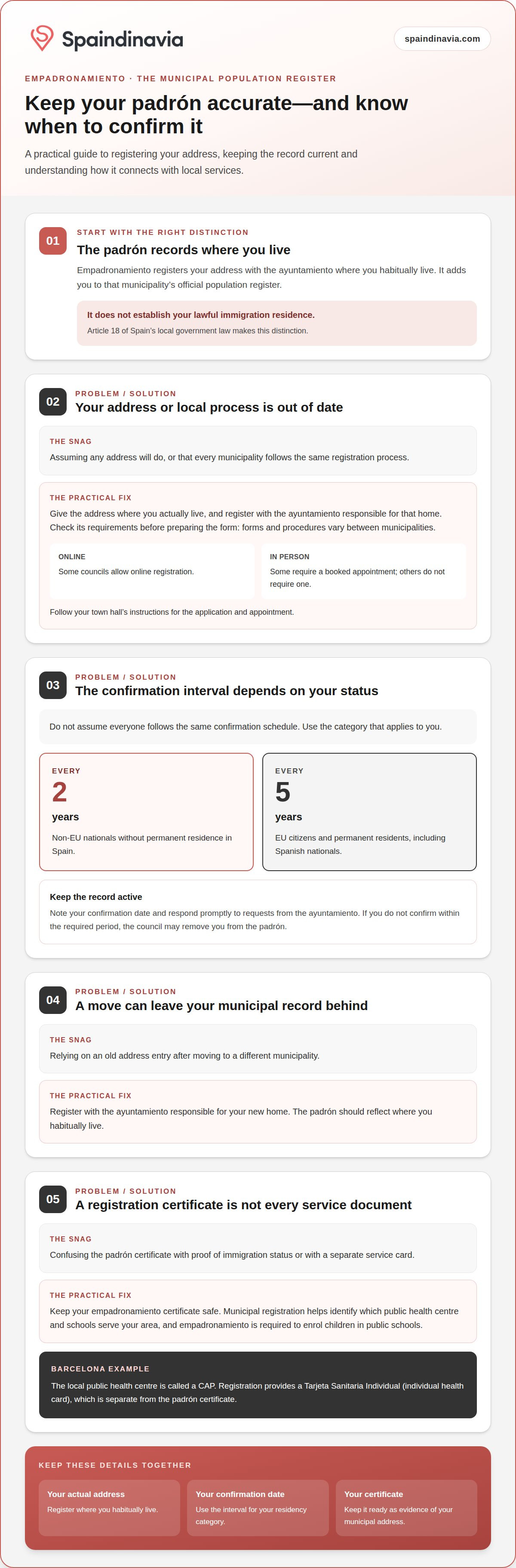
Register your address with the ayuntamiento where you habitually live. This process, called empadronamiento, adds you to that municipality’s padrón, its official population register. The register records residents; it does not establish your lawful immigration residence. Article 18 of Spain’s local government law makes that distinction. Give the address where you actually live, and update your registration after moving.
-
Arranging online registration and an appointment
Check your ayuntamiento’s registration process before preparing your paperwork. Procedures vary: forms differ, some councils allow online registration, and some do not require appointments. Others require a booked cita previa. Confirm whether you can apply online or must attend in person, and follow the town hall’s instructions for the form and appointment.
- Confirm your registration at the interval for your residency status. Non-EU nationals without permanent residence in Spain must confirm their padrón registration every 2 years. EU citizens and permanent residents, including Spanish nationals, must confirm it every 5 years. These periods are different, so use the category that applies to you rather than assuming everyone follows the same renewal schedule.
Keep track of the confirmation date and respond promptly to any request from your ayuntamiento. If you do not confirm within the required period, the council may remove you from the padrón. If you move, register with the ayuntamiento responsible for your new residence to keep the municipal record accurate.
- Use your padrón registration as part of accessing local public services. Municipal registration helps determine which public health centre and schools serve your area, and empadronamiento is required to enrol children in public schools. The padrón certificate can also support access to public and medical services. It records your address, rather than proving your immigration status.
Once registered, follow the local process for public healthcare. In Barcelona, the local public health centre is called a CAP, and registration provides a Tarjeta Sanitaria Individual, or individual health card. The health card is separate from the padrón certificate. Check the relevant local steps to understand which document applies to each service.
- Keep your certificate and registration details together, ready to show when a public service asks for evidence of your municipal address. For example, a family enrolling a child in a public school may need empadronamiento as part of the process. If you move to another municipality, register with the ayuntamiento where you now habitually live instead of relying on your former address entry.
These distinctions make navigating Spanish bureaucracy at the town hall more straightforward: the padrón records where you live, confirmation keeps that record active, and local services use it to identify the municipality responsible for your area.
Attending an appointment and receiving the certificate
Use these steps to book the right appointment, submit your application and follow its progress. Appointment procedures and certificate timing depend on the town hall.
-
Booking the correct town hall appointment
Choose the appointment option for empadronamiento or municipal registration, rather than a general residence or immigration appointment. In larger hubs such as Madrid, Barcelona, Malaga and Valencia, applicants need a cita previa and cannot simply walk into the town hall. Check the appointment details before booking to ensure your application matches the service listed.
For an appointment within Madrid, call 010. Outside Madrid, the appointment route depends on the local ayuntamiento. New cita previa slots may appear between 8:00 and 9:00, so refreshing the appointment page then can help you spot an opening. Appointments may be unavailable for weeks or months, so allow time in your plans.
-
Preparing useful Spanish appointment phrases
Write down a few phrases to explain your request and follow the next step. For example, say, “Tengo una cita para empadronarme” (“I have an appointment to register on the padrón”) and “¿Qué documentos necesito?” (“What documents do I need?”). Keep your wording simple and show your appointment confirmation if speaking feels difficult.
If a staff member asks you to wait or provide another document, try “¿Puede escribirlo, por favor?” (“Could you write it down, please?”). You can also ask “¿Cuándo estará listo el certificado?” (“When will the certificate be ready?”). These questions keep the conversation focused on your application and its documentation.
- Attend with your appointment confirmation and the documents requested for your application. At the counter, explain that you are applying for empadronamiento and give the address where you live. Before leaving, ask whether the application has been accepted and if anything else is needed. Keep any receipt or reference the office provides.
After registration, you receive a certificado de empadronamiento. In Madrid, it may be issued on the same day or take a few days or weeks, depending on the office. Ask how the certificate will be delivered or collected, especially if a government procedure requires proof of your address for a later step.
- Track your application using the reference or receipt provided, and contact the ayuntamiento through the channel you used to submit it. If the town hall rejects your application, request the reason in writing, correct the identified issue and follow the stated route for resubmission or review. To appeal a decision, follow the instructions and deadline in the written decision.
Keep the application, correspondence and any corrected documents together. A clear record helps explain what changed if the office asks about your submission. If you have not received a certificate within the timeframe given at your appointment, use your reference to ask the relevant office for an update.
Checking town hall identity and address-document requirements
Prepare identity and address evidence for the municipality where you live in Spain. Requirements can differ, so match each document to your housing situation and application.
-
Preparing identity and address documents
Check the ayuntamiento’s document list, then gather identification and proof of address. For empadronamiento in Madrid, accepted identification includes a DNI, NIE or passport. Your address evidence should match the home where you live and the details in your application. If you rent, check the contract’s dates and names before submitting it.
For a Madrid rental application, the contract must have a minimum duration of 6 months. If you rent a room, bring your rental contract, written permission from the homeowner and a copy of the homeowner’s ID. These documents help show both your address and your right to live there.
-
Bringing originals and photocopies
Bring the original documents alongside two printed photocopies of each. Under Spain’s Law 39/2015, plain copies are generally sufficient for administrative filings, although an office may ask to compare them with originals. Keep each original paired with its copy, such as your passport beside the photocopy of its identity page.
Use the formats requested by the ayuntamiento and complete any preliminary steps before applying. This helps prevent an incomplete application, such as a room renter’s rental contract without the homeowner’s written permission.
- Check whether any document has an expiry period that matters for your next official procedure. A Certificado de Empadronamiento is generally considered valid for official government applications for 90 days from the date it is printed. Check the padrón certificate requirements for your residence-card fingerprint appointment, as they may vary by procedure.
Criminal record checks are typically accepted only if they are less than 3-6 months old. If your application also needs a translated or legalised document, follow the format and preliminary requirements specified for that application. Don’t assume a document prepared for one process will meet another process’s requirements.
- Arrange your paperwork by purpose before attending: identification, address and supporting documents. For example, a room renter in Madrid can group their passport, rental contract, homeowner permission and a copy of the homeowner’s ID. This makes it easier to present the relevant evidence when the municipal office reviews the application.
Check names, address details and contract dates across the documents you submit. If an official document has an expiry date, note it alongside your appointment paperwork. A certificate printed for a later government process may need to meet the stated validity period, even if you already have an older copy.
Preparation and record-keeping for administrative processes
Identify the authority responsible for each task, then organise your records by procedure. Town hall processes differ, so follow the instructions for the municipality handling your application.
-
Preparing for online procedures with a digital certificate
Set up a digital certificate if you plan to complete administrative procedures online. It acts as a secure digital ID, allowing you to identify yourself when accessing online services. Spain’s Cl@ve system is another way to access digital public services. Keep your login details secure and note which method the relevant procedure accepts.
Save submitted forms and confirmation messages as soon as you complete an online application. For example, keep the registration form and its submission receipt together in a digital folder. If the ayuntamiento later asks for more information, you can find the original application and respond using the right reference.
-
Using a gestoría for administrative procedures
Consider a gestoría if you want help preparing or submitting administrative paperwork. This is a professional assistance cost, not a town hall registration fee: empadronamiento itself is free of charge.
Keep the gestoría’s messages, submitted forms and receipts with your own records. Ask for copies of paperwork submitted on your behalf so you can follow the application’s progress and retain evidence of the steps taken. A gestoría can help with paperwork, but the authority responsible remains the office handling the procedure.
-
Checking fees, payment methods and processing times
Separate official charges from any professional assistance fee before arranging payment. Empadronamiento in Spain is free, so no town hall payment is due for registration. If a different procedure has a fee, follow the payment instructions for that application and keep proof of payment with its paperwork.
Processing times also depend on the procedure. Where the governing rules set no maximum period, the default maximum is three months, according to the Boletín Oficial del Estado. Keep the submission date and reference number in your records. If the authority provides a timeframe, note it rather than assuming every application follows the same schedule.
- Direct each application to the authority responsible for its subject. The ayuntamiento handles local matters, while other government offices manage procedures outside municipal responsibilities. For example, use the relevant town hall for local registration and keep separate files for applications handled elsewhere. This helps prevent a municipal certificate from being confused with a different official document.
Allow for local differences in forms, online access and appointment arrangements. One municipality may accept online registration, while another requires an appointment or different paperwork. Record the ayuntamiento, procedure name, submission date and next action for each case. A paper folder and matching digital folder make documents easier to find.
The ayuntamiento's local responsibilities
The ayuntamiento manages local matters, including local tax, urban planning, water, waste, local police and social services. For municipal taxes, permits and deadlines, identify the responsible council and follow the instructions for that procedure.
- Start by matching your task to the relevant local service. An ayuntamiento handles local matters such as waste collection, water services and social services. For example, ask the municipality about local waste arrangements, while a national immigration matter belongs elsewhere.
This distinction helps foreign residents direct paperwork correctly. Keep copies of applications and notices, and retain originals when an office needs to inspect them. If a letter names a department, use that department’s details for your next step.
- Connect address registration with the local services it helps organise. The padrón helps determine which public health centre and schools serve residents. For a family, this can mean the municipality uses the registered address when allocating a local school or health centre.
Municipal registration also informs how public services are planned. Spain’s municipal register helps allocate funding for local healthcare, public transport and schools. It is an administrative record of residents, not proof of a person’s immigration status.
- Use the town hall for local tax and planning enquiries. Ayuntamientos handle local tax and urban planning, so direct questions about a local permit or municipal charge to the council responsible for the property or activity. Check the notice or application instructions for the relevant deadline and payment steps.
Keep each tax notice or permit application with its receipt and correspondence. Deadlines and paperwork depend on the procedure and municipality, so record the date stated in the document. Don’t assume a deadline for one local application also applies to another.
- Allow for differences between municipalities and regions. Spain has 17 autonomous communities, each with significant administrative autonomy, which can lead to regional differences in procedures. Town halls may also use different forms, online services and appointment arrangements for local tasks.
Before submitting a local request, identify the responsible ayuntamiento and the exact service involved. For example, a planning enquiry and a waste-service request concern different municipal functions. Organise the application reference, copies and originals under the relevant task.
- Use the local health pathway for healthcare questions rather than treating the padrón as a health card. In Barcelona, registration at a CAP, a local public health centre, provides a Tarjeta Sanitaria Individual. This example shows how municipal residence records and healthcare registration are related but remain distinct administrative steps.
If you are planning a move, explore your options for living in Spain alongside your local administrative arrangements.
Spaindinavia: Townhouses
Spaindinavia can help you explore townhouses as you plan your move to Spain. Once you understand the local registration process, choosing a home that suits your plans is a natural next step.
Consider what matters most in your day-to-day life, from the style of home to the kind of area you prefer. Alongside townhouses, explore New Build Villas, Resale Apartments and Bungalows to compare different ways of making a home in Spain.
If you’re ready to discuss your property search, contact Spaindinavia.
Take your next step towards life in Spain
A clear plan for navigating Spanish bureaucracy at the town hall (ayuntamiento) can help you feel more prepared as you settle into a new home. Your next step is to consider the kind of property and location that fit your everyday life, whether you’re planning a permanent move or a longer stay.
Spaindinavia offers New Build Villas, Resale Apartments and Townhouses, giving you different property types to consider as you shape your plans. Take time to reflect on what matters most, from your home’s layout to the local community you’d like to join.
When you’re ready to explore your property options, contact Spaindinavia. A considered next step can bring your plans for life in Spain closer.
Frequently Asked Questions
What is Empadronamiento?
Empadronamiento is the process of recording your home address with the municipality where you live. The entry is made in the padrón municipal, the council’s population register. For example, if you move to a different municipality, register your new address with its ayuntamiento. The register helps local authorities plan services, but it does not establish your immigration status or replace residence documents.
Need Help Navigating Spanish Bureaucracy?
Start by identifying which authority handles your task, then organise the relevant forms and records. If you plan to buy a home, Spaindinavia guides international buyers through the property purchase process and offers New Build Villas, Resale Apartments and Townhouses. That support relates to buying property, not submitting a padrón application. For a municipal procedure, follow the instructions of the ayuntamiento responsible for your address.
What services and procedures are handled by a Spanish ayuntamiento?
A Spanish ayuntamiento handles local matters such as municipal registration, local taxes, urban planning, water and waste services, local police and social services. For instance, direct a question about local planning to the relevant council. Other procedures, including immigration paperwork, may involve different authorities. If you are unsure where to direct an application, use the department named in the relevant municipal notice or form.
How do I find the correct town hall office for my municipality in Spain?
Use the ayuntamiento for the municipality where you habitually live. First identify the municipality for your home address, then find the department responsible for your task, such as registration or urban planning. If you have moved across a municipal boundary, your new address determines which council handles your local registration. Keep the department name and application reference with your related paperwork.
How do I book a cita previa at an ayuntamiento, and can I walk in?
Check the relevant ayuntamiento’s instructions and select the appointment type matching your procedure. Requirements vary: some councils offer online registration, while some villages do not require an appointment. Larger hubs such as Madrid, Barcelona, Malaga and Valencia require cita previa for this process, rather than walk-in attendance. In Madrid, call 010 to arrange an empadronamiento appointment within the city.
What documents and identification are typically required for town hall procedures in Spain?
Requirements depend on the procedure and municipality, so prepare the documents listed for your specific application. For empadronamiento in Madrid, identification can include a DNI, NIE or passport, alongside address evidence. Room renters should bring their rental contract, written homeowner permission and a copy of the homeowner’s ID. Carry originals and copies if requested, since an office may compare them.
How do I register on the padrón municipal, and what proof of address is accepted?
Apply to the ayuntamiento where you habitually live, using its stated registration process and address evidence. Accepted documents can depend on your housing arrangement. In Madrid, a rental contract used as proof of address must have a minimum duration of 6 months. Room renters should also provide written permission from the homeowner and a copy of the homeowner’s identification.
How can foreign residents get a certificado de empadronamiento or other municipal certificates?
First register with the ayuntamiento responsible for your home, then request the certificate through that council’s process. After padrón registration, you receive a certificado de empadronamiento. Ask the relevant office how to obtain any further municipal certificate, as the process depends on the document and municipality. Keep the certificate with your records; some official applications require a recently issued copy.


