

A smart villa earns its place through everyday convenience, not gadgetry. New-build villas with smart home technology in Spain can connect controls for lighting, temperature, blinds, household appliances and security. The key is to understand which everyday tasks the system simplifies and how its controls work.
It’s natural to want comfort and peace of mind in a home you may enjoy year-round or use as a holiday base. This guide explains how smart controls, remote appliance access and security features can work, then looks at the layouts you may encounter in Costa Blanca new builds.
The Costa Blanca is in the Valencia region, whilst the Costa Cálida is in Murcia. Each offers a distinct coastal setting; around Mazarrón, the Costa Cálida includes Puerto de Mazarrón, Isla Plana, La Azohía and Bolnuevo. As you explore the Costa Blanca, consider how the layout supports daily life, from managing light and temperature to keeping an eye on your home when you’re away.
- Compare lighting, temperature and blind controls by how they support your daily routine, not simply by how many features they offer.
- For remote appliance access, consider your routines at a Costa Blanca home in the Valencia region and a Costa Cálida home in the Murcia region.
- Use bedroom and bathroom layouts to assess whether a villa suits your household and the way you plan to use it.
- Explore how solar panels and occupancy-aware controls can contribute to a home’s energy efficiency.
- Factor additional purchase costs and taxes into your planning, and see how Spaindinavia’s new-build villa offering fits into your search.
Smart-home controls for lighting, temperature and blinds
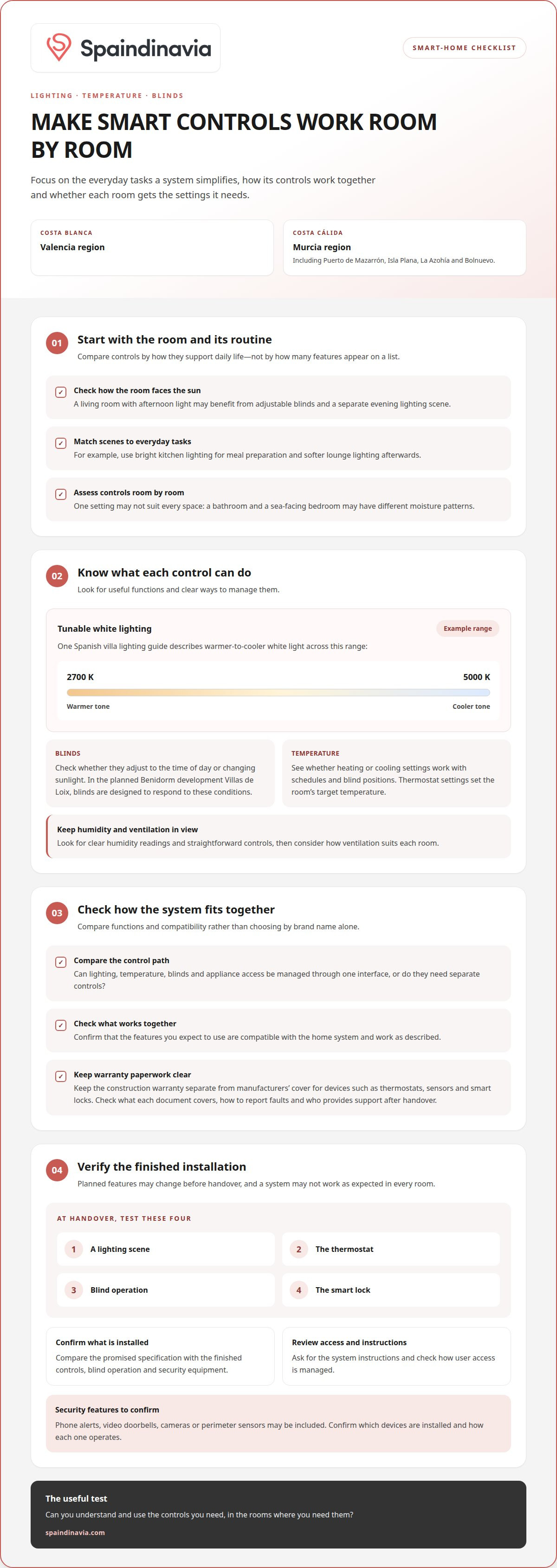
In a Costa Blanca villa in the Valencia region, smart controls can link lighting, temperature and blinds. The Costa Cálida is in Murcia, with coastal areas including Puerto de Mazarrón, Isla Plana, La Azohía and Bolnuevo. In either region, consider how rooms face the sun and how you’ll use them through the day. A living room with afternoon light may benefit from adjustable blinds and a separate lighting scene for evening.
Lighting controls can dim fittings or group them into scenes, such as bright kitchen lighting for meal preparation and softer lounge lighting afterwards. One Spanish villa lighting guide describes tunable white light from 2700-5000 K, spanning warmer and cooler tones. In a planned Benidorm development, Villas de Loix, blinds are designed to respond to time of day or changing sunlight. These examples show why it helps to assess controls room by room, rather than treating every switch as a standalone feature.
Temperature controls can connect heating or cooling settings with schedules and blind positions. Lowering the blinds during strong sunshine may reduce direct glare, while adjusting the thermostat sets the room’s target temperature. Humidity management is a separate consideration: look for clear readings and straightforward controls, then consider how ventilation suits each room. A bathroom and a bedroom facing the sea may have different moisture patterns, so one setting may not suit both.
How do systems compare by brand, features and compatibility? Compare functions and how they work together rather than choosing by brand name alone. Check whether lighting, temperature, blinds and appliance access can be managed through one interface or require separate controls.
What warranties and after-sales support are required? Keep the home’s construction warranty paperwork separate from manufacturers’ cover for devices such as thermostats, sensors and smart locks. Read what each document covers, how to report faults and who provides support after handover.
What are the risks of buying off-plan? A planned feature may change before handover, and a system may not work as expected in every room. Compare the promised specification with the finished installation, including controls, blind operation and security equipment.
How can you verify quality, security and privacy? At handover, test a lighting scene, thermostat, blind and smart lock, then check that each works as described. Ask for the system instructions and review how user access is managed. Security features may include phone alerts, video doorbells, cameras or perimeter sensors. Confirm what is installed and how each device operates.
Remote operation of household appliances
On the Costa Blanca in the Valencia region, remote appliance access can make a villa easier to manage between visits. The Costa Cálida in Murcia offers a different coastal setting, including Puerto de Mazarrón, Isla Plana, La Azohía and Bolnuevo. In either area, smart-home technology can be managed remotely through mobile devices. That ability is especially useful when you’re away from the property and want to manage connected household equipment from your phone.
Start with familiar appliances. A washing machine, dishwasher or oven may be part of a connected setup, but remote functions depend on the appliance and its connection to the home system. One device might let you view its status, while another may offer controls through its own interface. Treat “smart” as a description of how equipment communicates, not a promise that every appliance has the same features.
Home automation can bring controls together when appliances are compatible with the system. The practical question is whether you can easily access an appliance’s main function, not whether the system has the longest feature list. For example, you may want to check a connected appliance before travelling to the villa. A simple, understandable control path matters more than extra options you rarely use.
Remote access also changes how you manage everyday routines. After a journey, controlling a connected appliance through a mobile device may help you settle in sooner. When leaving, the same system can let you review connected equipment from outside the property. These examples illustrate the convenience of remote control, but they don’t mean every appliance can be started or stopped from afar.
Energy use is another useful consideration. Smart-home systems can adjust consumption according to occupancy and climate conditions. This system-level approach can complement appliance controls by responding to whether the villa is occupied. It doesn’t make every appliance more efficient by itself, so consider how household routines, connected equipment and wider controls work together.
Before choosing a layout or specification, list the appliances you expect to use most, such as kitchen and laundry equipment and climate controls. Then consider how you’d want to access each one at home and away. A clear list helps you compare the system’s everyday functions with the automation you’ll actually use. Whether you’re buying a holiday home or a year-round residence, practical controls and clear instructions can make the technology easier to live with.
Bedroom and bathroom counts
A bedroom count tells you how a villa may fit your household, but the floor plan shows how it works. A couple using a Costa Blanca home for holidays may value a guest bedroom, whilst a family may need separate sleeping spaces. Costa Blanca is in the Valencia region; Costa Cálida is in Murcia, including Puerto de Mazarrón, Isla Plana, La Azohía and Bolnuevo. Compare the coastal location and layout together.
A new-build villa in Polop is described as having 3 bedrooms. That gives a concrete example of a Costa Blanca layout, but the number alone doesn’t show whether bedrooms are beside each other, set on different floors or placed near bathrooms. Look at the plan alongside the listing details. Room position can influence privacy, noise and how easily guests or family members move around.
Bathroom count matters too, especially when a household shares the villa during holidays. Check the floor plan for bathroom locations, whether they’re convenient to reach from bedrooms, and whether guests must pass through private spaces. A bathroom near a guest room, for example, may make that room more practical for visiting relatives. Don’t infer the bathroom count from the number of bedrooms; review the property details and layout together.
Architecture shapes how the rooms feel and function. A single-storey plan may keep bedrooms and living areas on the same level, whilst a multi-level design separates spaces vertically. That difference affects stairs, daily movement and the relationship between bedrooms and outdoor areas. Consider your preferences, such as keeping a quiet bedroom away from a pool-facing terrace or placing guest accommodation near the entrance.
Room placement also matters when planning smart-home controls. A bedroom used as a home office, for example, may need convenient access to lighting and temperature controls. A guest room could benefit from simple controls visitors can use without learning an advanced system. Think about where you’ll spend time, not just how many rooms appear on the plans.
Compare each villa by matching the layout to real routines. Picture where family members sleep, where guests get ready, and how someone reaches the kitchen at night. In a Polop-style three-bedroom plan, note whether the main bedroom is separated from the other rooms. Then consider storage, circulation and access to bathrooms, which can make a practical difference during longer stays.
Before settling on a floor plan, mark the bedrooms and bathrooms on the drawing, then trace the route between them and shared spaces. For example, check whether a guest can reach a bathroom without crossing the main living area. This simple exercise helps you compare layouts across the Costa Blanca and Costa Cálida, and identify which architecture suits your household’s preferences.
What energy-efficiency and sustainability features do these villas offer?
Start by separating energy generation from energy management. Solar panels can generate electricity for a villa, whilst smart controls manage how energy is used indoors. These features do different jobs, so assess them separately. On the Costa Blanca, in the Valencia region, and the Costa Cálida, in Murcia, sunlight and local climate shape how a household uses its home. The Costa Cálida includes Puerto de Mazarrón, Isla Plana, La Azohía and Bolnuevo.
Solar panels are one part of a villa’s energy picture. Consider how generated electricity relates to everyday use, including lighting, household appliances and temperature control. The room layout and household routines influence demand. A home used mainly for holidays, for example, may have a different pattern from one occupied throughout the year. This context helps you assess whether its generation and consumption features suit your lifestyle.
Smart-home systems can adjust energy consumption according to occupancy and climate conditions. Controls may respond differently when rooms are in use than when the villa is empty. This connects automation to actual living patterns rather than treating every space identically. Check how the settings relate to the rooms you use most, such as the living area during the day and bedrooms overnight.
Climate-aware controls can also coordinate how the home operates. Temperature settings may respond to conditions, while occupancy settings reflect whether people are present. Together, these controls can help manage energy use in different situations. Their value depends on how clearly you can understand and adjust them, so consider whether they make sense for everyday living and time away.
Compare a villa’s sustainability features as a whole, not as a checklist. Solar panels address electricity generation; smart controls address consumption. A villa with both brings those functions into the same discussion, but they remain distinct. Consider which appliances and systems use electricity in your household, and how routines change between a quiet week and a full house of guests.
For a practical comparison, note the energy-related features beside each property’s floor plan and intended use. A family living year-round may prioritise different controls from owners visiting seasonally. Compare Costa Blanca options with Costa Cálida homes around Mazarrón, including Puerto de Mazarrón, Isla Plana, La Azohía and Bolnuevo. This regional comparison keeps the decision grounded in both the property’s systems and the coastal lifestyle you want.
What additional costs and taxes apply when buying a new-build villa in Spain?
Plan for the purchase price and the costs connected with completing the purchase as separate budget lines. For a new-build villa, distinguish purchase taxes from transaction-related expenses, then keep ongoing ownership costs separate. This makes comparisons clearer when you’re considering homes on the Costa Blanca, in the Valencia region, or the Costa Cálida, in Murcia. The latter includes Puerto de Mazarrón, Isla Plana, La Azohía and Bolnuevo.
Taxes depend on the property’s location and the transaction details, so don’t assume that a figure for one region applies everywhere. Compare the specific villa and its location, rather than using a general estimate from another Spanish property purchase. For example, a home on the Costa Blanca and one near Puerto de Mazarrón are in different autonomous communities. Keep their purchase figures in separate budget columns.
Record each purchase-related amount by purpose. A clear budget can distinguish the property price, purchase taxes, legal or administrative support, and financing-related expenses. Use figures supported by the documents for that transaction. This makes it easier to see what a quoted amount includes and what needs a separate line in your calculations.
Smart-home features also deserve a clear place in your comparison. Record the villa’s stated technology separately from taxes and transaction costs. For example, note whether the property description includes connected controls or remote appliance access, then keep those details distinct from the sums due during the purchase. This prevents a feature description from being mistaken for a cost breakdown.
Build a working budget in stages. First, enter the agreed property price. Next, add the taxes and purchase-related costs shown for that transaction. Keep recurring ownership expenses in another section so they don’t blur the amount needed to complete the purchase. If you’re comparing a new build with a resale villa, use the same headings for both and record the relevant figures under each property.
Location matters to your comparison, not just the villa’s layout. A Costa Blanca property belongs to the Valencia region, whilst Puerto de Mazarrón, Isla Plana, La Azohía and Bolnuevo are on the Costa Cálida in Murcia. Keep each region’s transaction figures tied to its own property documents. For a clearer shortlist, compare new-build villa options alongside your purchase budget.
Technology can be recorded separately from the amounts needed to complete the purchase, while still forming part of your villa comparison. The Villas de Loix homes in Benidorm, Spain, are planned to have flood sensors and automatic water valves that cut off the water supply when a potential malfunction is detected. When reviewing a property description, note whether such features are specified and whether they are included in the home’s stated specification.
Security is another feature to keep distinct from taxes and transaction expenses. Smart villa security systems can send alerts to a phone when they detect unusual activity and provide protection 24/7. Record the described systems alongside the property details, and check the purchase documents for what is included. This keeps technology features visible in your comparison without mixing them into the separate budget lines for taxes and purchase-related costs.
Spaindinavia: New Build Villas
Spaindinavia offers new-build villas for buyers comparing layouts, locations and features that matter in daily life. Use this guide to clarify your priorities, from room arrangements to connected home controls, and bring them into your property search. If a new build isn’t the right fit, resale villas, resale apartments, townhouses and bungalows are other property types to consider.
Whether you’re planning a permanent move or a place for holidays, a focused shortlist can help you compare homes across Spain’s coast and find a layout suited to your plans. Contact Spaindinavia to discuss your search.
Choose a home that fits the life you want
Let your next step be guided by how you want to live, not by technology alone. Choosing a new-build villa with smart-home technology in Spain means weighing the feel of a place alongside its practical details. The Costa Blanca sits in the Valencia region, whilst the Costa Cálida is in Murcia. Consider which coastal setting feels right for your plans, whether you’re moving permanently or creating a home for holidays.
Turn your preferences into a clear shortlist. Think about which rooms you’ll use most, how often you’ll be at the property and which smart features would make everyday routines easier. A focused brief can help you compare homes and keep your priorities in view as you explore.
Ready to take the next step? Explore villa options with Spaindinavia and begin shaping a search around the home and lifestyle you have in mind. Your ideal place on Spain’s Mediterranean coast could be the start of a wonderful new chapter.
Frequently Asked Questions
Where in Spain are new-build villas with smart home technology available?
They’re available in Spain, including on the Costa Blanca in the Valencia region. One planned example is Villas de Loix in Benidorm, with smart lighting and blinds designed to respond to time or sunlight. The Costa Cálida is in Murcia and offers a different coastal setting, including Puerto de Mazarrón, Isla Plana, La Azohía and Bolnuevo. Compare each property’s actual technology specification with its location and layout.
Which smart home features are typically included in new villas in Spain?
Features may include app-based controls for lighting, temperature and blinds, along with remote access to connected household appliances. Security options may include smart locks, video doorbells, cameras, perimeter sensors and phone alerts. Some homes may also have solar panels or occupancy-aware controls to manage energy use. Treat these as possible features, not a standard package: compare each villa’s specification and note which controls work together.
How do smart home systems in Spanish villas compare by brand, features, and compatibility?
Compare functions and how they work together rather than choosing by brand name alone. Check whether lighting, temperature controls, blinds and appliance access can be managed through one interface or require separate controls.
Which Spanish developers build villas with integrated smart home systems?
Villas de Loix in Benidorm is a planned development with smart lighting scenarios and blinds that respond to the time of day or changing sunlight.


