

If you’re asking what the ongoing costs of a Spanish apartment are, budget for taxes, community fees, utilities, insurance and maintenance. Non-resident owners may also pay imputed income tax on an unrented apartment, typically €150 to €400 per year.
It’s easy to focus on the purchase price, but the regular bills help shape what owning a Spanish home feels like day to day. The exact mix depends on the property, its shared facilities, local charges and how often you use it. This guide explains the main costs and how they can differ between the Costa Cálida in Murcia, including Puerto de Mazarrón, Isla Plana, La Azohía and Bolnuevo, and the Costa Blanca in Valencia. You’ll get a clearer picture of the ongoing budget, from community contributions and household bills to the tax obligations that can apply to non-residents.
Key Takeaways
- Include annual IBI in your budget, and understand how the property’s cadastral value and local rate affect the bill.
- Compare community fees alongside shared facilities, as pools and other amenities can influence the ongoing contribution.
- Estimate electricity, water and internet separately, taking your likely usage and time spent at the apartment into account.
- If you’re a non-resident with an unrented apartment, learn how imputed income tax may apply to your ownership.
- Choose home insurance with the difference between buildings and contents cover in mind.
What are the fixed costs of maintaining a property?
Apartment costs vary with location, size and shared amenities: a pool or lift can affect the budget, while local charges differ by municipality. In the Costa Cálida, compare Puerto de Mazarrón, Isla Plana, La Azohía and Bolnuevo; on the Costa Blanca in the Valencia region, the relevant municipal rates and building facilities may differ.
IBI and refuse collection
IBI is an annual local property tax, while refuse collection fees help fund waste services. Include both in your budget alongside utilities, community fees and repairs.
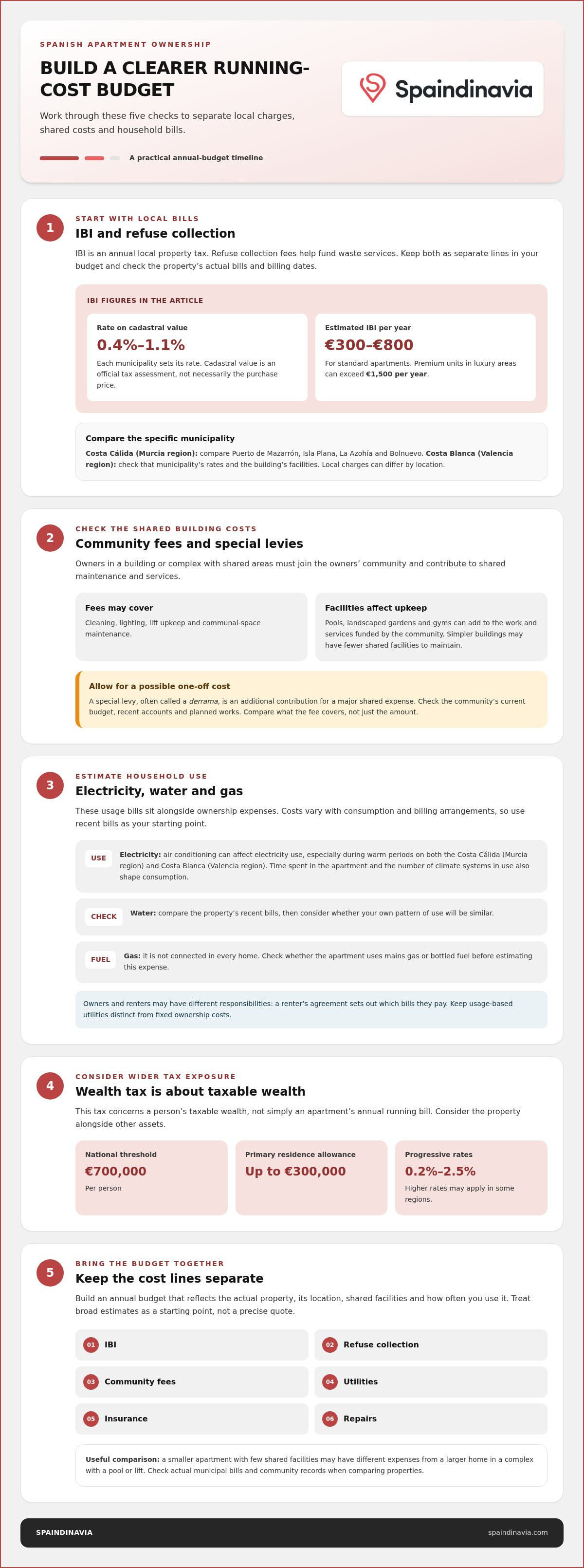
The IBI rate is generally 0.4% to 1.1% of the cadastral value, with each municipality setting its rate. This value is an official tax assessment, not necessarily the price paid when buying. Standard apartments are estimated to incur €300 to €800 in IBI per year; premium units in luxury areas can exceed €1,500 per year.
The amount and billing arrangements depend on the local authority. For a realistic annual budget, list IBI and waste charges separately, using the amounts and billing dates shown on the property’s bills. This makes it easier to account for them alongside monthly expenses.
Costs by property tier and location
Property tier helps frame likely costs: standard apartments have a different IBI estimate from premium units, while municipal charges vary by location. The estimates above give owners a starting point, not a single total for every Spanish apartment.
Any broad estimate is not an apartment-only figure or a fixed allowance for each property type. A smaller apartment with few shared facilities may have different expenses from a larger home in a complex with a pool or lift.
Municipalities set IBI rates and waste charges, so compare the specific location rather than assuming one standard bill applies everywhere. Building amenities can add costs through shared upkeep, while the apartment’s size and your use of it affect utilities and maintenance.
Wealth tax may also affect owners with substantial assets. Spain’s national threshold is €700,000 per person, excluding a primary residence allowance of up to €300,000. Rates are progressive, from 0.2% to 2.5%, with higher rates possible in some regions. This tax concerns a person’s taxable wealth, not simply an apartment’s annual running bill, so consider property alongside other assets.
Before buying, build an annual budget with separate lines for IBI, refuse collection, community fees, utilities, insurance and repairs. Compare the property’s actual municipal bills and facilities with any broad estimates. This gives you a clearer view of regular commitments without treating an estimate as a precise quote.
Are community fees compulsory in Spain?
Yes. Owners in a Spanish building or complex with shared areas must join the owners’ community and contribute to shared maintenance and services.
Fees for shared areas and services
Community fees contribute to maintaining shared parts of a building or development. The facilities you enjoy can affect your regular outgoings, separately from the apartment’s purchase price.
Fees can cover cleaning, lighting, lift upkeep and communal-space maintenance. A broad annual estimate can help frame the commitment, but compare the actual monthly fee with household utilities and other recurring bills.
A pool, landscaped gardens or a gym can add to the work and services funded by the community. Simpler buildings may have fewer shared facilities to maintain. Compare what the fee covers, not just its amount.
Fees aren’t determined by the apartment’s cadastral value or purchase price alone. Shared services and facilities also help shape the contribution. During the buying process, review the community’s current budget and recent accounts to understand what regular payments cover and whether planned works could affect future costs.
Special levies and shared amenities
A special levy, often called a derrama, is an additional contribution for a major shared expense. Owners may face this one-off bill on top of their usual community fees.
The amount each owner pays depends on how the community allocates costs. Shared amenities also require ongoing care, so a pool or lift may affect regular fees as well as the possibility of future repair contributions.
Check whether recent or planned works appear in the community’s records, and include possible shared repairs in your ownership budget. A low monthly fee does not account for every future expense if the building needs substantial work.
Gas and communications are separate from community fees unless a service is arranged collectively. Find out which services are included in the community contribution and which are billed directly to you.
As you compare buildings, consider how shared facilities fit your budget and lifestyle. Explore apartment options with those ongoing commitments in mind.
What are the monthly utility costs in Spain?
Owners pay these usage bills alongside ownership expenses. Renters’ responsibilities depend on the tenancy agreement.
Bills for electricity, water and gas
Electricity, water and gas bills cover household energy and water use. Consumption can make a noticeable difference to your monthly budget, and costs vary with use and billing arrangements.
Air conditioning can affect electricity use, especially during warm periods on the Costa Cálida and Costa Blanca. Time spent in the apartment and the number of climate systems in use also shape consumption. Compare recent bills for the property, then consider whether your own pattern of use will be similar.
Gas is not connected in every home. Check whether the apartment uses mains gas or bottled fuel before estimating this expense.
Owners may have costs that renters do not pay directly, including property tax, community fees, insurance and responsibility for repairs. A renter’s agreement sets out which bills they pay. In either case, distinguish usage-based utilities from fixed ownership costs when comparing monthly outgoings.
Internet and television costs
Internet and television are communications services, often billed monthly as a package. This recurring expense matters whether your home in Spain is a permanent residence or a holiday property.
For a practical budget, list electricity, water, gas and communications separately. Compare each amount with the apartment’s bills and your expected use. This shows which expenses depend on consumption and which may continue when you spend less time at home.
For an apartment in Puerto de Mazarrón, Isla Plana, La Azohía or Bolnuevo, consider seasonal occupancy when estimating usage. Apply the same approach on the Costa Blanca in the Valencia region. Local utility bills depend on the property and consumption, so compare the actual services and usage rather than assuming both coastal regions have identical totals.
A home used for only part of the year may still have recurring service charges, while consumption changes with occupancy. Review billing periods and standing charges alongside usage. Keeping the figures separate helps you see what may continue during an unoccupied month and plan household expenses more clearly.
Non-resident imputed income tax
Non-resident owners may owe Spanish income tax even when their apartment earns no rent. For an unrented second home, Spain calculates imputed income using the property’s cadastral value, then applies the relevant non-resident tax rate. This is separate from IBI, community fees and household bills.
If the cadastral value was revised since 1994, imputed income is generally calculated as 1.1% of that value. Otherwise, the general calculation uses 2%. The resulting imputed amount is not the apartment’s purchase price or rent: it is a notional income figure used for tax purposes.
For imputed rental income, the stated tax rate is 19% for EU and EEA residents, and 24% for owners from outside those countries. Non-resident owners of an unrented Spanish apartment typically pay €150 to €400 per year in imputed income tax. The amount depends on the cadastral value and applicable calculation.
Actual rental income is treated differently from notional income on an empty property. The stated rate is 19% of net rental earnings for EU residents and 24% of gross earnings for residents of the rest of the world. Net earnings means rental income after allowable costs; the basis used therefore matters when estimating tax.
Non-residents who rent out Spanish property must submit quarterly returns declaring rental income received and allowable costs. Keep rental records and expense documents organised by quarter, so income and claimed costs can be accounted for clearly. This applies whether the apartment is in Puerto de Mazarrón on the Costa Cálida or on the Costa Blanca in the Valencia region.
Short-term holiday letting can bring another consideration: tourist licences are required in many regions of Spain. Short-term holiday letting may involve additional licensing considerations, and requirements can vary by region. Requirements can vary by region, so the Costa Cálida and Costa Blanca should not be treated as one licensing area.
Separate the tax scenarios in your budget: an unrented second home may involve imputed income tax, while a rented apartment brings tax on actual rental income and quarterly reporting. The property’s cadastral value affects imputed-income calculations; rental income and allowable expenses shape the rental-tax calculation. Air-conditioning use may affect household bills, but it does not change these income-tax categories.
Residency status also matters. Non-residents are generally considered non-resident for Spanish tax purposes if they spend fewer than 183 days a year in Spain. If you plan to rent your apartment, include reporting and licensing considerations alongside the expected rental income when assessing the ongoing costs.
Home insurance
Home insurance is a recurring ownership expense, and the premium depends on the cover you choose. Treat any estimates as budgeting guidance, not a standard premium.
Buildings-only insurance is designed to cover the apartment itself rather than your belongings. Review what the policy covers and the insured amount, then compare it with any cover already arranged for the building’s shared areas.
Contents insurance covers belongings inside the apartment, such as furniture and personal possessions. It may suit an owner furnishing a second home, but the appropriate cover depends on what you keep there and the protection set out in the policy.
For a broader apartment estimate, property insurance is also put at €150 to €300 per year. That range differs from estimates for contents-inclusive cover because policies and levels of protection vary. Compare the cover, exclusions and insured contents, rather than choosing solely by the annual premium. Keep the policy cost separate from community fees and maintenance in your budget.
Location is another point to consider when planning for owning an apartment. The Costa Cálida is in the Murcia region, including Puerto de Mazarrón, Isla Plana, La Azohía and Bolnuevo. The Costa Blanca is in the Valencia region. These are distinct locations, so compare insurance for the particular property and its cover instead of assuming one coastal estimate applies everywhere.
Insurance and maintenance serve different purposes in your annual plan. A policy sets out what it covers, while routine upkeep and repairs remain separate expenses. List the premium apart from planned maintenance, then consider whether the policy suits an apartment used seasonally or year-round. This helps you understand the regular insurance cost without treating it as a repair fund.
As you compare apartments, include the likely insurance level in your ownership budget alongside the property’s other recurring charges. Explore apartments to compare with your intended use and ongoing costs in mind.
Spaindinavia: New Build Villas
Once you understand the ongoing costs of ownership, Spaindinavia can help you compare property options. If you’re considering an apartment, explore Resale Apartments alongside New Build Villas, Townhouses and Bungalows, and weigh each property type against your budget and plans.
Location matters too. On the Costa Cálida in the Murcia region, focus on Puerto de Mazarrón, Isla Plana, La Azohía and Bolnuevo. The Costa Blanca is in the Valencia region, with its own locations and property choices. Spaindinavia supports buyers through the buying process, helping you consider the practical costs as part of choosing a home.
To explore homes on either coast, contact Spaindinavia or visit spaindinavia.com.
Shape your next step around the life you want
Before deciding, consider how the ongoing costs of a Spanish apartment fit the way you plan to use your home. A property for long stays, occasional holidays or rental income may call for different priorities. Decide what matters most, then compare properties by location, layout and shared facilities.
Your plans may also evolve. Leave room in your thinking for both the practical commitments of ownership and the lifestyle you hope to enjoy. On the Costa Cálida, explore the coastal communities around Puerto de Mazarrón, Isla Plana, La Azohía and Bolnuevo; the Costa Blanca offers a different setting in the Valencia region. Your own budget will depend on the apartment and how you use it, so consider the full picture before choosing.
If you’re ready to discuss your next move, contact Spaindinavia about Spanish property. Take the next step at a pace that feels right, with a clearer sense of the home and lifestyle you’re looking for.
Frequently Asked Questions
Do non-residents pay tax on property in Spain?
Yes, non-resident owners may have Spanish tax obligations even if they keep an apartment for personal use. Renting the property can create separate tax and reporting responsibilities. Keep ownership and rental records organised, and distinguish a privately used home from one that earns income. Your residency status and how you use the property help determine which obligations apply.
Are there additional charges for an apartment in Spain?
Yes. Beyond household bills, ownership can bring local charges, shared-building contributions and upkeep costs. Buying also involves one-off transaction expenses, separate from ongoing ownership costs. To understand the ongoing costs of a Spanish apartment, organise your budget by payment type and frequency. This shows which expenses recur and which may arise only when a particular service or repair is needed.
Do I have to pay community fees if I do not use the swimming pool?
Yes. If the apartment is in a building or complex with shared areas, owners contribute to the owners’ community whether or not they personally use every amenity. The contribution supports shared responsibilities; it is not charged only to residents who use a pool. Before choosing a home, review the community information to understand which facilities and services are shared and how common areas are managed.
How much are monthly bills for a house in Spain?
There isn’t one monthly total that fits every apartment. Household use, property size and time spent at home all influence bills. For a practical estimate, review recent invoices for the specific property and note each billing period. If you plan seasonal stays, compare bills from occupied and quieter periods to build a budget that reflects your use.
How much does it cost to own a home in Spain each year?
The annual total depends on the property and your pattern of use. Convert regular monthly payments into annual amounts, then add bills paid less frequently. Keep occasional maintenance separate from predictable charges so an unusually costly repair does not distort your view of routine spending. Estimating the ongoing costs of a Spanish apartment is clearer when you group expenses by timing.
So, what expenses do I have to face each year?
Expect recurring property obligations and household spending, with upkeep adding occasional variable costs. The combination changes if you rent out the home or leave it unoccupied for part of the year. Keep a separate record for each expense type and update it as bills arrive. This makes it easier to compare expected costs with actual spending over the year.
Summary: how much does it cost to maintain an apartment in Spain in 2025?
There isn’t one maintenance total for every Spanish apartment in 2025. The amount depends on the home’s condition, its shared facilities and the upkeep it needs. For a realistic plan, review the property’s maintenance history and note any work already completed or anticipated. Keep routine care separate from larger repairs, so you can assess the ordinary running budget without overlooking less frequent work.
What are typical monthly utility costs for an apartment in Spain?
Costs depend on the services connected, household consumption and how often the apartment is occupied. To create your own estimate, review recent bills and note standing charges separately from usage. Adjust for your expected time at home, including seasonal stays. This gives you a more useful monthly picture than relying on figures from a household with different habits or circumstances.


