

The best Spanish coastal towns for UK digital nomads and remote workers from across Northern Europe depend on the balance you want between productive workdays, everyday costs and life by the sea. The Costa Cálida in Murcia and the Costa Blanca in the Valencia region each bring a different coastal setting and pace of life.
It’s easy to see the appeal of swapping grey mornings for sunshine and a view of the Mediterranean, whether you’re coming from the UK, Sweden, Norway, Poland, Germany, the Netherlands, Belgium or France. But a beautiful setting is only part of the decision: your internet connection, workspace, accommodation and access to everyday essentials can shape how well a place suits your working routine.
This guide compares coastal cities and towns by work options, connectivity, accommodation and lifestyle, helping you narrow your choices. It also highlights practical trade-offs between busy hubs and smaller communities, including the appeal of the Mazarrón area, so you can decide which Spanish coast suits you.
Key Takeaways
- Compare Barcelona and Málaga’s urban work scenes with island and smaller-town options to find the right balance between professional connections and a quieter coastal routine.
- Weigh the Costa Cálida in the Murcia region against the Costa Blanca in the Valencia region, including Puerto de Mazarrón, Isla Plana, La Azohía and Bolnuevo.
- Prioritise a suitable workspace and dependable internet for your day-to-day work; smaller coastal towns may have fewer fibre and coworking options than cities.
- Factor in practical access as well as scenery: Alicante has international airport connections, and Mallorca has direct flights from the UK and Europe.
1. Barcelona's international tech and coworking scene
Barcelona combines a coastal setting with an international tech and coworking scene, making it an urban option for remote workers. Spanish cities commonly have fibre internet and coworking spaces, but your choice should still match how you work. A dedicated desk can suit regular video calls, while a shared table may fit a more flexible routine.
Match the workspace to your working day. If calls are central to your job, look for a coworking space with private meeting rooms, quiet areas and a clear booking system. If you mainly need a desk between appointments, check access arrangements and whether drop-in use is available. Before choosing a neighbourhood, map the route between your accommodation, workspace and regular errands.
Work-friendly cafés can add variety, but they’re better as occasional work settings than as your only office. Choose a Barcelona café where the seating, noise level and table space suit your task: a short email session is different from a day of calls. Buy something, keep your setup compact and avoid occupying a busy table for too long. Use a coworking space when privacy or a steady routine matters.
Healthcare access and insurance for UK residents depend on whether you’re visiting or moving to Spain and on your residence circumstances. Establish which healthcare route applies to your situation and arrange suitable cover before relying on access to treatment.
Barcelona is a large city, so consider everyday safety when choosing where to work and live. Keep your laptop and phone close in cafés and shared workspaces, secure your belongings in busy public areas, and plan your journey home after late work sessions. These habits help protect your equipment and make your routine easier to manage.
Before comparing Barcelona with smaller coastal places, write down your non-negotiables: workspace access, a quiet place for calls, proximity to daily essentials and the atmosphere you want after work. Test the routine on an ordinary weekday, not just during a visit focused on beaches or sightseeing. Barcelona may suit you if you value an urban work scene by the coast; if you prefer a slower pace, compare smaller coastal options.
2. Coastal city and island options for remote workers
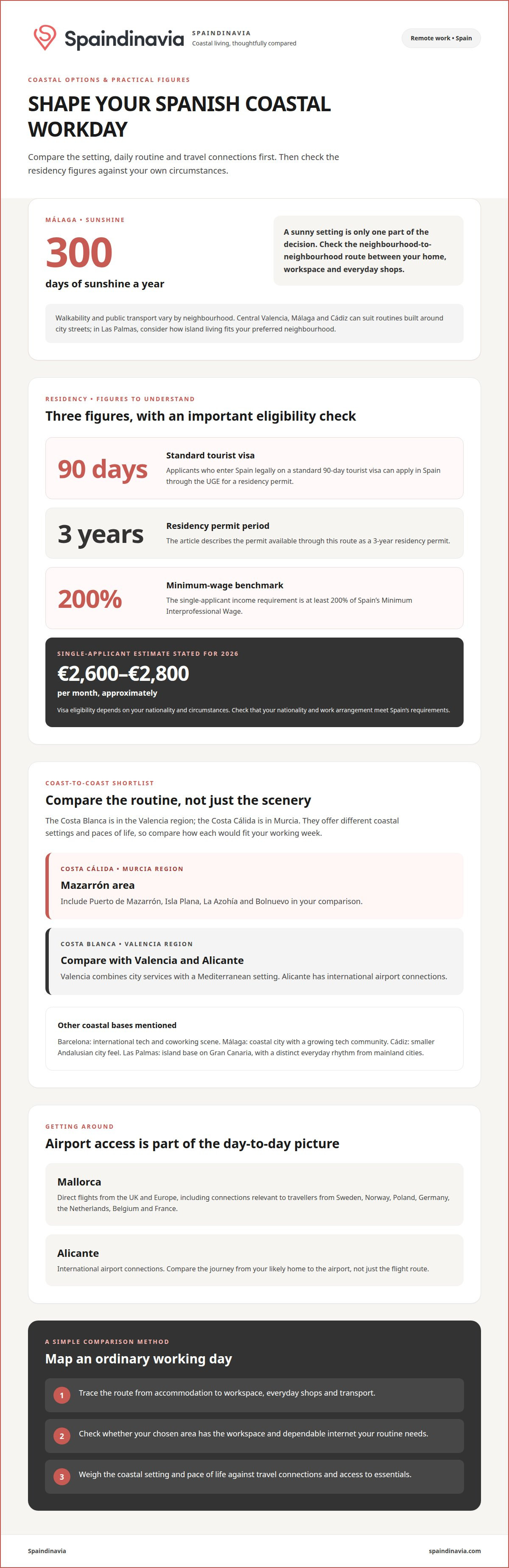
The best Spanish coastal towns for UK digital nomads and other Northern European remote workers depend on the workday and lifestyle you want. Valencia combines city services with a Mediterranean setting; Málaga pairs coastal life with a growing tech community. Alicante has international airport connections, while Cádiz offers a smaller Andalusian city feel. Las Palmas gives you an island base on Gran Canaria, with a distinct everyday rhythm from mainland cities.
For a year-round sunny setting, Málaga receives 300 days of sunshine a year. Walkability and public transport vary by neighbourhood, so map the route between your accommodation, workspace and everyday shops. Central Valencia, Málaga and Cádiz suit routines built around city streets. In Las Palmas, consider how island living and your preferred neighbourhood fit together.
Travel connections matter if you expect regular work trips or visits home. Mallorca has direct flights from the UK and Europe, including connections relevant to travellers from Sweden, Norway, Poland, Germany, the Netherlands, Belgium and France. Alicante’s airport also has international connections. Compare the journey from your likely home to the airport, not just the flight route.
Spanish-language immersion is possible across a dozen Spanish-speaking destinations, including coastal choices such as Cádiz, Málaga and Alicante. Practise through errands, local events and conversations with neighbours. Barcelona offers a different linguistic setting, with Catalan heard alongside Spanish. If Spanish practice matters to you, consider how your daily routine will bring you into Spanish-speaking settings.
Visa requirements depend on your nationality. Visa eligibility depends on your circumstances, so check that your nationality and work arrangement meet Spain’s requirements. Applicants who enter Spain legally on a standard 90-day tourist visa can apply in Spain through the UGE for a 3-year residency permit. The single-applicant income requirement is at least 200% of the Spanish Minimum Interprofessional Wage, estimated at roughly €2,600-€2,800 per month in 2026.
Plan tax and social security as separate parts of your move. Spain’s personal income tax covers a taxpayer’s income regardless of where it was earned or where the payer is resident, according to the Boletín Oficial del Estado. Your employment arrangement and residence position shape the tax picture, so identify whether you’ll work as an employee or independently when planning.
Use this comparison to identify the best Spanish coastal towns for UK digital nomads and other Northern European remote workers, then narrow your shortlist. Compare two cities and an island destination by mapping a typical workday, from home and workspace to groceries and transport. Weigh those routines against the Costa Blanca in the Valencia region and the Costa Cálida in Murcia, including Puerto de Mazarrón, Isla Plana, La Azohía and Bolnuevo.
3. Cost of living and accommodation trade-offs
Your monthly budget depends less on the coastline than on the home and routine you choose. In Valencia, list accommodation, groceries, local transport, utilities and workspace separately. Then compare that city routine with smaller coastal places, where transport needs and access to everyday services may differ.
Accommodation is usually the decision that shapes the rest of your budget. A central flat can make errands and coworking easier, while a home farther from the centre may offer more room or a quieter setting. Compare the full routine, including commuting, internet access and the time needed to reach shops, rather than judging a property by its setting alone.
On the Costa Cálida, compare Puerto de Mazarrón, Isla Plana, La Azohía and Bolnuevo. These smaller coastal locations offer a different pace from the Costa Blanca’s urban centres. Consider whether you need to travel regularly for work, appointments or shopping. A lower accommodation cost does not necessarily mean lower overall spending if your routine involves frequent journeys.
The best neighbourhood for a long-term rental is one that fits your actual workday. In Valencia or Alicante, consider the route to your workspace, public transport and daily essentials. Around Mazarrón, compare each home’s location with the services you use regularly. Shortlist areas, then view properties and check practical details such as workspace, internet access, utilities and rental terms.
Compare properties on a like-for-like basis. For each one, note what is included, how much space it offers, the kitchen’s condition and whether you can work comfortably at home. A furnished flat can simplify setting up, while an unfurnished place may suit a longer stay with different needs. Keep a written list to weigh your options consistently.
The season can also affect your accommodation decision. A busy seaside location may feel different during a quieter period, so consider what you need beyond beach access. In Puerto de Mazarrón, assess your route to shops and services as well as the waterfront. In Valencia, compare a central address with a residential area that better suits focused work.
Before committing, build a monthly plan around your own habits. Separate fixed housing and utility costs from flexible spending, such as meals out, coworking and weekend travel. Then consider whether your preferred location supports both work and leisure without relying on assumptions. Comparing the Costa Cálida with the Costa Blanca this way helps you choose a home that fits your budget and priorities.
4. Málaga's coastal lifestyle and growing tech community
Málaga combines a Mediterranean coastline, an established city centre and a tech community. It can suit remote workers who want professional connections as well as time outdoors. Plan focused work around your schedule, then explore neighbourhood cafés, local markets and the seafront after logging off.
The pace varies by area. Centro puts you near historic streets, shops and cultural venues, while Soho offers an urban setting close to the centre. Pedregalejo and El Palo feel more residential and coastal, with promenades and places to eat. Walk through your shortlisted neighbourhood during working hours and again in the evening to compare its everyday rhythm.
Málaga’s tech community gives remote workers a reason to look beyond its holiday appeal. Coworking spaces provide a shared professional setting, while local events can help you meet people working in technology and other fields. Choose your base to match your working pattern: regular collaboration favours access to shared spaces, while independent work places more emphasis on a comfortable home setup.
Picture a realistic weekday before choosing a neighbourhood. Map the route from your accommodation to a workspace, supermarket and the waterfront. A home near Pedregalejo, for example, can make an evening coastal walk part of your routine, while a central address places cultural venues and city services closer. Focus on the places you’ll use regularly, not a holiday itinerary.
Málaga offers a relaxed lifestyle, but a comfortable routine still needs structure. Set clear work hours, choose a regular place for focused tasks and make time for proper breaks. The outdoor setting makes it easy to plan a walk along the seafront or a meal in El Palo after work, rather than letting the laptop define every day.
Think about how Málaga differs from other Spanish coastal settings. It has the pace and facilities of a city; smaller places on the Costa Cálida in Murcia, including Puerto de Mazarrón, Isla Plana, La Azohía and Bolnuevo, offer a quieter coastal feel. The Costa Blanca in the Valencia region brings another mix of urban and seaside living. Compare daily errands and work routines, not just beach photographs.
Before settling in Málaga, test your preferred area during an ordinary workday. Spend time in the neighbourhood, try the journey to your chosen workspace and note where you’d shop or take a break. This helps reveal whether Centro, Soho, Pedregalejo or El Palo suits your working hours and preferred pace beyond the first impression.
5. Internet connectivity
Reliable internet can shape your choice as much as the coastline. Spanish cities commonly have fibre internet and coworking spaces, while smaller towns may have fewer options. That distinction matters if your work depends on video calls, shared files or long periods online. Compare connectivity alongside the setting instead of assuming every coastal address offers the same working conditions.
In cities such as Barcelona, Valencia and Málaga, fibre internet and coworking spaces are common parts of the working landscape. You can choose between working from home and using a shared workspace. In smaller places, including Puerto de Mazarrón, Isla Plana, La Azohía and Bolnuevo, the choice of home may matter more. The Costa Cálida has a quieter coastal character, while the Costa Blanca offers a different mix of coastal towns and urban centres.
Think through your actual working day before choosing a property. A role with frequent video calls calls for a quiet place and dependable connection at home or nearby. If you mainly send messages and work with documents, you may have more flexibility. List your essential tasks, then compare each location and workspace against them.
Coworking can provide a practical alternative to working from your accommodation. Consider whether a space has a suitable desk setup, areas for focused work and rooms for private calls. A café in Alicante or Málaga might work for a short email session, but may not suit confidential conversations or a full day of meetings.
In smaller coastal locations, plan a backup routine before you need one. Identify a suitable workspace in a nearby town and decide which tasks you can complete offline if your connection is interrupted. Keep important documents available on your device, and schedule call-heavy work in a setting that supports privacy and concentration.
Internet quality can vary between addresses in the same town. When comparing homes, consider the workspace, where the router can go and whether the layout allows for a quiet desk away from household activity. A terrace in Bolnuevo may be ideal for breaks, while an indoor workspace may be more practical for calls and focused tasks.
Include connectivity in your location shortlist. For each place, note whether you expect to work at home, use coworking or combine both. Then compare city infrastructure in Valencia or Málaga with the more relaxed setting of Puerto de Mazarrón or Isla Plana. This helps you match your work needs to the lifestyle you want, whether you’re moving from the UK or elsewhere in Northern Europe.
Start planning your coastal move with your work routine, preferred setting and day-to-day needs in mind.
Spaindinavia: New Build Villas
Once you’ve chosen a coastal area and are considering a longer-term base, Spaindinavia can help you explore property options. A New Build Villa may suit you if you want a dedicated home workspace, while a Resale Apartment, Townhouse or Bungalow offers a different property type to consider. Think about your working routine, preferred location and space needs before narrowing your shortlist.
Whether you’re weighing the Costa Cálida in Murcia against the Costa Blanca in the Valencia region, the right home depends on how you want to live beyond work. Spaindinavia’s property options give you a place to begin that comparison. Contact Spaindinavia to discuss your plans.
Turn your coastal shortlist into a practical plan
Choosing among the best Spanish coastal towns for UK digital nomads is only the first decision. Picture an ordinary month there, including the space you need to work, the community you want nearby and how you’d spend time away from your desk. Consider what would make the move sustainable, not just appealing during a holiday.
If a coastal move is becoming a longer-term plan, decide whether you want a newly built home or an established property. Spaindinavia offers New Build Villas, Resale Apartments and Townhouses, giving you distinct property types to consider. Start with the location and how you expect to use your home, then explore the option that suits your priorities.
Take the next step at a pace that feels right for you. Contact Spaindinavia to plan your move and explore a coastal future that brings your work and lifestyle together. A thoughtful plan can help turn the idea of living by the sea into a confident next chapter.
Frequently Asked Questions
Which Spanish coastal towns are best for UK digital nomads?
Barcelona, Valencia and Málaga suit remote workers from the UK and across Northern Europe who want urban work scenes, while Alicante offers international connections. Cádiz and Las Palmas provide different city-and-coast routines. For a quieter base, compare Puerto de Mazarrón, Isla Plana, La Azohía and Bolnuevo on the Costa Cálida in Murcia with Costa Blanca options in the Valencia region. Choose according to your workspace needs, everyday transport and preferred pace.
What are typical monthly rents for long-term apartments in popular Spanish coastal towns?
Long-term rent depends on the neighbourhood, property size, furnishing and lease arrangement, so one figure won’t represent every coastal town. Compare apartments with similar bedroom numbers and access to work, shops and transport. Separate rent from utilities and any shared-building charges when planning your monthly budget. This like-for-like approach makes options in Valencia, Málaga and smaller coastal communities easier to compare.
What are average monthly living costs, including utilities, food, and transport?
Treat this as a city-specific reference, not a fixed allowance for every destination. List rent, utilities, food and transport separately, then adapt your budget to your accommodation and daily travel. A smaller town may change your transport and workspace needs, while a city routine brings different housing and mobility trade-offs.
How reliable and fast is home broadband and mobile internet in each town?
Spanish cities commonly have fibre internet and coworking spaces, while smaller towns may offer fewer options. Broadband access can vary between addresses, so no single speed describes every town or home. Consider whether your work involves video calls, large file transfers or mainly email. Then choose a home workspace or coworking arrangement that suits those tasks, especially if calls require a quiet, private setting.
Which coastal towns have the best year-round climate, walkability, and public transport?
Málaga is described as receiving 300 days of sunshine a year. Central Valencia, Málaga and Cádiz suit routines built around city streets, but walkability and public transport vary by neighbourhood.


