

Did you know that as a British owner, you could be paying nearly 50% more in tax than your EU neighbours for the exact same Mediterranean view? Since Brexit, many owners across the Costa Calida and Costa Blanca have felt a genuine sense of unease regarding the 24% gross tax rate. It's perfectly natural to feel overwhelmed by the complexities of tax on rental income in spain for non-residents, especially when the fear of Hacienda fines might cloud the dream of owning a home in the sun.
We believe your investment in Puerto de Mazarrón or Isla Plana should be a source of freedom, not a source of stress. This 2026 guide is designed to help you master these tax obligations and discover how to keep your property venture profitable. We'll provide a clear preview of the annual filing process and the latest on deductible expenses, whilst highlighting the specific charms of La Azohia and Bolnuevo. Whether you're nestled in the Murcia region or the Valencia region, we're here to ensure your journey is smooth, secure, and entirely transparent.
Key Takeaways
- Clarify your residency status under the 183-day rule to ensure you're following the correct tax pathway for your property in the Murcia or Valencia regions.
- Discover how the latest 2026 regulations allow British owners to claim specific deductions and significantly reduce the tax on rental income in spain for non-residents.
- Master the schedule for quarterly filings to avoid Hacienda fines and learn how to handle the "imputed tax" on your home whilst it's not being rented.
- Explore how professional management in Puerto de Mazarrón, Isla Plana, and Bolnuevo can protect your profit margins and simplify your paperwork.
- Compare the investment potential between the Costa Calida and Costa Blanca to ensure your villa or apartment remains a high-yielding asset.
Understanding Non-Resident Income Tax (IRNR) in Spain
When you purchase a resale apartment in Puerto de Mazarrón or a new build villa on the Costa Blanca, you enter a new relationship with the Spanish tax office, known as Hacienda. The primary tax you'll encounter is the Impuesto sobre la Renta de no Residentes (IRNR). This is essentially a tax on any wealth or income generated within Spanish borders by those who live abroad. In 2026, Hacienda has become significantly more vigilant. They now use advanced digital cross-referencing with booking platforms to ensure every night stayed is accounted for. Understanding Non-Resident Income Tax (IRNR) in Spain is the first step to ensuring your investment in the sun remains a joy rather than a burden.
The IRNR is unique because it's a dual-purpose tax. It doesn't just apply when money is flowing into your bank account from holidaymakers. It also applies when your property is sitting empty, waiting for your next visit. We find that many owners in the Murcia region are surprised by this "empty property" tax, but once you understand the logic, it becomes a simple part of your annual financial planning. Whether you own a townhouse in Valencia or a bungalow in Bolnuevo, staying ahead of these requirements is the key to a stress-free lifestyle.
Who is Classified as a Non-Resident?
The Two Types of Property Tax Obligations
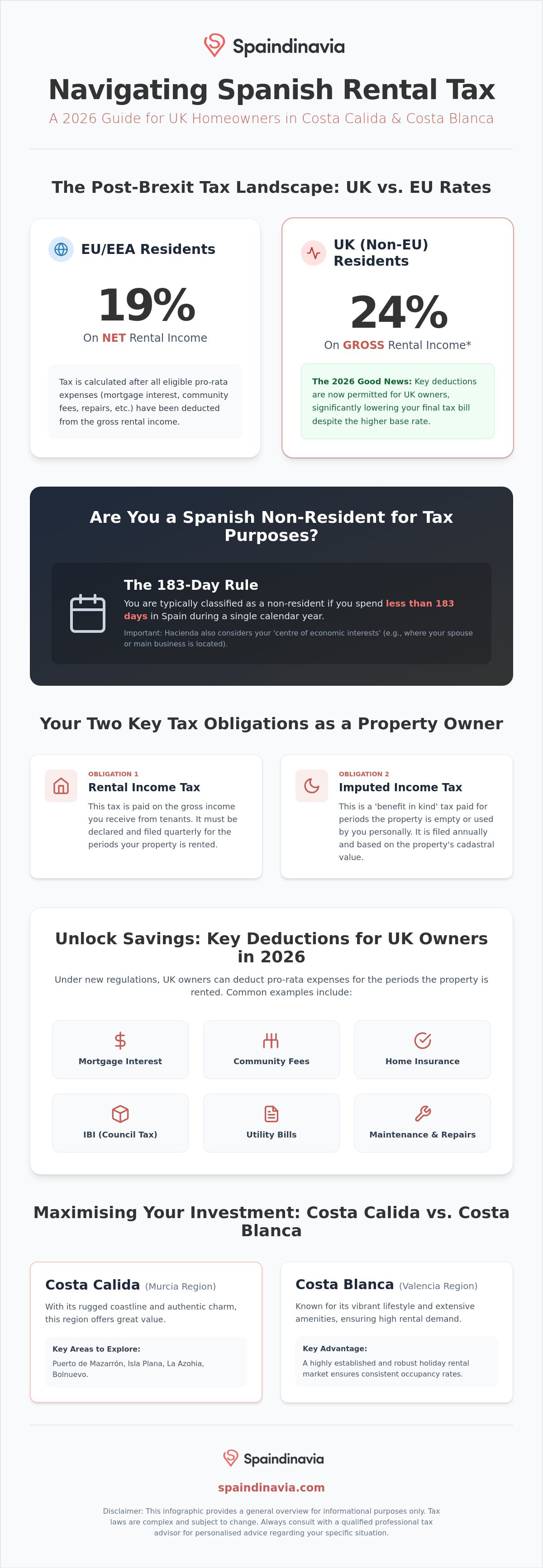
Owning a holiday rental property in Isla Plana or La Azohia comes with two distinct tax responsibilities. First, there's the tax on rental income in spain for non-residents. This is paid on the money you actually receive from guests during the periods the property is let. Secondly, there's the imputed income tax. This is a "benefit in kind" tax paid on unrented properties. The Spanish government assumes you derive a benefit from owning a second home, even if it's for your own personal use.
Whether you're enjoying the rugged beauty of the Costa Calida or the vibrant lifestyle of the Costa Blanca, you'll need to file for both. The imputed tax is calculated based on the property’s cadastral value, which is the official valuation found on your local IBI receipt. Whilst it might feel like a trap, it's a standard part of the process that we can help you manage easily, ensuring your investment in Puerto de Mazarrón remains a profitable and peaceful retreat.
Calculating Tax Rates: EU vs Non-EU (UK) Residents
The amount you contribute to the Spanish treasury depends heavily on where you call home. If you're a resident of the European Union, Iceland, or Norway, you'll benefit from a 19% tax rate on your net rental income. For those of us from the UK, the post-Brexit landscape has shifted our status to "Third Country" residents. This means the headline rate for tax on rental income in spain for non-residents from the UK is 24%. Whilst this jump might seem daunting, understanding the nuances of how these figures are applied is the first step toward protecting your investment.
This 5% difference in the base rate is only part of the story. Because British owners face a higher initial percentage, the need for precise accounting becomes paramount. Whether you're looking at holiday rental properties in the Murcia region or investment properties along the Costa Blanca, the goal is to keep your yields healthy. By choosing the right location, such as a charming apartment in Puerto de Mazarrón or a villa in Isla Plana, you can often offset these tax differences through higher occupancy and better rental rates. The vibrant local atmosphere in these areas ensures that demand remains high throughout the seasons.
The 24% Rule for British Owners
For many of our clients, the move to a 24% rate felt like a significant change. If you own a bungalow in La Azohia or a townhouse in Bolnuevo, this rate is applied to your rental profit. It's vital to compare the potential returns between regions; the Costa Calida often offers a lower entry price for high-quality homes compared to the Costa Blanca, which can help balance your overall tax burden. Smart property management is no longer just a luxury. It's a strategic tool to ensure your Spanish home remains a joy. If you're feeling unsure about your next steps, we can help you find investment properties that align with your financial goals.
Double Taxation Agreements (DTA)
One of the most common fears we hear is the worry of being taxed twice on the same pound. Thankfully, a robust Double Taxation Agreement exists between the UK and Spain. This treaty ensures you don't pay full tax in both countries. When you file your self-assessment with HMRC in the UK, you can typically claim the tax paid in Spain as a foreign tax credit. This effectively lowers your UK tax bill by the amount already settled with Hacienda. Keeping meticulous records of every Euro paid in Spain is vital for this process. It's this level of detail that ensures your dream lifestyle in the sun remains as secure as it is beautiful.
Deductible Expenses: Reducing Your Tax Bill in 2026
For several years, British owners were under the impression that the 24% rate applied to their gross income without any relief. However, a significant legal shift in 2026 has changed the game. Recent rulings have challenged the previous restrictions, allowing UK residents to claim deductions similar to their EU counterparts. This is a breath of fresh air for anyone managing a holiday rental property in Bolnuevo or a villa on the Costa Blanca. Mastering the tax on rental income in spain for non-residents now means knowing exactly how to lower that taxable base through smart, pro-rata calculations.
It's essential to understand the "direct link" requirement. You can't deduct the full annual cost of your internet or council tax if you only rent the property for three months of the year. You must calculate these expenses pro-rata, based on the number of days the property was actually let. If your apartment in Puerto de Mazarrón is a personal retreat for half the year, only the portion of costs corresponding to the rental days can be offset against your income. This ensures your investment in the Murcia region remains both legal and highly efficient.
What Can You Actually Deduct?
Identifying every allowable expense is the best way to protect your profit margins. Whether you own a bungalow in La Azohia or a townhouse in the Valencia region, these costs add up quickly:
- Management and agency fees: Essential for owners in Isla Plana who rely on professionals to handle guest arrivals and key holdings.
- Maintenance and repairs: This includes cleaning between guest stays, painting, or fixing a broken boiler. Improvements that add value to the property are treated differently, so focus on "restoration" costs.
- Utility bills: Water, electricity, and gas bills incurred specifically during the periods guests are staying.
- Mortgage interest: You can deduct the interest portion of your Spanish mortgage, though the capital repayment itself isn't eligible.
- Local taxes and fees: Pro-rata portions of the IBI (council tax) and community fees for your complex.
The Importance of Formal Invoices
A simple handwritten receipt or a bank transfer confirmation won't satisfy Hacienda. To ensure your deductions are accepted, you must collect official Facturas. These documents are formal tax invoices that must include your full name, NIE number, and the provider’s CIF (tax identification number). Whilst it might seem like a lot of paperwork, it's the only way to safeguard your profitability. We take pride in helping our clients organise their documentation, ensuring that every property investment remains compliant and stress-free across the Costa Calida and beyond.
Filing Deadlines and the Imputed Tax Trap
Staying on top of the Spanish tax calendar is just as vital as finding the right tenants for your new build villa. Hacienda, the Spanish tax authority, operates with a level of precision that requires owners to be equally organised. Missing a deadline for the tax on rental income in spain for non-residents can lead to unnecessary stress and financial penalties that quickly eat into your profits. Whether your property is in the Valencia region or the Murcia region, the rules are firm and consistently applied. In 2026, the tax office uses digital tracking and cross-referencing with rental platforms more than ever. This means they're likely to notice if a return is missing or filed late, making Hacienda a creditor you certainly don't want to ignore.
The Quarterly Rental Tax Calendar
Historically, Spanish rental tax was strictly declared every three months using Modelo 210. These deadlines fall in April, July, October, and January, covering the income generated during the preceding quarter. Whilst a simplification introduced in 2024 now allows many owners to group their rental income into a single annual declaration between January 1st and January 20th, the quarterly rhythm remains a helpful way for many to manage their cash flow. If your apartment in Puerto de Mazarrón or your townhouse in Bolnuevo sits empty for a quarter, you don't simply skip the paperwork. That vacant period must be accounted for under the imputed tax system. To make life easier, we recommend setting up a digital certificate. This allows you to sign and submit your returns securely from the UK, ensuring you never miss a date whilst enjoying your time away from the coast.
The Deemed (Imputed) Tax for Holiday Homes
The "Deemed Income Tax" is often described as the most common trap for owners in Isla Plana or La Azohia. Even if you never let your property to guests and only use it for personal family retreats, Spain considers this a taxable benefit. This is calculated as a percentage of the cadastral value, which is the official valuation found on your local IBI property tax receipt. It's a small price to pay for a slice of paradise on the Costa Calida, but it's one that must be settled to avoid future complications during a sale or inheritance. This tax is due by 31st December for the previous year. If you're looking for holiday rental properties that can generate enough income to cover these annual costs and more, focusing on the high-demand areas of the Costa Blanca or the Mazarrón coast is a brilliant strategy.
Maximising Investment Yields in Costa Cálida and Costa Blanca
Achieving a high net return isn't just about the rent you collect; it's about how effectively you manage the outgoings. Professional rental management serves as the bridge between a simple holiday home and a high-performing asset. By ensuring your property is consistently occupied, you can better justify the pro-rata deductions we discussed earlier. This strategic approach turns the tax on rental income in spain for non-residents from a hurdle into a manageable part of your business plan. Many owners find that balancing short-term holiday lets in the summer with a steady long-term rental in the quieter months provides the best tax positioning and consistent cash flow throughout the year.
Choosing the right location is the most powerful tool you have to influence your net return. Whilst the Valencia region offers high-profile glamour, the Murcia region provides a unique entry point for those seeking better value per square metre. By focusing on high-demand pockets, you ensure that your property remains a sought-after destination for guests, which naturally offsets the costs of ownership and taxation.
Choosing Between Costa Cálida and Costa Blanca
Deciding where to invest involves weighing up the distinct personalities of the Valencia and Murcia regions. The Costa Blanca is famous for its established tourism infrastructure and vibrant coastal cities, which often command higher purchase prices. In contrast, the Costa Calida, particularly the Mazarrón area, offers exceptional value for British investors in 2026. Towns like Puerto de Mazarrón and Bolnuevo provide a more authentic Mediterranean lifestyle whilst maintaining strong rental demand. Villages like Isla Plana and La Azohia attract a specific type of traveller looking for peace and beauty, which can lead to higher nightly rates. You should also consider regional variations in ITP (Transfer Tax); whilst rates vary between the Valencia and Murcia regions, the lower entry prices in Mazarrón often result in a more favourable initial outlay and better long-term yields.
The Spaindinavia Advantage
We understand that the paperwork can feel like a distraction from the dream of owning a home in the sun. That's why our management services are designed to maximise your occupancy whilst simplifying the administrative burden. We link you with independent solicitors and trusted banks to ensure every transaction is secure and transparent from day one. Our team takes pride in being local experts who care about your whole journey, especially when navigating the complexities of tax on rental income in spain for non-residents. If you're ready to explore the market further, our Spain Property Investment Guide offers deeper insights into ROI. For those just starting their journey, our Buying Property in Spain Guide is the perfect place to find your essential checklist.
Secure Your Future in the Spanish Sun
Mastering the complexities of tax on rental income in spain for non-residents is the final step in turning your Mediterranean dream into a sustainable reality. By understanding the 2026 shift in deductible expenses and staying vigilant with the quarterly filing calendar, you protect both your peace of mind and your profit margins. Whether you've chosen a resale apartment in Puerto de Mazarrón or a contemporary villa on the Costa Blanca, your investment deserves a professional touch to flourish.
Since 2016, we've specialised in bridging the gap for international owners across the Costa Calida and Valencia regions. From the initial acquisition of your NIE to the daily complexities of rental management, our team provides the comprehensive support you need. We offer a hand-picked portfolio of high-yield new build villas in Isla Plana, La Azohia, and Bolnuevo, ensuring your property is as attractive to guests as it is to your balance sheet. Maximise your rental returns with Spaindinavia’s expert property management and let us handle the paperwork whilst you enjoy the lifestyle you've earned. Your journey towards a rewarding Spanish investment starts with a partner you can trust.
Frequently Asked Questions
Do I have to pay tax in Spain if I already pay tax in the UK on my rental income?
Yes, Spain has the primary right to tax any income generated from properties located on its soil. Under the UK-Spain Double Taxation Agreement, you must declare and pay your tax in Spain first. You can then report this to HMRC on your UK self-assessment and claim the Spanish tax paid as a foreign tax credit. This prevents you from paying twice on the same income from your villa in Puerto de Mazarrón or the Costa Blanca.
What is the current tax rate for UK residents renting out property in Spain?
British residents are currently taxed at a flat rate of 24% on their rental income. Since Brexit, UK owners are classified as "Third Country" residents, which carries a higher rate than the 19% paid by EU citizens. This makes it vital to understand the latest rules for tax on rental income in spain for non-residents to ensure your investment in Isla Plana or Bolnuevo remains as efficient as possible.
Can I deduct the cost of my flights to Spain as a rental expense?
No, the cost of flights between the UK and Spain is not a deductible expense. Hacienda considers these to be personal travel costs rather than expenses directly and exclusively linked to the rental activity. You should instead focus on deducting direct costs such as cleaning, maintenance in La Azohia, or pro-rata utility bills, which are fully allowable under the 2026 guidelines for both the Murcia and Valencia regions.
What happens if I forget to file my non-resident tax return (Modelo 210)?
Missing a filing deadline can lead to financial penalties and the accumulation of late-payment interest. Hacienda has become increasingly proactive in identifying non-compliant owners through digital tracking. Beyond the immediate fines, having outstanding tax debts can block the future sale of your property or complicate inheritance processes. Whether you own a townhouse in Bolnuevo or a bungalow on the Costa Blanca, punctuality is key to a secure investment.
Is the "imputed tax" mandatory if I never rent out my property?
Yes, the imputed income tax is a mandatory requirement for all non-resident owners who don't rent out their property. Spain views the availability of a second home for personal use as a taxable benefit in kind. This tax must be settled annually for any period the property wasn't occupied by tenants. It applies equally to all property types, from luxury villas in Isla Plana to modern apartments in the Valencia region.
How is the "Catastral" value determined for my Spanish property tax?
The "Valor Catastral" is an official administrative value assigned to your property by the local town hall. You can find this figure on your annual IBI (council tax) receipt. It's usually much lower than the actual market price and serves as the base for calculating your annual imputed tax. If you've recently purchased a home in Puerto de Mazarrón, checking this value will help you accurately forecast your yearly holding costs.
Can I manage my Spanish tax returns myself or do I need a Gestor?
Whilst it's possible to file returns yourself using a digital certificate, most owners find the process quite technical. Calculating pro-rata deductions for mixed-use properties in the Murcia region requires precision to avoid triggering an audit. Many clients find that a professional partner provides the peace of mind that their tax on rental income in spain for non-residents is handled correctly, ensuring they remain compliant whilst maximising their net returns.
What documents do I need to prove my deductible expenses to Hacienda?
You must obtain official "Facturas" (tax invoices) for every expense you wish to claim. A simple till receipt or bank transfer record isn't sufficient for the Spanish tax authorities. These invoices must include your full name, NIE number, and the CIF (tax ID) of the service provider. Keeping these documents organised for your property in La Azohia or the Costa Blanca is essential for a smooth and successful tax declaration.


