

Buying a property without a licence of first occupation in Spain isn’t automatically illegal, but it can make it harder to arrange finance, connect utilities, resell or rent the home. A licence of first occupation records approval for a building’s initial use, while a certificate of habitability is a separate document that may be required under regional rules. The risks depend on the property’s history and the paperwork available.
It’s understandable to feel uncertain when an older home has no licence on file. Its absence doesn’t, by itself, show that the property is unlawful or unsuitable. It does mean you should understand what the missing document could affect before committing.
This guide explains how the documents differ, why older homes may have no licence, and what missing paperwork can mean for mortgages, utility contracts, resale and tourist rentals. It also covers what to consider when comparing homes on the Costa Cálida and Costa Blanca, so you can approach your search with greater clarity.
Key Takeaways
- Learn how a licence of first occupation differs from a habitation certificate, and why the distinction matters when you buy.
- For an older home, look beyond the seller’s paperwork: municipal records and property documents can help clarify its history.
- Check how missing occupancy documents could affect mortgage options, utility contracts, resale plans or tourist rentals.
- Understand why an absent licence doesn’t automatically mean a property is illegal, while still taking its planning history seriously.
- Compare homes across the Costa Cálida, including Mazarrón, and the Costa Blanca with the paperwork and your plans in mind.
First occupancy and habitation licences - what's the difference?
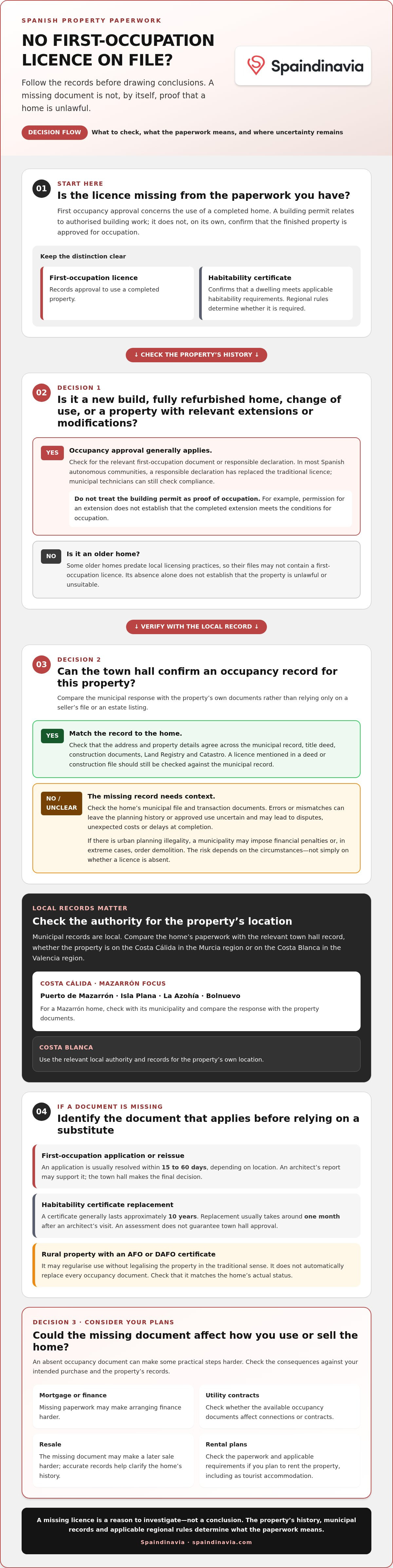
In Spain, a licence of first occupation confirms that a newly built home was legally constructed and approved for use. A building permit authorises construction, while “certificate of occupancy” is a broader term that may refer to approval to use a completed building.
A licence of first occupation is generally required for new homes, fully refurbished dwellings, changes of use, and relevant extensions or modifications. Construction approval alone does not confirm that the finished property is approved for occupation.
What a first occupancy licence certifies
The local town hall issues a licence of first occupation to confirm that a newly built property was constructed legally and is suitable for living in. It links the completed home to the permissions and requirements that applied to its construction. For a buyer, it provides a clearer record of the home’s approved use than a building permit alone.
In most Spanish autonomous communities, a responsible declaration of first occupation has replaced the traditional licence. Municipal technicians can still check whether the completed work complies with legal requirements and matches the declaration.
Occupancy licences and habitability certificates
A licence of first occupation concerns approval to use a completed property, while a certificate of habitability confirms that a dwelling meets applicable habitability requirements. Names and procedures vary across Spain, so the document required for a particular home depends partly on its location. In Catalonia and the Balearic Islands, a certificate of habitability is compulsory, including for older dwellings.
A certificate generally lasts approximately ten years. If it has expired, a new owner may need a replacement when selling or transferring the property through inheritance.
Licences, occupancy certificates and building permits
These terms describe different stages, although “certificate of occupancy” may be used broadly in English-language property discussions. A building permit relates to authorised building work; a first occupancy licence concerns use of the completed home. Treating the permit as proof of occupancy can leave a buyer without a document needed for a later transaction or service contract.
For example, a permit for an extension does not show that the completed extension meets the conditions for occupation. Compare the document’s name, property details and purpose instead of relying on an informal translation in an estate listing.
When a first occupancy licence is required
In Spain, the requirement generally applies to newly built dwellings, fully refurbished homes, changes of use, and buildings with relevant extensions or modifications. The developer should have handled the licence when selling a newly built home directly. For older homes, the property’s history and municipal rules help determine which occupancy document applies.
An application for a first occupancy licence is usually resolved within 15 to 60 days, depending on location. An architect’s report may support an application, but the town hall makes the final decision on approval or reissue.
To replace a certificate of habitability, apply through the relevant town hall and arrange the required property assessment. An application usually takes around one month after an architect’s visit. The inspection helps document the home’s condition, but it does not oblige the town hall to approve a certificate.
For rural homes, an AFO or DAFO certificate may regularise use without legalising the property in the traditional sense. It does not simply replace every occupancy document. Check the property’s municipal file and confirm that the certificate matches the home’s actual status before relying on it.
Why Don’t Older Properties in Spain Have an Occupation Licence, And Does It Matter?
Some older homes predate local licensing practices, so their files may not contain a first occupancy licence. Its absence doesn’t automatically make a property illegal, but checking municipal and transaction records can clarify what it means for your purchase.
Checking municipal records and property documents
Start by asking the relevant town hall whether it issued an occupancy licence for the property. For a home in Mazarrón, check with its municipality; a Costa Blanca property has its own local authority and records. Then compare the response with the title deed, construction documents, Land Registry and Catastro records.
A licence may be mentioned in a deed or construction file, so compare the property’s address and details across documents. If the seller or their legal representative has a copy, match it against the municipal record instead of relying on a listing description. Understanding the risks of buying a property without a licence of first occupation helps you assess the missing record in the context of the home’s history.
Document errors and legal risks
Errors in property transaction documents can lead to disputes, unexpected costs or delays at completion. For example, a mismatch between the property described in the deed and municipal records may raise questions about its planning history or approved use.
Poorly prepared sale paperwork can leave important property issues unclear. Check that documents identify the correct home and accurately describe its occupancy records. If there is urban planning illegality, a municipality may impose financial penalties or, in extreme cases, order demolition. These risks of buying a property without a licence of first occupation depend on the underlying circumstances, not just on a missing document.
Older homes can lack a licence because they were built before the 1980s or early 1990s, when many municipalities did not require or commonly issue one. That history differs from evidence of unauthorised building work. A property without a licence may still be bought, sold and legally lived in, but its planning status and records still matter.
An application for a first occupancy licence generally requires a final construction certificate signed by the architect and quantity surveyor, an approved technical project, an installation supervision report and proof of administrative fee payment. The town hall may also request a technical report and building permit.
The owner applies to the relevant town hall, which sets its own administrative fee. A qualified architect or quantity surveyor can assess an older dwelling and prepare a technical report. An owner can apply retroactively, but the process depends on the property’s age and local rules. Applying does not resolve questions about planning compliance.
Before proceeding, compare the municipal file with the deed, Land Registry and Catastro entries. A local solicitor or architect can help establish whether a licence existed and whether the documents describe the same property. For homes around Puerto de Mazarrón, Isla Plana, La Azohia or Bolnuevo, use the relevant municipal records; apply the same document-by-document approach across the Costa Cálida and Costa Blanca.
Once you understand the paperwork, you can explore property options across the Costa Cálida and Costa Blanca with the home’s records in mind.
Licence requirements when buying or selling Spanish property
The property is in Spain, where the relevant occupancy document and process depend on the municipality and, in some cases, the autonomous community. The property’s age, any building work and its intended use help determine which requirements apply.
Properties requiring an occupancy licence
A first occupancy licence is required for newly built dwellings, fully refurbished homes, changes of use, and buildings with relevant extensions or modifications. These categories matter because earlier paperwork may not cover later building work or a change in use.
For example, a property converted from another use or altered through a relevant extension may need occupancy approval for the completed work. In most autonomous communities, a responsible declaration of first occupation has replaced the traditional licence, although municipal technicians can still check compliance.
Contracts and legal requirements
Transaction contracts should accurately describe the property and its occupancy documents, so buyers understand what is being transferred. In Spain, a first occupancy licence is required to sell a property during its first ten years. The developer should have handled it when selling a home directly to the original buyer.
Before signing, compare the contract’s property description with the occupancy paperwork and records. A solicitor can prepare, review and finalise transaction documents, helping identify inconsistencies before they lead to a dispute or delay. Professional sales progression and legal oversight are crucial in any market; for investors who also handle transactions in the UAE, ASMA Property Services offers dedicated conveyancing and property transfer support.
Consequences of breaching occupancy requirements
Missing occupancy approval can complicate a sale, mortgage application or planned use. A purchaser seeking a mortgage is expected to have a first occupancy licence in place, and banks may refuse mortgages for properties without one.
If there is urban planning illegality, a municipality may impose financial penalties or, in extreme cases, order demolition. These outcomes relate to the underlying planning breach, not simply the missing document. Distinguish an absent record from evidence that construction or later work violated regulations.
Selling, mortgaging, insuring and renting
A property without a licence may still be bought or sold, but the missing document can affect the transaction. Mortgage access may be restricted because lenders may refuse applications without the licence. This can narrow the pool of buyers, particularly international buyers unfamiliar with the property’s planning history.
For rental plans, missing paperwork can make it harder to obtain a tourist rental licence in certain regions. Rules vary by location, so distinguish a planned tourist let from a standard sale or private use. An occupancy licence is not an insurance policy; the document itself does not determine the cover in an insurance contract.
The Costa Cálida and Costa Blanca have distinct municipal and regional frameworks, which shape the requirements for each property. For any Spanish home, match the contract and intended use to the occupancy documents before committing.
Utility connections and tourist accommodation registration
Missing occupancy paperwork can affect practical arrangements after purchase, including utility contracts and plans for tourist accommodation. Requirements depend on the service and the property’s location. Keep the relevant municipality in view when assessing a home on either coast.
A licence of first occupation is required to establish contracts for drinking water, telecommunications and electricity. Some utility providers may also require it for a new connection or contract. Correctly registered water, electricity and gas services may indicate that a property already has a licence, but service records cannot replace municipal paperwork.
Transferring an existing contract is different from arranging a new connection. Check the local requirements before changing the name on water or electricity contracts. Before completion, note which services are active and whose name appears on each agreement. This helps you identify whether you need a transfer or a new supply application.
For example, if you’re looking at a home in Puerto de Mazarrón, Isla Plana, La Azohia or Bolnuevo, record its current service arrangements alongside the property documents. Keep utility bills with the occupancy paperwork, then compare the property details shown on both. Use the same approach for homes on the Costa Blanca, while keeping each property’s own municipal records separate.
Occupancy documents can also matter to mortgage applications. Banks may refuse a mortgage for a property without a licence of first occupation, so include its status when planning how to fund your purchase. A solicitor can help coordinate transaction paperwork, while lenders, inspectors and other professionals may be involved in the wider property process.
Each document has a different role. An inspection concerns the property’s condition, while a utility bill records a service arrangement. Neither establishes the home’s municipal occupancy status. Keeping these records distinct helps you explain the property’s situation during a purchase, particularly if you’re arranging services and finance at the same time.
Tourist accommodation is a separate consideration. In certain regions of Spain, lacking a licence of first occupation may make it harder to obtain a tourist rental licence. If you’re considering a holiday let in Mazarrón or on the Costa Blanca, include tourist registration in your intended-use plans rather than assuming connected utilities establish rental eligibility.
An older dwelling may need a first occupancy licence if it underwent integral rehabilitation or structural modifications, never obtained one, needs basic services registered, or is being sold or rented, especially as tourist accommodation. Relating the property’s work and service history to your plans helps clarify which documents matter for your purchase.
For a home in Murcia or Valencia, keep the municipal occupancy record, utility contracts and intended use together in your purchase file. This gives you a practical way to discuss a name change, new supply or tourist-rental plan in the context of that specific property.
Risks of buying property without a habitation licence
The risks of buying a property without a licence of first occupation depend on what the missing document means for the home and your plans. In Spain, its absence alone doesn’t establish a planning breach. However, it can affect financing, utility arrangements, resale and rental options, so weigh these practical effects before committing.
Mortgage access may be affected: banks may refuse to lend on a property without the licence. That can limit your options if you need finance and reduce the number of potential buyers when you sell. If you’re relying on a mortgage, the risks of buying a property without a licence of first occupation include having fewer lenders willing to consider the purchase.
Utilities can bring separate complications. Missing occupancy paperwork may make it difficult or impossible to arrange basic supplies, including water or electricity. Existing services don’t establish whether a new owner can transfer contracts or arrange a new connection.
Rental plans need their own assessment. In certain regions, the absence of a first occupancy licence can make it harder to obtain a tourist rental licence. If your purchase depends on holiday income, factor that into your decision instead of assuming a home suitable for personal use will also suit tourist letting.
Keep the home’s physical condition separate from its legal and documentary status. A survey can identify visible condition issues, but it cannot establish whether the town hall issued an occupancy licence or whether alterations comply with planning requirements. For example, a survey may describe an extension, while the municipal file shows whether approvals are recorded.
For a home in Puerto de Mazarrón, Isla Plana, La Azohia or Bolnuevo, in Mazarrón, Murcia, compare municipal records with property documents before treating a missing licence as a minor gap. These locations are on the Costa Cálida; apply the same approach on the Costa Blanca in Valencia, where the relevant local authority and regional requirements may differ. An estate agent’s description helps explain a listing, but it doesn’t replace the underlying records.
Before proceeding, write down your intended use: living in the home, reselling it or seeking tourist-rental registration. Then weigh the paperwork against your plans, mortgage needs and utility requirements. A home may suit a buyer planning personal use but create obstacles for someone relying on finance or rental income.
If you’re weighing property options in these coastal regions, explore homes across Mazarrón and the Costa Blanca with your intended use in mind.
Spaindinavia: New Build Villas
Spaindinavia can help you compare property options once you understand how occupancy documents may affect a purchase. If you’re interested in a new-build home, explore New Build Villas or New Build Apartments. Resale Apartments, Townhouses and Bungalows offer other options to consider.
Focus your search on the Costa Cálida and Costa Blanca, where each property has its own local planning history. Around Mazarrón, consider Puerto de Mazarrón, Isla Plana, La Azohia and Bolnuevo alongside locations on the Costa Blanca. Spaindinavia supports buyers through the purchase process, working with independent solicitors, banks and local experts as needed.
As you compare homes, keep your intended use and the property’s paperwork in view. Contact Spaindinavia to discuss your search.
Make your next move with clarity
The risks of buying a property without a licence of first occupation are best judged against what you want from your home. A place for quiet stays near Bolnuevo may suit different priorities from a property you plan to rent or resell. Keep your intended use at the centre of your decision, and consider how the home’s paperwork fits those plans.
As you compare properties, note what matters most to you: location, lifestyle, future flexibility or investment potential. For buyers and investors also exploring property markets internationally, agencies such as Terra Firma assist with ready and off-plan acquisitions. Whether you’re drawn to Mazarrón on the Costa Cálida or exploring the Costa Blanca, a clear brief can help you focus your search and discuss the right questions during the purchase process.
Spaindinavia can help you explore New Build Villas, Resale Apartments and Townhouses across these coastal regions. Take the next step at your own pace and contact Spaindinavia for property advice. Your Spanish property search can move forward with a clearer sense of what fits you.
Frequently Asked Questions
Does the Lack of an LPO Make a Property Illegal?
No. In Spain, a property without a licence of first occupation isn’t automatically illegal, and it may still be bought, sold and legally lived in. The key distinction is between a missing document and an underlying planning breach. For example, unauthorised structural work can raise a different issue from an older home whose municipality never issued the licence. Check the property’s planning history before drawing conclusions.
How Does This Affect Buyers on the Costa del Sol?
The same broad Spanish considerations apply, but the relevant town hall holds the local property record and makes decisions about occupancy approvals. Don’t assume a document issued or accepted for a home elsewhere applies in the same way. Before committing, match the property’s address and details against its municipal file, and ensure the purchase contract reflects the occupancy documents available for that home.
What Can Be Done If the Property Doesn’t Have an LPO?
First establish why the document is missing: ask the town hall whether it issued one, then compare its answer with the deed and construction records. If no licence exists, an owner can apply retroactively; the process depends on the property’s age and local rules. A qualified architect or quantity surveyor can assess an older dwelling and prepare a technical report for the application. Don’t treat an application as approval.
What Legal Risks Arise from Buying or Occupying a Property Without a Licence of First Occupation?
The main legal concern is whether the missing paperwork points to a planning breach. A municipality may impose financial penalties or, in extreme cases of urban planning illegality, order demolition. That outcome does not follow automatically from a missing licence. Look for differences between the approved plans and the property as built, such as an extension absent from the municipal file, and establish its status before proceeding.
Who Is Responsible for Obtaining the Licence: the Developer, Seller, or Buyer?
For a newly built home bought directly from a developer, the developer should have handled the first occupancy licence. For a resale, the property’s history and transaction arrangements matter; an owner can also apply retroactively. Make the contract clear about which occupancy documents the seller will provide and who will address any outstanding application. This avoids leaving responsibility unclear between buyer and seller after completion.
How Can a Buyer Verify Whether a Property Has a Valid Licence of First Occupation?
Ask the seller or their legal representative for the licence, then compare its property details with the title deed and construction documents. You can also apply to the relevant town hall or consult the Land Registry. A licence mentioned in a deed is a useful lead, but compare it with the municipal record. Check that it relates to the home you’re buying, not another unit or an earlier stage of work.
Can a Buyer Obtain a Licence After Purchase, and What Happens If Approval Is Refused?
An owner can apply for a first occupancy licence after purchase, but the property’s age and local rules affect the process. The town hall makes the final decision; an architect’s report alone does not require it to approve the application. If the application is refused, the property remains without that licence. Read the reasons and establish whether they concern missing documents, completed work or planning compliance before deciding what to do next.
What Buyer Protections, Contract Clauses, or Remedies Apply When a Property Lacks the Licence?
Protection starts with a contract that accurately describes the occupancy documents and records what the seller must provide. A buyer can discuss making completion conditional on receiving specified paperwork or setting out how an outstanding application will be handled. The available remedy depends on the signed contract and circumstances, so have an independent solicitor review the wording before signing. Keep written records of document requests, replies and agreed responsibilities.


