

If you’re asking what is an AFO certificate and why do I need it, the answer may affect how you assess a Spanish property before buying. In property contexts, AFO is commonly used for Asimilado Fuera de Ordenación, a planning status associated with certain existing buildings. The exact terminology and legal effect depend on the documents and rules that apply to the property.
An AFO document should not be treated as proof that every part of a building is fully legal or that it has the same status as a property with planning permission for all its works. It may record a particular planning position, but it does not automatically remove restrictions or replace other documents needed for a purchase. That distinction matters when you are comparing properties or deciding whether to proceed.
This guide explains what an AFO certificate may refer to, what it does not prove, and how to include it in your property checks. You’ll also find practical questions to raise during the buying process, from reviewing the building’s planning history to budgeting for the purchase as a whole.
Key Takeaways
- An AFO document relates to a planning status for certain existing buildings. Its precise meaning depends on the property’s documents and applicable rules.
- It is not automatically the same as planning permission, a title deed or an occupancy document, and does not prove that every alteration is authorised.
- Have an independent solicitor review the ownership, debts, contracts and planning documents before you commit to a purchase.
- Budget for the full purchase, including a reservation fee of €3,000 to €10,000, an Arras deposit typically around 10% after the reservation fee, and additional buying costs of approximately 10% to 15% of the property price.
- Spaindinavia supports buyers through personalised property searches and the purchase process, working with independent legal and financial professionals.
What Is an AFO Certificate? Understand the Aquatic Facility Operator Credential
In a Spanish property search, AFO usually refers to Asimilado Fuera de Ordenación, a planning status associated with some existing buildings that do not fully align with current planning rules. People may use “AFO certificate” to refer to documentation recording that status. The name alone does not tell you what has been recognised, which parts of the building are covered or what restrictions remain.
If you’re asking, “what is an AFO certificate and why do I need it?”, separate three things: the building’s planning status, the documents that record that status, and the legal checks needed before buying. A document may help explain how a building is treated under the applicable planning framework. It is not, by itself, a complete legal review of the property or proof that every structure and alteration has the required permissions.
What does AFO mean in a property context?
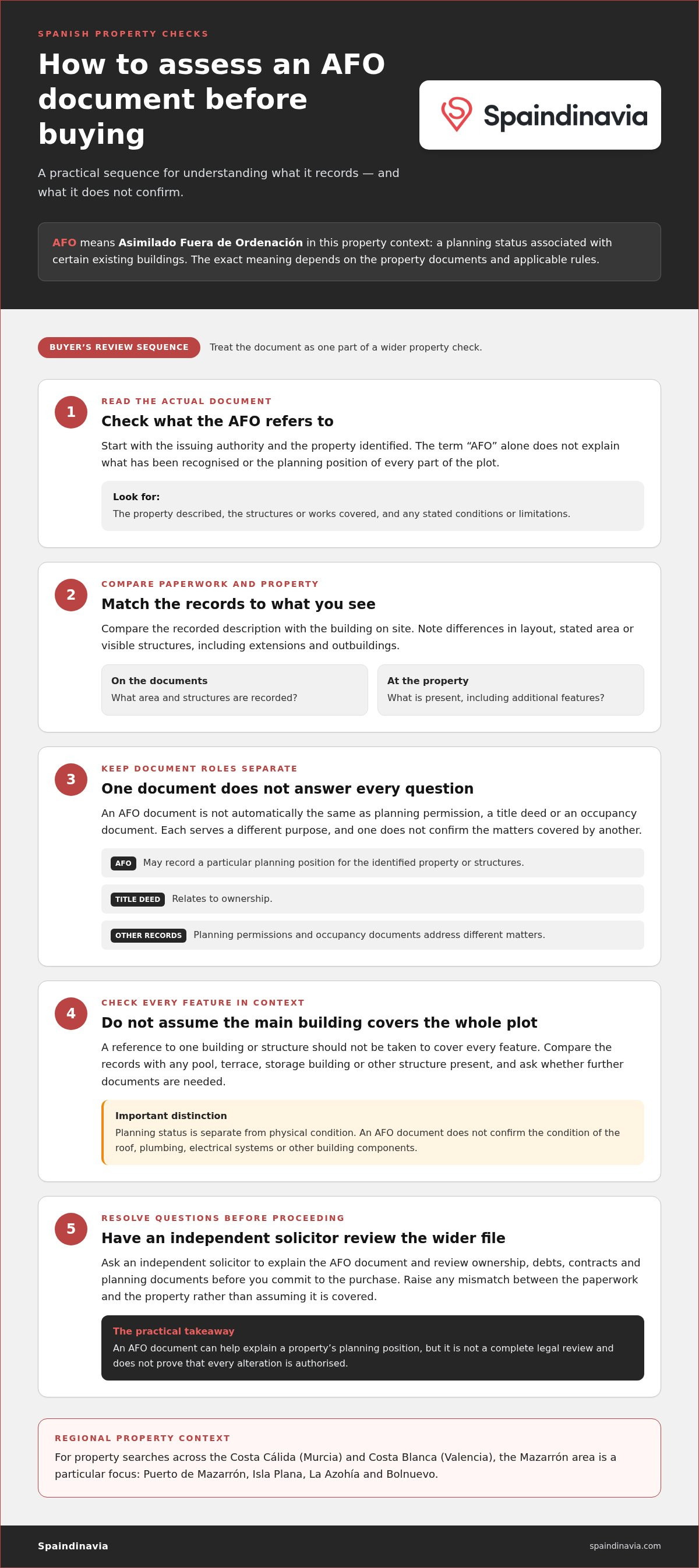
AFO is an abbreviation for Asimilado Fuera de Ordenación. In practical terms, it signals that a building has a particular planning position that needs to be understood in context. The term is not a substitute for reading the actual document. Check the issuing authority, the property it identifies, the works or structures it covers, and any limitations or conditions stated in it.
Do not confuse an AFO document with a title deed, planning permission for new works, or an occupancy document. These serve different purposes. A title deed relates to ownership, while planning documents concern the building’s relationship with planning rules. One document does not automatically confirm the matters covered by another. For a buyer, the important question is not only whether an AFO document exists, but what it establishes about the specific property.
Who should pay attention to an AFO certificate?
An AFO document is particularly relevant when you are considering a property whose planning history or building status needs careful review. This may include a home where the recorded built area appears different from what you see on site, or where extensions, outbuildings or other alterations are part of the property. These are prompts for investigation, not proof that a property has a particular problem.
Start by comparing the property description in the available documents with the building itself. Note any differences in the layout, recorded area or structures. Then have an independent solicitor review the documentation and explain what it means for ownership, use and any planned changes. A document that refers to one building or structure should not be assumed to cover every feature of the plot.
As a buyer, you do not need to interpret planning terminology alone. Spaindinavia assists buyers throughout the purchase process and can introduce them to independent lawyers, notaries and banks. Keep the legal review independent, and make sure any questions about the AFO document are resolved as part of your due diligence before you proceed.
What Does AFO Training Cover? Explore the Core Pool-Operation Skills
For a property buyer, the useful question is not what training an AFO certificate covers, but what the document covers about the building. Read it alongside the property’s other records, rather than treating the label as a complete account of its legal or physical condition. The details to understand include the property identified, the structures described, the status recorded and any conditions or restrictions stated.
An AFO document should be assessed as one part of a wider property review, alongside ownership records, planning information, the purchase contract and the condition of the building. Each source answers different questions. Comparing them can reveal points that need clarification before you make a decision.
Water quality, chemistry and disinfection
The original meaning of AFO in this article is a property planning term, not an aquatic-facility qualification. If the property includes a swimming pool, the presence of a pool does not change what an AFO planning document means. Nor should you assume that planning paperwork for the main building automatically confirms the status of every feature on the plot.
As part of your review, note any pool, terrace, storage building or other structure shown in the documents and compare that with what is present at the property. Ask your independent solicitor to clarify whether the available records cover those features and whether further documentation is needed. This is a document-checking step, not an assessment of pool safety or maintenance.
Mechanical systems, maintenance and facility safety
Planning status and the physical condition of a property are separate matters. An AFO document does not tell you whether the roof, plumbing, electrical systems or other building components are in good condition. A property viewing can help you identify visible questions, but it is not a replacement for reviewing the paperwork or arranging appropriate professional checks.
For example, if the recorded description differs from the building you view, make a note of the discrepancy and ask for it to be addressed before you rely on the document. Do not assume that an extension is included simply because it is attached to the main house. Similarly, do not infer from an AFO reference that all works are approved, that the building can be altered without restriction or that every use is permitted.
Use a simple comparison when reviewing the file: what does the document say, what is physically present, and what does the purchase contract describe? Any mismatch is a reason to pause and get an explanation from your independent solicitor. Spaindinavia can support the wider buying journey, including property searches and organised inspection trips, while independent legal professionals advise on the meaning and effect of the documentation.
If you are comparing homes with outdoor features, you can explore property options across the Costa Cálida and Costa Blanca as a separate part of your search.
Do You Need an AFO Certificate? Separate Job Expectations from Legal Requirements
Whether an AFO document matters to you depends on the property you are considering and what its records show. It is not a standard item that every buyer should interpret in the same way. The key is to establish whether the document relates to the property, what it actually records and how it affects your plans for the home.
If you’re asking “what is an AFO certificate and why do I need it?”, separate two questions. First, what does the document say about this building? Second, are the property’s ownership, planning status and intended use clear enough for you to proceed? A document may be relevant without resolving every question about a purchase.
When could an AFO document be useful?
An AFO document may help explain the planning status of an existing building. It can be a useful part of the information available to your solicitor when reviewing a property, especially if the building’s history, recorded dimensions or alterations need attention. Its practical value depends on its contents and how it relates to the specific property you plan to buy.
Before making a decision, compare the document with the title and purchase paperwork, the property description and what you see during a viewing. Write down any difference rather than trying to resolve it from the document’s heading alone. Ask your independent solicitor to explain the issue and whether it changes your understanding of the property or the terms on which you are prepared to buy.
Is an AFO certificate a universal legal requirement?
An AFO document is not a universal certificate that every buyer must obtain for every property. Whether one is relevant depends on the building’s circumstances and the documentation available. Do not assume that a property is unacceptable because an AFO document is mentioned, or that it is fully compliant simply because such a document exists.
Have an independent solicitor review ownership, debts, contracts and planning documents. The solicitor can explain what the records establish and identify any outstanding questions relevant to the purchase. Keep the enquiry specific to the property and your intended use. Avoid relying on a general description of AFO to make a legal conclusion about a particular building.
Use this practical comparison to organise your checks:
- Document scope: Confirm which property and structures the document identifies. Do not assume it covers features that are not described.
- Planning status: Ask your independent solicitor to explain the recorded status and any conditions or limitations stated in the documents.
- Property match: Compare the paperwork with the building and plot you viewed. Record differences in the layout, structures or description.
- Purchase decision: Make sure unanswered questions are addressed before you commit. An AFO reference alone is not a complete due-diligence process.
The purchase budget also needs to be clear. The reservation fee is between €3,000 and €10,000, varying between resale and new development. After the reservation fee, the deposit under a private purchase contract, known as “Arras”, is typically around 10% of the purchase price. Budget approximately 10% to 15% of the property price for additional buying costs, including taxes and fees such as notary, land-registry, legal and administrative costs.
For non-resident buyers, mortgage financing is typically 60% to 70% of the property value. The buying process after reservation usually takes 4 to 6 weeks. These figures help with financial planning, but they do not replace the legal review of an AFO document or the rest of the property file. Spaindinavia assists with the purchase process and introductions to independent solicitors, notaries and banks.
How Do You Get an AFO Certificate? Check the Current Course and Exam Steps
If a property is described as having an AFO certificate, the next step is to obtain and review the document, not to assume that the label explains the entire planning position. Ask for the relevant paperwork early enough for it to be considered as part of the purchase checks. The document’s wording and relationship to the property matter more than a brief description in an advertisement.
If you’re asking “what is an AFO certificate and why do I need it?”, use the steps below to make the review more practical. They can help you organise your questions while your independent solicitor examines the property documentation.
- Obtain the document being referred to. Confirm that you have the actual AFO-related document, rather than relying on a listing description or a verbal summary. Note the property details and any structures it names.
- Compare it with the property records. Read it alongside the ownership information, planning documents and draft purchase contract. Look for differences in the property description, recorded structures or built area that need an explanation.
- Compare the paperwork with the property. During a viewing, note additions or structures that do not appear to match the information you have. A viewing can identify questions, but it cannot establish the legal status of a feature.
- Ask for an independent legal review. Have an independent solicitor verify ownership, debts, contracts and relevant planning documents. Ask them to explain what the AFO document establishes, what it does not establish and whether any points remain unresolved.
- Keep your decision and purchase costs in view. Consider the document review alongside the full buying budget, your intended use of the property and the terms of the purchase contract. Resolve material questions before relying on the AFO description as a reason to proceed.
For context, the reservation fee is between €3,000 and €10,000, depending on whether the property is a resale or in a new development. After reservation, the Arras deposit is typically around 10% of the purchase price. Additional buying costs are approximately 10% to 15% of the property price. Non-resident mortgage financing is typically 60% to 70% of the property value, and the purchase process after reservation usually takes 4 to 6 weeks.
Keep copies of the documents and a written note of the questions that have been answered. This makes it easier to follow the review and understand which points relate to the building’s planning status, ownership or purchase terms. Spaindinavia offers personalised property searches, organised inspection trips and assistance throughout the buying process, working with independent legal and financial professionals.
Is AFO Certification Right for You? Make a Role-Based Decision
For a buyer, the decision is not whether to obtain an AFO qualification. It is whether the AFO documentation available for a particular property gives you enough information to understand its planning status, alongside the other checks required for a purchase. The answer depends on the actual document and your plans for the building.
If you’re still wondering “what is an AFO certificate and why do I need it?”, assess it as one part of your property review. A buyer comparing homes, an owner planning to make changes and someone purchasing an investment property may have different questions. In each case, the document should be considered in relation to the specific building and the intended use.
Match AFO topics to your everyday responsibilities
Start with your plans for the property, then identify which records are relevant to those plans. If you want to live in the home, focus on understanding the recorded status and whether the property description matches what you are buying. If you are considering changes, make sure you understand that an AFO document does not automatically authorise future works. If rental income is part of your plans, include the property’s legal and practical suitability in your review.
Write down the questions you want answered and compare the responses with the documents you have. For example: does the document identify the same property, does it describe the structures you have viewed, and are there any conditions or restrictions stated? A clear list makes it easier to keep planning questions separate from purchase costs, maintenance considerations and contract terms.
- Home buyers: Compare the property description and planning documents with the home you viewed. Ask your independent solicitor to explain any differences before proceeding.
- Buyers planning changes: Do not treat an AFO reference as permission for future alterations. Get clear advice on the rules and documents relevant to the proposed work before making plans.
- Investment buyers: Review the planning and ownership paperwork alongside your intended use of the property. Rental management services can help owners manage bookings and guest communication, but they do not replace legal due diligence.
What to verify before relying on the certificate
Before committing to a purchase, have an independent solicitor review the AFO document alongside the ownership records, debts, contracts and other relevant planning information. Check that the document refers to the property you intend to buy and understand any limits it records. Do not rely on an old summary or a listing description when the underlying paperwork is available for review.
Keep the legal and financial checks distinct. The solicitor can explain the documentation, while your purchase planning should account for the reservation fee, deposit, mortgage arrangements and additional costs. The reservation fee is between €3,000 and €10,000, the Arras deposit is typically around 10% of the purchase price after reservation, and additional buying costs are approximately 10% to 15% of the property price. Non-resident buyers typically obtain mortgage financing of 60% to 70% of the property value. After reservation, the buying process usually takes 4 to 6 weeks.
Your next step is straightforward: gather the property documents, list any differences you notice, and make sure your independent solicitor addresses them before you proceed. Spaindinavia can help you find and compare properties, organise inspection trips and support you through the purchase process, with introductions to independent lawyers, notaries and banks.
Take Your Next Step with Clarity
The question “what is an AFO certificate and why do I need it” is best answered by looking at the document for the property you are considering. It may help explain a building’s planning status, but it does not replace a review of ownership, debts, contracts and other relevant records. Have an independent solicitor explain what it covers and resolve any questions before you rely on it in a purchase decision.
Plan for the whole purchase, not just the reservation. In addition to a reservation fee of €3,000 to €10,000 and an Arras deposit typically around 10% after reservation, budget approximately 10% to 15% of the property price for taxes and fees. Non-resident mortgage financing is typically 60% to 70% of the property value, and the process after reservation usually takes 4 to 6 weeks.
Explore Spaindinavia’s property-buying guidance and get support with a personalised property search, organised inspection trips and the purchase process. Spaindinavia works with independent legal and financial professionals to help buyers move forward with clear information.
Frequently Asked Questions
What is an AFO certificate?
In a Spanish property context, AFO commonly refers to Asimilado Fuera de Ordenación, a planning status associated with certain existing buildings. An AFO document may record that status, but its effect depends on its wording and the rules that apply to the property. It is not automatically proof that every structure or alteration is authorised. Have an independent solicitor review it alongside the other property documents.
Is an AFO certificate required to operate a swimming pool?
An AFO certificate is a property-planning document, not a pool-operations qualification. Whether an AFO document is relevant depends on the planning status and records for the property; it does not, by itself, establish whether a pool or other feature is covered. If a property includes a pool, compare the available documents with the structures on site and have the planning paperwork reviewed as part of the purchase.
Who can take the AFO certification exam?
There is no AFO certification exam to take in the property-planning sense described here. AFO refers to a planning status, not an aquatic-facility operator qualification. If an AFO document is mentioned in a property listing, ask for the document itself and have an independent solicitor explain what it records for that specific building.
What does the AFO examination cover?
There is no AFO examination associated with the property-planning document discussed here. The useful checks are to confirm which property and structures the document identifies, read any conditions or limitations, and compare it with the ownership and planning records. An independent solicitor can review those documents and explain their relevance to the purchase.
How long does AFO certification last?
AFO is a planning status, not a professional certification with an exam-validity period. The document itself should be reviewed for its wording, the property it identifies and any conditions it records. Have an independent solicitor confirm how it relates to the current property documentation before you rely on it when buying.
What is the difference between AFO and CPO certification?
In this article, AFO refers to a property-planning term, Asimilado Fuera de Ordenación. It should not be confused with an aquatic-facility qualification. The abbreviation alone does not explain a property’s full planning position, so review the actual document and ask an independent solicitor to clarify its meaning in relation to the building.
Can AFO training help me manage a pool facility?
This article covers AFO as a property-planning term, not as pool-operations training. If you are buying a home with a pool, an AFO document does not assess the pool’s condition or maintenance needs. Consider the planning paperwork separately from the physical condition of the property, and have an independent solicitor review the documents relevant to the purchase.


