

Did you know that your neighbours now hold the power to decide the future of your holiday home investment with a simple vote? Since April 2025, communities of owners can restrict rental activity with a three-fifths majority, making it more important than ever to understand the laws and regulations for renting out short term properties in Costa del Sol. It's completely natural to feel some anxiety after the May 2026 Supreme Court decision to annul the national registry, but we're here to provide the clarity you need to stay compliant and profitable. We understand that your dream of a Mediterranean lifestyle should be defined by sun and relaxation, not by the fear of unexpected fines.
In this guide, we'll provide a clear roadmap to securing your tourist licence and navigating the new annual tax filing requirements for 2026. Whilst the Costa del Sol remains a powerhouse for rental yields, we'll also compare these rules with the Costa Blanca and the Costa Calida. In the Murcia region, specifically within the charming locales of Puerto de Mazarrón, Isla Plana, La Azohia, and Bolnuevo, the local nuances offer different levels of flexibility for owners. You'll gain the expert insights needed to manage your property with confidence, ensuring your investment remains a source of joy rather than stress.
Key Takeaways
- Grasp the latest changes to the Ley de Propiedad Horizontal, including the legal right for communities to increase maintenance fees by up to 20% for holiday rental properties.
- Master the laws and regulations for renting out short term properties in Costa del Sol whilst identifying why the Costa Blanca and Costa Calida often provide more flexible alternatives for investors.
- Explore the specific licensing requirements for the Mazarrón area, focusing on the coastal gems of Puerto de Mazarrón, Isla Plana, La Azohia, and Bolnuevo.
- Learn the essential steps for securing your regional tourist licence and how to navigate the mandatory SES.HOSPEDAJES database for guest registration.
- Discover how professional property management can safeguard your investment by ensuring constant compliance with local behaviour rules and tax obligations.
The 2026 Legal Framework for Short-Term Rentals in Spain
The landscape for property owners has changed significantly. In 2026, we've moved away from the idea that owning a home automatically grants you the right to run a holiday business. Instead, we operate in a compliance-first environment where safety and community harmony take centre stage. Whilst the Supreme Court recently annulled the national rental registry in May 2026, the regional Tourism in Spain framework remains robust and mandatory. For those exploring the laws and regulations for renting out short term properties in Costa del Sol, the focus has shifted back to regional decrees and the power of individual building communities.
The most impactful change stems from the recent amendments to the Ley de Propiedad Horizontal. This law now gives your neighbours a seat at the table. It's no longer just about what the regional government says; it's about what your local Community of Owners (HOA) permits. This shift ensures that holiday lets coexist peacefully with permanent residents, protecting the long-term value and lifestyle appeal of your investment property.
What Constitutes a Short-Term Holiday Let?
In Spain, the line between a residential lease and a tourist rental is usually drawn at the 30-day mark. If you're renting your property for periods shorter than this, and you're promoting it on platforms like Airbnb or Booking.com, you fall under the tourist rental umbrella. A Vivienda de Uso Turístico (VUT) is a residential property marketed through tourism channels for short-term stays, requiring a specific regional licence and adherence to local safety and comfort standards. This status requires you to demonstrate "habitual" rental activity, meaning the property is regularly available for guests throughout the year.
Existing vs. New Owners: Who is Affected?
If you secured your licence before April 2025, you're generally protected by a 'grandfather clause'. However, new buyers must tread carefully. When purchasing a resale apartment or villa, don't assume the existing licence automatically transfers or remains valid under new HOA rules. In the Costa del Sol, due diligence is now the most critical step for any British buyer. Interestingly, some investors are looking towards the Costa Calida and Costa Blanca, where regulations can differ slightly in their application. In the Murcia region, particularly around the Mazarrón area, including Puerto de Mazarrón, Isla Plana, La Azohia, and Bolnuevo, the local authorities have their own specific requirements. These areas often provide a different pace of life and varying levels of rental flexibility compared to the more urbanised stretches of the Costa Blanca.
The Power of the Community of Owners (HOA) in Rental Permissions
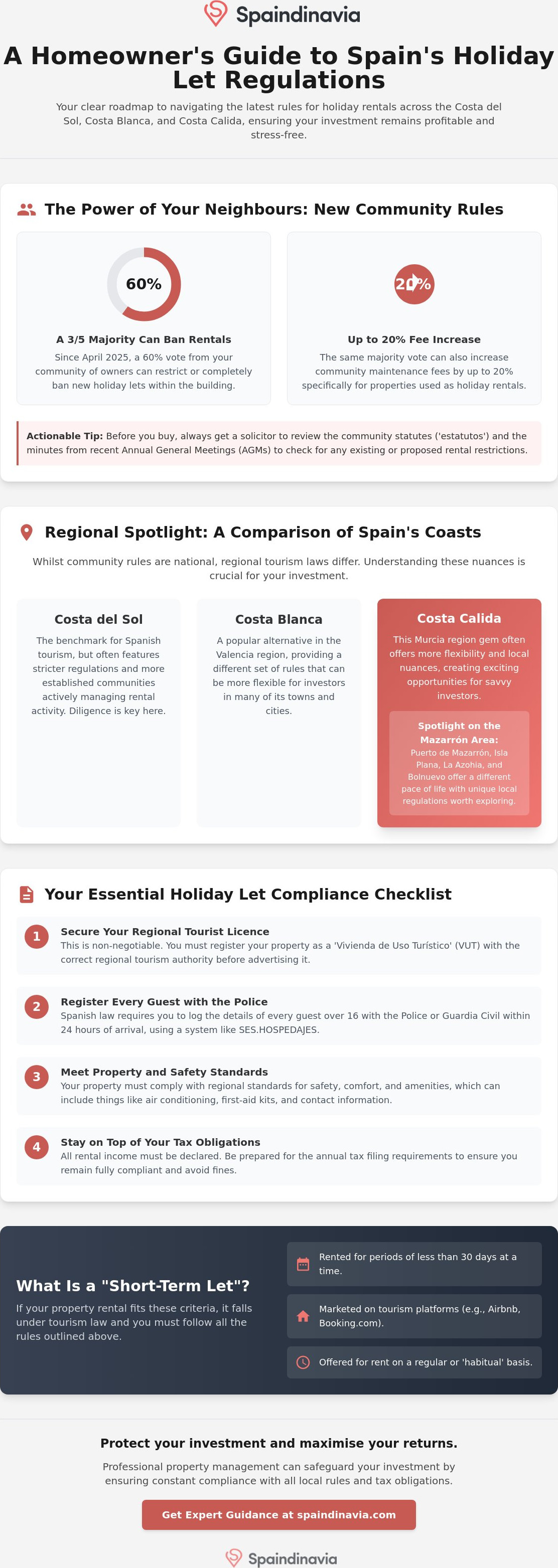
In your journey toward owning a holiday home, the building's internal rules are now just as vital as regional decrees. Since the legislative shifts in early 2025, your Community of Owners (HOA) holds significant sway over your property's potential. Specifically, a three-fifths majority (60%) of owners can now vote to restrict or entirely ban new short-term rental activities within their complex. This makes reviewing the community statutes and the minutes from recent Annual General Meetings (AGMs) an essential part of your due diligence. It's no longer enough to check the laws and regulations for renting out short term properties in Costa del Sol; you must also check the pulse of your future neighbours.
Whilst we often focus on the bustling stretches of the Costa del Sol, these community powers apply across the country. However, the atmosphere in a high-density complex in Marbella might be very different from a relaxed development in Puerto de Mazarrón or Isla Plana. In the Costa Calida and Costa Blanca, communities often have a different balance of residents and holidaymakers. This balance can heavily influence how these votes swing. Even though the national registry landscape has shifted, the legislative intent seen in documents like Royal Decree 1312/2024 paved the way for this localised control. It's this level of authority that allows for the 20% surcharge on community fees.
Increasing Community Fees for Holiday Rentals
The logic behind the 20% surcharge is straightforward. Guests often use the lifts, pools, and shared gardens more frequently than an owner who only visits twice a year. An HOA can legally increase the community fees for rental properties by up to 20% to cover extra maintenance and security. To avoid surprises, always request a 'Certificado de la Comunidad' before you sign a purchase contract. This document confirms there are no outstanding debts or specific prohibitions against rentals that might affect your investment properties.
Challenging an HOA Ban: Is it Possible?
If you find yourself facing a new ban, don't lose hope immediately. Spanish law includes a principle called 'Abuso de Derecho' (Abuse of Right). If a community targets one owner unfairly or acts without proper justification, the decision can be contested in court. Litigation is a long road; therefore, your best defence is proactive communication with the community president. Building a positive relationship and showing you are a responsible owner often prevents restrictions before they ever reach a vote. This is particularly true in smaller communities in La Azohia or Bolnuevo, where a personal touch goes a long way.
Regional Nuances: Comparing Costa del Sol, Costa Blanca, and Costa Cálida
The regulatory environment isn't uniform across the Spanish coast. Whilst the laws and regulations for renting out short term properties in Costa del Sol are heavily influenced by the Official Andalusian Government Tourism Decree, savvy investors are looking further east and south. The differences between the Costa del Sol, Costa Blanca, and Costa Cálida can significantly impact your rental yields and peace of mind. Choosing the right region is just as important as choosing the right property type. If you're just starting your search, our Buying property in Spain guide offers a comprehensive checklist for secure investment in these diverse areas.
Currently, the Costa del Sol faces the tightest restrictions, particularly in urban centres where "saturation zones" limit new licences. This has led many to view the Costa Cálida and parts of the Costa Blanca as regulatory havens. These regions often provide a more predictable path for those looking to invest in holiday rental properties without the constant fear of sudden municipal bans.
The Appeal of Costa Cálida and the Murcia Region
The Costa Cálida, specifically the Murcia region, is increasingly popular for its stable rental environment. In the Mazarrón area, including Puerto de Mazarrón, Isla Plana, and La Azohia, the process for obtaining a tourist licence remains relatively straightforward. Local authorities here recognise the value of tourism and have maintained a welcoming stance. Bolnuevo, with its iconic sandstone erosions and pristine beaches, is a prime example of where occupancy rates remain high whilst the legal burden remains manageable. We often see clients choosing resale apartments or new build villas in these specific pockets because the regional laws differ from Andalusia's stricter urban restrictions, allowing for greater investment flexibility.
Costa Blanca South: A Balanced Regulatory Approach
The Costa Blanca, located in the Valencia region, offers a balanced middle ground. The key requirement here is the 'Compatibilidad Urbanística', a certificate from the local town hall confirming that your property is in an area where tourist rentals are permitted. Towns like Torrevieja and Orihuela Costa remain favourites for British investors because they combine modern infrastructure with a clear, albeit firm, legal framework. Whilst the laws and regulations for renting out short term properties in Costa del Sol might feel restrictive, the Costa Blanca provides a structured process that, once mastered, offers great security for your investment. The distinct differences in licence processing times and local town hall requirements make it essential to have local experts by your side during the purchase.
Mandatory Requirements: Licences, Taxes, and Guest Registration
Securing your property is only the first step; keeping it legal is what ensures long-term peace of mind. To begin, you'll need a Spanish NIE (Foreigner's Identification Number) and a digital certificate. These tools allow you to communicate with the Spanish tax office and regional authorities from your home in the UK. Whilst the national rental registry was annulled in May 2026, the laws and regulations for renting out short term properties in Costa del Sol still demand a regional VFT (Vivienda con Fines Turísticos) licence. Without this number, your property cannot legally appear on any booking platform.
Taxation is another area where precision pays off. For 2026, non-residents from the EU or EEA pay 19% on net rental income. However, British owners and other non-EU residents are taxed at 24% on gross income, with no deductions permitted. The reporting process has been simplified; you now file your Modelo 210 tax return annually by 20th January of the following year. If you're looking for holiday rental properties that offer the best balance of tax efficiency and lifestyle, we can help you compare the costs between the Costa del Sol and the Murcia region.
Applying for Your Tourist Licence (VUT)
The application process involves gathering several key documents, including the 'Licencia de Primera Ocupación' (First Occupation Licence) and a valid Energy Performance Certificate, which typically costs between €200 and €400. You'll also need a Certificate of Occupancy for older properties, often priced between €300 and €600. Once you have these, you register with the regional 'Registro de Turismo' to receive your unique ID number. Your unique licence number must be clearly displayed on all digital and physical advertisements to ensure transparency and avoid heavy fines.
Guest Registration and the 2026 National Database
Security is a top priority for the Spanish authorities. You're legally required to collect ID data from every guest over the age of 14 and transmit it to the SES.HOSPEDAJES platform within 24 hours of their arrival. This national database is separate from the annulled rental registry and focuses purely on public safety. Failing to register your guests can lead to significant penalties under the 2026 enforcement tiers. This rule is strictly applied whether your property is in a bustling centre like Puerto de Mazarrón or a quiet retreat in Isla Plana. In the Costa Blanca and Costa Calida, local police often provide specific login credentials for their regional portals, so it's vital to check the local requirements in Bolnuevo or La Azohia before your first guests arrive.
Maximising Your Investment Whilst Remaining Compliant
Achieving a successful holiday let is about more than just finding the right property; it's about building a sustainable and respected local business. Whilst the laws and regulations for renting out short term properties in Costa del Sol have become more stringent, they also provide a clearer framework for those who take their responsibilities seriously. By focusing on quality and compliance, you position your home as a premier choice for the high volume of travellers visiting the coast. In Málaga province, where listings can receive an average of 38 inquiries each, standing out as a professional and legal host is your greatest competitive advantage.
Managing a property from the UK presents unique challenges that require a boots-on-the-ground approach. This is where professional oversight becomes your most valuable asset. A local partner doesn't just hold keys; they manage the delicate balance between guest satisfaction and community harmony. In the Mazarrón area, we've seen how proactive management can prevent issues before they arise. Whether your property is a resale apartment in Puerto de Mazarrón or a modern bungalow in Isla Plana, having a team on the ground ensures that guest registration data is uploaded to the national database within the strict 24-hour window, protecting you from the latest 2026 penalty tiers.
The Role of Rental Management Services
Remote owners benefit immensely from local key holding and guest communication services. These professionals handle the 'Check-in' process to satisfy both the guests' expectations and the HOA's security requirements. Spaindinavia assists owners in Mazarrón and the wider Murcia region by providing management oversight that keeps your investment running smoothly whilst you are away. This presence is equally vital in the Costa Blanca, where local town halls often conduct spot checks on holiday lets. By ensuring your guests understand the community rules regarding noise and behaviour, you protect your property's reputation and your right to rent.
Future-Proofing Your Spanish Property Investment
The legal landscape in Spain continues to evolve, particularly with the ongoing discussions surrounding the 'Ley de Vivienda'. Staying adaptable is the best way to secure your future. We often find that new build villas and apartments in the Costa Blanca and Costa Calida face fewer HOA hurdles than older urbanisations, as they are frequently designed with modern rental needs in mind. In coastal gems like La Azohia and Bolnuevo, the demand for high-quality, compliant accommodation remains exceptionally strong. For a deeper look at balancing these operational costs with your expected returns, our Spain property investment guide provides essential insights into maximising ROI. Before you sign any contract, always work with an independent solicitor to verify the rental viability of your specific plot or building. This final layer of security ensures your journey toward a Mediterranean lifestyle is both safe and incredibly rewarding.
Secure Your Future in the Spanish Sun
Success in the Spanish holiday market now requires a proactive approach to community relations and regional compliance. By mastering the 60% majority rule within your HOA and staying updated on the latest annual tax filing procedures, you protect both your income and your peace of mind. Whilst navigating the laws and regulations for renting out short term properties in Costa del Sol can feel daunting, remember that regions like the Costa Cálida and Costa Blanca offer diverse paths to rental success. Whether you're drawn to the charm of Puerto de Mazarrón, the tranquillity of Isla Plana, or the natural beauty of Bolnuevo and La Azohia, the right preparation makes all the difference.
We're here to bridge the gap between your dream and reality. Our team provides expert guidance across the Costa Cálida and Costa Blanca, collaborating with independent solicitors to ensure every transaction is fully secure. We offer comprehensive support through the entire journey, from the initial property search to long-term rental management oversight. Secure your Spanish investment with Spaindinavia's expert property management services and take the first step toward your new lifestyle. Your Mediterranean adventure awaits, and we're ready to help you make it a lasting success.
Frequently Asked Questions
Do I need a tourist licence if I only rent to friends and family?
You don't need a licence if you aren't charging for the stay or promoting the property on commercial platforms. However, if any financial transaction occurs or you advertise through tourism channels, you must comply with the regional requirements. This rule applies regardless of whether your property is in the Costa Blanca (Valencia region) or the Costa Cálida (Murcia region).
Can the Community of Owners (HOA) ban short-term rentals if I already have a licence?
Existing licences obtained before the April 2025 legislative changes are typically protected by grandfather clauses. However, the HOA can still vote to restrict future activity for new owners or increase community fees by up to 20%. It's a vital part of the laws and regulations for renting out short term properties in Costa del Sol to check the specific statutes of your building, whether you are looking in Puerto de Mazarrón or Isla Plana in the Costa Cálida, or a managed complex in the Costa Blanca.
What are the penalties for renting out a property without a tourist licence in 2026?
Penalties in 2026 are severe, with fines for serious infractions often starting at several thousand euros and reaching up to €600,000 for the most extreme cases. Authorities across both the Murcia and Valencia regions are using digital tools to cross-reference booking platforms with regional registries. Operating without a valid ID number is a high-risk strategy that could jeopardise your entire investment in either region.
How much is the non-resident rental tax in Spain for UK citizens?
UK citizens are currently taxed at a flat rate of 24% on their gross rental income. Because the UK is no longer part of the EU, you cannot deduct property-related expenses like maintenance or utility bills. You'll need to file the Modelo 210 tax return annually by 20th January. This is a key difference to keep in mind when comparing your net returns in Bolnuevo (Costa Cálida) versus a high-demand area like Torrevieja in the Costa Blanca.
What is the SES.HOSPEDAJES system and how do I use it?
SES.HOSPEDAJES is the mandatory national database used to register guest identity details for public security. You must collect ID data from every guest over 14 and upload it within 24 hours of their arrival. To use it, you'll need to register your property with the local police or Civil Guard to receive your specific login credentials, a process that is standard whether your home is in the Mazarrón area or along the Orihuela Costa.
Is it easier to get a rental licence in Costa Cálida than in Costa del Sol?
Yes, the Murcia region, particularly the Mazarrón area, currently offers a more streamlined process than the saturated urban centres of the Costa del Sol. Whilst towns like Puerto de Mazarrón, La Azohia, and Bolnuevo remain welcoming to new investors, the Costa Blanca requires an additional municipal compatibility certificate. This makes the Costa Cálida's process slightly more direct than the requirements found in the Valencia region. Always check the latest laws and regulations for renting out short term properties in Costa del Sol alongside these regional nuances to find your best investment fit.
Do I need to charge VAT (IVA) on my holiday rental bookings?
You generally don't need to charge VAT if you only provide basic accommodation without hotel-like services. If you offer daily cleaning, fresh linen during the stay, or on-site catering, you must register for VAT and charge a reduced rate of 10%. Most owners in both the Costa Blanca and the Costa Cálida choose the exempt route to keep their operations simple and cost-effective.
Can I use the same licence if I sell my property to a new owner?
Tourist licences are typically tied to both the property and the owner's specific activity, meaning they don't always transfer automatically during a sale. In many cases, the new owner must submit a new declaration of responsibility to the regional registry. Before purchasing a resale apartment in Isla Plana (Costa Cálida) or a townhouse in the Costa Blanca, verify with a solicitor if the existing licence can be updated or if a fresh application is required.


